The Tabiano Bagni asset enters the AS GEN.CO judicial liquidation process. The entry price appears exceptionally low, but the real investment case will be determined by CAPEX, product strategy, demand, stabilised EBITDA and exit value
In distressed hospitality, the acquisition price is often the number that attracts the most attention.
It is also frequently the number most likely to be misunderstood.
In Tabiano Bagni, within the municipality of Salsomaggiore Terme, a hotel complex comprising approximately 1,700 sqm of commercial floor area is being offered as part of Judicial Liquidation No. 302/2026 before the Court of Milan, with both the base price and minimum bid set at €275,000.
The sale is scheduled for 27 October 2026, with bids due the previous day. The proceedings concern AS GEN.CO S.r.l., which was placed into judicial liquidation by the Court of Milan on 14 May 2026. (gobidreal.it)
At first glance, the figure is striking:
approximately €162 per square metre of commercial area.
But this is precisely where a professional investor should stop and reassess.
Because €275,000 is not the cost of the transaction.
It is merely the potential entry price for the asset.
The real question is:
How much capital will ultimately need to be deployed before the property can generate sustainable hotel EBITDA and a return commensurate with the risk undertaken?
That is the question that separates a purely real-estate reading from a genuine hospitality investment analysis.
The asset: approximately 1,700 sqm in the Tabiano spa district
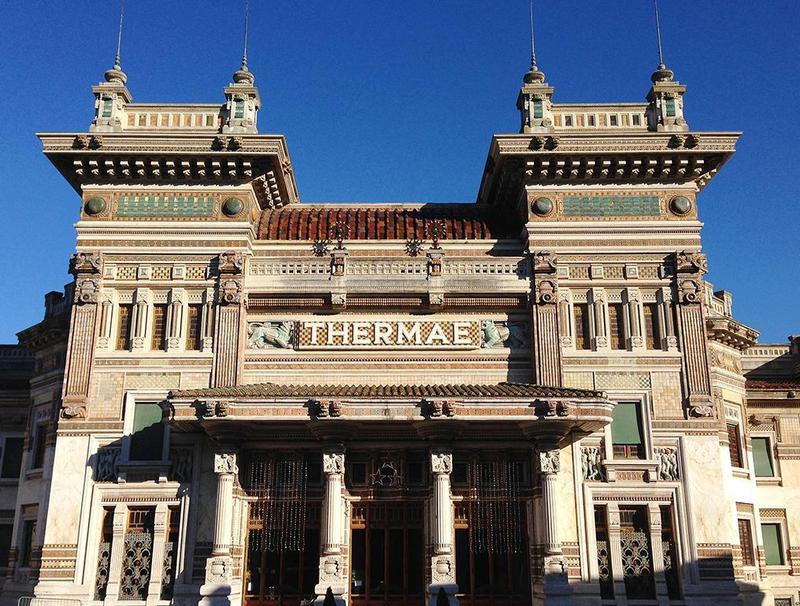
The property is located at 27 Viale Maria Luigia, Bagni di Tabiano, in the municipality of Salsomaggiore Terme.
Available documentation indicates a total commercial area of approximately 1,700.72 sqm.
The complex comprises a single hotel building arranged over several levels.
The basement includes service areas, cellar space, plant rooms, a garage and an apartment originally intended for the caretaker or manager.
The ground floor accommodates the hotel's principal common areas:
-
entrance;
-
reception;
-
restaurant;
-
TV lounge;
-
kitchen;
-
pantry.
The upper floors are primarily dedicated to guestrooms, generally equipped with private bathrooms.
The building also has a lift.
The property further includes external areas and a canopy originally used as covered parking for hotel guests, which the available documentation describes as currently partially collapsed. (gobidreal.it)
From a cadastral perspective, the main portion of the property is classified as D/2, consistent with hotel use.
The scale of the asset is potentially interesting.
However, in hospitality, square metres only create value when they can be converted into sellable rooms, ADR, occupancy, EBITDA and cash flow.
A previous sale attempt failed to attract a buyer
The property's recent history provides an additional piece of relevant market evidence.
The complex had already been included in Enforcement Proceeding No. 103/2025 before the Court of Parma.
The sale scheduled for 17 June 2026 was structured as follows:
| Metric | Figure |
|---|---|
| Base price | €275,000 |
| Minimum bid | €206,250 |
| Commercial area | approx. 1,700 sqm |
| Outcome | No award |
The sale concluded without an award. (portaleaste.com)
This fact should neither be overinterpreted nor disregarded.
It means that only a few months ago the market did not produce a sufficient bid even when the minimum admissible offer was €206,250.
The property is now being brought back to market under a different proceeding — Judicial Liquidation No. 302/2026 before the Court of Milan — with €275,000 indicated as both the base price and minimum bid. (gobidreal.it)
The two proceedings are not directly comparable.
Nevertheless, the previous unsuccessful sale represents relevant market evidence that should form part of any underwriting exercise.
€275,000 is not the investment cost
This is the central point of the entire case.
A hotel investor should not ask:
“Is it attractive to buy 1,700 sqm for €275,000?”
The appropriate question is:
“What is the Total Investment Cost required to deliver a competitive hospitality product, and what level of EBITDA can that investment realistically generate?”
Available documentation describes a vacant property that has been unused for several years, with dated finishes, systems requiring assessment and significant refurbishment needs.
Reported issues also include roofing deficiencies, water infiltration, non-conformities and the presence of asbestos-cement elements requiring appropriate technical investigation. (iaste.it)
CAPEX could therefore rapidly become the dominant component of the overall investment.
Purchase Price ≠ Total Investment Cost
The economics of the transaction should be assessed through a straightforward framework:
**Purchase Price
-
Transaction Costs
-
CAPEX
-
FF&E
-
Professional Fees
-
Pre-opening Costs
-
Working Capital
-
Financing Costs
-
Contingency
= Total Investment Cost**
Only once the Total Investment Cost has been established does it become meaningful to discuss returns.
This is precisely where many apparently “cheap” hospitality assets become materially less attractive from an investment perspective.
Three scenarios: how significantly could the real investment requirement change?
Without a technical due diligence exercise, it is not possible to estimate the actual CAPEX required for the Tabiano property.
However, it is useful, for illustrative purposes only, to demonstrate how dramatically the investment profile could change depending on the scale of the refurbishment.
Illustrative scenarios
| Scenario | Acquisition | CAPEX + FF&E + ancillary costs | Total Investment Cost |
|---|---|---|---|
| Light refurbishment | €0.28m | €1.50m | ~€1.78m |
| Full repositioning | €0.28m | €3.00m | ~€3.28m |
| Upper-upscale / extensive transformation | €0.28m | €4.50m | ~€4.78m |
These figures are not an estimate of the Tabiano asset. They simply illustrate a fundamental investment principle:
the acquisition price could represent only 6–15% of the total capital requirement.
At that point, the headline price per square metre becomes almost irrelevant.
Stress test 1: what product should the asset become?
Before building the business plan, the investor needs to establish what type of hotel actually makes sense.
Simply restoring the previous product may not represent the highest-value strategy.
An asset requiring substantial refurbishment provides — and often demands — the opportunity to reconsider:
-
room count;
-
average room size;
-
ratio between guestrooms and common areas;
-
guest services;
-
food & beverage;
-
wellness;
-
parking;
-
energy performance;
-
hotel category;
-
target customer segments;
-
pricing strategy.
The right question is therefore not:
“How do we reopen this hotel?”
It is:
“Which product configuration can generate the strongest risk-adjusted return from this property?”
Stress test 2: can Tabiano support the proposed product?
The second layer of analysis concerns the destination itself.
Tabiano Bagni sits within a territory with a long-established spa and wellness tradition.
But a contemporary hotel investment cannot rely solely on the historical reputation of a destination.
Current and prospective demand must be quantified.
Market due diligence should assess at least:
-
spa tourism;
-
medical wellness;
-
leisure;
-
senior tourism;
-
group demand;
-
sports-related demand;
-
events;
-
local corporate demand;
-
weekend demand;
-
seasonality;
-
potentially addressable international markets.
An investor needs to understand how much demand is genuinely available, which segments are willing to pay, and what ADR the market can realistically sustain.
The formula remains simple:
Rooms × Occupancy × ADR = Room Revenue
The challenge lies in ensuring that each of those assumptions is realistic.
Stress test 3: how much EBITDA can the invested capital generate?
The next question is not revenue.
It is EBITDA.
A hotel can generate significant turnover and still fail to produce an adequate return on invested capital.
The analysis should therefore reconstruct:
Revenue
– Operating Costs
= GOP
followed by:
GOP
– Fixed Costs
– Management / Franchise Costs
– Reserve for Replacement
= Normalised EBITDA
It is this normalised EBITDA that ultimately supports the stabilised value of the asset.
Not the price originally paid for the building.
Stress test 4: how much CAPEX can the deal economically support?
Maximum CAPEX should not be determined by how much capital an investor happens to have available.
It should be derived from the future value that the asset is capable of supporting.
The right question is:
How much can be invested today while still allowing the stabilised value tomorrow to deliver the required return?
The analytical sequence should therefore be:
Future EBITDA → Stabilised Value → Required Return → Maximum Total Investment Cost → Maximum Acquisition Price
Not:
Purchase Price → we will determine the refurbishment cost later.
Reversing that logic is one of the most common mistakes in value-add hotel investment.
Stress test 5: retain the hotel use or assess a different highest and best use?
There is a further strategic question to consider.
Does hotel use necessarily represent the property's highest and best use?
That cannot be determined without detailed planning and urban-development checks.
The D/2 cadastral classification reflects the current use of the building, but does not in itself determine every potential future use.
Before submitting an offer, investors should therefore verify:
-
permitted planning uses;
-
potential change-of-use options;
-
restrictions;
-
planning standards;
-
parking requirements;
-
development capacity;
-
potential extensions;
-
compliance of the existing building.
Only after completing this analysis would it make sense to compare alternative scenarios.
Potential scenarios, subject entirely to planning feasibility, could include:
-
hotel renovation;
-
hospitality repositioning;
-
serviced accommodation;
-
senior living;
-
healthcare hospitality;
-
mixed hospitality concepts.
This is not to suggest that conversion would necessarily be preferable.
The objective is to determine the asset's genuine highest and best use.
Stress test 6: leverage and bankability
A distressed opportunity does not automatically become financeable simply because the acquisition price is low.
Quite the opposite.
A bank or institutional lender will focus primarily on:
-
post-refurbishment value;
-
sponsor equity;
-
loan-to-cost;
-
loan-to-value;
-
DSCR;
-
debt-service capacity;
-
sponsor track record;
-
available contingency;
-
ramp-up period.
Where CAPEX represents the majority of the investment, the primary risk is no longer the acquisition itself.
It is the ability to complete the project and reach stabilisation without exhausting equity or liquidity.
Due diligence: the valuation report alone is not enough
For an asset such as Tabiano, due diligence should be genuinely multidisciplinary.
Technical Due Diligence
It should assess:
-
structural condition;
-
mechanical and electrical systems;
-
roofing;
-
building envelope;
-
lift;
-
guestrooms;
-
bathrooms;
-
kitchen;
-
fire-safety compliance;
-
energy efficiency;
-
potential remediation;
-
CAPEX;
-
contingency.
Legal & Urban Planning Due Diligence
It should verify:
-
title and ownership history;
-
building permits;
-
compliance;
-
outstanding irregularities;
-
potential regularisation;
-
restrictions;
-
planning designation;
-
potential change of use.
Market Due Diligence
It should assess:
-
demand;
-
competitive set;
-
ADR;
-
occupancy;
-
seasonality;
-
segmentation;
-
potential market positioning.
Operational Assessment
It should define:
-
room count;
-
organisational structure;
-
FTE requirements;
-
cost structure;
-
outsourcing;
-
F&B strategy;
-
potential GOP.
Financial Model
Finally, it should measure:
-
Total Investment Cost;
-
stabilised EBITDA;
-
break-even point;
-
DSCR;
-
cash-on-cash return;
-
IRR;
-
equity multiple;
-
exit value;
-
sensitivity analysis.
This is the integrated approach applied by HotelManagementGroup.it when assessing hotel assets, transactions and operating models.
Work backwards from future value to the maximum acquisition price
Professional investment underwriting should begin at the end.
Not at the beginning.
First, define the product.
Then build the business plan.
Estimate stabilised EBITDA.
Determine the potential value of the property by applying a yield or multiple consistent with:
-
destination;
-
category;
-
risk profile;
-
liquidity;
-
real-estate quality;
-
quality and sustainability of cash flow.
From that value, deduct:
**CAPEX
-
transaction costs
-
financing costs
-
working capital
-
contingency
-
required developer/investor return.**
The residual figure represents the Maximum Acquisition Price.
Only if that number is equal to or above the price required to acquire the asset should the investment move to the next stage of underwriting.
This is the methodology used in investment, value-creation and special-situations analyses developed within InvestHotel.it.
Distressed hotels are not acquired on a price-per-square-metre basis
The Tabiano Bagni case highlights a fundamental principle.
A hotel is not simply a building.
It is simultaneously:
real estate + operating business + CAPEX + management + financing + destination risk.
Reducing the analysis to €162 per square metre would mean ignoring almost everything that will ultimately determine the investment outcome.
In hospitality, a property acquired at an exceptionally low price can become a very expensive investment.
And a property that initially appears expensive can generate an excellent return if it produces stable and growing cash flow.
An opportunity only exists if the downside case works
A professional investment committee should not assess this deal starting from the upside case.
It should begin with a credible downside scenario.
What happens if:
-
CAPEX overruns by 20%?
-
opening is delayed by six months?
-
ADR is 10% below budget?
-
occupancy takes three years rather than two to stabilise?
-
payroll costs exceed expectations?
-
financing costs more than originally assumed?
If the investment can still produce an acceptable return under a reasonable downside scenario, the project begins to demonstrate genuine resilience.
If, by contrast, the IRR only works under aggressive assumptions, the low entry price becomes largely irrelevant.
Salsomaggiore: an opportunity to underwrite, not an “obvious bargain”
The Tabiano asset presents several potentially attractive characteristics:
-
approximately 1,700 sqm;
-
an existing hotel configuration;
-
common areas;
-
guestrooms;
-
a lift;
-
external areas;
-
a low nominal entry price.
At the same time, several material issues require further investigation:
-
physical condition;
-
CAPEX;
-
building systems;
-
water infiltration;
-
compliance issues;
-
environmental matters requiring verification;
-
hotel demand;
-
positioning;
-
economic sustainability.
The previous sale attempt ending without an award also adds another reason for caution. (portaleaste.com)
For this reason, we would not describe the property today as a “bargain”.
A more accurate definition would be:
an opportunity requiring full due diligence and disciplined investment underwriting.
Return first, price second
The key lesson from this case can be summarised in a single sentence:
In distressed hospitality, the lowest price may be the least important number in the entire transaction.
The purchase price determines the cost of entry.
CAPEX determines the cost of transformation.
The market determines what can be sold.
Operations determine how much EBITDA can be generated.
Financing determines how much leverage can be sustained.
Exit value determines how much capital value can ultimately be created.
Only by combining all of these factors can an investor determine whether €275,000 genuinely represents an opportunity — or merely the beginning of a much larger capital commitment.
Investimenti Alberghieri
InvestimentiAlberghieri.it analyses hotel transactions, hospitality real estate, development projects, distressed assets and value-creation opportunities through an integrated approach combining real estate, operations and finance.
The platform forms part of a wider professional ecosystem that includes:
RobertoNecci.it, focused on economic and strategic analysis of the hotel industry;
InvestHotel.it, focused on hospitality investment, finance, value creation and extraordinary transactions;
HotelManagementGroup.it, dedicated to hotel advisory and management.
Our approach does not begin with the question:
“How much does the property cost?”
It begins with:
“What value can be created, with how much capital, and at what level of risk?”
For feasibility studies, valuations, business plans, acquisition underwriting and hospitality investment assessments:
info@investimentialberghieri.it
Methodological note
This article has been prepared on the basis of publicly available information concerning Judicial Liquidation No. 302/2026 before the Court of Milan, the sale of the property in Tabiano Bagni and the previous enforcement proceedings.
Any observations regarding investment strategies, CAPEX, repositioning, financial scenarios or potential alternative uses are provided solely for informational and methodological purposes.
The financial scenarios included above are illustrative and do not constitute a valuation or estimate of the property.
Any potential transaction would require independent technical, planning, legal, tax, environmental, commercial and financial due diligence.
|
|
|