Twenty-seven accommodation units, potential capacity for 92 guests, approximately 1,838 sqm, two swimming pools and a minimum bid of €835,571. ABA Village, a serviced tourist residence in Puntone di Scarlino, Tuscany, is heading back to auction on 4 November 2026. Yet the price is only one part of the investment case: the property appears to remain commercially operational, while the sale documentation describes the asset as occupied under an enforceable title. For an investor, therefore, the real question is not simply how much the bricks and mortar cost, but what income stream, rights and degree of operational control come with the acquisition.
The investment at a glance
Appraised value: €2,570,000
Minimum bid: €835,571.25
Commercial area: approximately 1,838 sqm
Accommodation units: 27
Potential guest capacity: 92
Auction date: 4 November 2026
Bid submission deadline: 30 October 2026
Minimum bidding increment: €50,000
Indicative value per unit at the minimum bid: approximately €30,950
Indicative value per sqm at the minimum bid: approximately €455
Discount to appraisal: approximately 67.5%
The discount to the stated appraisal is therefore substantial.
In hospitality, however, a deep discount to an appraisal does not automatically translate into an attractive investment.
The key issue is understanding exactly what the investor is acquiring.
ABA Village: a serviced tourist residence in the Maremma market
The property is located in Puntone di Scarlino, in the province of Grosseto, approximately one kilometre from Marina di Scarlino.
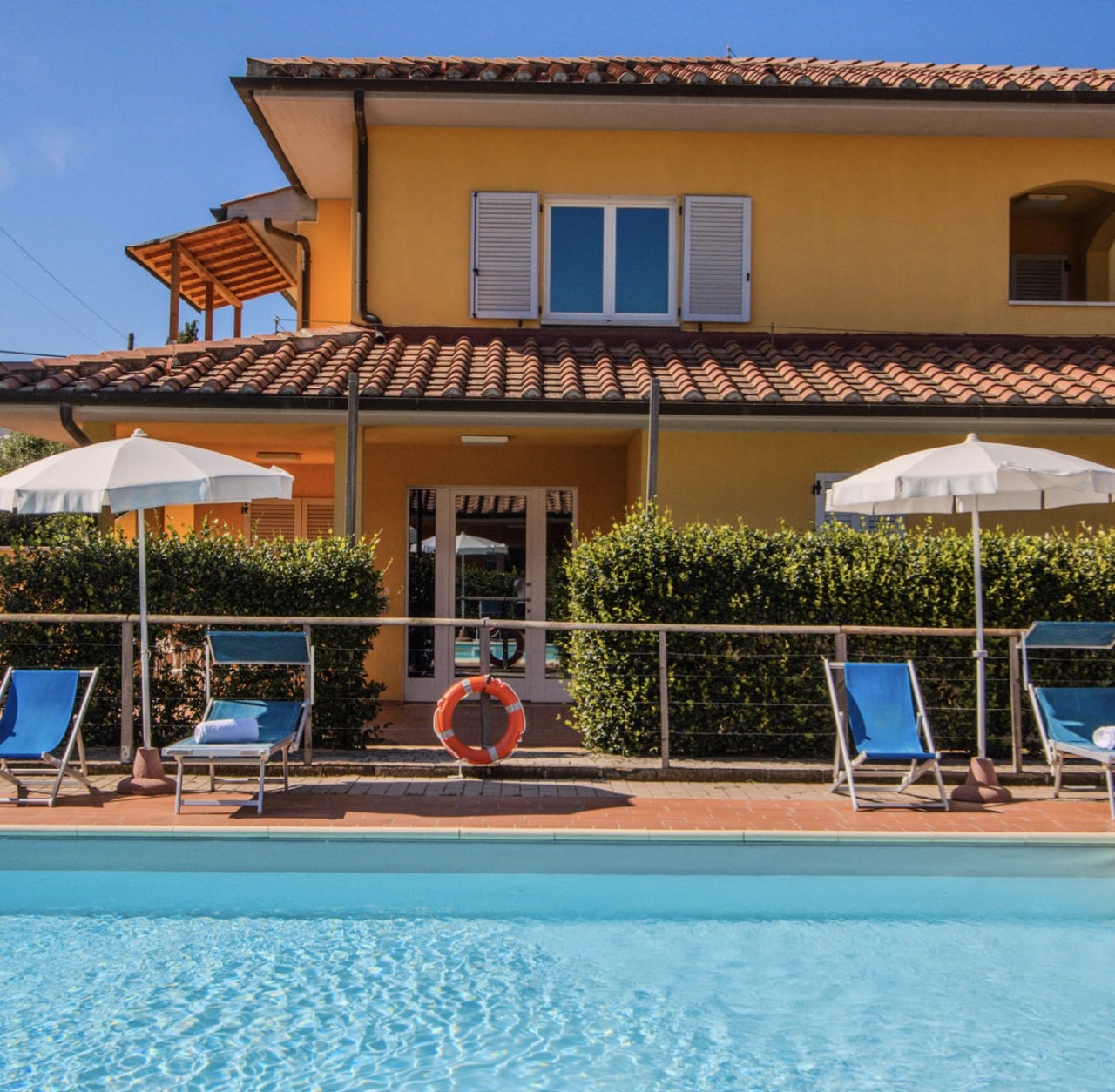
The complex operates as a Residenza Turistico Alberghiera — RTA, broadly comparable to a serviced tourist residence or aparthotel, and comprises three buildings containing 27 units, including studios and one- and two-bedroom apartments, together with reception facilities, communal areas, outdoor spaces and swimming pools.
The sale information indicates a total commercial area of approximately 1,838 sqm and potential accommodation capacity of 92 guests.
The location is strategically relevant from a leisure perspective. Follonica, Marina di Scarlino, Cala Violina and the wider Maremma coastline benefit from an established tourism market, with demand driven predominantly by leisure travel.
But another feature of the asset is arguably even more important.
ABA Village does not appear to be an abandoned hospitality property awaiting redevelopment.
Its official website remains active, presenting accommodation and services and allowing prospective guests to enquire about stays. The property also continues to maintain a commercial presence within tourism distribution channels.
This materially changes the investment analysis.
The critical issue: the property is reportedly occupied under an enforceable title
The sale documentation describes the property as occupied under a title enforceable against the purchaser.
This is potentially the single most important feature of the transaction.
When acquiring a hotel or serviced residence through a judicial auction, an investor should not simply ask:
How much am I paying for the property?
The more important question is:
What level of economic and operational control over the property will I actually obtain following completion?
The distinction is fundamental.
An enforceable occupancy or operating arrangement may affect the owner's ability to take possession of the property, the timing of any repositioning strategy, the cash flows available to the owner and, ultimately, the investment value of the asset.
The underlying agreements should therefore be reviewed in full before any assumptions are made regarding yield, operational control or future repositioning.
Buying the real estate does not necessarily mean buying ABA Village
This distinction is fundamental in hospitality investment.
The real estate, the hospitality business and the operating platform are not necessarily the same asset.
An investor considering ABA Village should therefore analyse at least four separate layers.
1. Real estate
The underlying value of the three buildings, communal areas, swimming pools, systems and ancillary areas must be assessed independently.
The auction price establishes the acquisition cost, but it does not necessarily establish the ultimate economic value of the investment.
2. Occupancy and operating arrangements
The investor should verify:
-
remaining contractual term;
-
enforceability against the successful bidder;
-
rent or other consideration payable;
-
indexation provisions;
-
deposits and guarantees;
-
maintenance responsibilities;
-
allocation of capital expenditure;
-
termination rights;
-
default and termination provisions;
-
any pre-emption rights or other material contractual clauses.
This documentation may determine whether the acquisition should be viewed primarily as an income-producing real estate investment or as an asset whose operational flexibility is constrained for a period of time.
3. Hospitality business
A separate assessment is required to establish which elements belong to the operating business and which form part of the real estate being sold.
Brand, customer database, employees, operating licences, FF&E, commercial agreements, OTA relationships and goodwill all require individual analysis.
The acquisition of the property should not automatically be assumed to include the operating business conducted from it.
4. Future upside
The fourth layer concerns the potential future value of the asset.
Possible value-creation opportunities may include:
-
repositioning;
-
ADR growth;
-
higher occupancy;
-
seasonality extension;
-
stronger integration with Marina di Scarlino;
-
development of outdoor and nature-based tourism demand;
-
distribution optimisation;
-
potential evolution of the operating model when existing contractual arrangements permit.
The combination of these factors ultimately determines the industrial and investment value of the opportunity.
At InvestimentiAlberghieri.it we focus specifically on the difference between the purchase price of a hospitality asset and its underlying investment value.
€835,000: a low price or simply the right price for the risk?
At first glance, the headline numbers are compelling.
A minimum bid of approximately €835,000 equates to:
-
approximately €30,950 per accommodation unit;
-
approximately €455 per sqm;
-
less than one third of the stated appraisal value.
These metrics are immediately attention-grabbing.
But they are not, by themselves, a hotel valuation.
A professional investor should begin by determining the sustainable income attributable to the property.
Where an asset is occupied by an operator under an enforceable title, its value may depend heavily on:
actual rent + operator covenant strength + contractual duration + required CAPEX + residual property value.
A simple comparison between the minimum bid and the original appraisal can therefore be misleading.
The price per apartment can be deceptive
There is another crucial point.
The sale information refers to planning provisions that envisage unified management of the complex and the retention of its hospitality use.
This means that dividing €835,000 by 27 units produces an interesting financial indicator, but it does not mean an investor is acquiring 27 freely marketable residential apartments.
That distinction is critical.
The property should primarily be valued as a single hospitality asset capable of generating operating or rental income, rather than as the sum of individual residential units.
Any alternative strategy would require specific legal, planning and administrative due diligence before it could be considered viable.
What could ABA Village actually be worth?
A property appraisal alone is not enough to answer that question.
At least three investment scenarios should be modelled.
Scenario 1 — Income-producing real estate investment
The existing operator remains in place and the owner receives the contractual rent or consideration.
Under this scenario, value should primarily be assessed through an income approach, taking into account yield, counterparty risk and the duration and quality of the contracted cash flow.
Scenario 2 — Acquisition followed by repositioning
The investor acquires the real estate today and plans a medium-term repositioning of the property.
Value would then depend on:
CAPEX + timing + future market positioning + ADR + occupancy + normalised EBITDA.
Scenario 3 — Future alignment of ownership and operations
A hospitality operator or investor may ultimately be interested not only in owning the real estate but, subject to legal and commercial feasibility, in gaining direct control of the operating business.
In such a scenario, the analysis should distinguish between:
Enterprise Value of the operating business + Market Value of the real estate.
This distinction is essential whenever ownership and operations may follow different structures.
Hospitality special situations, restructuring and distressed real estate transactions are also analysed by Investhotel Capital Partners, while Hotel Management Group provides advisory services covering hotel analysis, valuation, development and asset management.
At RobertoNecci.it, further analysis is available on the relationship between hotel ownership, operations, credit and value creation.
Due diligence before the auction
In the case of ABA Village, an investment due diligence process should cover at least:
-
full judicial sale documentation;
-
appraisal report and annexes;
-
cadastral and planning compliance;
-
occupancy title and its enforceability against the purchaser;
-
residual contractual term and economic conditions;
-
identity and financial standing of the current operator;
-
hospitality licences and permits;
-
employee-related matters;
-
ownership of FF&E;
-
commercial contracts;
-
physical condition of the property;
-
required CAPEX;
-
historical and prospective revenue;
-
ADR, occupancy and RevPAR;
-
competitive benchmarking;
-
normalised profitability;
-
rent sustainability;
-
income-based real estate valuation;
-
equity return;
-
exit strategy.
Only after this analysis can an investor determine whether €835,571 represents an unusually attractive entry price or simply the appropriate price for the risks attached to the transaction.
The real value may lie in the contract, not in the discount
ABA Village provides a broader lesson for the Italian hospitality investment market.
Where property ownership and hotel operations are separated, the value of the real estate is partly determined by the quality of the contract attached to it.
A property acquired at a significant discount may still generate an unattractive return if the rent is low, the landlord bears extensive capital expenditure obligations or contractual arrangements materially restrict the owner's ability to reposition the asset.
Conversely, an asset acquired at an attractive basis, with a credible operator, sustainable rent and balanced contractual terms, may represent a compelling income-producing hospitality real estate investment.
That is why the relevant question in hotel investment should never simply be:
“How much does the hotel cost?”
The better question is:
“How much sustainable income can it generate, at what level of risk, and who actually controls the creation of value?”
ABA Village is precisely this type of special situation
The headline number will inevitably attract attention:
€835,571.
But the number an investor should want to understand first is different:
the sustainable net income attributable to the property.
Together with the duration and terms of the enforceable occupancy arrangement, that figure is the starting point for a genuine investment valuation.
And this is precisely where the logic of a judicial auction ends and the logic of hotel investment begins.
Investimenti Alberghieri
InvestimentiAlberghieri.it monitors and analyses hotel investments, assets for sale, judicial auctions, distressed situations, NPL/UTP exposures, restructuring transactions and special situations across the hospitality sector.
The opportunities discussed in our articles are provided for information and analytical purposes only and do not constitute investment solicitation or confirmation of the economic merits of any transaction. Any potential acquisition requires a detailed review of the official documentation together with appropriate legal, tax, planning, technical, financial and hospitality due diligence.
For confidential analysis of hospitality opportunities, valuations, business plans, industrial due diligence and distressed transactions:
info@investimentialberghieri.it