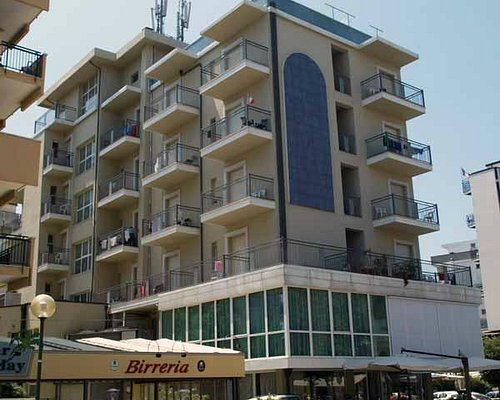
Twenty-five rooms, approximately 2,198 sqm, a gym, multi-purpose spaces and a minimum entry price of €516,937. Active Hotel in Bratto, Castione della Presolana, is returning to the market through enforcement proceedings. Yet the most interesting figure is not the price per key: the appraisal itself describes the property as an annex functionally linked to another hotel, while commercially Active Hotel operates in close integration with Hotel Milano Alpen Resort directly opposite. The real question for an investor is therefore different: what are those 25 rooms worth within the existing ecosystem, and what would they be worth if they had to operate independently tomorrow?
Real estate enforcement proceedings No. 628/2024 before the Court of Bergamo concern the property known as Active Hotel, at Via Silvio Pellico 6, Bratto, in the municipality of Castione della Presolana.
The sale is scheduled for 14 October 2026.
The reserve price is €689,250, while the minimum bid is €516,937.50.
The numbers to understand immediately
Appraised value: €1,226,000
Reserve price: €689,250
Minimum bid: €516,937.50
Rooms: 25
Indicative total area: approximately 2,198 sqm
Indicative value per key: approximately €20,700
Indicative value per sqm: approximately €235
Discount to appraisal: approximately 57.8%
Sale date: 14 October 2026
At first glance, these figures are highly compelling.
But Active Hotel is precisely the type of asset that demonstrates why, in hospitality, a low price per key does not automatically translate into an attractive investment.
A hotel property in apparently good condition
The technical documentation describes a hotel property classified as D/2, comprising 25 en-suite guest rooms together with ancillary and multi-purpose spaces.
The overall state of maintenance is assessed positively.
The building includes a lift, electrical systems, air conditioning and fire-safety equipment.
There is, however, an important detail that immediately calls for caution: the appraisal states that the heating system does not appear to be owned by the company that owns the property.
What may initially appear to be a technical detail perfectly introduces the central issue in this transaction:
the physical perimeter of the asset does not necessarily coincide with the economic perimeter required to operate it.
The most important sentence is in the appraisal
The appraiser describes Active Hotel as a “dependance” — an annex to another hotel property — and highlights its functionality when operated in conjunction with that property, because it expands the overall accommodation capacity.
This observation is far more important than the price per key.
It means the investor should not simply ask:
“How much am I paying for 25 rooms?”
The more relevant question is:
“How much of the value of these 25 rooms comes from the building itself, and how much comes from the hotel ecosystem to which they are connected?”
That is the difference between a real estate appraisal and a genuine hotel investment analysis.
This distinction between the price of the bricks and mortar and the asset’s actual cash-flow-generating capacity lies at the heart of the analysis published by InvestimentiAlberghieri.it.
KEY ISSUE — Active within the Hotel Milano ecosystem vs Active as a standalone hotel
Scenario A — Active within the Hotel Milano system
Under the current configuration, the property benefits from a broader operating ecosystem:
-
brand;
-
food & beverage;
-
Spa;
-
marketing;
-
distribution;
-
reputation;
-
revenue management;
-
guest services;
-
potential cross-selling;
-
operational infrastructure.
In this configuration, the 25 rooms do not necessarily have to absorb the full cost base of a completely independent hotel.
Scenario B — Active as a fully standalone operation
If the property were eventually separated from the existing platform, the investor would need to determine which functions would have to be recreated:
-
reception;
-
breakfast service;
-
potentially F&B;
-
booking engine;
-
distribution;
-
marketing;
-
revenue management;
-
administration;
-
maintenance;
-
housekeeping;
-
customer care;
-
potentially a replacement wellness offering.
The financial outcome could be materially different.
The difference between these two EBITDA profiles represents one of the key value drivers of the entire transaction.
That is the number an investor should be trying to establish.
Two properties facing each other, but one commercial guest experience
Hotel Milano’s official website presents Active Hotel as being located directly opposite Hotel Milano Alpen Resort.
Active offers rooms and suites, a gym and meeting facilities.
Its guests can also access services at the main hotel, including Alpen Spa and Ristorante Al Caminone.
Physically, the two properties are separated by only a few metres.
Economically, however, the relationship may be much deeper.
For an investor, this means establishing:
-
which services contractually belong to Active;
-
which are provided by Hotel Milano;
-
which can continue following a change of ownership;
-
which are essential to maintaining the current market positioning.
What is the investor actually buying?
Within the real estate perimeter
Subject to the final sale documentation, the investor acquires:
-
the property;
-
the 25 guest rooms;
-
multi-purpose spaces;
-
ancillary areas;
-
appurtenances included in the lot;
-
the lease relationship to the extent that it is enforceable against the purchaser.
What should not automatically be assumed to be included
-
Hotel Milano Alpen Resort;
-
Alpen Spa;
-
Ristorante Al Caminone;
-
the Active Hotel brand;
-
the Hotel Milano brand;
-
website;
-
booking engine;
-
customer database;
-
OTA contracts;
-
employees;
-
goodwill;
-
marketing infrastructure;
-
shared services;
-
systems owned by third parties;
-
FF&E not included in the transfer.
This distinction is fundamental.
The real estate is being transferred. The hotel ecosystem must be independently verified.
There is also a lease in place
The property is reportedly occupied under a lease entered into in November 2018.
The documentation refers to a 9 + 9-year term, with the first period expiring in November 2027, and indicates that the lease predates the enforcement proceedings and is enforceable against third parties.
For the investor, this introduces a second layer of value:
not only the property itself, but also the contractual cash flow attached to it.
The €86,981 figure must be interpreted correctly
For the purposes of its income-based valuation, the appraisal refers to an aggregate rent covering other properties as well.
The updated annual amount used in the appraisal is approximately €197,820.
The appraiser allocates 43.97% of this figure to Active Hotel, equivalent to approximately:
€86,981 per year.
Using this income allocation and a 6.5% capitalisation rate, the appraiser derives an income-based value of approximately €1.337 million.
This is highly relevant information.
But it must be used carefully.
€86,981 does not necessarily mean that Active Hotel has a standalone contractual rent of €86,981 per year.
It is an economic allocation made by the appraiser within a broader lease arrangement.
Before calculating any investment yield, the full lease documentation would therefore need to be reviewed.
The apparent yield can be misleading
If, purely as a theoretical exercise, €86,981 were divided by the €516,937 minimum bid, the resulting gross yield would exceed:
16% per annum.
An exceptional headline number.
But also a figure that could be materially misleading without further due diligence.
The investor first needs to reconstruct:
-
actual contractual rent;
-
properties covered by the lease;
-
allocation methodology;
-
tenant identity;
-
historical payments;
-
indexation;
-
guarantees;
-
maintenance obligations;
-
shared services;
-
CAPEX;
-
remaining contractual term.
In hotel investment, an unusually high paper yield is often the point at which due diligence should begin — not the conclusion of the investment case.
The most interesting risk: a stranded hospitality asset
Active Hotel introduces a particularly useful concept.
A property may be physically capable of operating as a hotel while not being economically configured as a standalone hotel business.
If branding, distribution, Spa, food & beverage and key services are provided through an external platform, separating the property from that platform may create what can be described as a stranded hospitality asset:
a building containing guest rooms and hotel-use infrastructure, but without part of the operating ecosystem that previously supported its performance.
This does not mean Active Hotel could not operate independently.
It means the investor needs to calculate the cost of making it independent and the EBITDA it could generate once separated.
This type of industrial analysis is central to hospitality special situations handled by Investhotel Capital Partners.
Three investment scenarios
Scenario 1 — Full continuity
The investor acquires the property and the existing ecosystem remains substantially unchanged.
Active continues to operate in close integration with Hotel Milano.
Value is driven by:
rent + tenant quality + lease duration + CAPEX + residual value.
This is essentially an income-producing hospitality real estate strategy.
Scenario 2 — Separate ownership, shared services retained
The property changes ownership, but formal agreements are put in place with Hotel Milano to preserve:
-
food & beverage;
-
Spa access;
-
reception;
-
distribution;
-
marketing;
-
revenue management;
-
other guest services.
This scenario could preserve a significant proportion of the current industrial value.
However, those services would need to be contractually secured and economically priced.
An investor should not pay today for synergies that may not be guaranteed tomorrow.
Scenario 3 — Fully standalone hotel
This is the scenario that places the greatest stress on the investment case.
The investor would need to rebuild the P&L on the assumption that Active operates without Hotel Milano.
The key question becomes:
What ADR, occupancy, RevPAR and EBITDA could a standalone Active Hotel generate after absorbing all costs that are currently shared?
This is the critical stress test.
Price per key therefore becomes almost secondary
The minimum bid equates to approximately:
€20,700 per key.
And approximately:
€235 per sqm.
Both figures are very low.
But a hotel room does not generate revenue simply because it physically exists.
It generates revenue through a platform made up of:
demand + brand + distribution + pricing + people + services + reputation + management.
The true value of Active therefore depends on the cost of preserving or rebuilding that platform.
CAPEX: good condition does not necessarily mean future competitiveness
The appraisal describes the property as being in good condition.
That is clearly positive.
But an investor must distinguish between:
physical condition
and
future product competitiveness.
A hotel may be perfectly operational today and still require substantial investment to maintain ADR and market share over the next ten years.
Due diligence should therefore assess at least:
-
guest rooms;
-
bathrooms;
-
windows and insulation;
-
energy efficiency;
-
air conditioning;
-
plant and systems;
-
lift;
-
fire safety;
-
technology;
-
Wi-Fi;
-
soundproofing;
-
lighting;
-
gym;
-
common areas;
-
FF&E.
Future CAPEX must be incorporated into the investment return.
At Hotel Management Group, this type of analysis is addressed through valuations, due diligence, business planning and hotel asset value-creation strategies.
The real due diligence on Active Hotel
Before assigning a definitive value to the transaction, an investor should verify at least:
-
full lease agreement;
-
tenant identity;
-
properties covered by the agreement;
-
contractual rent;
-
economic allocation attributable to Active;
-
historical payments;
-
indexation;
-
guarantees;
-
duration and renewal provisions;
-
enforceability;
-
maintenance responsibilities;
-
CAPEX;
-
ownership of the heating system;
-
FF&E;
-
OS&E;
-
operating licences;
-
CIN registration;
-
employees;
-
brand rights;
-
relationship with GestHotel;
-
relationship with Hotel Milano;
-
access to the Spa;
-
access to the restaurant;
-
reception arrangements;
-
shared services;
-
distribution;
-
OTA relationships;
-
booking engine;
-
occupancy;
-
ADR;
-
RevPAR;
-
GOP;
-
integrated EBITDA;
-
standalone EBITDA;
-
income-based real estate value;
-
terminal value.
At RobertoNecci.it, further analysis explores the relationship between ownership, operations, governance, profitability and value creation in the hotel sector.
The number to focus on is not €20,700
This is the central point.
€20,700 per key is the number that captures attention.
But it is not the number that determines the investment.
The investor should instead calculate:
Active Hotel EBITDA within the Hotel Milano ecosystem
versus
Active Hotel EBITDA as a fully standalone operation.
The difference between the two represents the economic value of the ecosystem currently supporting those 25 rooms.
And that value may not automatically be included in the transfer of the real estate.
The true asset is therefore not simply the building.
It is the ability to preserve — or economically recreate — the network of services, distribution and operational infrastructure that enables the building to generate income.
At that point, €516,937 may represent an exceptionally attractive entry price.
Or it may simply be the cost of entering a project that requires new capital and a new operating platform.
Only due diligence can establish the difference.
And that is precisely where a straightforward real estate analysis ends and genuine hotel investment analysis begins.
Investimenti Alberghieri
InvestimentiAlberghieri.it monitors and analyses hotel investments, hospitality assets for sale, distressed situations, NPL/UTP exposures, restructuring transactions and special situations across the Italian hospitality market.
The publication of an investment opportunity is for information and analytical purposes only and does not constitute an assessment of its economic attractiveness.
Every acquisition requires dedicated:
real estate, contractual, legal, planning, technical, financial and hospitality due diligence.
For confidential analysis of hotel investment opportunities, valuations, business plans, industrial due diligence, PropCo/OpCo analysis and special situations:
info@investimentialberghieri.it
To submit a hotel, distressed asset or transaction for a confidential preliminary assessment:
info@investimentialberghieri.it
Further insights:
InvestimentiAlberghieri.it
Investhotel Capital Partners
Hotel Management Group
RobertoNecci.it