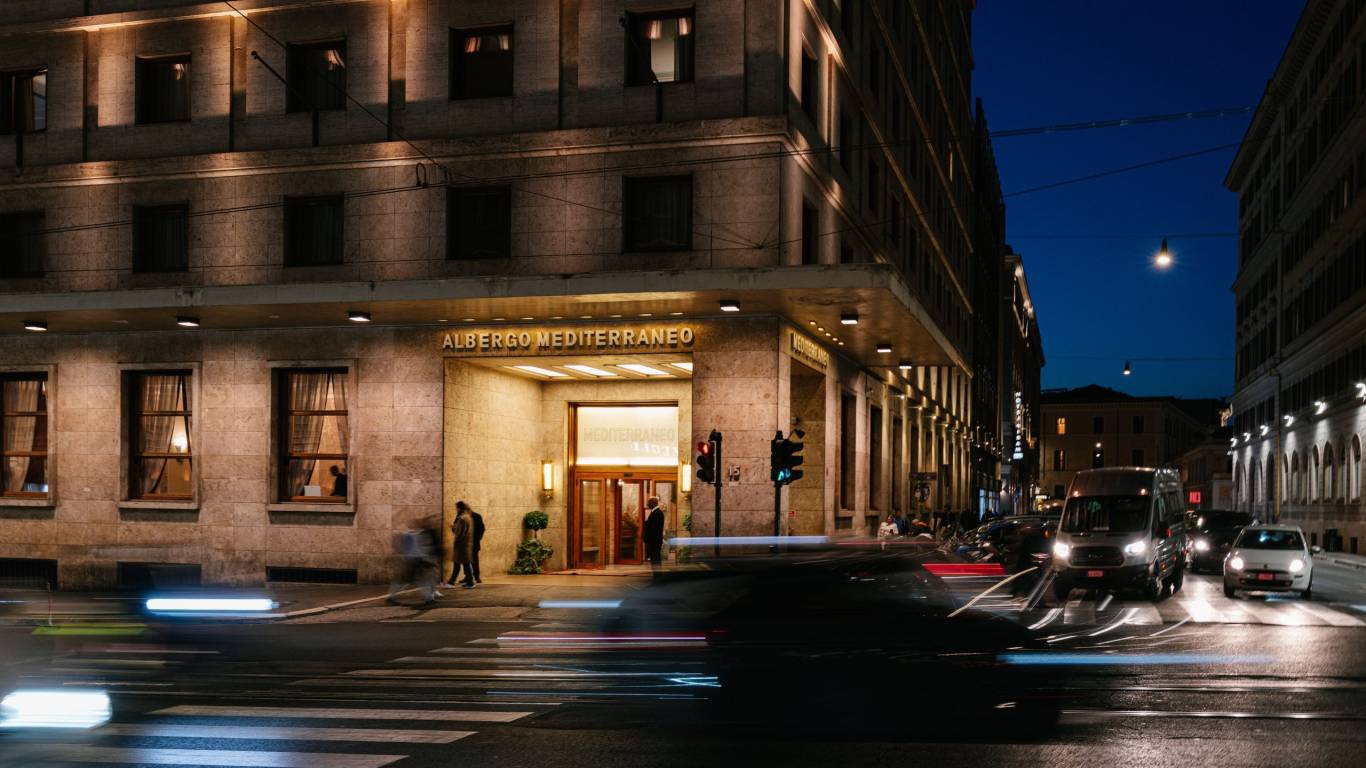
The Bettoja family is not selling its hotels or withdrawing from the hospitality industry. It is progressively transferring the management of Hotel Atlantico and Hotel Mediterraneo to ACHM Hotels by Marriott, with the aim of combining the two properties into a single hotel project affiliated with Autograph Collection.
The transition, scheduled to take place between 2027 and 2028, is therefore not an asset disposal. It is a management, international affiliation and commercial repositioning transaction.
The most interesting question, however, goes beyond the contractual structure.
Can a hotel brand with 150 years of history, such as Bettoja Hotels, genuinely be considered weaker than a relatively new management platform, even when that platform operates within the Marriott ecosystem?
The answer is no — at least not in absolute terms.
The Bettoja name possesses something that cannot be purchased or rapidly manufactured: history, recognition, family continuity, real estate heritage, a deep connection with Rome and a place in the collective memory of Italian hospitality.
Marriott, through Autograph Collection and its wider commercial ecosystem, brings a different form of value: global scale, technology, loyalty, corporate accounts, distribution systems and the ability to reach international demand.
The agreement is therefore not a contest between a strong brand and a weak one. It is an attempt to combine two different forms of value: the historical capital of the owner and the distribution power of a global platform.
The success of the transaction will depend on whether these two forms of capital can be combined without allowing the second to erase the first.
The facts, stripped of the communications narrative
Hotel Atlantico, with approximately 65 rooms, and Hotel Mediterraneo, with approximately 245 rooms, are expected to be progressively combined into a single hotel operation.
Hotel Atlantico is scheduled to enter ACHM’s management portfolio during the first four months of 2027, while Hotel Mediterraneo is expected to follow during the second four-month period of 2028.
The transaction will therefore unfold over more than two years and will involve a gradual process of operational, commercial and real estate integration.
The proposed brand is Autograph Collection, Marriott International’s soft brand for independent hotels with their own architectural, cultural and destination-specific identity.
This is not a fully standardised hotel flag. The brand proposition is specifically designed to allow affiliated hotels to retain a distinctive personality while gaining access to Marriott’s reservation, loyalty and distribution systems.
For ACHM Hotels by Marriott, led by Antonio Catalán, the project represents a strategic development in the Italian market and, more importantly, in Rome.
One of the most significant aspects of the transaction, however, concerns the property that has been excluded from it.
Hotel Massimo d’Azeglio, the oldest and arguably most identity-defining hotel in the Bettoja portfolio, will continue to operate under the family’s direct control.
This is not a minor detail.
It means that Bettoja is not abandoning its brand, leaving the hotel business or transferring its entire symbolic heritage to an international operator.
The family is segmenting its portfolio.
On one side, it is retaining direct control of the hotel most closely connected to its history. On the other, it is entrusting Atlantico and Mediterraneo to an international platform capable of supporting their repositioning and distribution.
This is a diversification of operating models, not a disposal strategy.
Is Bettoja really the weaker brand?
In today’s hotel industry, brand strength is often measured almost exclusively through:
-
the number of affiliated hotels;
-
loyalty programme membership;
-
distribution capabilities;
-
international presence;
-
technology investment;
-
access to corporate accounts;
-
the ability to generate bookings through proprietary platforms.
When judged solely against these criteria, an Italian family-owned hotel brand cannot compete with Marriott.
But this is an incomplete assessment.
A hotel brand is not merely a booking system. It is also accumulated reputation, a relationship with the destination, continuity over time, authenticity, architectural heritage and the ability to represent a place.
Bettoja Hotels has survived generations, urban transformation, economic crises, wars and radical changes in both tourism and hotel distribution.
A more recently established management platform does not automatically acquire the same historical depth simply because it operates within the ecosystem of a global group.
It may have more technology, more rooms under distribution, greater commercial capacity and stronger economies of scale.
But it does not necessarily have more identity.
The correct question is therefore not:
“Is Marriott stronger than Bettoja?”
The real question is:
“Can Bettoja use Marriott’s commercial power without diluting the value it has built over 150 years?”
That is the central issue at the heart of the transaction.
An international affiliation creates value when it amplifies the identity of the hotel. It destroys value when it replaces that identity with an indistinguishable and replicable experience.
Autograph Collection should, at least in principle, be the most suitable Marriott brand for avoiding this form of standardisation.
The outcome, however, will depend on execution: naming, storytelling, interior design, preservation of historical features, the guest experience, commercial independence and the ability to communicate continuity with the Bettoja tradition.
What the Bettoja family stands to gain
The agreement may generate several advantages for the family.
The first is access to Marriott’s global distribution system: reservation channels, the Bonvoy loyalty programme, corporate relationships, international demand, technology and revenue management capabilities that would be difficult for an independent operator to replicate.
The second is the opportunity to reposition two historic assets without necessarily selling the underlying real estate.
The third is access to a network capable of supporting higher average daily rates, stronger international market penetration and a more loyal customer base.
The growth of internationally branded hotel supply in Rome is increasing competitive pressure on independent upper-midscale and upscale properties.
Owning a significant building or possessing a long history is no longer sufficient. Those attributes must be transformed into a product that is commercially relevant, recognisable and profitable in the global market.
This is a central theme in the analysis published on RobertoNecci.it, where hotel value is assessed through the interaction between real estate, operations, positioning, profitability and contractual structure.
The risk is that access to global distribution may be purchased at the cost of reduced autonomy, higher fees and increasing dependence on the brand’s systems.
The value of the transaction should therefore be measured not only by any increase in revenue, but above all by the improvement in net operating performance after accounting for:
-
management fees;
-
franchise and system fees;
-
loyalty costs;
-
marketing expenses;
-
capital expenditure;
-
replacement reserves;
-
higher staffing costs;
-
compliance with international brand standards.
A higher ADR does not automatically translate into a more valuable asset.
The real question is whether the additional revenue generated by the brand will be sufficient to cover the full cost of affiliation and produce an adequate return on the capital invested.
What ACHM Hotels by Marriott stands to gain
For ACHM, the transaction represents a high-profile entry point into the Rome hotel market.
A project comprising more than 300 rooms across two adjacent historic buildings provides sufficient scale to justify operational, technological, commercial and managerial investment.
Rome is one of the European hotel markets most closely monitored by international investors, operators and global groups.
Entering the market through a historic owner such as Bettoja allows ACHM to avoid launching a product with no local roots. Instead, it can associate its Italian expansion with one of the best-known names in Roman hospitality.
Further analysis of the relationship between ownership, operators, capital and hotel development strategy is available on Investhotel.it, which focuses on hospitality asset enhancement, restructuring and operating models.
The value to ACHM does not lie solely in the number of rooms added to its management portfolio.
It also lies in the opportunity to demonstrate that a family-owned hotel heritage can be integrated into an international platform without erasing its identity.
If ACHM succeeds, the Bettoja project could become a model for other independent Italian hotel groups.
If it fails, the transaction may be perceived as another example of a historic brand being standardised within a global system.
What Marriott stands to gain
Marriott expands the presence of Autograph Collection in a strategic destination without acquiring the underlying real estate or funding the entire redevelopment programme.
This reflects the asset-light model that supports the expansion of the world’s leading hotel groups.
Marriott provides:
-
the brand;
-
global distribution;
-
loyalty;
-
operating standards;
-
technology;
-
commercial systems;
-
international recognition.
The owner contributes the real estate, normally finances the capital expenditure and retains a significant proportion of the economic risk.
The operator executes the operational and commercial strategy.
This combination can generate value only when the interests of all parties are properly aligned through the contractual structure.
The negotiation of a hotel management agreement, franchise agreement or combined contractual structure cannot therefore be reduced to the selection of a brand.
The parties must analyse:
-
contract duration;
-
termination rights;
-
performance tests;
-
owner priority;
-
area of protection;
-
key money;
-
fee structure;
-
budget approval rights;
-
capital expenditure obligations;
-
the furniture, fixtures and equipment reserve;
-
brand compliance obligations;
-
exit conditions.
These are precisely the areas in which an independent adviser should intervene before the agreement is signed, ensuring that the prestige of the brand does not automatically override the economic protection of the owner.
The full contractual structure has not been disclosed
The available information indicates that ACHM will assume management of the hotels and that the combined project will join Autograph Collection.
This does not necessarily mean that the transaction is governed by a single agreement.
The structure may include:
-
a hotel management agreement between the owner and ACHM;
-
a franchise or brand licence agreement relating to Autograph Collection;
-
separate agreements covering loyalty, distribution, technology and technical services;
-
agreements relating to design development and compliance with Marriott standards.
The distinction is essential.
Under a hotel management agreement, the operator manages the hotel and is generally remunerated through a base fee calculated on revenue and an incentive fee linked to performance.
The economic risk, working capital requirements and capital expenditure normally remain with the owner.
Under a pure franchise model, by contrast, the owner or an independent third-party operator manages the hotel while using the franchisor’s brand, distribution platform and operating standards.
In the Bettoja transaction, it is plausible that management and brand affiliation will coexist. However, the commercial and contractual terms have not been made public.
It would therefore be inappropriate to assign specific fee percentages, guarantees or risk allocations that have not been officially disclosed.
Capital expenditure is the major missing figure
The announcement refers to a significant renovation and redevelopment programme, but does not disclose:
-
the total investment;
-
the party responsible for funding it;
-
the debt structure;
-
any additional equity contribution;
-
any operator contribution;
-
key money;
-
the detailed construction schedule;
-
the cost of connecting the two buildings;
-
the impact of architectural restrictions;
-
periods of full or partial closure.
The renovation of historic and protected buildings to an upper-upscale standard may require substantial capital expenditure.
A broad benchmark of between €150,000 and €250,000 per room could imply a total commitment of several tens of millions of euros across more than 300 rooms.
This is only an indicative range, not the actual cost of the Bettoja transaction.
The final amount will depend on:
-
the condition of the mechanical and electrical systems;
-
structural works;
-
the quality of finishes;
-
furniture, fixtures and equipment;
-
public areas;
-
kitchens and food and beverage facilities;
-
façade works;
-
fire safety compliance;
-
energy efficiency measures;
-
internal connections between the buildings;
-
protection of historic architectural elements.
A credible assessment cannot rely solely on a cost-per-room benchmark.
It must determine whether the projected increase in ADR, occupancy and ancillary revenue will be sufficient to remunerate the capital invested and absorb the higher operating costs required by the new positioning.
On Investhotel.it, capital expenditure sustainability is assessed through the combined analysis of investment, operating performance, real estate value and the hotel’s prospective ability to generate cash flow.
A long implementation period increases execution risk
The time between Hotel Atlantico entering the ACHM portfolio in 2027 and Hotel Mediterraneo following in 2028 is not a minor organisational issue.
For an extended period, the project may involve:
-
two adjacent hotels at different stages of transformation;
-
different service standards;
-
commercial systems that have not yet been fully integrated;
-
partially active construction sites;
-
employees undergoing organisational change;
-
guests with different expectations;
-
interference between hotel operations and building works.
The length of the programme increases exposure to design changes, authorisation delays, construction cost inflation, procurement difficulties and revisions to brand standards.
The parties will also need to prevent the transitional phase from damaging the reputation of either property.
Execution capability will therefore be at least as important as the brand itself.
For transactions of this complexity, an independent control function capable of monitoring budgets, deadlines, quality, contracts and financial targets can provide essential protection for the owner.
Asset management, management control, advisory and performance-monitoring services are also described on HotelManagementGroup.it, with a particular focus on protecting the value of hospitality investments.
Can Via Cavour support premium positioning?
Via Cavour is not traditionally part of the Roman luxury hotel circuit associated with areas such as Piazza di Spagna, Via Veneto or the Trevi Fountain district.
This does not mean, however, that the location is incompatible with Autograph Collection.
The area benefits from:
-
proximity to Roma Termini railway station;
-
national and international transport connections;
-
access to the Colosseum and the Roman Forum;
-
strong accessibility;
-
both leisure and business demand;
-
the gradual upgrading of the surrounding hotel supply.
The real question is whether the project can achieve a premium ADR relative to the traditional perception of its immediate micro-market.
The Marriott logo alone will not be enough.
The hotel will require a distinctive product, coherent design, superior service, high-quality food and beverage, public areas capable of attracting local customers and a narrative that transforms the Bettoja heritage into a competitive advantage.
The location must be reinterpreted, not simply compensated for by the brand.
The greatest risk: losing Bettoja inside Marriott
The most significant strategic risk may not be financial.
It may be one of identity.
When a historic hotel group enters an international network, it may gain distribution and visibility while progressively losing its own recognition.
Guests may remember Autograph Collection and Marriott Bonvoy, but not Bettoja.
That could represent a commercially effective outcome in the short term, but a questionable one from the perspective of the family’s long-term brand equity.
The Bettoja story should not become a decorative narrative used by the international brand.
It should remain a structural part of the product.
The project will need to clarify:
-
the name of the combined hotel;
-
the visibility retained by the Bettoja name;
-
how family continuity will be communicated;
-
which historical elements will be preserved;
-
how the architecture of Hotel Mediterraneo will be enhanced;
-
the relationship with Hotel Massimo d’Azeglio;
-
who will control institutional communications;
-
who will own the customer data and relationship.
The decision to exclude Hotel Massimo d’Azeglio from the agreement may be interpreted as a deliberate effort to protect the group’s core identity.
The family appears to be using Marriott to support the development of two assets without transferring its entire name and history into the international system.
The questions that remain unanswered
Before the agreement can be described as an established success, at least six issues remain to be clarified:
-
What is the total capital expenditure and who will fund it?
-
What is the complete contractual structure between Bettoja, ACHM and Marriott?
-
Which fees will apply, and what impact will they have on GOP and owner cash flow?
-
How will the transitional period between 2027 and 2028 be managed?
-
What role will the Bettoja brand retain within the new project?
-
What is the long-term business plan for Hotel Massimo d’Azeglio?
These questions do not diminish the relevance of the agreement.
They make the analysis more concrete.
Why the transaction matters for the wider Italian hotel market
The Bettoja case reflects an increasingly common market dynamic.
Hotel-owning families with significant real estate, historic buildings and recognised local brands are being required to choose between:
-
continuing to operate independently;
-
appointing an international operator;
-
joining a soft brand;
-
leasing the property;
-
selling;
-
creating a joint venture;
-
segmenting the portfolio across different operating models.
There is no universally correct solution.
An international brand is not automatically superior to a family-owned hotel brand.
It may be superior in specific functions: distribution, technology, loyalty, market access and commercial capacity.
A historic brand may be superior in authenticity, local relevance, reputation, continuity and uniqueness.
The real strategic capability lies in combining those strengths without allowing one to destroy the other.
Bettoja should not become Marriott.
Marriott should help Bettoja express a value that, as an independent operator, it may no longer be able to convert fully into demand, profitability and asset appreciation.
That is the challenge at the heart of the agreement.
The issue is not which brand is more important. It is whether international distribution can amplify 150 years of history without absorbing it.
Conclusion
The agreement between Bettoja Hotels, ACHM Hotels by Marriott and Autograph Collection is industrially coherent and has the potential to create value.
The owner retains the real estate and segments the portfolio. ACHM secures a strategic entry into Rome. Marriott expands its asset-light system. Atlantico and Mediterraneo gain access to international distribution, loyalty and operational expertise.
But the result will not depend on the announcement or the power of the logo.
It will depend on the quality of the contracts, the sustainability of the capital expenditure, execution capability, alignment of interests and the protection of the Bettoja identity.
A 150-year history is not inferior to a more recently established management platform simply because that platform operates within the Marriott ecosystem.
It is a different form of capital.
The purpose of the transaction should be to combine the two: Bettoja’s history and Marriott’s scale.
If the new hotel is perceived as an authentic evolution of Bettoja hospitality, supported by the Marriott platform, the agreement may create lasting value.
If Bettoja becomes merely a footnote in Autograph Collection’s communications, the family may gain distribution while progressively weakening the asset that would be most difficult to rebuild: its brand.
Advisory services for hotel management agreements, franchising and repositioning
Are you considering affiliating your hotel with an international brand, entering into a hotel management agreement or launching a repositioning programme?
Before signing, it is essential to assess not only the potential increase in revenue, but also:
-
the full fee burden;
-
required capital expenditure;
-
performance tests;
-
brand obligations;
-
exit provisions;
-
impact on GOP;
-
protection of ownership rights;
-
future asset value;
-
the risk of losing the company’s identity.
Request an independent assessment of the transaction: r.necci@robertonecci.it.