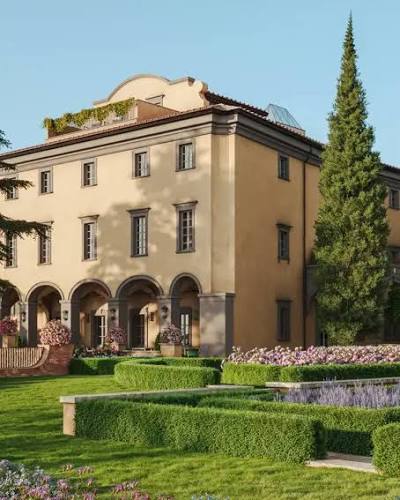
The opening of Borgo Pignano Florence is not just another luxury hotel announcement. It is a strategic signal.
It tells us something important about where Italian hospitality investment is heading: at the top end of the market, value is no longer measured only in rooms, square metres, star ratings or location. It is measured by the ability to turn a property into a coherent value-creation platform.
A platform made of place, architecture, service, food and beverage, wellness, sustainability, privacy, identity and reputation.
That is the real lesson behind Borgo Pignano’s expansion: the hotel is no longer just an accommodation asset. It is an ecosystem.
And for anyone investing in Italian hospitality, that distinction matters.
The story is not the opening. It is the model.
Borgo Pignano was built as a deeply rooted hospitality project in the Tuscan countryside, between Volterra and San Gimignano. Its identity is not based only on rooms or design, but on the integration of hospitality, landscape, agriculture, gastronomy, wellness and sustainability.
The new Florence project brings that identity into a very different environment: not the countryside, but one of the most competitive and internationally recognised art cities in the world.
That is where the move becomes interesting.
Borgo Pignano is not simply adding a second property. It is transferring a hospitality language. It is taking a place-based concept and turning it into a brand platform.
In hotel investment, this is a critical step. When a project can replicate its values without becoming standardised, it moves into a higher category.
It is no longer just hotel operations.
It is no longer just real estate enhancement.
It is long-term brand and asset value creation.
Florence does not need more hotels. It needs stronger concepts.
Florence is an extraordinary destination, but it is also a difficult one.
It has global recognition, consolidated tourism demand, a strong luxury segment and a unique real estate heritage. But it is also mature, expensive, competitive, heavily regulated and increasingly selective.
In a market like Florence, opening a hotel is not enough.
The risk is obvious: entering a crowded destination with a beautiful, expensive product that is not sufficiently differentiated.
Borgo Pignano appears to be targeting a much more precise space: discreet luxury.
Not ostentatious luxury.
Not decorative luxury.
Not luxury measured only by suite size or interior finishes.
But luxury built around distance from noise, greenery, silence, service, privacy, wellness, historic architecture and a genuine relationship with place.
This positioning is highly relevant today. High-spending travellers want Florence, but not necessarily the congestion of Florence. They want culture, but also privacy. They want access, but also space. They want experience, but not exposure.
That is why hybrid hospitality products — somewhere between a city hotel, a private villa, an urban resort and an estate hotel — are becoming increasingly compelling.
The real value is not the building. It is how the building is interpreted.
Many hotel investments in Italy start from the wrong assumption: if the property is beautiful, the project will work.
It will not.
A historic building may be rare, prestigious, protected and visually powerful. But it may also be inefficient, expensive to maintain, difficult to convert, complex to operate and financially fragile.
Hotel value does not automatically come from the beauty of the asset.
It comes from how the asset is interpreted, positioned and operated.
The question is not:
“How beautiful is this property?”
The real question is:
“What hospitality model can this property actually support?”
That difference separates a disciplined hotel investment from an emotional real estate transaction.
A historic asset can generate value only when it is connected to real demand, a clear positioning, a sustainable cost structure, a credible commercial strategy and professional management.
The Borgo Pignano case is interesting because it does not appear to standardise the asset. It builds around its uniqueness.
And in luxury hospitality, uniqueness is not decoration. It is an economic lever.
Low density, high willingness to pay
In traditional hospitality, the number of rooms is often seen as a source of strength. More rooms usually mean greater ability to absorb fixed costs, stronger operating leverage and higher revenue volume.
In high-identity luxury hospitality, however, the logic changes.
A small-key property may be harder to operate, but it can also become more desirable. Low density creates privacy. Privacy supports exclusivity. Exclusivity allows higher rates.
The point is not having fewer rooms.
The point is making those rooms capable of generating superior value.
That requires a very precise combination:
-
high ADR;
-
controlled operating costs;
-
strong ancillary revenues;
-
international reputation;
-
qualified distribution;
-
direct demand;
-
services aligned with the positioning;
-
management capable of protecting margins.
Without these elements, a small luxury property can become fragile. With them, it can become a highly attractive hospitality asset.
This is where many investors misread the opportunity. They assess these projects through the logic of a standard hotel, without considering that in luxury hospitality value can also be created through scarcity, reputation and the brand’s ability to increase willingness to pay.
Brand is no longer cosmetic. It is a value multiplier.
The Italian market still tends to underestimate the role of the hotel brand.
Many owners believe that value sits mainly in the property. That is partly true. But in today’s market, especially at the upper end, the brand can have a direct impact on asset value.
A property without identity competes on location, price and availability.
A property embedded in a strong brand competes on desirability, trust and belonging.
That difference can affect ADR, occupancy, distribution channels, online reputation, ability to attract talent, appeal to institutional investors and exit value.
Borgo Pignano seems to be moving exactly in this direction. It is not simply opening a second hotel. It is expanding a recognisable universe.
When a brand can carry its values from one property to another, value no longer remains trapped inside the single asset. It becomes a platform.
And a well-built platform can be worth more than the sum of its individual properties.
The risk many investors overlook: beauty is not enough.
The Borgo Pignano case is positive, but it should not lead to the wrong conclusion.
Not every historic villa can become a profitable luxury hotel.
Not every village can become a resort.
Not every noble palace can sustain a hospitality operation.
Not every prestigious property is automatically a good hotel investment.
This is one of the most important points for owners, investors and family offices.
Italy is full of fascinating but economically complex assets: historic residences, farmhouses, convents, palaces, masserie, villas, villages and agricultural estates. Many of these properties have potential. But potential is not value. It is only a possibility.
Value is created only when the project passes a series of fundamental tests:
-
Is there demand consistent with the positioning?
-
Does the room count allow economic balance?
-
Are labour costs sustainable?
-
Can the market absorb the required rates?
-
Can the spaces generate ancillary revenues?
-
Does the destination support adequate seasonality?
-
Is the brand strong enough to generate direct demand?
-
Is the capital expenditure proportionate to the expected returns?
Without clear answers, the risk is to create beautiful but financially weak properties.
And it is exactly on this boundary — between real estate appeal and operational sustainability — that the quality of hotel investment is now determined.
For further analysis on valuation, repositioning, management and development of hospitality assets, visit the InvestimentiAlberghieri blog:
https://www.investimentialberghieri.it/blog
Sustainability is not a message. It is part of the product.
In contemporary luxury, sustainability can no longer be treated as a marketing claim.
Sophisticated travellers are not looking for generic statements. They are looking for visible coherence.
Sustainability becomes credible when it is embedded in the product: in the relationship with the territory, the supply chain, the cuisine, the materials, energy management, landscape care, supplier selection and company culture.
In the Borgo Pignano model, this element appears central because it is not presented as an add-on. It is part of the identity.
This is an important lesson.
In luxury hospitality, sustainability should not be treated only as a cost or compliance issue. It can become a lever of positioning, reputation and differentiation.
But only if it is authentic.
Weak sustainability does not move value.
Integrated sustainability can increase it.
What Borgo Pignano teaches hotel investors
The first lesson is that luxury is no longer synonymous with abundance. Increasingly, it is about selection, space, silence, privacy and quality of experience.
The second is that territory is not a backdrop. It is part of the product. A hotel that does not interpret its territory remains weaker and more replaceable.
The third is that the property is not enough. Even the most prestigious asset must be translated into a viable operating model.
The fourth is that low density can be an advantage only if it is supported by rates, brand and management.
The fifth is that the brand can become a value multiplier, especially when it turns a single hotel into a recognisable platform.
The sixth is that operational risk remains central. In luxury hospitality, the beauty of the project does not eliminate the complexity of the profit and loss account.
These lessons apply to Florence, but also to many other Italian destinations: Rome, Venice, the Amalfi Coast, rural Tuscany, Lake Como, Puglia, Sicily, Umbria, the Langhe and the Dolomites.
Italy has one of the strongest combinations of real estate heritage, landscape and cultural capital in the world. But heritage alone does not generate returns.
Dormant heritage preserves value.
Poorly managed heritage consumes value.
Well-managed heritage multiplies value.
Where real competitive advantage begins
The true competitive advantage of a hotel project does not come from one single element.
It does not come only from location.
It does not come only from interior design.
It does not come only from renovation.
It does not come only from the luxury label.
It does not come only from communication.
It comes from alignment.
When property, market, brand, management, pricing, service, distribution and identity tell the same story, the project becomes stronger. When those elements are inconsistent, even the most expensive investment can become fragile.
The Borgo Pignano case matters because it points in a clear direction: value is not being created through standardisation, but through coherence.
And today, coherence is one of the rarest assets in hospitality.
The question every investor should ask
The decisive question is no longer:
“How much is this property worth?”
The decisive question is:
“What value ecosystem can be built around this property?”
It is a harder question, but a far more useful one.
Because it forces investors to consider capital, management, market, positioning, demand, identity, risk and return together.
That is the difference between a real estate operation with rooms and a true hotel investment.
Borgo Pignano is expanding its footprint, but the point is not the expansion itself. The point is the message this move sends to the market: in Italian luxury hospitality, the future will not necessarily belong to the largest hotels, but to the most coherent, most recognisable and hardest-to-copy projects.
Looking to reposition or unlock the value of a hotel asset in Italy?
Hotel Management Group supports owners, investors and operators in assessing, repositioning and developing hospitality projects built around real market demand, profitability and long-term value creation.
To explore the methodology further, read the hotel guides available on RobertoNecci.it:
https://www.robertonecci.it
Or visit the InvestimentiAlberghieri blog for analysis, strategies and investment models in the hospitality sector:
https://www.hotelinvestments.it/blog
Roberto Necci - r.necci@robertonecci.it