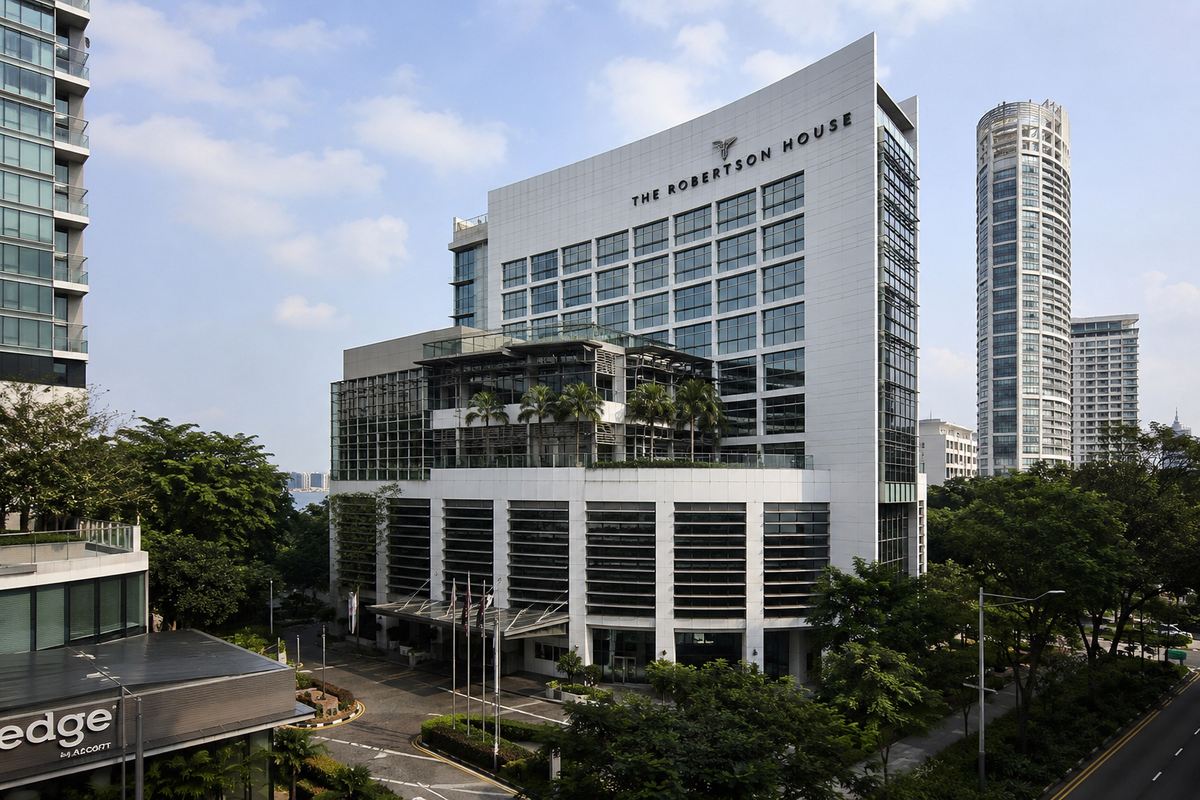
The sale of The Robertson House by The Crest Collection in Singapore by CapitaLand Ascott Trust is more than a hotel transaction. It is a clear signal of where institutional capital is still prepared to pay: scarce, well-located, professionally managed hospitality assets in markets with depth, liquidity and long-term credibility.
According to CapitaLand Ascott Trust, the 336-room hotel is being sold to an unrelated third party for S$360 million, with completion expected in the third quarter of 2026. The price is equivalent to approximately S$1.1 million per key, stands 4% above book value, and reflects an exit yield of 2.3%.
Using the European Central Bank reference rate of 1 June 2026, equal to €1 = S$1.4881, the transaction value is approximately €242 million. On the same basis, the price per key is around €739,000 per room. The euro figures are indicative and depend on the exchange rate applied at completion, but they provide a useful benchmark for European investors.
The headline number is striking. The more important question is what it reveals: why would an investor acquire a hotel at such a compressed yield?
The answer lies in the difference between buying hotel income and buying prime hospitality real estate.
Key transaction metrics
The transaction includes several figures that are relevant beyond the Singapore market:
-
Sale price: S$360 million, approximately €242 million;
-
Asset: The Robertson House by The Crest Collection, Singapore;
-
Rooms: 336;
-
Price per key: approximately S$1.1 million, or around €739,000 per room;
-
Premium to book value: 4%;
-
Exit yield: 2.3%;
-
Estimated net proceeds: S$341.7 million, approximately €229.6 million;
-
Estimated net gain: S$38.1 million, approximately €25.6 million;
-
Expected completion: third quarter of 2026.
These figures do not simply describe a sale. They describe the valuation logic behind institutional hotel capital.
Prime hotels are not priced on income alone
In hospitality investment, yield matters. But yield is only one part of the underwriting.
A hotel is not a passive real estate asset. It is an operating business, a physical property, a brand platform and a market position. Its value depends not only on current income, but also on future rate growth, asset scarcity, capex requirements, operating upside and exit liquidity.
That is why a prime hotel can trade at a yield that appears low when viewed purely through an income lens.
In the case of The Robertson House, the buyer is not only acquiring today’s cash flow. The buyer is acquiring exposure to Singapore, a tightly supplied hospitality market, a branded operating asset and a long-term position in one of Asia’s most institutional real estate environments.
That is the line between owning a hotel property and holding an institutional hospitality investment.
Why a 2.3% exit yield is significant
An exit yield of 2.3% is highly compressed. It implies a strong price relative to the income produced by the asset.
In a higher-rate environment, that level of pricing is possible only when investors see value beyond the immediate return. Prime hospitality assets can command low yields when they offer a combination of capital preservation, market resilience, limited supply and credible resale prospects.
Singapore has many of those characteristics. It is liquid, regulated, internationally recognised and supply-constrained. In that context, investors may accept a lower initial yield because the asset is considered durable, defensible and difficult to replicate.
But this is not a general market statement. It does not mean any hotel can trade at a prime yield.
Compressed yields are reserved for assets with a very specific profile:
-
prime location;
-
institutional scale;
-
diversified demand;
-
strong operating structure;
-
transparent financial information;
-
manageable capital expenditure;
-
credible brand positioning;
-
clear exit liquidity.
When these conditions are absent, the required yield rises and the valuation falls.
Price per key: why €739,000 per room is only the starting point
The reported price of approximately €739,000 per room is an important benchmark, but it should not be read in isolation.
Price per key is one of the most frequently quoted metrics in hotel transactions. It is useful, but it can also be misleading. It does not explain profitability, capex, market depth, operating risk or future upside.
Two hotels with the same number of rooms can have entirely different values. A 300-room property in a secondary location with heavy investment needs is not comparable with a hotel of similar size in a prime market with international demand, strong pricing power and limited new supply.
For that reason, price per key should always be tested against other indicators:
-
RevPAR;
-
ADR;
-
occupancy;
-
GOP;
-
EBITDA;
-
EBITDA per room;
-
capex requirements;
-
management or lease structure;
-
competitive positioning;
-
demand mix;
-
liquidity on exit.
Price per key is a benchmark. It is not a valuation method.
This is particularly relevant in European and Italian hotel markets, where assets are still too often compared by room count alone. That approach misses the real drivers of value: income quality, location, capital intensity, operating efficiency and investor liquidity.
Capital recycling, not retreat
The sale is also important because of what it says about CapitaLand Ascott Trust’s strategy.
This is not a retreat from hospitality. It is a disciplined capital recycling move.
By selling a mature asset above book value, the seller crystallises value, releases capital and creates room for redeployment. The proceeds can support new acquisitions, debt reduction, asset enhancement or portfolio repositioning.
That is how institutional owners manage hospitality real estate. They do not simply accumulate hotels. They allocate capital across cycles.
The decision is not only whether an asset is good. The decision is whether the capital tied up in that asset can generate a better risk-adjusted return elsewhere.
For hotel owners, this is a critical distinction. A hotel is not always an asset to be held indefinitely. In institutional portfolios, the cycle is clear: acquire, operate, enhance, stabilise and exit.
Selling well is part of value creation.
What this transaction means for Italy
Although the transaction took place in Singapore, its implications are highly relevant for Italy and other European hospitality markets.
Italy has many of the characteristics international investors seek: globally recognised destinations, strong leisure demand, cultural depth, historic real estate and genuine barriers to new supply. Rome, Milan, Florence, Venice, the Amalfi Coast, Lake Como, Capri, Taormina and several high-end resort markets all have the potential to attract institutional capital.
But location alone is not enough.
Not every hotel in a strong destination is an institutional asset. For a property to attract professional investors, it must be legible. Buyers must be able to understand the income, the risk, the legal position, the operating structure, the capex profile and the exit strategy.
Many Italian hotels have strong underlying potential but reach the market with weaknesses that reduce liquidity:
-
incomplete documentation;
-
non-normalised accounts;
-
unclear lease or management agreements;
-
unquantified capex;
-
inefficient operating structures;
-
planning or zoning uncertainty;
-
fragmented ownership;
-
unrealistic pricing expectations;
-
limited transparency on historical performance.
International capital does not buy charm alone. It buys clarity, control and predictability.
That is often the difference between an attractive hotel and a financeable hotel.
Due diligence is where value becomes real
Every serious hotel transaction is ultimately tested in due diligence.
This is where the asking price is measured against the operational, technical, legal and financial reality of the asset.
A professional investor will typically review:
-
historical occupancy, ADR and RevPAR;
-
room revenue and ancillary revenue;
-
food and beverage performance;
-
payroll cost structure;
-
departmental profitability;
-
GOP and EBITDA;
-
distribution costs;
-
OTA exposure;
-
management or lease agreements;
-
technical condition;
-
deferred maintenance;
-
future capex requirements;
-
permits and licences;
-
zoning and planning compliance;
-
health and safety issues;
-
competitive positioning;
-
repositioning potential;
-
exit scenarios.
This is where theoretical valuations are adjusted.
A hotel may look highly valuable because of its location, but lose value if due diligence reveals heavy capex, weak margins, legal uncertainty or contractual limitations.
Conversely, a well-documented hotel with stable performance, clear governance and a credible repositioning strategy can command a stronger valuation because it reduces uncertainty.
In hotel investment, transparency has economic value.
Why the premium to book value matters
The fact that The Robertson House is being sold 4% above book value is significant.
A sale above book value means the market recognises value beyond the carrying amount recorded in the owner’s accounts. That premium may reflect asset quality, market growth, scarcity, investor demand, timing or confidence in the destination.
For an institutional seller, it validates the asset management strategy. For the market, it signals that prime hotels remain liquid when the asset, pricing and buyer universe align.
This matters because liquidity is not evenly distributed.
The strongest assets still attract capital. Weaker, less transparent or capex-heavy assets face a much more selective market.
Prime hotels and ordinary hotels are moving further apart
The hospitality investment market is becoming increasingly polarised.
At one end are prime assets: scarce, well located, professionally managed, institutionally legible and supported by deep demand. These hotels can still achieve strong pricing and compressed yields.
At the other end are ordinary, under-managed or poorly documented assets. These properties face longer processes, tougher financing conditions, higher return requirements and more aggressive pricing adjustments.
This polarisation is already visible across Europe, including Italy.
Investors remain interested in hotels in major cities, international leisure destinations and markets with diversified demand. But they are far more cautious when an asset requires significant capex, lacks operational efficiency or has no clear positioning strategy.
The market is not closed. It is selective.
Why hotels still attract institutional capital
Despite higher interest rates, rising operating costs and more disciplined underwriting, hotels continue to attract capital for structural reasons.
The first is inflation protection. Room rates can be adjusted daily, unlike long-term rental income streams.
The second is operating upside. Better revenue management, brand repositioning, distribution strategy, refurbishment and cost control can materially improve value.
The third is scarcity. In many global cities and prime leisure destinations, creating new hotel supply in central or high-demand locations is difficult.
The fourth is professionalisation. Investors increasingly understand hotels not simply as complex real estate assets, but as operating platforms capable of generating value through specialist management.
That is why hospitality remains attractive, but only when the asset is underwritten with discipline.
The investor lesson
The sale of The Robertson House offers five lessons for hotel investors.
First, price must be tested against income quality. A high valuation is sustainable only when there is credible evidence of income stability, growth or long-term capital protection.
Second, location must be analysed deeply. A central address is not enough. Investors need demand depth, rate potential, competitive resilience and long-term liquidity.
Third, capex matters. A hotel can appear profitable today but require future investment that materially reduces the real return.
Fourth, exit liquidity is essential. A good acquisition is not only about buying well. It is about knowing who may buy the asset in five or ten years.
Fifth, governance creates value. Reliable data, clear reporting, professional management and transparent documentation reduce risk and support stronger pricing.
These principles apply in Singapore. They also apply in Rome, Milan, Florence, Venice, Naples, the Italian lakes, coastal resorts and mountain destinations.
Conclusion: capital is not buying rooms. It is buying quality.
The sale of The Robertson House confirms a central truth of hospitality real estate: institutional capital is still available, but it is increasingly concentrated on assets that combine location, quality, governance and exit visibility.
The headline figure is impressive: S$360 million, approximately €242 million. But the deeper message is more important.
Prime hotels remain investable because they are scarce, operationally relevant and capable of preserving capital over time. Ordinary hotels, by contrast, must work much harder to justify their valuation.
For the Italian market, the lesson is direct. Owning a hotel in an attractive destination is no longer enough. The asset must be transformed into an investment product: documented, measurable, financeable, manageable and saleable.
That is the difference between a hotel property and an institutional hospitality investment.
A hotel becomes more valuable when a buyer can understand its risks, measure its upside and believe in its exit.
For further analysis on hotel valuation, hospitality transactions and investment strategy, see the hotel guides on www.robertonecci.it and the insights published on Investimenti Alberghieri: https://investimentialberghieri.it/blog.
Roberto Necci - r.necci@robertonecci.it