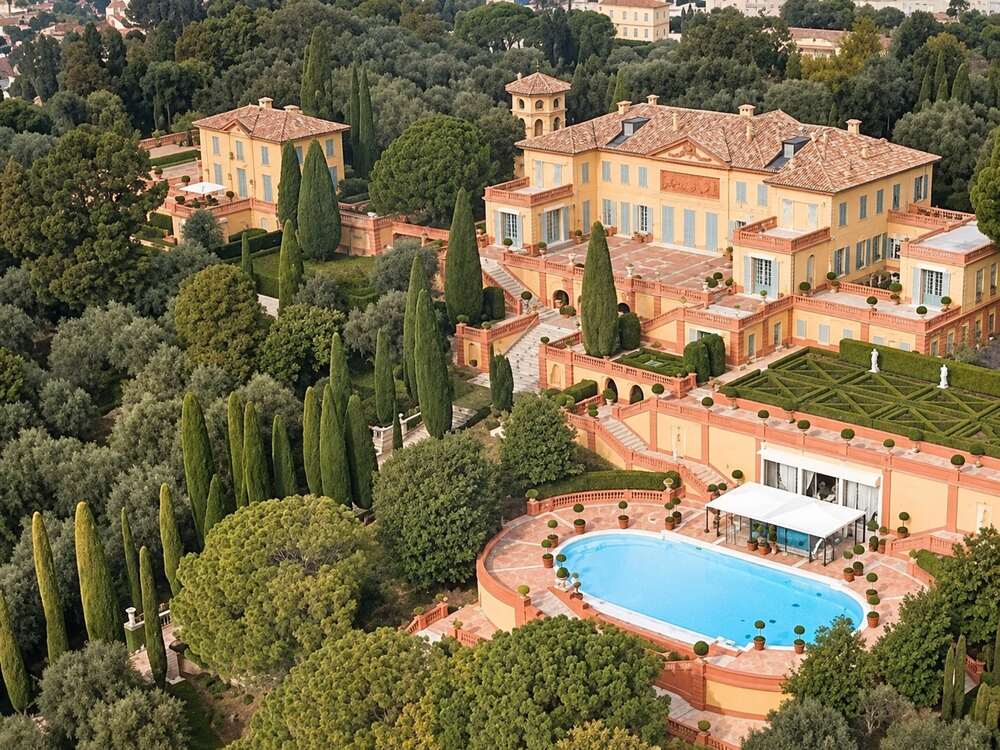
Nearly eight hectares between Villefranche-sur-Mer and Saint-Jean-Cap-Ferrat, one of the world's most celebrated private residences, and a real estate value that is difficult to benchmark against conventional market metrics. But could Villa La Leopolda ultimately be worth more as a private residence—or as an ultra-luxury hotel with just a handful of rooms?
The question may sound provocative.
In reality, it goes to the heart of one of the most compelling issues in trophy-asset hospitality investment: an asset’s highest revenue-generating use is not necessarily its highest-value use.
In the case of Villa La Leopolda, there is currently no publicly available evidence of an announced hotel development, an agreement with a hospitality operator, or an ongoing conversion process.
This is therefore an investment scenario analysis, not a report on an existing transaction.
And that is precisely what makes the case interesting.
Villa La Leopolda: Far More Than a Villa
The estate is located in Villefranche-sur-Mer, along one of the most exclusive stretches of the French Riviera, between Nice, Beaulieu-sur-Mer, Saint-Jean-Cap-Ferrat and Monaco.
Its modern history is closely associated with King Leopold II of Belgium, who acquired a substantial tract of land in the area at the end of the nineteenth century.
Over time, the property was expanded and transformed into what is better described as a private estate rather than simply a villa, comprising the main residence, ancillary buildings, gardens, service facilities and extensive landscaped grounds.
Publicly available planning documentation relating to the Nice Côte d'Azur metropolitan PLUm has referred to a landholding of approximately 78,860 sq m and around 1,770 sq m of built area.
It is this extraordinary ratio that makes Villa La Leopolda particularly interesting from a hospitality perspective:
almost eight hectares of land for less than 2,000 sq m of built space.
From a hotel investment perspective, the implication is clear:
the potential value lies not in density, but in scarcity.
The Wrong Question Is: “How Many Rooms Could We Build?”
That would probably be the first mistake an investor could make.
In a conventional hotel development, efficiency typically means maximising room count, revenue-generating space, GOP and returns on invested capital.
For an estate such as Villa La Leopolda, the logic should arguably be reversed.
Adding significant built volume, developing dozens of new rooms, heavily infrastructure-intensive facilities or converting the estate into a conventional resort could destroy precisely what creates its premium:
privacy, uniqueness, heritage, gardens, extraordinarily low density and an irreplaceable location.
The most compelling hospitality concept—assuming it could ever be made planning-compliant—might therefore not be an 80-room hotel.
It could be an ultra-luxury estate hotel with just 15 to 30 keys.
The Real Product: A Hospitality Estate, Not a Conventional Hotel
The most coherent operating concept could potentially include:
-
15–30 rooms and suites;
-
exceptionally generous guestroom sizes;
-
a limited number of independent villas or residences;
-
spa, wellness and longevity facilities;
-
highly personalised dining;
-
curated garden experiences;
-
dedicated concierge services;
-
maximum-level privacy and security;
-
highly selective private events;
-
full-property reservations;
-
exclusive buy-outs.
The guest would not simply be purchasing a hotel room.
They would be purchasing temporary access to a place that is normally inaccessible.
That fundamentally changes the economics of the asset.
From RevPAR to Revenue per Guest
A project of this nature should not be assessed exclusively through conventional hotel KPIs.
ADR, occupancy and RevPAR would remain essential metrics—but they would not tell the full story.
The more relevant metric could become:
Revenue per Guest
In other words, the total economic value generated by each guest across:
accommodation, F&B, wellness, experiences, transportation, concierge services, private events and estate buy-outs.
At this level of hospitality, the room becomes only one component of total guest revenue.
A Scenario Analysis: How Much Revenue Would Such a Hotel Need to Generate?
A credible business plan cannot be developed without knowing the actual CAPEX requirement, the areas capable of being converted, the planning framework and the final operating configuration.
However, it is possible to illustrate the order of magnitude.
Assume, purely for scenario-analysis purposes:
25 keys
Average ADR: €3,000
Occupancy: 60%
Room revenue alone would be:
25 × 365 × 60% × €3,000
= approximately €16.4 million in annual room revenue.
If F&B, wellness, private events, experiences and buy-outs generated additional revenues equivalent to 35–50% of room revenue, total annual turnover could theoretically reach approximately:
€22–25 million.
At an average ADR of €4,000, with the same occupancy:
25 × 365 × 60% × €4,000
= approximately €21.9 million in room revenue, before ancillary revenues.
Total turnover could therefore move beyond €30 million per year.
These figures are purely illustrative and do not constitute a valuation of the property.
They do, however, demonstrate the economic logic that such a project would require:
not maximising occupancy—but maximising value per guest.
The Real Test Comes Next: GOP
Generating €20 million or €30 million in annual revenue would not automatically create value.
An operation at Villa La Leopolda would likely carry an exceptionally high cost base.
Staff.
Security.
Landscaping.
Heritage maintenance.
Utilities.
Ultra-luxury housekeeping.
F&B.
Wellness.
Engineering.
Concierge.
Transportation.
Management fees.
International marketing.
Insurance.
Planned maintenance.
And, above all, CAPEX.
The central financial question would therefore not be:
How much revenue could Villa La Leopolda generate as a hotel?
It would be:
What stabilised GOP could the property generate, and how much total invested capital could that GOP reasonably support?
That is the question that separates an iconic property from an investable hotel asset.
Preliminary Feasibility Matrix
| Scenario | Preliminary Feasibility | Economic Rationale |
|---|---|---|
| Trophy private residence | High | Maximum preservation of scarcity |
| Conventional 80–100 room hotel | Very low | Potential conflict with heritage, density and planning constraints |
| 40–60 key ultra-luxury hotel | Low | Likely requirement for significant additional volume and infrastructure |
| 15–30 key palace hotel | Medium | Greater consistency with scarcity and extreme pricing power |
| Wellness / longevity retreat | Medium | Potentially attractive if planning-compatible |
| Hospitality estate / exclusive buy-out | Medium-high | Potentially the most coherent hospitality model |
| Large new-build resort | Very low | Significant planning and landscape compatibility risk |
This is not a definitive planning assessment.
It is a preliminary investment-feasibility framework.
Before the Business Plan Comes Planning
This is where Villa La Leopolda becomes particularly complex.
In documentation relating to the PLUm planning process, the property was predominantly identified within Na zoning, with certain portions falling under other planning classifications.
Natural zones are, by definition, subject to significant development restrictions.
A potential hotel conversion could therefore not be assessed simply by looking at existing floor area and calculating a theoretical number of rooms.
A serious feasibility study would need to establish, at minimum:
-
planning classification on a parcel-by-parcel basis;
-
current permitted use of each building;
-
landscape constraints;
-
heritage protections;
-
existing authorised volumes;
-
ability to change use;
-
potential expansion rights;
-
parking requirements;
-
accessibility;
-
fire safety;
-
ERP requirements;
-
mobility and logistics;
-
back-of-house implications.
For a trophy asset, planning is not an ancillary due-diligence exercise.
It is a value driver.
One Particularly Interesting Detail
During the 2019 planning process, an observation was submitted specifically in relation to Villa La Leopolda.
The purpose was to avoid a situation in which the new planning framework would effectively freeze the estate, preventing rehabilitation, adaptation and improvement works on existing buildings.
The issue was taken into consideration, subject to compliance with applicable requirements and oversight by the relevant heritage authorities.
This does not imply that the authorities would support a future hotel conversion.
It does, however, demonstrate that the ability to intervene on the estate's existing built fabric is not merely a theoretical issue.
The Precedent That Makes the Case Even More Interesting: Villa Eiffel
Only a few kilometres away lies a case that deserves particular attention.
Villa Eiffel in Beaulieu-sur-Mer.
For that property, the Métropole Nice Côte d'Azur used a Déclaration de Projet emportant mise en compatibilité du PLUm to enable the development of a high-end hospitality project.
The scheme contemplated a five-star hotel with approximately 35 rooms and a wellness centre.
The planning documentation directly addressed the relationship between:
heritage,
hotel development,
project economics,
landscape,
and tourism-related public interest.
This is highly relevant.
Villa Eiffel does not create an automatic planning precedent that can simply be applied to Villa La Leopolda.
What it does demonstrate is that, on the same French Riviera:
a hospitality project considered strategically relevant can itself become the catalyst for a specific planning procedure.
For an investor, that is perhaps the most interesting aspect of the case.
Hospitality Must Serve the Heritage, Not Consume It
For historic trophy assets of this calibre, project sustainability cannot be framed exclusively in terms of financial return.
The business model would also need to demonstrate that the operating activity could fund, over the long term:
-
maintenance;
-
restoration;
-
landscaping;
-
conservation;
-
skilled employment;
-
international positioning;
-
year-round operation;
-
permanent stewardship of the estate.
The narrative would therefore need to change completely.
Not:
“We want to turn a historic villa into a hotel.”
But:
“We want to create an economically sustainable operation capable of permanently funding the preservation of an exceptional heritage asset.”
That distinction could prove decisive in any dialogue with local authorities and stakeholders.
But How Much Could the Conversion Cost?
Potentially an enormous amount.
Even an extraordinary private residence is not designed around the operating requirements of a luxury hotel.
The project could require substantial investment in:
building services,
fire safety,
guest and staff circulation,
lifts where required,
commercial kitchens,
storage,
housekeeping infrastructure,
staff changing facilities,
offices,
engineering,
back of house,
logistics,
waste management,
deliveries,
security,
parking,
technology,
and wellness.
The area actually monetised through guest accommodation could therefore be significantly smaller than the total space requiring investment.
This is why a business plan built solely around ADR and occupancy could be dangerously misleading.
The Comparison That Ultimately Matters: Hotel Value vs Residential Value
This brings us to the real investment question.
Villa La Leopolda is a trophy residence.
And a trophy residence may carry such an extraordinary private-market value that converting it into a hotel becomes economically irrational.
The analysis would therefore need to compare at least three different value concepts:
1. Value as a Private Residence
What is the property worth while preserving maximum privacy and scarcity?
2. Value as a Stabilised Hotel
What is the capitalised value of the NOI/GOP generated by the hospitality operation once stabilised?
3. Residual Value After CAPEX
How much capital must be deployed to create that operating cash flow?
The comparison should therefore be:
Residential Value
versus
Hotel Enterprise Value – CAPEX – Cost of Capital – Development Risk.
This is where many trophy-hospitality projects cease to make economic sense.
A hotel can generate an extraordinary cash flow and still represent the economically inferior use of the underlying real estate.
Three Possible Strategies
Scenario 1 — Private Estate
Preserve the residential use.
Maximum protection of scarcity.
Potentially the highest underlying real estate value.
Little or no operating cash flow.
Scenario 2 — Ultra-Luxury Hotel
15–30 keys.
Exceptional ADR potential.
Significant ancillary revenue.
Material CAPEX and complex planning requirements.
Potential creation of one of the world's most distinctive hospitality assets.
Scenario 3 — Private Hospitality Estate
This may be the most compelling conceptual scenario.
Not a hotel distributed through conventional channels.
Not simply a private villa.
Instead, an estate serving an ultra-high-net-worth clientele through:
-
exclusive buy-outs;
-
extended stays;
-
full hotel services;
-
wellness;
-
private chefs;
-
concierge;
-
controlled events;
-
extremely selective access.
Very few guests.
Exceptionally high revenue per stay.
Maximum privacy.
If permitted within the applicable regulatory framework, it could potentially represent the best compromise between residential value and hospitality cash flow.
What Kind of Operator Could Manage Such a Product?
Operator selection would form an integral part of the financial analysis.
A conventional luxury brand would not necessarily be sufficient.
The project would require a brand capable of distributing such an offering to a global UHNW clientele while preserving the estate's private character.
The appropriate competitive set would therefore consist of operators active at the very top end of global hospitality.
This does not suggest that any particular international operator has expressed interest in Villa La Leopolda.
It simply means that this level of brand positioning would be required to support ADR and revenue-per-guest assumptions capable of remunerating the invested capital.
The Brand Could Create Real Estate Value
In a conventional hotel, a management agreement is often assessed primarily through fees and operating performance.
With a trophy asset, the equation can be different.
The right global brand could potentially:
-
increase pricing power;
-
accelerate distribution;
-
reduce ramp-up risk;
-
broaden access to the UHNW customer base;
-
enhance the property's future enterprise value.
In such a case, the management agreement would not simply represent an operating cost.
It could become one of the drivers of real estate value creation.
The Decisive Issue: Remunerating the Capital
For InvestimentiAlberghieri.it, the Villa La Leopolda case leads to a clear conclusion.
It is not enough to demonstrate that the building could accommodate hotel rooms.
It is not enough to demonstrate that a customer base exists.
It is not even enough to assume ADRs of €3,000 or €5,000.
The project would need to demonstrate that:
Stabilised GOP
less
Management Fees
less
FF&E Reserve
less
Recurring CAPEX
can produce an appropriate return on:
underlying real estate value + initial CAPEX + cost of capital + planning risk + development risk.
That is the real investment threshold.
Villa La Leopolda Is Not Currently a Hotel Project
This point needs to be stated clearly.
Based on the public sources reviewed, there is currently no announced project to convert Villa La Leopolda into a hotel.
There is no publicly disclosed agreement with a hotel operator.
There is no publicly announced hospitality development.
And there is no publicly marketed sale of the estate specifically for hotel conversion.
This analysis therefore considers the potential highest and best use of one of the most extraordinary properties on the French Riviera.
And that is precisely the point.
The most interesting hotel investments do not necessarily begin when an existing hotel is officially put on the market.
Sometimes they begin when an investor looks at an asset that is not yet a hotel and asks:
Is this property currently producing the maximum value it could create?
Conclusion: Fewer Rooms Could Ultimately Be Worth More
Villa La Leopolda provides an almost perfect case study for understanding the economics of ultra-luxury hospitality.
Nearly eight hectares.
An almost impossible-to-replicate location.
Exceptional international recognition.
Heritage.
Privacy.
Scarcity.
The most compelling theoretical hospitality concept should therefore probably not seek to maximise room count.
It should do the opposite:
maximise the value of every single stay.
The potential model would involve very few keys, exceptionally large guest spaces, highly personalised services, wellness, destination dining, extreme privacy and the possibility of exclusive estate buy-outs.
Yet the ultimate question would remain financial.
The issue is not whether Villa La Leopolda could physically accommodate hotel rooms. The issue is whether hotel cash flow could simultaneously remunerate the underlying real estate value, CAPEX, heritage-preservation requirements, planning risk and the cost of capital.
If the answer were yes, the French Riviera could potentially gain one of the most exclusive hospitality assets in the world.
If the answer were no, the conclusion would be equally important:
Villa La Leopolda may simply be worth more by never becoming a hotel at all.
And that is exactly the distinction between an attractive real estate idea and a genuine hotel investment case.
Investimenti Alberghieri
InvestimentiAlberghieri.it analyses hotel assets, transactions, value-enhancement strategies, turnarounds, distressed situations and hospitality development opportunities.
For feasibility studies, business plans, valuations, due diligence and hotel investment advisory:
info@investimentialberghieri.it
Further insights and advisory:
Investhotel Capital Partners
Hotel Management Group
Roberto Necci