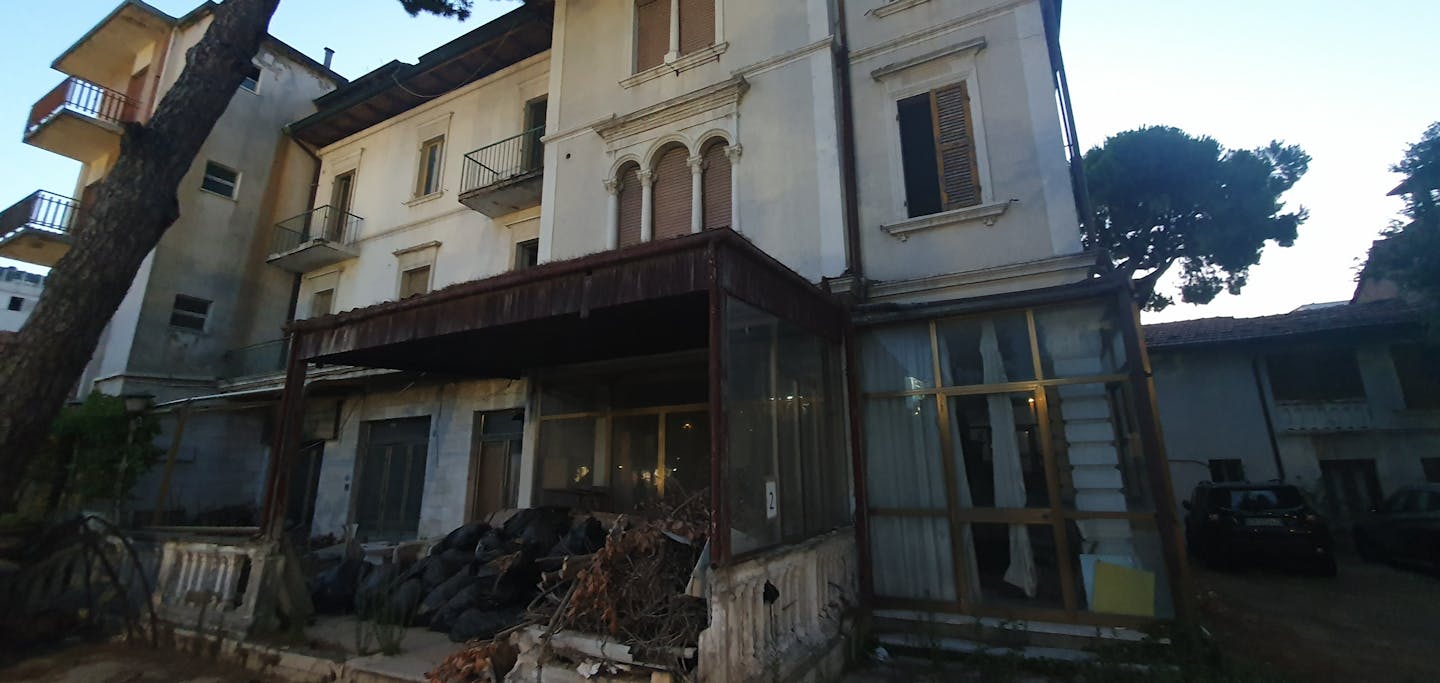
At 4 Viale Giuseppe Verdi, in the heart of Riccione’s tourism district, an early twentieth-century hotel stands abandoned. Its architectural identity, historic hospitality use and strategic location could support a distinctive boutique hotel redevelopment. Yet the former Hotel Amarcord will only become a viable investment if acquisition price, capital expenditure, planning constraints and operating potential are assessed through rigorous due diligence.
Riccione has a hidden hospitality heritage that does not appear in tourism statistics, booking platforms or hotel performance rankings.
It consists of closed hotels, historic buildings that have lost their original use and hospitality assets whose architectural value has survived long after their economic function disappeared.
The former Hotel Amarcord at 4 Viale Giuseppe Verdi belongs to this category.
The property is listed on the FAI “I Luoghi del Cuore” platform, where it is described as an Art Nouveau building dating from the early twentieth century, located within Riccione’s tourism and commercial area and currently in a serious state of abandonment.
In the 2024 census, the property received 13 votes and ranked 763rd. The platform correctly states that its information is user-generated and does not constitute a formal technical assessment or heritage certification by FAI.
This distinction matters.
Being listed by FAI does not automatically mean that the building is subject to a formal cultural heritage restriction. It does, however, show that the property is perceived as part of Riccione’s architectural identity and that its deterioration has become a matter of public concern.
For an investor, however, preserving a historic building is not enough.
The central question is whether the asset can once again generate revenue, operating profit and long-term real estate value.
An abandoned hotel is not necessarily a worthless asset
Abandonment often distorts property valuation.
Owners may continue to attribute to a building the emotional, historical or potential value it had when it was still operating.
Investors, by contrast, see deteriorated roofs, obsolete systems, water infiltration, fire-safety requirements, accessibility works, structural reinforcement and potentially lengthy approval procedures.
Neither perspective is sufficient on its own.
The value of the former Hotel Amarcord does not lie only in its history, nor can it be reduced to the cost of refurbishment.
Its real value depends on whether the property can be transformed into a contemporary hospitality product that is:
-
financially sustainable;
-
operationally efficient;
-
architecturally coherent;
-
commercially differentiated;
-
capable of generating an adequate return on total project cost.
A historic hotel may command a significant positioning premium when it combines:
-
distinctive architecture;
-
an authentic story;
-
a strong tourism location;
-
usable outdoor space;
-
a commercially viable room count;
-
redevelopment costs aligned with future cash flow;
-
planning permissions compatible with efficient hotel operations.
The same building may become a financial trap when architectural appeal leads the buyer to underestimate capital expenditure, planning constraints, inefficient layouts or the inability to create enough keys.
The former Hotel Amarcord should not reopen as an ordinary seaside hotel
The first question should not be:
“How many stars could the hotel achieve?”
The correct question is:
“What hospitality concept can be created inside this building without erasing its identity or undermining its economics?”
The former Hotel Amarcord is unlikely to compete effectively with Riccione’s larger seaside hotels, many of which rely on:
-
substantial room inventories;
-
swimming pools;
-
full-board packages;
-
family-oriented services;
-
entertainment programmes;
-
highly seasonal leisure demand.
Its competitive advantage could lie in the opposite direction:
-
intimate scale;
-
historic architecture;
-
personalised service;
-
an urban and cultural identity;
-
independent boutique positioning;
-
higher value per available room.
The most coherent redevelopment strategy would be an Art Nouveau boutique hotel, potentially featuring individually designed rooms and suites, a small food-and-beverage concept, landscaped outdoor areas and a narrative connected to Riccione’s early tourism history.
Such a property could appeal to:
-
Italian and international couples;
-
design- and architecture-conscious travellers;
-
upper-middle and high-spending leisure guests;
-
visitors attending events, trade fairs and conferences;
-
travellers visiting Riccione outside the summer season;
-
small corporate groups and private events;
-
guests seeking an experience beyond the standard seaside hotel.
The name “Amarcord” also has significant commercial and emotional resonance.
Before using it, however, an investor should verify trademark availability, previous registrations and any rights associated with the former hotel operation.
Boutique hotel or all-suite property?
The number of rooms will be the decisive variable.
A small independent hotel must sustain several fixed and semi-fixed costs that do not decline proportionally with the room count:
-
reception;
-
management;
-
maintenance;
-
property-management systems;
-
insurance;
-
night coverage;
-
fire-safety compliance;
-
marketing;
-
distribution;
-
administration.
These costs remain significant even when the hotel has a limited inventory.
If the redevelopment produces too few standard rooms, an all-suite or predominantly suite-based concept may be more viable.
This model could include:
-
larger accommodation units;
-
higher average daily rates;
-
concierge services;
-
premium breakfast;
-
limited in-house dining;
-
partnerships with local restaurants and beach clubs;
-
a leaner staffing model;
-
strong direct-booking capabilities.
The project would then focus less on maximising occupancy and more on increasing the value generated by every available room.
Commercial feasibility should therefore not be assessed through ADR alone.
The investment model must also consider:
-
RevPAR;
-
GOPPAR;
-
labour cost per available room;
-
customer acquisition cost;
-
OTA commission exposure;
-
ancillary revenue;
-
season length;
-
working-capital requirements;
-
stabilised GOP;
-
return on total investment cost.
As repeatedly highlighted in the analyses published on RobertoNecci.it, a hotel’s value cannot be determined solely by its number of rooms or official classification.
It depends on the asset’s capacity to generate sustainable cash flow over time.
The greatest risk is designing the hotel before understanding the constraints
From a planning and regulatory perspective, the operation requires considerable caution.
The Municipality of Riccione publishes its Urban Building Regulations, which govern construction, functional transformation, building conservation, architectural elements and green areas.
In 2026, the municipality also advanced the process for its new General Urban Plan. Official communications identify hotel regeneration as one of the plan’s key themes, together with wider urban and environmental transformation.
This policy context may support redevelopment, but it does not allow investors to assume that extensions, changes of use or planning incentives will automatically be approved.
Before developing any architectural concept, the following matters must be verified:
-
precise planning classification;
-
cadastral map sheet, parcel and sub-units;
-
legally authorised condition of the property;
-
potential historic or architectural classification;
-
existence of formal cultural heritage restrictions;
-
validity of the hospitality use;
-
historically authorised room count;
-
possibility of maintaining or changing the hotel use;
-
parking and planning-standard requirements;
-
unauthorised works, amnesties or regularisation procedures;
-
impact of the new urban plan and any interim safeguarding measures.
The FAI listing does not, by itself, prove that the building is protected under Italian cultural heritage legislation.
At the same time, the absence of a national heritage restriction does not rule out protection under local planning regulations.
That distinction may materially affect design freedom, development cost and approval timing.
What an investor must verify before submitting an offer
An operation of this kind should not begin with price negotiations.
It should begin with a complete and reliable data room.
Ownership and encumbrances
The investor should obtain:
-
current and historical cadastral records;
-
cadastral maps;
-
floor plans and building layouts;
-
title deeds;
-
a full twenty-year mortgage and title search;
-
details of mortgages and enforcement proceedings;
-
easements;
-
registered leases;
-
pending litigation and court filings.
The current owner cannot be identified with sufficient reliability through open online sources alone.
It would therefore be inappropriate to attribute the property to any individual or company without reviewing official records.
Planning and building compliance
The due diligence process must reconstruct the building’s complete administrative history, including:
-
the original building permit;
-
subsequent alterations;
-
extensions;
-
changes of use;
-
building amnesties;
-
occupancy certificates;
-
hotel operating authorisations;
-
consistency between the physical building, cadastral records and legally authorised condition.
Structure and building systems
A property in a serious state of abandonment requires detailed investigations into:
-
foundations;
-
load-bearing walls;
-
floors;
-
roof structure;
-
balconies;
-
seismic vulnerability;
-
water infiltration and rising damp;
-
asbestos and hazardous materials;
-
electrical and plumbing systems;
-
heating and cooling;
-
drainage;
-
fire safety;
-
acoustic performance;
-
energy efficiency.
Capital expenditure cannot be assessed accurately through an external inspection or preliminary visual survey.
Hotel feasibility
Technical due diligence must be supported by a detailed hotel space-planning study.
The investor must determine how many commercially viable rooms can be created after allocating adequate space for:
-
staircases and escape routes;
-
lifts;
-
plant rooms;
-
storage;
-
housekeeping;
-
bathrooms;
-
reception;
-
common areas;
-
staff facilities;
-
kitchen and service areas;
-
accessible rooms.
Gross floor area is never equivalent to revenue-generating area.
For this reason, Investhotel assesses extraordinary hotel transactions through the overall feasibility of the investment, rather than relying on a simple price-per-square-metre valuation.
The acquisition price must be calculated on a residual basis
One of the most common mistakes in hotel redevelopment is to agree the purchase price first and calculate the transformation cost afterwards.
For the former Hotel Amarcord, the process must be reversed.
The maximum sustainable acquisition price should be calculated as follows:
Value of the completed and stabilised project
minus redevelopment costs
minus professional and approval costs
minus financing costs
minus pre-opening expenditure
minus contingency
minus the investor’s required return
equals the maximum acquisition price.
The property should not be valued as an operating hotel.
Nor should it be valued as an ordinary residential building in a central location.
It should be treated as a high-risk redevelopment project whose current value depends on the future cash flow that can be created and the capital required to achieve it.
The contingency reserve must also be materially higher than for a conventional refurbishment.
Historic and abandoned buildings may reveal:
-
hidden structural defects;
-
complex demolition requirements;
-
hazardous materials;
-
additional heritage-related conditions;
-
specialist craftsmanship requirements;
-
longer-than-expected approval procedures;
-
design changes during construction;
-
the inability to install standard technical systems.
Paying a high acquisition price on the assumption that future extensions or changes of use will be approved means transferring the entire development risk to the buyer.
Residential conversion should never be assumed
When evaluating a former hotel, many investors immediately consider conversion into apartments.
That option may be theoretically possible, but only after verifying:
-
whether the hotel-use restriction can be removed;
-
the applicable planning rules;
-
parking requirements;
-
public-space and planning standards;
-
heritage constraints;
-
compatibility with the building’s original typology;
-
development charges;
-
obligations linked to previous public incentives or grants.
In the case of the former Hotel Amarcord, residential conversion could also destroy the feature that makes the property distinctive: its historic hospitality identity.
The hotel scenario should therefore be tested first.
Alternative uses should only be considered if the achievable room count, capital expenditure or planning constraints make a sustainable hospitality project impossible.
Direct operation, lease or hotel management agreement?
The optimal operating model will depend on the final room count, service level and commercial positioning.
For a small boutique property, an international brand may not be necessary. Its fees, technical standards and operating requirements may be disproportionate to the hotel’s revenue base.
The principal alternatives are:
Direct operation
Direct operation provides maximum control over positioning, service standards and profitability.
It also requires strong operational, financial and commercial expertise.
Business lease or property lease
A lease reduces the owner’s direct exposure to hotel operations.
However, rent must remain consistent with the GOP that the hotel can realistically generate.
An excessive rent may destabilise the operator and ultimately reduce the value of the underlying asset.
Hotel management agreement
A management agreement can separate ownership from hotel operations, but management fees, performance tests and termination rights must be proportionate to the scale and profitability of the property.
Specialist independent management
This may be the most suitable option for a historic boutique hotel, particularly when the operator has proven capabilities in:
-
cost control;
-
revenue management;
-
digital distribution;
-
service design;
-
direct sales;
-
repositioning.
Through NecciHotels.it, our hospitality ecosystem can assess management structures, temporary management solutions and turnaround strategies aligned with the property’s operational and financial characteristics.
A potential symbol of Riccione’s hotel regeneration
The former Hotel Amarcord possesses something that many new hotel developments attempt to manufacture:
an authentic story.
There is no need for invented narratives or theatrical design unsupported by the building itself.
Its value already lies in:
-
the façade;
-
the balconies;
-
the decorative features;
-
the architectural proportions;
-
the relationship with the garden;
-
its connection with the history of tourism in twentieth-century Riccione.
The redevelopment should avoid two opposite mistakes:
-
a purely conservative restoration incapable of generating an adequate return;
-
an aggressive transformation that destroys the identity that made the asset attractive in the first place.
The correct strategy is to balance preservation and performance.
A boutique hotel can respect a historic building while remaining commercially and operationally efficient.
It can integrate technology, automation, digital distribution and rigorous management control without becoming anonymous.
Achieving this balance requires expertise across:
-
urban planning;
-
law;
-
finance;
-
engineering;
-
architecture;
-
hotel operations;
-
sales;
-
marketing;
-
revenue management.
More than the architectural concept alone, this integration will determine the success or failure of the investment.
Conclusion: a genuine opportunity, but only at the right price
The former Hotel Amarcord could become one of Riccione’s most compelling hotel regeneration projects.
Its potential derives from the combination of three elements:
-
a distinctive architectural identity;
-
a historic hospitality use;
-
a location within one of Italy’s best-known tourism markets.
However, its abandoned condition, limited public documentation and potential regulatory constraints require a highly selective investment approach.
This is not a property that should be acquired on the basis of price per square metre.
It is not a project that can be assessed through attractive renderings alone.
It is not an asset on which an investor should speculate by assuming that future approvals will be granted.
The investment case must be built on:
-
complete legal, planning and technical due diligence;
-
a verified and commercially sustainable room count;
-
a realistic capital expenditure budget;
-
a robust hotel business plan;
-
a conservative residual valuation.
When these elements are correctly aligned, the regeneration of a historic hotel can produce attractive financial returns while restoring an important part of the city’s identity.
When they are ignored, the appeal of Art Nouveau architecture can become an investment with no sustainable return.
Are you considering the acquisition, sale or redevelopment of a hotel?
Do not submit an offer or begin the design process before verifying the asset’s value, planning restrictions, redevelopment costs, achievable room count and operating sustainability.
Hotel Management Group coordinates hotel due diligence, asset valuations, business plans, planning assessments, operating feasibility studies, management strategies and turnaround projects for hospitality properties.
A mistake made during the acquisition stage can cost millions of euros and permanently compromise the entire investment
Contact info@investimentialberghieri.it today to request a confidential assessment of the asset.
Roberto Necci - r.necci@robertonecci.it