The Fertitta-Caesars deal is not just a major acquisition: it is a thesis on the future of hospitality
The acquisition of Caesars Entertainment by Fertitta Entertainment for approximately $17.6 billion, including the assumption of around $11.9 billion of debt, is not merely a major transaction in the US gaming sector. It is an industrial thesis on the future of hospitality.
The agreed consideration is $31 per share in cash. The transaction values Caesars’ equity at approximately $5.7 billion, while the enterprise value reaches approximately $17.6 billion once assumed debt is included. Caesars’ board has unanimously approved the agreement, which also includes a go-shop period until July 11, 2026, during which Caesars may evaluate alternative proposals.
These figures already say a great deal.
Fertitta is not simply buying hotels, casinos or iconic real estate on the Las Vegas Strip. It is seeking to integrate a complex platform made up of resorts, gaming, food and beverage, restaurants, sports betting, loyalty, customer databases, entertainment and distribution.
The central point is this: capital is no longer buying rooms alone; it is buying ecosystems.
In today’s hotel market, value is no longer determined only by location, number of rooms, category, square metres or historical operating margin. Increasingly, value depends on the ability to control the customer relationship, multiply spending occasions, integrate services, use data, strengthen direct distribution and manage complex assets with industrial discipline.
For the Italian market, this transaction may appear distant: Las Vegas, gaming, casino resorts, sports betting and US regulation. In reality, the underlying logic is highly relevant to Italian hotels: transforming hotel properties into value-generating platforms.
Who Fertitta Entertainment is: restaurants, gaming, hotels and entertainment in one ecosystem
To understand the significance of the transaction, it is necessary to start with the buyer.
Fertitta Entertainment is controlled by Tilman Fertitta, the US entrepreneur known for Golden Nugget Hotels & Casinos, Landry’s, a broad portfolio of restaurant brands, entertainment venues and leisure assets. Fertitta also owns the Houston Rockets and has built a wide-ranging business ecosystem that began in restaurants and expanded into hospitality, gaming, sports and entertainment.
This profile is decisive.
Fertitta is not a pure real estate investor. He does not think only in terms of walls, rooms or property yields. He thinks in terms of experiential consumption.
His model integrates:
-
hotels;
-
casinos;
-
restaurants;
-
entertainment;
-
sports;
-
events;
-
loyalty;
-
customer databases;
-
retail hospitality;
-
leisure destinations.
This integration represents one of the most important trajectories in contemporary hospitality.
The customer is no longer viewed merely as a guest purchasing a room. The customer is a multi-platform consumer who can generate value through stays, restaurants, events, gaming, sports, entertainment, memberships, loyalty and ancillary services.
In this sense, Fertitta Entertainment represents an evolved form of hospitality company: not only an owner of assets, but the operator of a consumer relationship ecosystem.
Who Caesars Entertainment is: an iconic brand, but above all a platform
On the other side of the transaction is Caesars Entertainment, one of the most recognisable names in American gaming and hospitality.
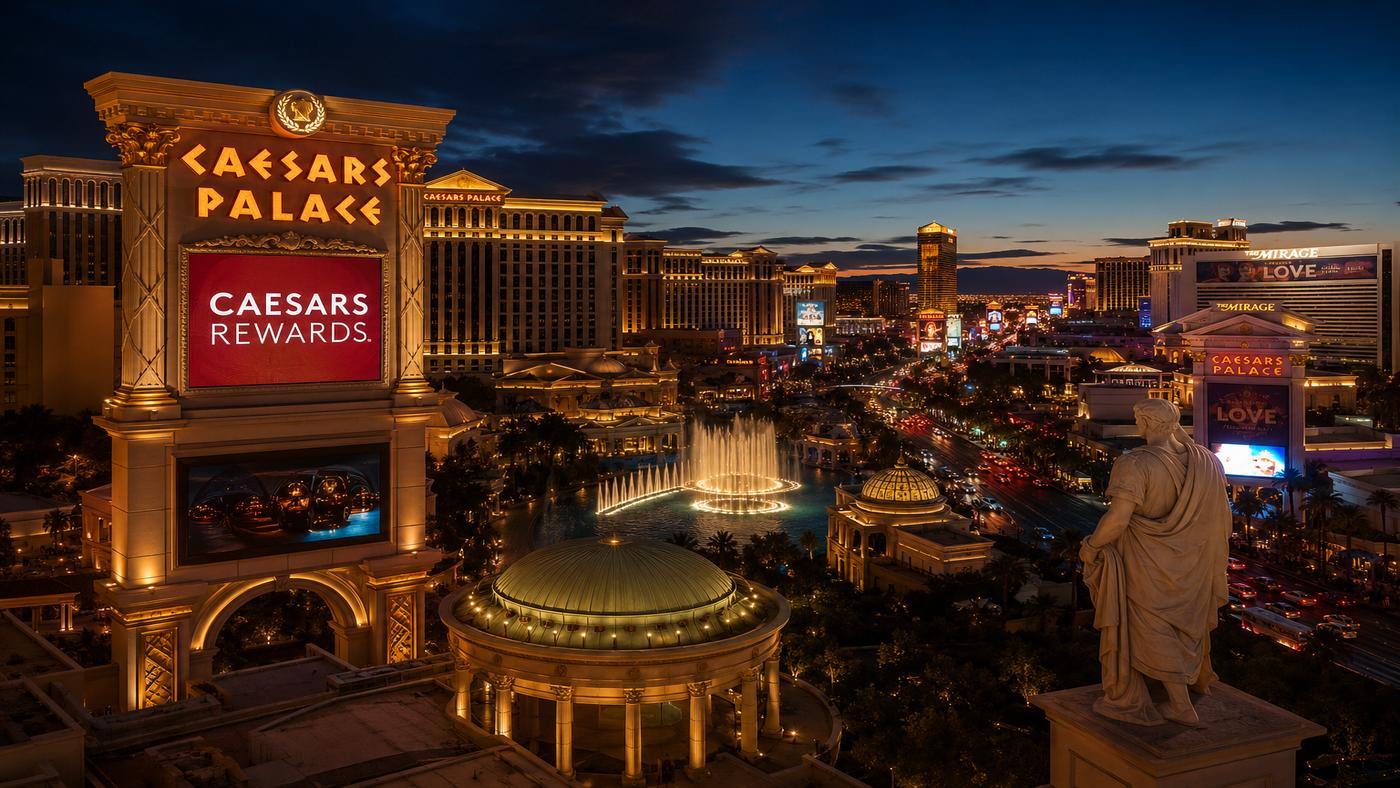
Caesars is not only Caesars Palace. It is a complex platform of casino resorts, hotels, brands, loyalty, land-based gaming, sports betting, online gaming and destinations. Its portfolio includes iconic brands such as Caesars Palace, Harrah’s, Horseshoe, Paris Las Vegas, Planet Hollywood, The LINQ, Flamingo and The Cromwell.
According to public information on the transaction, the combined group would control approximately 60 domestic casino resorts and gaming facilities, more than 200 William Hill retail sports betting locations and over 550 Fertitta/Landry’s outlets.
This perimeter is fundamental.
The value of Caesars is not only real estate value. It is also:
-
brand value;
-
database value;
-
loyalty value;
-
distribution value;
-
location value;
-
customer engagement value;
-
cross-selling value;
-
regulatory value;
-
operating value;
-
financial value.
The Caesars Rewards programme is one of the platform’s most important assets because it turns individual transactions into an ongoing relationship. In a market where customer acquisition costs continue to rise, proprietary data and loyalty become economic assets.
This point is also central for independent hotels.
A hotel that depends only on OTAs, intermediaries and occasional demand has limited control over its future. A hotel or hotel group that owns its database, CRM, direct relationship, repeat guests and communication channels has a higher value.
The financial structure: the real issue is not price, but enterprise value
The most interesting figure in the transaction is not only the $31-per-share price. It is the difference between equity value and enterprise value.
The equity value of the transaction is approximately $5.7 billion, while the overall value reaches $17.6 billion once the assumed debt of approximately $11.9 billion is included.
This distinction is essential for anyone investing in hotels.
In hospitality, asset value cannot be assessed without considering the financial structure. A hotel or platform may appear very significant in terms of scale, brand and location, but debt determines the real sustainability of the investment.
Debt amplifies everything.
It amplifies returns if the transaction generates stronger-than-expected cash flow. But it also amplifies risk if margins compress, capex increases, demand slows, the cost of capital rises or integration takes longer than expected.
In the Fertitta-Caesars deal, the challenge will not only be acquiring Caesars. It will be managing the debt through a larger, more integrated and more efficient platform.
For every hotel investor, including in Italy, the lesson is clear: one should not look only at the gross value of the property or the asking price. One must assess the sustainability of the capital structure.
The right questions are:
-
what operating cash flow supports the debt?
-
what capex will be required?
-
what margins are truly normalised?
-
which synergies are credible?
-
which risks could reduce debt service capacity?
-
what cost of capital is sustainable?
-
what exit value is realistic?
-
how long will it take to stabilise the asset?
In hotel investment, price is only the beginning of the analysis. Real value lies in the sustainability of the financial structure.
The real risk is not buying Caesars: it is integrating it
Every major acquisition begins with an initial phase of excitement. But in hospitality, the real challenge starts after closing.
The main risk is not buying Caesars. It is integrating Caesars.
The transaction involves physical assets, casinos, hotels, restaurants, digital platforms, loyalty, gaming licences, state regulators, debt, staff, contracts, technology, brands and different corporate cultures.
The complexity is extremely high.
There are at least seven key risks.
1. Regulatory risk
Gaming is a heavily regulated sector. Each jurisdiction has its own authorisations, licences, requirements and controls. The closing of the transaction will require regulatory approvals and reviews. The scale of the combined group may increase complexity.
2. Antitrust and competitive risk
The combination of gaming portfolios, resorts, sports betting and brands may attract scrutiny from a competition perspective. Even where the transaction is ultimately approvable, the process may require time and conditions.
3. Operational integration risk
Combining platforms does not simply mean adding assets together. It means integrating systems, processes, people, standards, management, corporate culture and reporting.
4. Technology and digital risk
Sports betting, iGaming, loyalty and CRM require efficient, secure and scalable systems. Data integration is one of the most sensitive areas.
5. Financial risk
The assumed debt is significant. The ability to generate stable cash flow will be critical to supporting leverage.
6. Reputational risk
Gaming, sports, restaurants, hotels and entertainment are high-visibility sectors. Management mistakes or inconsistencies in service quality can affect brand value.
7. Execution risk
The theoretical value of synergies must become operating performance. This is where many large transactions fail: not in the thesis, but in execution.
This is an important lesson for Italy as well. A hotel acquisition does not end with the deed, the contract or the closing. It truly begins the day after, when the business plan must be converted into results.
Gaming is the laboratory, not the real message
The Fertitta-Caesars transaction is about gaming, but its message goes beyond gaming.
The point is not that Italian hotels should imitate Las Vegas. That would be the wrong reading.
The point is that Las Vegas is one of the world’s most advanced laboratories for integrated hospitality. In that model, a hotel is never only a hotel. It is rooms, food and beverage, entertainment, events, shows, shopping, gaming, nightlife, loyalty, databases, direct marketing and customer experience.
Profitability does not depend only on the room night. It depends on the ability to monetise the entire stay and the customer relationship before, during and after the visit.
This principle is perfectly applicable to Italian hotels, even with entirely different content.
For an Italian resort, the ecosystem may be:
-
rooms;
-
beach club;
-
restaurants;
-
wellness;
-
events;
-
local experiences;
-
wine tourism;
-
sports;
-
membership;
-
services for high-spending guests.
For an urban hotel, it may be:
-
rooms;
-
meetings;
-
rooftop;
-
destination restaurant;
-
corporate events;
-
extended stay;
-
coworking;
-
cultural experiences;
-
local partnerships;
-
professional community.
For a historic hotel, it may be:
-
hospitality;
-
culture;
-
heritage;
-
food and beverage;
-
private events;
-
brand storytelling;
-
bespoke experiences;
-
international relationships.
The message is not “gaming”. The message is “platform”.
Loyalty becomes a balance-sheet component of hotel value
One of the most strategic elements of the transaction is the combination of loyalty programmes, customer databases, gaming, dining and resorts.
Loyalty should not be viewed merely as a points programme. It is a relationship infrastructure.
It allows operators to:
-
reduce customer acquisition costs;
-
increase repeat frequency;
-
improve customer knowledge;
-
personalise offers and communication;
-
shift demand across different assets;
-
strengthen direct distribution;
-
reduce dependence on intermediaries;
-
increase database value;
-
create cross-selling across hotels, restaurants, events and services.
In the Italian hotel market, this theme remains underdeveloped.
Many hotels work well on product, but poorly on the ongoing customer relationship. They collect data but do not use it. They have satisfied guests but do not build return strategies. They rely on intermediaries even when they could develop stronger direct channels.
Loyalty is not just marketing. It is asset value.
A hotel with a proprietary database, a well-managed CRM, a repeat guest strategy and a growing share of direct bookings is stronger than a hotel that has to buy each customer from scratch.
Food and beverage: from operating cost to value lever
Fertitta brings a strong restaurant culture to the transaction. Landry’s and the group’s many restaurant brands represent operational expertise, formats, purchasing power, standards, brand management, cost control and customer experience.
This is highly relevant to the hotel sector.
For years, in many hotels, food and beverage was treated as a necessary service but not always as a strategic business line. In some cases, it was even perceived as a cost centre or a source of operational complexity.
In the contemporary hospitality model, however, food and beverage can become a powerful value lever.
It can generate:
-
external revenues;
-
reputation;
-
local attractiveness;
-
events;
-
memorable experiences;
-
cross-selling;
-
premium positioning;
-
longer guest dwell time;
-
differentiation;
-
brand value.
Of course, not every hotel restaurant creates value. Many destroy it.
The difference lies in concept, management, cost control, reputation, pricing, identity, service quality and the ability to attract non-resident guests as well.
The Fertitta-Caesars deal is a reminder that restaurants and hospitality should not be treated as separate worlds. When properly integrated, they can increase the value of the entire platform.
Hotel valuation: what changes when the hotel becomes an ecosystem
Traditional hotel valuation considers essential variables: rooms, location, category, revenues, occupancy, ADR, RevPAR, costs, GOP, EBITDA, capex and contracts.
These remain fundamental.
But they are no longer sufficient.
When the hotel becomes an ecosystem, hotel valuation must include additional drivers.
1. Customer database
A proprietary, clean and actionable database increases value because it reduces dependence on intermediated demand.
2. Direct booking share
The higher the share of direct bookings, the greater the control over margin and customer relationship.
3. Loyalty and repeat guests
The ability to generate repeat business reduces acquisition costs and improves demand predictability.
4. Ancillary revenues
Restaurants, wellness, events, experiences, beach clubs, meetings, memberships and additional services can radically change value per key.
5. Cross-selling
A hotel that sells more services to the same customer has a different value from a property that monetises only the room night.
6. Data and CRM
The ability to understand, segment and reactivate customers becomes a competitive factor.
7. Scalability
A model that can be replicated across multiple assets is more attractive to capital than a single isolated hotel.
8. Governance
Reporting, management control, KPIs and asset management directly affect investment legibility.
9. Debt sustainability
Value does not lie only in the asset, but in the ability of cash flows to support the financial structure.
10. Contract quality
Management contracts, leases, franchises, direct operations and commercial agreements determine risk, upside and bankability.
The hotel guides published on www.robertonecci.it explore many of these themes: hotel valuation, management control, revenue management, operating models, commercial strategies and hotel performance.
In the new market, a hotel is not worth only what it produces today. It is worth the degree of control it has over the customer, margin and its own future.
Asset management: the invisible dimension that determines value
One of the most important lessons of the Fertitta-Caesars transaction concerns asset management.
When acquiring a complex platform, owning the assets is not enough. They must be governed.
Hotel asset management means controlling:
-
operating performance;
-
revenues by segment;
-
margins;
-
capex;
-
contracts;
-
brands;
-
staffing;
-
energy costs;
-
maintenance;
-
distribution;
-
reputation;
-
investments;
-
return on capital;
-
exit value;
-
debt sustainability;
-
quality of management.
In the case of Caesars, the complexity will be enormous: casino resorts, hotels, digital platforms, sports betting, restaurants, loyalty, regulated markets, significant debt and post-acquisition governance.
But the same logic applies to a single Italian hotel.
An owner should not simply own the hotel. The owner must govern its value.
This means reading the data, controlling margins, reviewing commercial strategy, monitoring reputation, assessing capex, comparing budget and actual performance, measuring management effectiveness and preparing the asset for potential future transactions.
In today’s market, passive ownership is increasingly risky. Value requires governance.
Contracts: the hidden economic lever
In the hotel sector, the contract is not a legal detail. It is an economic lever.
Who controls the asset? Who operates the business? Who funds capex? Who benefits from the upside? Who assumes the risk? What obligations arise from brand, management, lease, franchise, food and beverage, gaming, distribution and digital service agreements?
In the Fertitta-Caesars deal, contractual complexity will certainly be very high because it involves physical assets, digital platforms, licences, regulators, staff, restaurants, loyalty and multiple markets.
But even in a single Italian hotel, the contract can determine value.
A lease can provide stability, but limit upside.
A management contract can increase potential returns, but leaves more risk with the owner.
A franchise can improve distribution and brand strength, but involves fees and obligations.
Independent operation can provide freedom, but requires higher managerial capability.
For this reason, a true hotel valuation should never exclude contractual analysis.
A hotel with a bankable contract can be more attractive to investors and lenders. A hotel with a weak contract can lose value even when the real estate is interesting.
Why this deal speaks directly to the Italian market
At first glance, Fertitta’s acquisition of Caesars may seem distant from the Italian market.
In reality, the deal highlights at least eight trends that are directly relevant to hotel investment in Italy.
1. Value is moving from the individual asset to the platform
The market rewards ecosystems, not only isolated properties.
2. Customer data is becoming an asset
Databases, CRM and direct marketing influence value creation.
3. Loyalty strengthens valuation
Repeat guests reduce acquisition costs and increase predictability.
4. Food and beverage and entertainment become strategic levers
They are not merely ancillary services, but potential engines of revenue and reputation.
5. Debt requires discipline
Asset value must always be assessed together with financial sustainability.
6. Contracts affect bankability
The operating model determines risk, upside and attractiveness.
7. Asset management becomes indispensable
Passive ownership is no longer enough.
8. Scale matters only if it is governed
Having more assets or more services does not automatically create value. Governance is required.
These themes are fully applicable to the Italian market.
Many Italian hotels have significant potential but remain under-structured: weak direct distribution, undervalued databases, underperforming restaurants, insufficient management control, opaque contracts, lack of business plans and governance that is not always aligned with professional capital.
The point is not to copy Las Vegas. The point is to understand that the future value of hotels will depend on their ability to become more integrated, more measurable and more financeable platforms.
The hidden value in Italian hotels
Many Italian hotels have unrealised potential because they are not yet conceived as platforms.
A seaside hotel can also become a beach club, restaurant, event venue, wellness destination, experience platform and membership product.
An urban hotel can become a meeting hub, rooftop destination, standalone restaurant, corporate venue, extended-stay product, local community space and professional relationship platform.
A resort can become an experiential destination, not simply an accommodation facility.
A historic hotel can become a narrative brand, not just a prestigious building.
Hidden value emerges when the asset is reinterpreted not only for what it is, but for what it can generate.
This requires cross-disciplinary expertise: real estate, operations, finance, marketing, revenue management, technology, contracts, asset management and management control.
The Invest Hotel blog is useful for following transactions and updates in the hospitality market, while the Investimenti Alberghieri blog explores trends, valuations and strategies from the perspective of investors, owners and operators. The hotel guides on www.robertonecci.it provide a useful foundation for understanding the managerial and financial drivers that affect hotel value.
The questions every hotel owner should ask
An Italian hotel owner looking at a transaction such as Fertitta-Caesars should ask very practical questions.
Is my hotel only an operating property, or is it a value platform?
How much control do I really have over the customer?
What percentage of bookings comes from direct channels?
Is my customer database usable, segmented and actionable?
Do I have a loyalty or repeat guest strategy?
Does food and beverage create value or destroy it?
Are common areas being monetised properly?
Does my management contract increase or reduce asset value?
Is the debt sustainable relative to actual cash flows?
Does planned capex generate revenues and margins, or only aesthetics?
Is my reporting legible to a bank, investor or fund?
Is the hotel ready for a partnership, sale or capital entry?
These questions are decisive because professional capital does not buy generic potential. It buys demonstrable potential.
The final thesis: capital buys ecosystems, not just rooms
The Fertitta-Caesars deal confirms an increasingly clear thesis: capital is no longer buying only rooms, walls or locations. It is buying ecosystems.
It buys brands.
It buys databases.
It buys loyalty.
It buys cross-selling capability.
It buys operating platforms.
It buys customer management.
It buys margins.
It buys scale.
It buys governance.
It buys a controllable future.
In the hotel sector, this evolution will become increasingly important.
Hotels that remain simple operating properties risk being valued only on the basis of existing cash flows. Hotels capable of becoming integrated platforms, by contrast, may command more attractive multiples, greater investor appeal and stronger competitive positioning.
For the Italian market, the challenge is significant.
Italy has extraordinary destinations, unique real estate, international demand and assets with substantial potential. But to compete with global capital, the market needs a step change in management, data intelligence, direct distribution, food and beverage, loyalty, contracts and asset management.
The future of hotel investment will not belong only to those who own the most beautiful hotels.
It will belong to those who can transform them into the most profitable, legible and financeable hospitality ecosystems.
Are you evaluating a hotel, a hotel portfolio or a value-enhancement project?
Hotel Management Group supports owners, investors, family offices and operators in the valuation, enhancement and strategic management of hotel assets.
From due diligence to business planning, from management model selection to repositioning, from contract analysis to value creation, the objective is to transform the hotel from a simple property into a structured, legible and sustainable investment.
To explore hotel investment topics further, you can also consult:
-
the hotel guides on www.robertonecci.it;
-
the Invest Hotel blog;
-
the insights published on the Investimenti Alberghieri blog.
For a strategic assessment of your hotel asset, hotel portfolio or potential investment opportunity, visit Hotel Management Group.