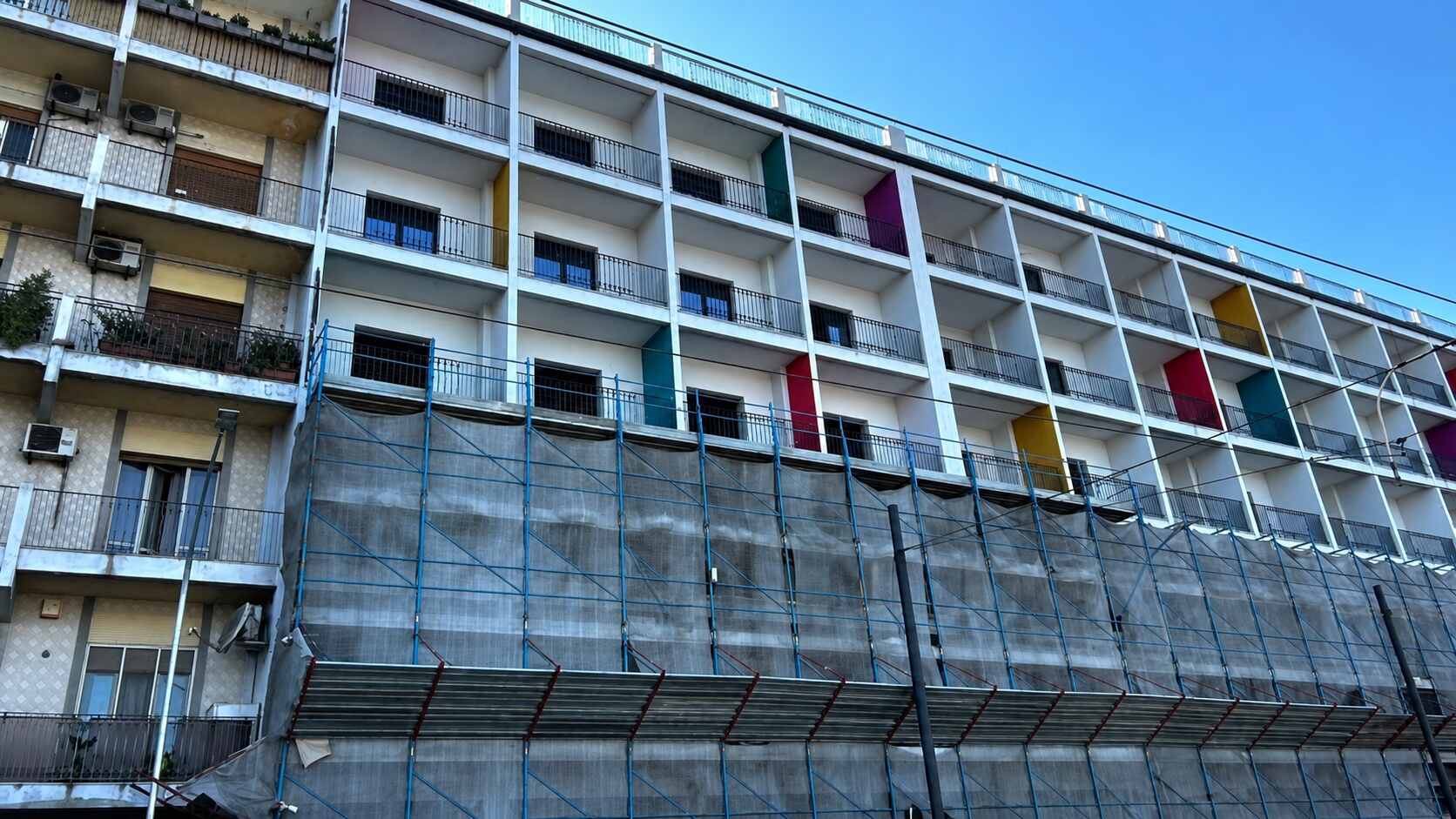
A former hotel acquired by a public-sector institution, converted into student housing and now preparing to transition to an operating model managed by an external operator.
The case of the former Hotel Riviera in Messina is particularly relevant because it brings together three trends that are materially reshaping hospitality real estate:
-
the conversion of obsolete or non-operational hotels;
-
the expansion of alternative living asset classes;
-
the increasing convergence between hospitality and student accommodation.
The University of Messina acquired the property in 2021 for approximately €3.6 million and subsequently launched a major refurbishment and repurposing programme.
The future Residence Riviera will provide a total of 190 beds.
The project is now entering what may prove to be its most important economic phase.
The University has launched an exploratory process to identify an operator to undertake the integrated management of the residence, with proposals due by 15 October 2026.
The central question therefore changes.
Previously, it was:
How can a former hotel be converted?
It now becomes:
How can the new use be made economically sustainable?
This is precisely the point at which a real estate conversion ceases to be merely a development project and becomes an operating business.
From Hotel Riviera to Residence Riviera
The former Hotel Riviera, located on Viale della Libertà overlooking the Strait of Messina, was owned by the Metropolitan City of Messina.
For years, the property remained substantially underutilised.
In 2021, the University of Messina acquired the asset for approximately €3.6 million, identifying student housing as an alternative use capable of addressing existing accommodation demand within the university market.
The redevelopment has involved significant works, including:
-
building refurbishment;
-
seismic upgrading;
-
replacement and upgrading of technical systems;
-
energy-efficiency improvements;
-
internal reconfiguration;
-
creation of residential rooms;
-
development of communal areas;
-
technology infrastructure.
The resulting property will operate through what the University itself describes as an essentially “hotel-style” model, incorporating reception services, communal areas, laundry facilities, a gym, Wi-Fi and operational services.
It is precisely this characteristic that makes the project particularly relevant from a hospitality investment perspective.
The Use Changes. Many of the Economics Do Not.
Formally, the property will no longer operate as a hotel.
Operationally, however, many of the same hospitality capabilities will remain essential.
A 190-bed residence requires:
-
reception;
-
guest and resident services;
-
cleaning;
-
maintenance;
-
utilities management;
-
security;
-
customer service;
-
technology;
-
management of common areas;
-
cost control;
-
occupancy management.
The average length of stay changes.
Pricing changes.
Demand segmentation changes.
Yet the underlying economic principle remains remarkably similar:
a real estate asset creates value only when its operating model can convert occupancy into margin.
This is why the conversion projects analysed by InvestimentiAlberghieri.it should be assessed simultaneously as real estate transactions and operating businesses.
The Critical Transition: The Operator Enters
The University’s new process therefore opens a second phase in the development.
The future operator will be required to provide integrated management services including, among others:
-
concierge and front-desk services;
-
reception;
-
cleaning and sanitation;
-
routine maintenance;
-
technical systems management;
-
equipment management;
-
laundry services;
-
ancillary services;
-
utilities.
This is therefore not simply a conventional facility-management contract.
The selected operator will assume a meaningful share of the property’s operating risk.
It is particularly significant that the University intends to consider the relationship between:
the investment proposed by the operator and the duration of the operating agreement.
This introduces an explicitly financial dimension.
Capital invested → operating cash flow → payback period → contractual duration.
The greater the capital commitment required from the operator, the longer the contractual horizon generally needs to be in order for that investment to be recovered.
From Real Estate Development to Operating Economics
During the development phase, the principal question was:
How much does it cost to acquire and convert the property?
The question now becomes:
What does it cost to operate each bed, and what margin can each bed generate?
This is the transition from:
CAPEX
to:
OPEX.
And this is often the point at which real estate developments reveal their true economic sustainability.
A building can be exceptionally well refurbished and still have a weak operating model.
Because economic value is not determined solely by the physical quality of the asset.
It depends on the relationship between:
revenue – operating expenses = NOI.
NOI Becomes the Key Metric
Hospitality investors are accustomed to metrics such as:
-
ADR;
-
RevPAR;
-
GOPPAR;
-
EBITDA.
In student housing, some of the metrics change.
Particularly relevant indicators include:
Occupancy
The percentage of available beds actually occupied.
Revenue per Bed
Average revenue generated by each bed.
Operating Cost per Bed
Average operating expense per occupied or available bed.
Utility Cost per Bed
Energy, water, heating and cooling expenditure per resident.
Maintenance Cost per Bed
Routine maintenance expenditure.
NOI
Net Operating Income, representing the operating income generated by the property before financing costs and capital structure.
To determine whether the conversion has genuinely created value, one metric will therefore become particularly important:
the sustainable NOI that the new use can generate.
A Conversion Creates Value Only If the New Use Is Economically Superior
This is the core investment principle.
Converting a hotel into student housing does not automatically create value.
The conversion makes economic sense when:
Stabilised Value of the Alternative Use
minus
Conversion CAPEX
minus
Transformation Costs and Risk
produces an outcome economically superior to retaining the original use.
The relevant comparison should therefore be:
Hotel Value vs Alternative Use Value
—not simply:
closed hotel → student residence = successful investment.
The real question is:
Which use generates the strongest risk-adjusted return?
In some cases, the optimal use will remain hospitality.
In others, it may be:
-
student housing;
-
serviced apartments;
-
senior living;
-
residential;
-
healthcare;
-
mixed-use.
This is one of the core issues in value-creation strategies and special situations analysed by Investhotel.it.
The Numbers: What Can Be Established with Confidence
Publicly available documents relating to the former Riviera report different amounts because they refer to different stages and scopes of the project.
The clearest figure is the acquisition price:
approximately €3.6 million.
For redevelopment and completion, University documents have reported different amounts over time, reflecting changes in project definition and financial programming.
An earlier feasibility study contained a higher overall economic framework, while subsequent documents reported lower amounts relating to programmed works.
It would therefore be methodologically incorrect simply to add every published figure together.
The economically relevant conclusion is instead:
the capital required to transform the asset has been materially higher than the acquisition price alone.
It is against this Total Investment Cost that the future value of the conversion should ultimately be assessed.
Conversion Does Not Mean Low CAPEX
Hotels are often considered relatively straightforward candidates for conversion into student housing.
The logic is understandable.
They already contain:
-
rooms;
-
bathrooms;
-
corridors;
-
reception areas;
-
vertical circulation;
-
communal spaces.
But physical compatibility does not eliminate the need for substantial investment.
A modern student residence requires:
-
safety systems;
-
fire-safety compliance;
-
accessibility;
-
study areas;
-
social spaces;
-
laundry facilities;
-
digital infrastructure;
-
access-control systems;
-
modern technical systems;
-
energy-efficiency improvements.
The Riviera project has also required structural and technical upgrades.
Therefore:
conversion does not mean low CAPEX.
It means using an existing real estate configuration to create a different asset class.
Why Hotels Can Still Be Ideal Conversion Candidates
Hotels nevertheless possess one important structural advantage.
Modularity.
Their typical layout is repetitive:
room → bathroom → corridor → vertical core.
This configuration can be particularly compatible with:
-
student housing;
-
senior living;
-
coliving;
-
serviced apartments;
-
micro-living.
Where room dimensions, building depth, natural light, circulation and technical infrastructure are suitable, converting a former hotel may require fewer structural changes than converting another type of property.
That can create a genuine economic advantage.
But only when the required CAPEX remains consistent with the future value of the asset.
190 Beds Change the Scale of the Operating Challenge
A 190-bed residence already represents a meaningful operating platform.
It is therefore not enough to establish that university demand exists.
The operator must assess:
-
effective occupancy;
-
average length of stay;
-
average revenue per bed;
-
resident turnover;
-
cleaning costs;
-
maintenance;
-
utilities;
-
communal services;
-
staffing requirements.
The economics need to be designed with the same discipline applied to an hotel.
The metrics may change.
The operating discipline does not.
Utility Costs Could Have a Material Impact on Margin
The future operator is expected to assume a significant share of utility costs.
For a 190-bed residence:
electricity + water + heating + cooling
can represent a meaningful proportion of OPEX.
Residence Riviera also incorporates a photovoltaic system of approximately 100 kWp, which should contribute to reducing part of the energy burden.
Nevertheless, a credible business plan should model at least three scenarios.
Base Case
Normalised consumption and energy prices.
Adverse Case
Energy prices above expectations.
Stress Case
Higher energy prices combined with higher-than-planned consumption.
The resulting variance could materially affect NOI.
From Public CAPEX to Private OPEX
The Riviera model creates an interesting allocation of risk.
The public owner has primarily absorbed:
acquisition risk
development risk
construction risk.
The future operator will instead assume a meaningful share of:
operating risk
maintenance risk
utility risk
service-delivery risk.
This type of risk allocation is common across modern operational real estate.
But it works only when each party is given the opportunity to earn a return commensurate with the risks it assumes.
Three Stakeholders Need to Be Economically Aligned
The operating model needs to reconcile three distinct interests.
The University
Requires quality, affordability and continuity of service.
Students
Require affordable pricing, comfort and reliability.
The Operator
Needs a sufficient margin to cover operating costs, risk and invested capital.
The sustainability of the project will therefore depend on achieving the correct balance.
If tariffs are too low, the operator may have insufficient margin.
If they are too high, the social objective may be undermined.
If the contract term is too short, investment becomes difficult to amortise.
If it is excessively long, the owner sacrifices flexibility.
The contractual structure therefore becomes an integral component of real estate value.
Student Housing and Hospitality Are Converging
The Riviera case highlights a broader structural trend.
The property market continues to classify:
-
hotels;
-
student housing;
-
serviced apartments;
-
coliving;
-
senior living
as distinct asset classes.
Operationally, however, they are increasingly converging.
All require:
hospitality + technology + services + maintenance + customer experience.
The main differences relate to:
-
length of stay;
-
service intensity;
-
pricing;
-
contractual structure;
-
demand segmentation.
This is why hospitality operating capabilities are increasingly transferable to alternative living asset classes.
The work developed by HotelManagementGroup.it focuses precisely on the relationship between product, organisation, cost structure, positioning and operating performance.
The Riviera Paradox: It May Create More Value by No Longer Being a Hotel
This is perhaps the most interesting aspect of the entire case.
For years, the Riviera remained unused as a hospitality asset.
The solution was not:
find a way to reopen the same hotel.
It was:
identify a different use capable of responding to existing demand.
This represents a form of highest and best use analysis.
And it contains a fundamental lesson for distressed hospitality assets.
A Hotel Is Not Necessarily Worth More as a Hotel
When a hotel becomes financially or operationally distressed, preserving its original use should not automatically be the default strategy.
Investors should compare:
stabilised value as a hotel;
CAPEX required to maintain competitiveness;
value under an alternative use;
conversion costs;
risk-adjusted return.
Only after this comparison can the use that maximises value be identified.
This principle is particularly relevant to distressed assets analysed on RobertoNecci.it, where the distinction between real estate value, hotel business value and operating sustainability is a recurring theme.
The Same Logic Could Reshape the UTP and NPL Hotel Market
The analysis becomes even more relevant when applied to financially distressed hotels.
Consider a property that is:
-
underperforming;
-
highly leveraged;
-
classified as UTP;
-
unable to attract additional equity;
-
unable to finance the CAPEX required to remain competitive.
The traditional response might be:
restructure debt → retain hotel use → wait for recovery.
But that may not always be the optimal solution.
A superior economic outcome could instead involve:
restructure debt → convert the asset → introduce new capital → create a higher-value use.
From this perspective:
student housing, senior living and serviced apartments can become tools for restructuring value.
Not simply alternative real estate uses.
But Conversion Must Also Be Underwritten
Saying:
“this hotel could become student housing”
is not an investment thesis.
Investors still need to assess:
-
planning and zoning;
-
layout;
-
dimensions;
-
demand;
-
competition;
-
pricing;
-
CAPEX;
-
OPEX;
-
financing;
-
operations;
-
stabilised value.
The correct process remains:
Feasibility → CAPEX → Operating Model → NOI → Stabilised Value.
Conversion is a strategy.
It is not a guarantee of returns.
The Real Economic Test for Residence Riviera
The project can ultimately be represented through a simple sequence:
Obsolete Hotel
↓
Public Acquisition
↓
Conversion
↓
CAPEX
↓
Operator Selection
↓
Operating Model
↓
Stabilised NOI
↓
Sustainable Asset Value
Residence Riviera is currently positioned precisely at the transition between:
real estate development
and
operating business.
And this may prove to be the most important stage of the entire transaction.
The Real Investment Lesson from the Former Hotel Riviera
The Messina case illustrates four fundamental principles.
First.
A hotel does not necessarily need to remain a hotel.
Second.
Conversion does not eliminate risk. It reallocates it.
From development risk to operating risk.
Third.
The value of the alternative use depends on the NOI it can sustainably generate.
Fourth.
A conversion creates value only when:
Stabilised Alternative Use Value > Hotel Value + Conversion Cost + Required Return.
That is the real economic test.
Not simply the completion of the redevelopment works.
After CAPEX, the Real Investment Begins
The original question was:
How can an obsolete hotel be recovered?
The answer was:
convert it into student housing.
Now comes the second and more difficult economic question:
Can the new use produce a sustainable operating equilibrium?
This is where the quality of the conversion will ultimately be measured.
Because:
The property determines what is possible.
CAPEX determines what can be delivered.
The contract determines how risk is allocated.
Operations determine NOI.
NOI determines value.
That is perhaps the most important investment lesson from the former Hotel Riviera in Messina.
InvestimentiAlberghieri.it | Hotel Conversion & Alternative Hospitality
Hotel conversions into student housing, serviced apartments, senior living and other uses require an integrated analysis of:
real estate + planning + CAPEX + demand + OPEX + operating model + NOI + stabilised value.
InvestimentiAlberghieri.it analyses investments, conversions, special situations and transformation opportunities across the Italian hospitality market.
For hotel valuation, hospitality economics and operating sustainability analysis: RobertoNecci.it.
For distressed hotels, UTP/NPL situations, conversions, value creation and extraordinary transactions: Investhotel.it.
For operating models, business planning, cost control and hotel performance: HotelManagementGroup.it.
For investment analysis, hotel conversions, student housing, distressed assets and hospitality special situations:
info@investimentialberghieri.it