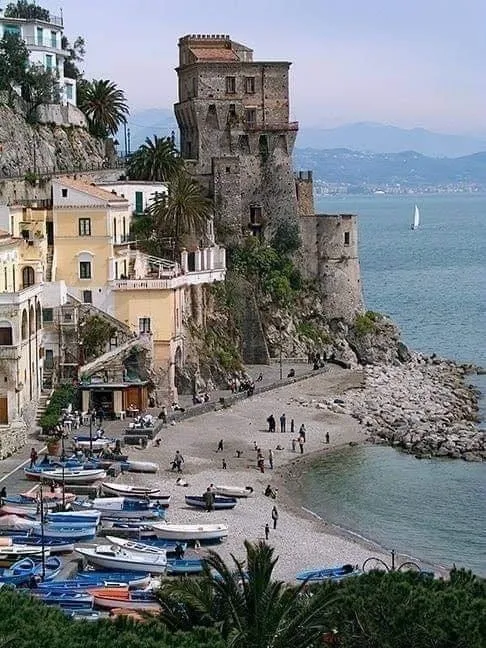
A multimillion-euro dispute, an operating suspension stayed by the Regional Administrative Court, and a hotel that remains open: the Salerno case shows why hospitality distress should be identified before it develops into a formal crisis
Distress in the hospitality sector rarely appears overnight.
Long before formal restructuring or insolvency proceedings begin, subtler but equally significant warning signs may emerge: tax disputes, administrative litigation, licensing issues, tensions between owners and operators, planning irregularities, employment disputes, or liabilities capable of affecting business continuity.
The Grand Hotel Salerno is particularly interesting precisely because it currently sits within this intermediate zone.
Based on the information publicly available, the property is not currently involved in formal insolvency proceedings.
However, a dispute with the Municipality of Salerno escalated in August 2026 to an administrative order suspending the hotel’s operations. The effects of that order were subsequently stayed on an interim basis by the Regional Administrative Court.
In the meantime, the hotel remains operational.
It is precisely this combination — an operating asset, material litigation and potential continuity risk — that makes the case particularly relevant to investors analysing hospitality assets and special situations.
Grand Hotel Salerno: the asset
Grand Hotel Salerno is located on Lungomare Clemente Tafuri, in a strategic central position within easy reach of the railway station, the port and the city centre.
The property offers a diversified hospitality platform including guestrooms, restaurants, a lounge bar, conference facilities, weddings and events.
Its economic value therefore does not depend solely on room revenue.
Meetings, conferences, banqueting, food and beverage and private events represent additional revenue streams.
This is precisely why any event capable of affecting operational continuity can carry significant economic consequences.
August 2026: the dispute becomes an operational issue
The key development came in August 2026.
According to local media reports, the Municipality of Salerno ordered the suspension of operations in connection with a dispute concerning municipal taxes.
Published sources have referred to amounts running into several million euros, with reports focusing in particular on IMU property tax and TARI waste tax liabilities relating to several tax years.
Panoramica Immobiliare challenged the measure.
The Regional Administrative Court subsequently granted interim relief, staying the effects of the suspension and allowing operations to continue pending a fuller judicial review.
According to the available reports, the next hearing is scheduled for 30 September 2026.
This distinction is important.
An interim court order does not constitute a final ruling on the merits of the dispute.
Likewise, the amounts reported by the media concern sums that are under dispute and should not automatically be treated as finally established liabilities.
That distinction is also what makes the case particularly relevant from an investment-analysis perspective.
The real issue is not the litigation. It is continuity
For an investor, the critical question is not simply whether litigation exists.
The real question is:
Could that litigation materially affect the hotel’s ability to continue operating normally?
In the Grand Hotel Salerno case, this question becomes particularly relevant because the dispute has already resulted in an administrative measure capable, at least potentially, of interfering with operations.
This is where the concept of hospitality pre-distress becomes relevant.
At InvestimentiAlberghieri.it, monitoring is not limited to hotels that have already entered formal restructuring or insolvency proceedings.
It also covers situations where developments begin to emerge that could materially change the risk profile of an asset.
A hotel’s value is not the same as the value of its real estate
A hotel is not simply a building.
Its value derives from the interaction of at least four components:
real estate + operating business + licences and permits + prospective cash flow generation.
If any one of these components comes under pressure, the value of the entire investment can change.
An issue capable of affecting operating continuity may have consequences for:
-
revenue;
-
EBITDA;
-
forward bookings;
-
commercial reputation;
-
relationships with OTAs and intermediaries;
-
meetings and events contracts;
-
suppliers;
-
credit facilities;
-
financial covenants;
-
refinancing capacity;
-
investor and operator appetite.
This is why the analysis undertaken by Investhotel.it does not consider financial performance in isolation from legal, administrative, real estate and operational factors.
A strong income statement does not eliminate licensing risk.
And a valuable property does not make potentially disruptive litigation irrelevant.
When risk does not appear in the financial statements
The hospitality sector has a particular characteristic.
Many issues capable of fundamentally changing the value of an investment do not immediately appear in the profit and loss account.
A hotel may continue to generate revenue, maintain healthy occupancy and remain commercially active while significant risks develop elsewhere.
This issue has also been explored on Robertonecci.it in the analysis “From the Arsenale Bond to Grand Hotel Salerno: The Hospitality Risks the Headlines Do Not Tell You About.”
The underlying principle is the same:
the real risk of a hospitality investment is not necessarily visible in headlines or financial statements.
It may sit within the relationship with a municipality.
It may lie within a concession.
It may arise from litigation.
It may be embedded in a licence.
It may sit within the debt structure.
Or it may stem from the relationship between ownership and management.
That is why hospitality due diligence must necessarily be multidisciplinary.
Operational continuity as a component of value
In hospitality, continuity has an economic value of its own.
An operating hotel retains:
-
customers;
-
employees;
-
bookings;
-
distribution channels;
-
contracts;
-
commercial relationships;
-
online reputation;
-
operating history;
-
revenue-generating capability.
Even a temporary disruption can gradually erode some of that value.
For this reason, an investor should always consider at least two scenarios.
Going-concern scenario
The business continues to operate normally and the dispute is managed without materially affecting operations.
Under this scenario, valuation remains primarily driven by the property’s prospective cash flows.
Disruption scenario
The dispute leads to restrictions, suspensions or other forms of operational interruption.
In this scenario, the critical variables become:
-
liquidity requirements;
-
working capital;
-
employee retention;
-
booking retention;
-
supplier relationships;
-
the restoration of operations;
-
the ability to reposition the property commercially.
At that point, the entire approach to hotel valuation changes.
What should an investor investigate?
A robust analysis of Grand Hotel Salerno should address at least seven areas.
1. Scope of the dispute
Principal amounts, penalties, interest, tax years involved and any sums already settled, determined or challenged.
2. Status of the proceedings
All available filings, interim measures and potential subsequent developments should be reviewed.
3. Ownership and operating structure
The relationship between the property, the hotel business, the entity holding the operating authorisations and any related companies must be clearly reconstructed.
4. Debt structure
Bank debt, tax liabilities, trade payables, guarantees, mortgages and other encumbrances should be assessed as a single financial picture.
5. Hotel performance
Occupancy, ADR, RevPAR, normalised EBITDA and the contribution generated by meetings, events, food and beverage and banqueting.
6. CAPEX
A property of this scale requires ongoing capital expenditure to preserve its market positioning and competitive relevance.
7. Business-continuity scenario
The financial impact of potential further restrictions, settlements or interruptions should be modelled.
These are precisely the types of analyses required when an ordinary hospitality investment begins to move into special-situations territory.
Administrative risk can precede financial distress
For many years, distressed hospitality was viewed primarily through the lens of debt.
But a hotel can come under pressure for reasons that have little to do initially with its capital structure.
These may include:
-
tax disputes;
-
concessions;
-
planning and zoning issues;
-
owner-operator disputes;
-
administrative proceedings;
-
employment disputes;
-
licensing matters;
-
corporate conflicts.
In some cases, these issues are resolved without significant consequences.
In others, they may eventually create the need for:
-
new capital;
-
debt restructuring;
-
the entry of a new investor or partner;
-
a change of operator;
-
a business sale;
-
a real estate disposal;
-
a turnaround process.
This is the area in which HotelManagementGroup.it operates through industrial, financial, operational and strategic analysis.
It should not yet be described as a “hotel in crisis”
Terminological discipline matters.
Based on the information currently available, it would not be appropriate to automatically describe Grand Hotel Salerno as insolvent or financially distressed.
There is a material dispute.
There has been an administrative measure affecting operations.
There is an ongoing legal challenge.
The Regional Administrative Court has granted interim relief.
And the hotel remains operational.
The case should therefore currently be viewed as a pre-distress situation requiring monitoring, rather than as a formal insolvency case.
That distinction is precisely what makes it particularly interesting.
The real informational advantage lies in getting there early
Once a property enters formal restructuring or insolvency proceedings, the market already knows that a problem exists.
The real informational advantage comes earlier.
It comes when litigation has not yet translated into financial distress.
When the hotel remains operational.
When strategic alternatives are still available.
When owners, banks, investors and advisers can still intervene on the debt structure, governance, operations or ownership before the range of available options begins to narrow.
This is the phase in which value may still be preserved.
And it is precisely the phase in which a professional investor should begin monitoring the asset.
Grand Hotel Salerno will therefore remain under observation, with particular attention to the hearing scheduled for 30 September 2026 and to any subsequent developments.
Because in hospitality, the real difference is not simply knowing where a crisis already exists.
It is understanding where one may be beginning to form.
CTA
Hospitality investment analysis, special situations, distressed assets and pre-distress cases
InvestimentiAlberghieri.it analyses hospitality transactions, situations of financial or operational pressure, and investment cases requiring an integrated assessment of the real estate, operating business, financial structure and operational risk.
For confidential enquiries and analysis:
info@investimentialberghieri.it