A closed hotel is not always a worthless asset
A closed hotel near a railway station is never just an empty building. It can be an urban problem, a stranded real estate asset, a court-led liquidation, or an investment opportunity.
The difference is whether you can spot value before the market does.
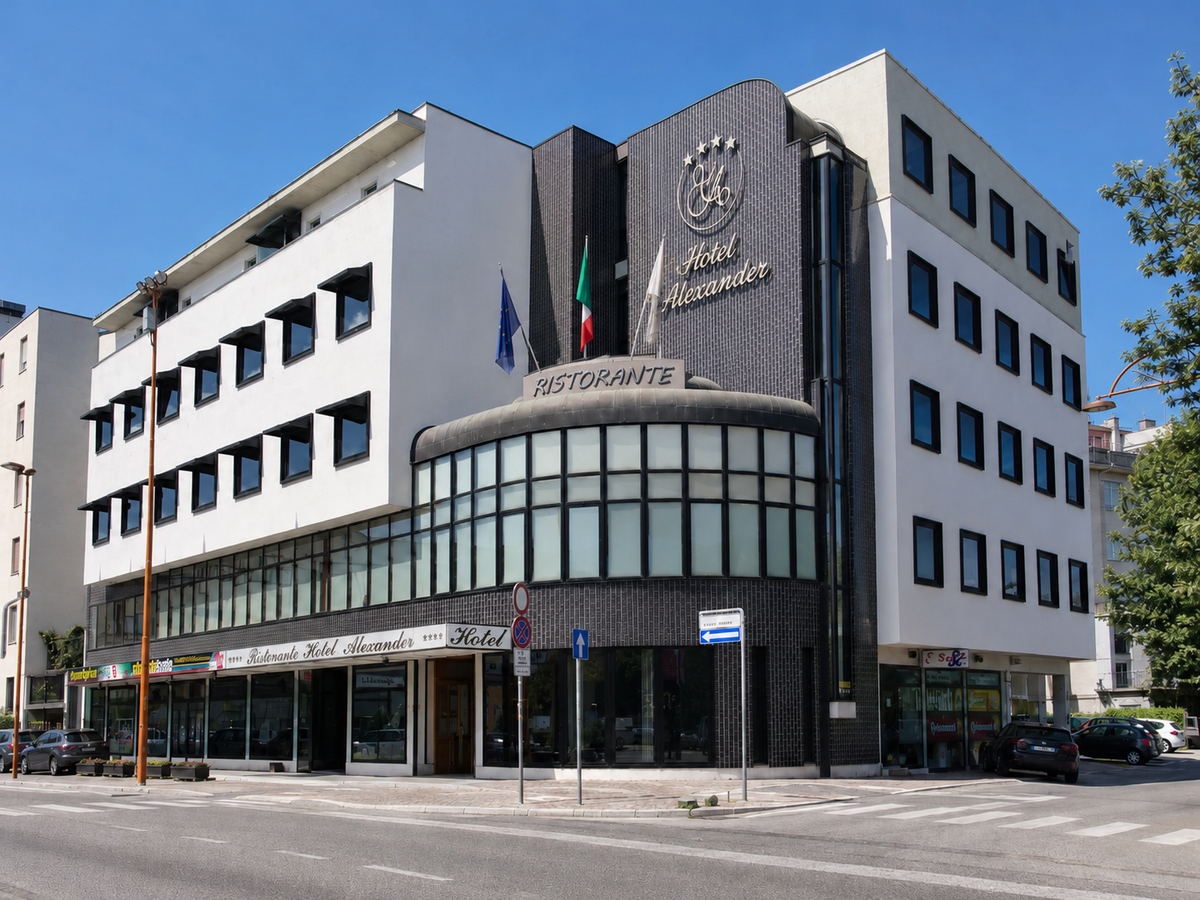
That is what makes the Hotel Alexander case in Cesena particularly interesting. The property is located in Piazzale Karl Marx, close to the railway station and within easy reach of the city centre.
According to local press reports, the Court of Forlì has declared the judicial liquidation of the company that owns the hotel, which has been closed for some time and may now be sold as part of the liquidation process.
The case is local. The issue is national.
Across Italy, many hotels are closed, obsolete, underused or caught up in insolvency proceedings. Some have no viable future. Others can become strategic assets if they are properly analysed, adequately capitalised and repositioned with a clear industrial vision.
The right question is not “what does it cost?”, but “what could it be worth?”
In hotel real estate, especially when dealing with closed properties or distressed assets, the first mistake is to focus only on the purchase price.
Price matters. But price is not value.
A hotel in liquidation may look attractive because the entry price appears lower than that of an operating asset. Yet the real cost of the transaction does not stop at the acquisition price or auction award.
It includes taxes, technical and legal fees, potential encumbrances, renovation works, plant and systems upgrades, energy-efficiency improvements, the period with no income, the capital required for the commercial relaunch and the financial costs linked to the timing of the transaction.
So the real question is not: “How much does Hotel Alexander cost?”
The real question is: “What kind of project could turn this closed hotel into an asset capable of generating income, capital value and market interest?”
That is where a simple real estate purchase becomes a true hospitality investment.
A railway-station location: opportunity, not guarantee
Hotel Alexander’s location is one of the most relevant aspects of the case. The property sits close to Cesena railway station, in a central and strategically significant urban area.
For a hotel, proximity to a railway station can be a major competitive advantage. It can capture business travellers, individual guests, short-stay demand, groups, rail-related mobility, events, cultural tourism and flows linked to urban, healthcare, university and professional functions.
But location alone is not enough.
In hospitality, location is necessary. It is not sufficient. A property can sit in a strategic position and still fail to compete if the product is obsolete, the layout is inefficient, the rooms no longer meet market expectations, operating costs are too high, or the commercial strategy is unclear.
The real analysis must go beyond the map.
The question is whether that location can support a modern hotel product: which category, how many rooms, what achievable rate, which operating model and what capacity to generate margins.
The value of a distressed hotel lies in its transformation
Not all struggling hotels are the same.
Some lose competitiveness because of weak management. Others because of balance-sheet pressure. Others because of excessive debt, lack of investment, failed generational transition, demand shocks or an inability to keep pace with changing market standards.
In a hospitality distressed asset, value is not defined by the current condition. It lies in the potential for transformation.
A closed hotel is worth little if it is seen only as an inactive building. It can be worth far more if it is understood as a development platform.
That transformation, however, is never automatic. It requires capital, expertise and a coherent project.
At least five layers of analysis are required:
-
real estate analysis, to assess the building’s condition, size, surfaces, constraints, potential and intervention costs;
-
urban planning analysis, to verify permitted uses, authorisations, possible extensions and the preservation of hotel use;
-
market analysis, to assess potential demand, competition, rates, occupancy, seasonality and addressable segments;
-
operational analysis, to estimate revenues, costs, GOP, EBITDA, break-even and operating sustainability;
-
financial analysis, to measure total capital requirement, expected return, payback timing, risk and exit value.
Only after these checks can an investor understand whether the transaction makes sense.
For readers wishing to explore the economic and operational assessment of hotels in greater depth, the hotel guides by Roberto Necci provide further insights into hotel management, valuation, development and positioning.
Reopening is not the same as relaunching
One of the most common mistakes in closed-hotel transactions is to assume that reopening and relaunching are the same thing.
They are not.
Reopening means the hotel is operating again. Relaunching means the hotel has become competitive again.
The difference is substantial.
A hotel can technically reopen and still remain weak if its concept, positioning, pricing, distribution, identity and guest experience have not been redesigned.
A proper relaunch must answer specific questions:
-
which guests are we trying to attract?
-
which category and product standard are sustainable?
-
what average rate is realistic?
-
what occupancy can be achieved?
-
which distribution channels will generate demand?
-
what share of direct bookings can be built?
-
which operator is best placed to manage the asset?
-
what could the asset be worth in three to five years?
Without those answers, the risk is simple: turning a closed hotel into an open but fragile one.
Urban regeneration and hotel value
The Hotel Alexander case is also interesting because of its relationship with the urban context. The area around Cesena railway station is a sensitive part of the city and forms part of a broader discussion about the transformation of urban spaces.
Hotels are not just buildings. They are economic functions embedded in a territory.
When an area is regenerated, mobility improves, services expand and new public or private functions are introduced, the hotel potential of that area can also change.
Urban regeneration can create new demand, improve the perception of a district and increase investor interest. But assumptions must be tested.
It is not enough to say that an area will be regenerated. The key is to understand what kind of demand it will generate.
A mainly residential regeneration project creates one type of value. A project involving university, office, cultural, healthcare or conference functions may create another. A mobility-led transformation can have a different impact again.
Hotel value depends on the demand the context can generate and on the property’s ability to capture it.
Cesena and the potential of intermediate cities
The Cesena case is also relevant because it concerns an intermediate city: not a major metropolis, not an exclusively leisure destination, but a territory capable of generating business, cultural, healthcare, professional and transit demand.
Italy’s intermediate cities deserve close attention from hospitality investors. They often face less competitive pressure than major art cities, yet they can offer selective opportunities for efficient, well-positioned hotel products aligned with real demand.
In these markets, a luxury hotel is not always the answer. A standardised product is not always the answer either. What is often needed is a solid, functional, digitally strong hotel, with controlled costs and a clear commercial strategy.
For investors, this means value can also be created outside the most obvious markets, provided the analysis is rigorous.
Value does not end with renovation
A hotel investment does not end with the acquisition of the property or the completion of renovation works.
It truly begins when the hotel enters the market.
That is why, in any relaunch project, digital strategy must be planned from the outset. Not as an accessory, but as part of the business plan.
A renovated hotel that remains invisible online risks becoming overly dependent on OTAs. A hotel with strong digital positioning, by contrast, can build direct demand, improve margins and increase the value of the business.
The elements to assess include the official website, booking engine, SEO, paid campaigns, revenue management, online reputation, CRM, email marketing, editorial content, portal presence, disintermediation strategy and conversion tracking.
In today’s market, hotel value does not depend only on rooms, square metres and location. It also depends on the asset’s ability to be found, chosen and booked.
Further insights and hospitality market cases are available on the Investimenti Alberghieri blog and the Investhotel blog, with analysis dedicated to transactions, investments and transformation in the accommodation sector.
Hotel due diligence: the decisive step
A hotel in liquidation, judicial sale or abandonment requires much deeper due diligence than a standard commercial property.
The investor must verify not only ownership, but whether the asset can realistically be transformed into an economically sustainable hospitality product.
The main areas of investigation include ownership status, mortgages or litigation, the state of the procedure, building permits, urban planning designation, occupancy certificates, cadastral and systems compliance, fire prevention, health and hygiene requirements, accessibility, constraints, maintenance condition, renovation costs, authorisation timelines, local competition, potential demand, realistic rates, operating costs, management model, taxation, capital requirement and exit strategy.
These checks help avoid a common mistake: buying well from a real estate perspective, but badly from a hotel investment perspective.
A property may be attractive because of its location, yet unsustainable as a hotel. Conversely, it may be technically complex but highly interesting if correctly repositioned.
Due diligence is what allows investors to distinguish apparent risk from real risk, and real risk from potential value.
The operating model must be decided before, not after
Another decisive point is the operating model.
After acquisition or renovation, who will operate the hotel?
The options may include direct management, business lease, operating lease, management contract, franchise, white-label operator, partnership with a hotel group, or conversion into hybrid formats such as aparthotels, serviced apartments and hospitality mixed-use.
Each model has different implications for risk, return, operational control and asset value.
Direct management offers greater control, but requires strong hotel expertise. A business lease may provide greater stability, but limits the owner’s participation in performance upside. A management contract can enhance the asset, but requires the right balance between owner and operator. A franchise can strengthen distribution and brand awareness, but brings costs and brand standards.
In a closed-hotel transaction, the operating model should not be chosen at the end. It must shape the project from the beginning.
You are not buying a hotel. You are buying a project.
The most important lesson from the Hotel Alexander case is this: in hospitality, you are not merely buying a building. You are buying a project.
The purchase price is only one variable. The real value depends on the ability to transform that property into a product aligned with the market.
An investor should therefore consider three scenarios:
-
a conservative scenario, with limited reopening and contained investment;
-
an industrial scenario, with renovation, repositioning and professional management;
-
an alternative scenario, with change of use, mixed use or conversion, where compatible with constraints and demand.
Only by comparing these scenarios is it possible to identify the most rational path for the asset.
Sometimes the best solution is to return to hotel use. Sometimes it is to change the accommodation formula. In other cases, the property may have greater value under a different use.
A sophisticated investor does not start with a predetermined answer. A sophisticated investor starts with the analysis.
Conclusion: closed hotels can become a new source of value creation
The Hotel Alexander case in Cesena shows how differently a closed hotel can be interpreted.
For the city, it may be an urban void.
For the procedure, it may be an asset to liquidate.
For an investor, it may be a risk.
For a prepared operator, it may become an opportunity.
The difference lies in the quality of the analysis.
The Italian hospitality market will increasingly face cases of this kind: historic hotels in need of repositioning, family-run properties without generational continuity, obsolete accommodation assets, hotels involved in insolvency proceedings and closed properties located in strategic positions.
Not all of them will become opportunities. But some will.
And those that are correctly analysed and transformed can generate value in the years ahead.
The future of hotel investment will not be shaped only by large acquisitions in primary cities. It will also depend on the ability to recover, rethink and relaunch existing properties in intermediate markets, transforming cities and urban contexts where hospitality can once again play an economic and social role.
Are you assessing a closed hotel, a hotel for sale or a property in procedure?
Hotel Management Group supports investors, owners, family offices, operators and entrepreneurs in the analysis, due diligence, valuation, development and repositioning of hotel assets.
We help assess the transaction, estimate economic potential, evaluate relaunch costs, define the operating model and build a project aligned with market demand.
Explore how HotelManagementGroup.it can support your next hospitality investment.
Roberto Necci - r.necci@robertonecci.it