Hotel Asset Management: why many hotels lose value after acquisition
Meta title: Hotel Asset Management: Why Hotels Lose Value After Acquisition
Meta description: Hotel Asset Management protects hotel value after acquisition. It helps owners, investors and lenders control management, CapEx, contracts, debt, performance and exit strategy.
Primary keyword: hotel asset management
Secondary keywords: hospitality asset management, hotel asset manager, hotel value, hotel investment management, hotel performance management, hotel investment control, hotel value protection
The real risk does not end at closing
Many investors focus most of their attention on the acquisition phase.
They analyse the price.
They negotiate the contract.
They review the documentation.
They estimate CapEx.
They assess the debt structure.
They close the deal.
Then the most delicate phase begins: protecting and increasing the hotel’s value over time.
In hospitality, closing is not the finish line. It is the starting point.
A hotel can be acquired well and managed poorly.
It can be financed correctly and still lose margins.
It can have a strong business plan and fail to execute it.
It can have a powerful brand and a contract that limits control.
It can generate revenue without creating value.
It can appear stable and slowly begin to deteriorate.
This is why Hotel Asset Management is not an accessory activity. It is the discipline that connects capital, operations, performance, control, risk and exit strategy.
The question is not only:
“Did we acquire the hotel well?”
The more important question is:
“Are we governing the hotel in a way that protects and increases the value of the capital invested?”
What is Hotel Asset Management?
Hotel Asset Management is the strategic, financial and operational oversight of a hotel asset, aimed at preserving and increasing the value of the investment.
It is not the same as day-to-day hotel operations.
The general manager runs the hotel.
The hotel operator manages the business.
The brand oversees standards, distribution and positioning.
The owner invests capital.
The bank provides financing.
The asset manager ensures that all these parties are working in the same direction.
This asset management discipline answers a precise question:
Is the hotel producing value that is consistent with the capital invested and the risk taken?
This function is particularly important for:
- hotel owners;
- real estate investors;
- funds;
- family offices;
- banks;
- private equity firms;
- asset managers;
- international hotel chains;
- operators;
- hotel management companies;
- creditors;
- distressed investors;
- hotel entrepreneurs.
A hotel without asset management may continue to operate.
But operating does not necessarily mean creating value.
Why hotel asset management is different from ordinary hotel management
In hospitality, there is often a dangerous misunderstanding: if a hotel is being managed, it is assumed to be properly governed.
That is not true.
Hotel operations focus on rooms, staff, rates, services, guests, costs, procedures, reputation and revenue.
Hotel Asset Management looks at the hotel from the perspective of capital.
It asks whether:
- the budget is aligned with the investment plan;
- EBITDA is sustainable;
- CapEx generates a return;
- debt is manageable;
- the contract protects the owner;
- the operator is accountable;
- the brand creates real value;
- the exit remains credible;
- the asset is improving or losing lender confidence and debt-supportable value.
This distinction is also central to the Investimenti Alberghieri article “L’investimento alberghiero non va solo fatto: va capito”, where a hotel is presented as capital exposed every day to management, debt, contracts, people, distribution, costs, reputation and market risk.
Buying a hotel without asset oversight can turn an investment into blind delegation.
The most underestimated risk: the hotel operates, but does not create value
A hotel can be open, sell rooms, have acceptable reviews and generate revenue.
And yet it may still fail to create value.
This happens when:
- revenue grows but margins decline;
- occupancy increases but ADR remains weak;
- direct business does not improve;
- labour cost absorbs too much margin;
- CapEx is deferred;
- reputation does not support pricing power;
- the operator does not execute the plan;
- the brand costs more than it produces;
- debt reduces flexibility;
- the exit becomes less credible.
In these cases, the hotel may appear operational, while the capital behind it is weakening.
In the guide “Perché molti hotel funzionano ma non creano valore”, Roberto Necci explains that strategy, numbers, people, technology and operations must be read as parts of a single system, not as separate areas of competence.
This is exactly the logic behind hospitality asset management.
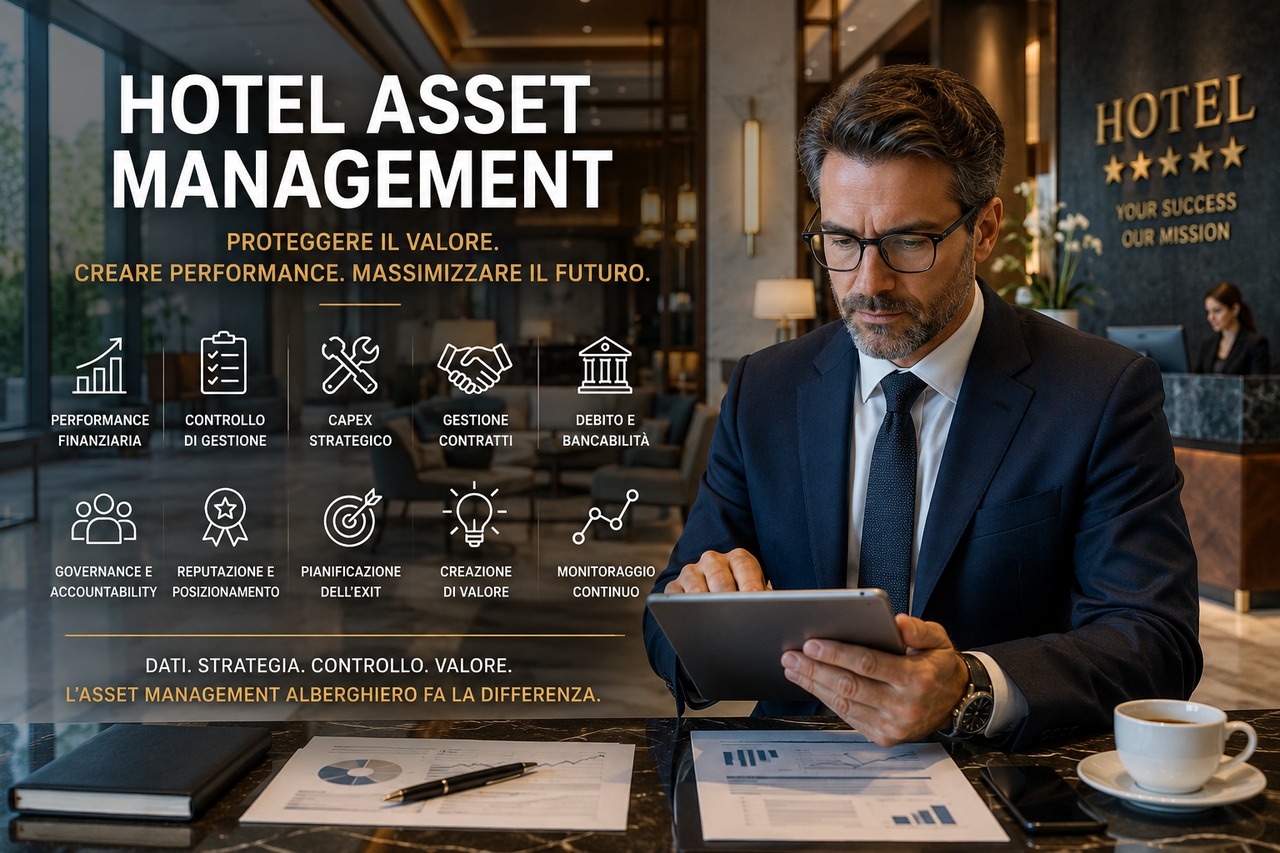
The 10 areas Hotel Asset Management must control
1. Budget and business plan
The budget is not an administrative document.
It is the first tool for controlling value.
A hotel asset manager must verify whether the annual budget is aligned with:
- the investment plan;
- the approved business plan;
- EBITDA targets;
- planned CapEx;
- debt structure;
- covenants;
- market positioning;
- exit strategy.
A budget that is too conservative may hide a lack of ambition.
A budget that is too aggressive may create unrealistic expectations.
A budget that is not connected to value may become a mere accounting exercise.
The right question is:
Does the budget protect capital, or does it simply describe current operations?
2. Normalised EBITDA and margin quality
Hotel Asset Management must monitor not only operating performance, but the quality of that performance.
EBITDA can grow for healthy reasons or fragile reasons.
It grows in a healthy way when it comes from:
- ADR growth;
- improved guest mix;
- lower customer acquisition cost;
- higher productivity;
- cost control;
- better departmental management;
- growth in direct business;
- stronger reputation.
It grows in a fragile way when it comes from:
- deferred maintenance;
- excessive staff reductions;
- lower standards;
- unrecorded costs;
- non-recurring revenue;
- temporary cost compression.
The asset manager must distinguish between margin that creates value and margin that prepares a future problem.
3. CapEx: investing, deferring or destroying value
CapEx is one of the most important levers in hotel asset management.
Not investing may temporarily improve cash flow, but it can damage the product, reputation, ADR and exit value.
Investing poorly may absorb capital without generating returns.
Investing well means linking every euro of CapEx to a value rationale:
- ADR growth;
- RevPAR improvement;
- lower energy costs;
- stronger reputation;
- regulatory compliance;
- alignment with brand standards;
- improved future liquidity;
- protection of real estate value.
CapEx should not be read only as a technical cost.
It should be read as a strategic investment.
In the guide “Quanto vale un hotel?”, Roberto Necci highlights that without multi-year CapEx plans, competent management, a data-driven approach and accountability for results, unexpressed potential is unlikely to be recognised by investors.
4. Revenue management and pricing power
The asset manager should not replace the revenue manager.
But the asset manager must understand whether the pricing strategy is creating value.
The key questions are:
- is ADR growing faster than the market?
- is RevPAR aligned with the competitive set?
- is occupancy being bought through excessively low rates?
- is the guest mix improving?
- are groups compressing margins?
- does corporate business create real value?
- is direct business increasing?
- are OTAs weighing too heavily on profitability?
- does reputation support price?
A hotel that grows only in occupancy but not in ADR may appear to perform well, but it is not necessarily creating value.
True pricing power is visible when the hotel can defend or increase rate, margin and reputation at the same time.
5. Contracts: who really controls the hotel
In hotel real estate, the contract can be either a protection tool or a trap.
The asset manager must monitor:
- business lease / lease of the hotel operating business;
- property lease;
- management contract;
- franchise agreement;
- white-label management;
- fees;
- rents;
- performance tests;
- CapEx obligations;
- termination rights;
- reporting;
- budget approval;
- owner rights;
- operator responsibilities.
The Investimenti Alberghieri article on hotel management contracts, leases and franchising makes the key point clear: the real issue is not the operator’s name, the strength of the brand or the level of rent, but who truly controls the hotel after the contract is signed.
A contract without control mechanisms can turn the owner into a passive investor inside an operating asset.
6. Governance and accountability
Governance is the system that prevents the hotel from drifting out of control.
Without governance, even a good asset can lose value.
The asset manager must ensure clarity on:
- who approves the budget;
- who decides CapEx;
- who monitors the operator;
- who controls KPIs;
- who reviews variances;
- who intervenes if performance deteriorates;
- who is accountable for results;
- who protects the owner;
- who communicates with banks and investors.
This issue is central to the Investimenti Alberghieri article “Hotel fuori controllo: quando la cattiva governance può distruggere il valore di un investimento alberghiero”, which explains how management governance can determine the real resilience of a transaction.
A hotel without governance is not a controlled investment.
It is exposed capital.
7. Debt, DSCR and bankability
Hotel Asset Management must monitor the relationship between operating performance and financial structure.
For the bank, the issue is not only the value of the property.
It is the hotel’s ability to generate cash flows consistent with debt service.
The following must be monitored:
- DSCR;
- normalised EBITDA;
- operating cash flow;
- seasonality;
- covenants;
- interest;
- amortisation;
- future CapEx;
- need for new money;
- refinancing risk.
A hotel can remain operational and become less attractive to lenders.
This happens when cash flows do not grow, CapEx increases, debt becomes too heavy or governance does not allow timely intervention.
The asset manager must protect not only market value, but also lender confidence and the hotel’s debt-supportable value.
8. Reputation and economic value
Reputation is not only marketing.
It is a component of value.
It affects:
- conversion;
- ADR;
- direct business;
- customer acquisition cost;
- trust;
- pricing power;
- repositioning capacity;
- attractiveness to brands and operators;
- exit value.
A hotel with weak reputation must spend more to acquire demand and often struggles to defend rate.
A hotel with strong reputation can create more value even with the same number of rooms and the same location.
Asset management should therefore read reputation as an economic indicator, not simply as an online score.
9. Competitive positioning
A hotel can lose value even when the market is growing.
This happens when the competitive set improves faster, when new supply enters the market, when the product becomes less aligned with demand or when the brand loses relevance.
The asset manager must monitor:
- new competitors;
- destination pipeline;
- demand evolution;
- relative performance;
- reputation versus the market;
- pricing position;
- product consistency;
- most profitable segments;
- commoditisation risk.
A hotel’s value does not depend only on absolute demand.
It depends on the asset’s relative position within the market.
10. Exit strategy
Hotel Asset Management must prepare the exit from day one.
A hotel does not become saleable when the owner decides to sell it.
It becomes saleable if, over time, it has built:
- transparent cash flows;
- orderly reporting;
- documented CapEx;
- clear contracts;
- solid governance;
- defensible reputation;
- measurable performance;
- sustainable debt;
- recognisable positioning;
- further growth potential.
The Investimenti Alberghieri article on Palazzo Scanderbeg points to an important principle: the ideal asset is not the one that finds any buyer, but the one that finds the right buyer.
Exit is not improvised.
It is built through asset management.
Hotel asset management: value-control matrix
| Area | Key question | Risk if not controlled |
|---|---|---|
| Budget | Is it aligned with the investment plan? | Operations disconnected from capital |
| EBITDA | Is it normalised and sustainable? | Overstated value |
| CapEx | Does it generate return or only cost? | Capital absorbed without value |
| Contracts | Who really controls the hotel? | Owner without levers |
| Governance | Who is accountable for results? | Asset drifting out of control |
| Debt | Does DSCR remain sustainable? | Loss of lender confidence and bankability |
| Reputation | Does it support pricing power? | Compressed margins |
| Market | Does the hotel remain competitive? | Loss of positioning |
| Exit | Can the asset attract the right buyer? | Illiquid capital |
This matrix shows why Hotel Asset Management cannot be reduced to a periodic review of numbers.
It is a discipline for governing value.
Warning signs that a hotel is losing value
A hotel rarely loses value suddenly.
It usually loses value gradually, through signals that are underestimated.
The main warning signs are:
- ADR flat while the market grows;
- occupancy supported by low rates;
- EBITDA stable only because CapEx is deferred;
- increasing OTA dependency;
- declining direct business;
- worsening reviews;
- labour cost increasing without productivity gains;
- deferred maintenance;
- missed budgets;
- unclear reporting;
- operator not accountable;
- progressively weakening DSCR;
- declining attractiveness to potential buyers.
The role of the asset manager is to identify these signals before they become value loss.
When Hotel Asset Management creates value
Hotel Asset Management creates value when it turns an operating asset into a controlled investment.
This happens when:
- the budget is linked to strategy;
- CapEx is planned and measured;
- the operator is monitored;
- contracts are controllable;
- EBITDA is transparent;
- debt is sustainable;
- reputation supports price;
- the market is monitored;
- the exit is prepared;
- the owner retains control over key decisions.
In the guide “Il vero valore di un hotel: perché l’asset management determina quanto vale davvero una struttura alberghiera”, Roberto Necci explains how two hotels similar in location, category and size can have completely different valuations because of the quality of asset management.
Value is not only in the property.
It is in the ability to govern it.
When asset management is missing: the risk of blind delegation
One of the most frequent mistakes is believing that appointing an operator solves the value problem.
Operational delegation is necessary.
Blind delegation is dangerous.
If the owner does not oversee budget, CapEx, reporting, contracts, performance and strategy, the operator may work according to a logic that is not always aligned with capital.
The operator may prioritise revenue, occupancy, operational continuity or brand standards.
The owner must protect value, return, lender confidence and exit.
These two perspectives may coincide, but they do not coincide automatically.
Hotel Asset Management exists precisely to keep operator, owner, lenders and investment strategy aligned.
FAQ on Hotel Asset Management
What is Hotel Asset Management?
Hotel Asset Management is the strategic, financial and operational oversight of a hotel asset, aimed at protecting and increasing the value of the investment.
What is the difference between hotel management and hotel asset management?
Hotel management concerns the day-to-day operation of the hotel. Hotel asset management assesses whether that operation is creating value consistent with invested capital, risk, CapEx, contracts, debt and exit strategy.
Who needs Hotel Asset Management?
Hotel owners, investors, funds, banks, asset managers, family offices, private equity firms, hotel chains, operators and creditors who want to monitor and protect the value of a hotel.
Why is asset management important after acquiring a hotel?
Because value is not protected only at closing. After acquisition, budget, EBITDA, CapEx, management, contracts, debt, reputation, market and exit must be monitored continuously.
Can a hotel operate but fail to create value?
Yes. A hotel can generate revenue, occupancy and regular operations without creating value if margins are weak, CapEx is deferred, debt is excessive or governance is absent.
Hotel value is not protected by ownership alone.
It is not enough to buy well.
It is not enough to appoint an operator.
It is not enough to have a brand.
It is not enough to sell rooms.
It is not enough to generate revenue.
In hospitality, capital remains exposed every day to operations, market, contracts, CapEx, debt, reputation and governance.
Hotel Asset Management is the discipline that prevents this exposure from becoming value loss.
A well-acquired hotel that is not properly governed can deteriorate.
A complex hotel that is managed as an asset can increase value, lender confidence and exit potential.
The difference is control.
Have you acquired, financed or are you assessing a hotel?
After closing, value must be protected month after month through management control, margin analysis, CapEx planning, governance, operator monitoring, contract review, debt sustainability and exit strategy.
Before a hotel loses value silently, the following must be assessed together:
- budget;
- normalised EBITDA;
- CapEx;
- contracts;
- governance;
- debt;
- reputation;
- market;
- operator performance;
- exit strategy.
For a confidential discussion on Hotel Asset Management, hospitality investments, value control, due diligence, Hotel Valuation Reports and strategic advisory, visit:
Roberto Necci - r.necci@robertonecci.it