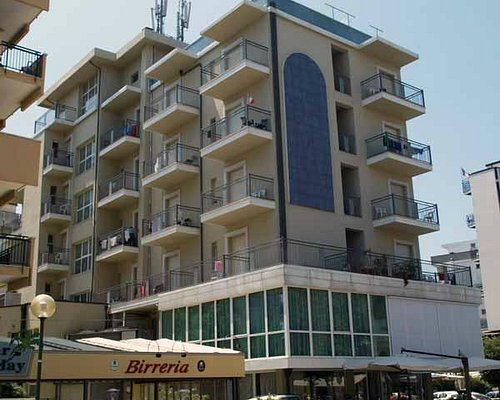
Forty-six rooms around 100 metres from the beach, a swimming pool, parking, a wellness area and more than 2,270 sqm of commercial space. The hotel property at Viale Bernini 15 in Valverde di Cesenatico has a minimum entry price of €754,350. Yet the most important number may not be the purchase price: the property is subject to a lease enforceable against the proceedings, generating annual rent of €50,000 plus VAT.
It is precisely this combination of entry price, lease terms, tenant quality and residual value that turns the transaction from a straightforward real estate opportunity into a genuine hotel investment case.
The real estate enforcement proceedings, RGE 197/2024 before the Court of Forlì, concern the property at Viale Bernini 15 in Valverde di Cesenatico.
The sale is scheduled for 4 November 2026.
The reserve price is €1,005,750, while the minimum bid is €754,350.
The investment at a glance
Reserve price: €1,005,750
Minimum bid: €754,350
Commercial area: approximately 2,270 sqm
Rooms: 46
Annual rent: €50,000 plus VAT
Lease term: 9 years, with a contractual renewal provision for a further 9 years
Sale date: 4 November 2026
Indicative value per room at the minimum bid: approximately €16,400
Indicative value per sqm: approximately €332
Indicative gross yield at the minimum bid: approximately 6.6%
The previous sale attempt, with a reserve price of €1,341,000, attracted no bids.
The new entry level therefore represents a meaningful repricing.
But that is where the investment analysis should begin, not end.
A hotel approximately 100 metres from the beach
The property extends over five above-ground floors, in addition to a rooftop level.
The sale documentation describes 46 guest rooms, all with private bathrooms, balconies and air conditioning, together with accommodation for a caretaker.
The complex also includes:
-
lobby;
-
wellness area;
-
children's spaces;
-
swimming pool;
-
parking;
-
service areas;
-
fitness facilities;
-
entertainment and reading rooms.
The total commercial area is stated at approximately 2,270 sqm.
Location is an obvious strength. Valverde di Cesenatico is an established tourism destination on the Adriatic Riviera, and the property is situated only a short distance from the seafront.
Location alone, however, does not determine investment value.
What is the investor actually buying?
This is arguably the most important question in the entire transaction.
Commercially, the hospitality product is presented as Hotel Bravo & Condor, while the real estate perimeter subject to the proceedings relates specifically to Viale Bernini 15.
Historical commercial sources distinguish between:
Hotel Bravo — Viale Bernini 17
Hotel Condor / Bravo annex — Viale Bernini 15
The commercial hotel operation therefore appears to extend beyond the single building included in the sale.
For an investor, this is not a minor detail.
What the investor is acquiring
Subject to the final sale documentation, the purchaser would acquire:
-
the real estate included in the lot;
-
the rooms and physical areas described in the proceedings;
-
the lease relationship to the extent that it is enforceable against the successful purchaser;
-
the contractual cash flow arising from that lease under its applicable terms.
What the investor should not assume is automatically included
-
the Bravo & Condor brand;
-
the hotel operating business;
-
the customer database;
-
the website;
-
OTA relationships;
-
employees;
-
goodwill;
-
restaurant operations potentially associated with the wider complex;
-
services belonging to the adjoining property;
-
FF&E not owned by the property company.
This distinction defines the true nature of the investment.
Acquiring 46 hotel rooms does not necessarily mean acquiring a complete, standalone hotel business.
€16,400 per room: a compelling headline, but not a valuation
Dividing the €754,350 minimum bid by the 46 rooms described in the proceedings produces an indicative value of approximately:
€16,400 per room.
It is an immediately striking figure.
But a professional hospitality investor should not automatically interpret it as evidence of an attractive acquisition.
The relevant question is:
how much sustainable income can those 46 rooms actually generate for the property owner?
A hotel is not simply valued as:
number of rooms × price per room.
Its value depends on cash flow, quality of operations, competitive positioning, required investment and the degree of control the owner can exercise over the asset.
This distinction between real estate pricing and underlying hotel investment value is central to the analysis published by InvestimentiAlberghieri.it.
The real asset may be the lease
The available documentation indicates that the property is occupied under a lease enforceable against the proceedings.
The agreement appears to have been registered in March 2024 and provides for:
annual rent of €50,000 plus VAT
with an indicated term of:
9 years, with a contractual renewal provision for a further 9 years.
If an investor acquired the property at €754,350 and the €50,000 annual rent were fully collectible, the theoretical gross yield would be approximately:
6.6% per annum.
At the €1,005,750 reserve price, the gross yield would fall to approximately:
5%.
These figures are arguably more meaningful than the headline price per room.
But they are still only the first layer of the investment analysis.
From gross yield to actual return
The 6.6% figure is a gross yield.
To understand what the investor actually retains, the analysis must consider:
rent – ownership costs – CAPEX – tenant credit risk = actual economic return.
The key question is therefore who bears the cost of:
-
routine maintenance;
-
extraordinary maintenance;
-
plant and equipment;
-
the swimming pool;
-
lifts;
-
façades and roofing;
-
fire safety compliance;
-
energy-efficiency improvements;
-
room refurbishment;
-
regulatory upgrades.
If a significant proportion of these expenses remains with the landlord, the net return may differ materially from the headline 6.6%.
Tenant quality becomes critical
A long lease is not automatically an advantage.
A lease has value only if the tenant has the financial capacity to honour it.
The due diligence should therefore examine:
-
balance-sheet strength;
-
profitability;
-
payment history;
-
guarantees;
-
security deposits;
-
bank or shareholder guarantees;
-
rent sustainability relative to the operating business's EBITDAR.
In other words:
knowing the rent is not enough. The investor must understand who is required to pay it and whether that party has the financial capacity to do so.
This is one of the core issues in distressed hospitality transactions and special situations analysed by Investhotel Capital Partners.
The Bravo & Condor issue
There is a second strategic variable.
The property at Viale Bernini 15 should not be assessed only as a building. It must also be considered as part of a wider commercial hospitality proposition.
The Bravo & Condor website presents different room categories and services within an integrated hotel offering.
For an investor, that raises several specific questions:
-
Can the Condor property operate economically on a standalone basis?
-
Which services currently depend on Hotel Bravo?
-
Is the restaurant located within the property being sold?
-
Are reception and back-office functions independent?
-
Which operating licences relate specifically to Viale Bernini 15?
-
Can the Bravo & Condor brand continue to be used?
-
Are there contractual arrangements covering shared services?
-
What would happen if ownership and operation of the two properties became permanently separated?
Each of these questions directly affects value.
Three investment scenarios
The transaction should be modelled under at least three scenarios.
Scenario 1 — Property income
The investor acquires the real estate and retains the existing lease.
Value is driven primarily by:
rent + lease duration + tenant risk + CAPEX + residual value.
This is effectively an income-producing hospitality real estate strategy.
Scenario 2 — Property income plus future repositioning
The investor initially receives the contracted rent while preparing a future strategy for the asset.
The valuation equation becomes:
present value of lease cash flows + future property value – required CAPEX.
The quality of the entry price therefore also depends on what can ultimately be recovered from the property once the contractual relationship evolves or terminates.
Scenario 3 — Future control of the hotel operation
A hospitality investor may ultimately seek greater control over the operating platform, provided the contractual and commercial circumstances allow it.
Under this scenario, it becomes essential to understand whether the property can:
-
operate independently;
-
be repositioned;
-
retain access to currently shared services;
-
ultimately be reintegrated with other elements of the Bravo & Condor system.
At that point, the analysis is no longer confined to real estate.
It becomes a combination of:
Enterprise Value + Real Estate Value + CAPEX + potential EBITDA.
This is the type of approach used by Hotel Management Group when assessing the value, development potential and operational sustainability of hospitality assets.
Further analysis on the relationship between ownership, management, governance, credit and value creation in the hotel sector is also available on RobertoNecci.it.
The due diligence required
Before assigning a definitive investment value to the opportunity, an investor should review at least:
-
the full lease agreement;
-
enforceability against the purchaser;
-
actual remaining lease term;
-
renewal provisions;
-
rent and indexation mechanisms;
-
payment history;
-
identity and financial strength of the tenant;
-
guarantees;
-
security deposit;
-
allocation of maintenance obligations;
-
historical and prospective CAPEX;
-
ownership of furniture, fixtures and equipment;
-
operating licences;
-
administrative authorisations;
-
fire safety compliance;
-
relationship with Hotel Bravo;
-
access to restaurant facilities;
-
reception arrangements;
-
shared services;
-
brand usage;
-
website and distribution infrastructure;
-
staffing arrangements;
-
historical occupancy;
-
ADR;
-
RevPAR;
-
normalised EBITDA;
-
rent coverage and sustainability;
-
income-based real estate value;
-
expected net return;
-
exit strategy.
Only after completing this analysis can an investor determine whether €754,350 represents a genuinely attractive entry point or simply the appropriate price for a hotel property operating within a specific contractual and operational structure.
This is not simply a purchase of 46 rooms
The easiest headline would be:
46 hotel rooms near the beach for just over €750,000.
But that would also be the least useful way to understand the transaction.
The investor is considering something considerably more complex:
a leased hotel property, operating within a broader commercial platform, with a predefined contractual cash flow and future control of the asset determined by the lease.
The relevant question is therefore not:
“How much does each room cost?”
The better question is:
“What is the present value of the contractual cash flow attached to these walls, and what will the property be worth when the investor is once again able to determine how the asset is used?”
The real asset to be valued is not the 46 rooms.
It is the contractual cash flow attached to those rooms, the risk required to earn it and the residual value that ultimately remains with the property owner.
That is where a genuine hospitality investment analysis begins.
Investimenti Alberghieri
InvestimentiAlberghieri.it monitors and analyses hotel investment opportunities, hospitality assets for sale, distressed situations, NPL/UTP exposures, restructuring transactions and special situations across the Italian hotel market.
The publication of an opportunity is for information and analytical purposes only and does not constitute an assessment of the economic attractiveness of the investment.
Any acquisition requires dedicated:
real estate, legal, planning, financial, tax and hospitality due diligence.
For confidential hotel asset analysis, valuations, business plans, industrial due diligence, distressed transactions and investment sustainability assessments:
info@investimentialberghieri.it
Further insights:
InvestimentiAlberghieri.it
Investhotel Capital Partners
Hotel Management Group
RobertoNecci.it