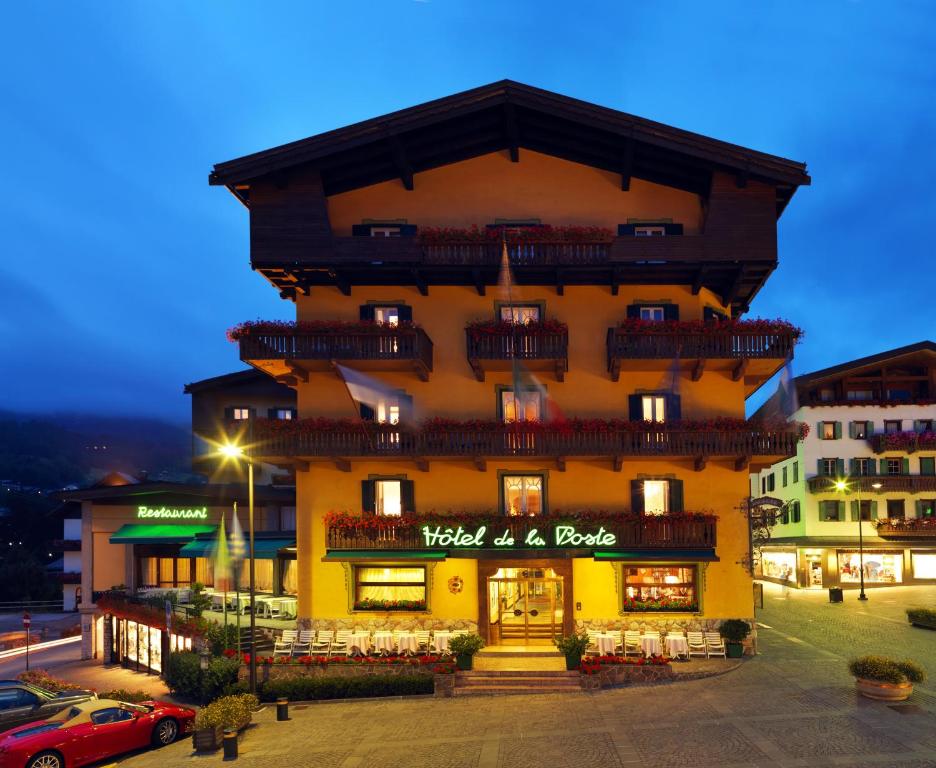
Italian industrialist Alberto Vacchi is reportedly finalising the acquisition of the historic Hotel de la Poste in Cortina d’Ampezzo. The transaction offers a particularly compelling case study for the hospitality investment market: how do you value a hotel when more than two centuries of history, reputation, brand equity and scarcity must be added to the underlying real estate and operating performance?
Some hotels can largely be assessed through room count, ADR, RevPAR, occupancy, EBITDA, real estate value and required CAPEX.
Then there are properties for which those metrics, while still essential, cannot fully explain their value.
The Hotel de la Poste in Cortina d’Ampezzo clearly belongs to the latter category.
According to reports in the Italian press, Alberto Vacchi, Chief Executive Officer of IMA, is finalising the acquisition of the historic Cortina hotel, with closing expected in the coming weeks.
The transaction price has not been publicly disclosed.
And that is precisely what makes the deal particularly interesting from the perspective of InvestimentiAlberghieri.it.
Because the most relevant question is not simply:
How much was paid for the Hotel de la Poste?
The more important question is:
How do you value a hotel that cannot be replicated?
In the Heart of Cortina Since 1804
The history of the Hotel de la Poste dates back to 1804.
For more than two centuries, the property has evolved alongside Cortina d’Ampezzo itself and the development of Italian Alpine tourism.
Over the years, the hotel has welcomed international personalities, members of European aristocracy, artists and leading figures from the worlds of culture and entertainment.
Among its most celebrated guests was Ernest Hemingway, who stayed at the hotel on several occasions.
But this legacy should not be viewed merely through a romantic or historical lens.
From an investor’s perspective, it represents a genuine intangible asset.
A new hotel can be developed.
A property with more than 200 years of history in the centre of Cortina cannot be recreated.
And it is precisely this scarcity and non-replicability that can command a significant valuation premium.
Vacchi Is Not Simply Buying Hotel Rooms
When an iconic hotel changes hands, the investment is not merely the acquisition of a building.
The buyer is simultaneously acquiring:
-
real estate in a location that is exceptionally difficult to replicate;
-
an established hotel business;
-
an existing market position;
-
a recognised brand;
-
a unique history;
-
a reputation built over generations;
-
commercial relationships and a customer base;
-
significant barriers to entry;
-
a storytelling platform that cannot easily be reproduced by a new competitor.
This is the essence of a hospitality trophy asset.
And it is precisely the type of transaction in which applying a standard EBITDA multiple or a simple price-per-key benchmark mechanically may provide only a partial picture.
How Do You Actually Value an Iconic Hotel?
A robust valuation of an asset of this nature should separate at least five distinct components.
1. Real Estate Value
The first component is, inevitably, the underlying real estate.
Location, floor area, permitted use, physical quality, condition, development or extension potential and the real estate values of the immediate micro-location all form the starting point.
In Cortina, real estate scarcity is itself a major value driver.
2. Hotel Operating Value
The second layer concerns the hotel’s ability to generate earnings.
At a minimum, the analysis should consider:
-
revenue;
-
ADR;
-
RevPAR;
-
occupancy;
-
GOP;
-
normalised EBITDA;
-
labour costs;
-
energy costs;
-
distribution costs;
-
seasonality;
-
prospective operating margins.
The key issue is to distinguish current operating performance from the industrial and commercial potential of the asset.
3. CAPEX
A historic hotel may carry substantial real estate and reputational value while still requiring significant investment.
The acquisition price therefore cannot be assessed separately from the CAPEX required over the following five or ten years.
Guest rooms, MEP systems, public areas, F&B outlets, energy efficiency and the standards expected by the international luxury market can materially alter the actual return on the investment.
This is one of the reasons why, at Investhotel.it, the assessment of a hotel acquisition is never limited to the initial purchase price.
4. Goodwill and Brand Equity
In the case of the Hotel de la Poste, another particularly important element comes into play: goodwill.
The hotel’s reputation, recognition, heritage and association with Cortina may support pricing power and commercial positioning.
In transactions of this kind, the brand is therefore more than a marketing asset.
It can become an identifiable economic component of the investment case.
5. Strategic Value
Finally, there is the value that a particular asset may have in the hands of a particular investor.
That value does not necessarily coincide with a theoretical market valuation.
A family office, an industrial entrepreneur, a real estate fund and a hotel operator may all attribute different values to the same hotel depending on their respective strategies.
This is why price and value are never automatically the same thing.
The Real Investment Begins After the Acquisition
The market naturally tends to focus on the moment when a transaction closes.
In hospitality, however, closing is only the beginning.
The real process of value creation starts the following day.
In the case of the Hotel de la Poste, the strategic questions will therefore be numerous.
What will its future positioning look like?
Will the property remain fully independent?
Will a refurbishment programme be undertaken?
What level of CAPEX will be committed?
Could the hotel progressively move further upmarket within the luxury segment?
Will some form of affiliation with an international hospitality brand be considered, or will its historic independent identity be preserved in full?
These are fundamental decisions.
Because iconic hotels face a very specific risk:
investing so heavily in upgrading the product that the very character responsible for the asset’s premium value is ultimately diluted.
Cortina: Value Extends Far Beyond the Olympic Effect
The transaction comes at a particularly important moment for Cortina.
Milano Cortina 2026 has further increased the destination’s international exposure and supported investment in infrastructure, real estate and tourism.
Yet interpreting Cortina solely through the lens of the Winter Olympics would be reductive.
The destination’s real strength comes from the combination of:
real estate scarcity, global recognition, high-spending demand, lifestyle appeal, leisure tourism and the strength of the destination brand itself.
These are precisely the factors that make hotel valuation in prime destinations particularly complex.
Historical performance therefore becomes only one part of the analysis.
Investors need to build scenarios.
When History and Reputation Become Economic Capital
The Hotel de la Poste also highlights an issue that remains frequently underestimated within the Italian hospitality market:
the value of intangible assets.
The history of the hotel, the personalities who have stayed there, its relationship with Cortina and its remarkable continuity are not merely elements of storytelling.
They can translate into:
-
international recognition;
-
differentiation;
-
pricing power;
-
greater appeal to international guests;
-
stronger marketing effectiveness;
-
lower comparability with standardised hotel products.
Naturally, intangible assets cannot justify any valuation at any price.
A proper hotel due diligence process, as also explored by Hotel Management Group, must still assess the asset from real estate, planning, contractual, operational, corporate and financial perspectives.
But ignoring intangible value would be equally misleading.
In luxury hospitality, reputation itself can become a genuine component of economic value.
When Generational Transition Becomes a Market Transaction
There is another important dimension to the story.
The transfer of the Hotel de la Poste also represents the transfer of an entrepreneurial legacy built over generations.
This is an issue that is likely to become increasingly relevant across the Italian hotel market.
A growing number of family-owned hotels will progressively face four potential paths:
family succession, the entry of new capital, consolidation, or a sale.
These transitions require a far more sophisticated assessment than a straightforward property disposal.
As also discussed on Robertonecci.it, changes in hotel ownership simultaneously involve governance, real estate, the operating business, debt structure and management continuity.
The Greatest Risk: Confusing Price with Value
This may ultimately be the most important lesson from the transaction.
In hotel investment, price is simply the point at which buyer and seller agree.
Value is far more complex.
It may include:
real estate + operating business + profitability + future potential + brand + goodwill + scarcity + future value-creation capacity.
In the case of an iconic hotel, the relative weight of each of these factors can be entirely different from that of a conventional urban property.
This is why comparing two hotels purely on a price-per-key basis can be deeply misleading.
Hotel de la Poste: The Value of What Cannot Be Rebuilt
If the transaction is completed, Alberto Vacchi will not simply be acquiring a four-star hotel in Cortina.
He will be acquiring real estate, an operating business, a brand and more than two centuries of hospitality history.
Above all, however, he will be acquiring something no new investor can create from scratch:
time.
And that may ultimately be the real premium embedded in iconic hotels.
Buildings can be refurbished.
Guest rooms can be redesigned.
Services can be improved.
Brands can be created.
But some things cannot be replicated.
History is one of them.
And that is precisely why, in the most sophisticated hospitality investments, the value of a hotel can never be reduced simply to the value of its walls.
Hospitality Investment and Transaction Analysis
InvestimentiAlberghieri.it analyses hotel acquisitions, investment opportunities, assets, redevelopment projects and transactions across the Italian hospitality market.
For confidential analysis and advisory enquiries:
info@investimentialberghieri.it