When debt becomes more powerful than ownership
In distressed hotel investments, formal ownership is not always the same as control.
When leverage becomes excessive, when collateral is valuable and when an asset no longer generates enough cash flow to sustain its financial structure, real control can shift from the owner to the creditor.
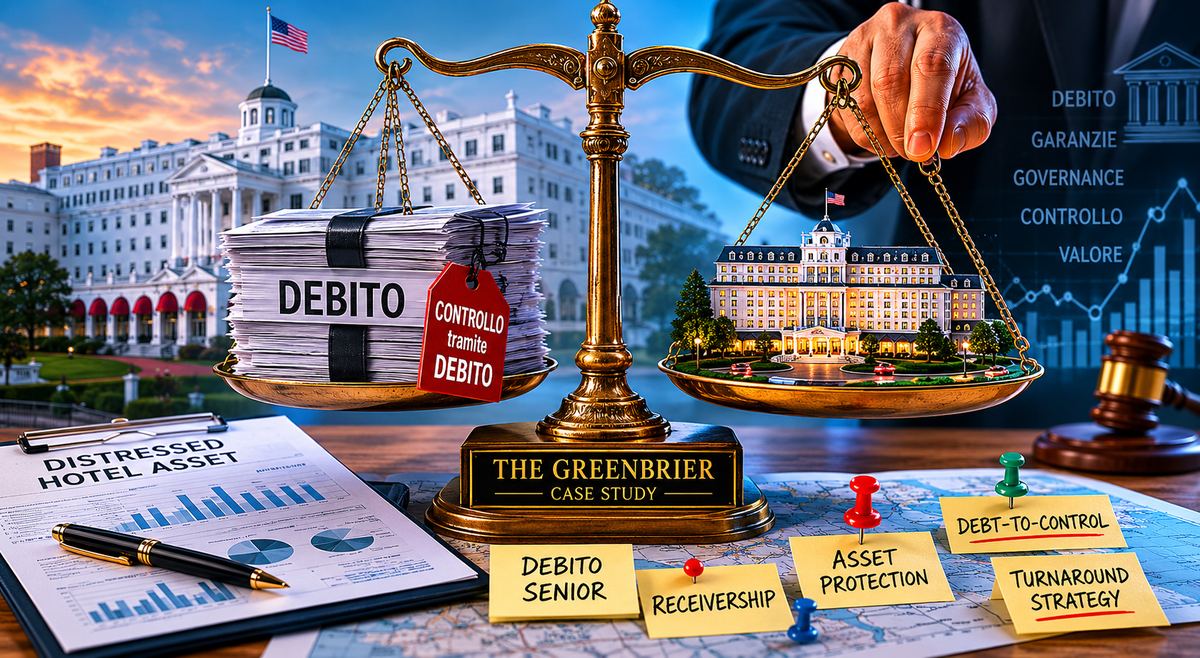
That is the central lesson of The Greenbrier case, the historic luxury resort in West Virginia now at the centre of a complex legal and financial dispute.
The Greenbrier is not merely an iconic hotel. It is a case study in one of the most important dynamics of hotel special situations: control can move through the debt before it ever moves through the equity.
The dispute involves the Justice family, owner of the resort, and White Sulphur Springs Holdings, an entity connected to TRT Holdings, owner of Omni Hotels & Resorts. White Sulphur Springs Holdings acquired a significant portion of the debt previously held by Carter Bank & Trust and subsequently petitioned the federal court for the appointment of a receiver over the resort and related entities.
The Justice family contests the transaction, arguing that it represents a hostile attempt to gain control of The Greenbrier through its debt. The new creditors, by contrast, frame their action as a necessary step to protect the collateral and prevent further deterioration of the asset.
Whatever the court ultimately decides, the case highlights a fundamental principle for hotel investors: in a distressed hotel scenario, the party controlling the debt may become more important than the party formally owning the hotel.
Formal ownership and effective control are not the same thing
In the ordinary hotel market, the roles appear clear: owner, operator, brand, lender, investor.
Under normal conditions, those distinctions work.
In distressed situations, they often break down.
When a hotel carries significant debt, real estate collateral, breached covenants, tax liabilities, liquidity pressure or unfunded capital expenditure requirements, the decisive player may no longer be the formal owner. It may be the senior lender. It may be the party acquiring the debt. Or it may be the court asked to decide how the value of the asset should be protected.
That is the core of The Greenbrier case.
White Sulphur Springs Holdings did not directly acquire the hotel. It acquired a credit position. But if that position is valid and enforceable, it may become a powerful lever to request far-reaching measures over the asset, including the appointment of a receiver.
For hotel investors, this distinction is critical.
Acquiring debt secured by a hotel does not simply mean buying a financial claim. It means acquiring a legal, negotiating and strategic position that may lead to control, restructuring, a forced sale, refinancing or a new governance framework for the asset.
Debt is not merely a liability. In a distressed hotel, it can become the map of power.
Receivership: Protecting the operating value of the hotel
Receivership is a legal tool commonly used in common law jurisdictions. In simple terms, a court may appoint a third party to preserve, manage or control an asset or business when there is a risk that its value may be impaired.
In the hotel sector, this is particularly sensitive.
A receiver does not merely oversee a building. A receiver may influence cash management, payments, suppliers, employees, maintenance, bookings, contracts, licences, capital expenditure and operational continuity.
A resort such as The Greenbrier is not just a physical property. It is a complex economic platform.
Its value depends on a combination of factors:
-
real estate quality;
-
brand strength;
-
reputation;
-
employees;
-
maintenance;
-
forward bookings;
-
events;
-
local relationships;
-
management capability;
-
future investment;
-
debt sustainability.
For this reason, in hotel distress, a creditor is not concerned only with repayment. The creditor is also concerned with the risk that the collateral may lose value while the dispute is being resolved.
A hotel can deteriorate much faster than a standard real estate asset.
If employees lose confidence, if suppliers reduce credit, if maintenance is deferred, if reviews decline, if events are cancelled or if the market perceives instability, the operating value of the hotel can fall quickly.
The key question is therefore not only: who owns the hotel?
The more important question is: who is capable of protecting its value while the financial crisis is being resolved?
The creditor’s perspective
From the creditor’s perspective, the logic is straightforward.
If debt is secured by a hotel asset, if the borrower is in default and if the value of the collateral is at risk, the creditor may seek protective measures.
Seen from this angle, acquiring the debt is not necessarily a hostile move. It may be interpreted as a legitimate financial transaction: one party acquires a loan, steps into the position of the previous lender and uses the legal tools available to protect its exposure.
The distinctive point is that, in hospitality, protecting a credit position often means entering the operational field.
It is not enough to preserve the property. The hotel business itself must be preserved.
A hotel that loses operational continuity may lose value even if the building remains physically intact. This is what makes hotel credit fundamentally different from pure real estate credit.
In a distressed hotel, the senior creditor may hold greater negotiating power than the equity holder. The equity holder retains formal ownership, but if the debt is due, secured and unpaid, decision-making leverage may gradually shift toward whoever controls the credit.
The legal title may remain with the owner. The economic leverage may sit elsewhere.
The owner’s perspective
The Justice family presents the opposite interpretation.
According to its position, the acquisition of the debt by an entity connected to Omni Hotels & Resorts is part of a strategy to gain control of The Greenbrier through a financial position.
This is the typical defensive argument of an owner who no longer sees the creditor merely as a lender, but as a potential strategic acquirer.
The issue therefore becomes broader than non-payment.
It enters the territory of fair dealing, confidential information, competition, good faith, the legitimacy of the debt acquisition and the possibility that a financial position may be used to obtain an industrial advantage.
This distinction is decisive.
If the court reads the case as a conventional credit dispute, the creditor will be in a strong position. If, however, elements of abuse, collusion or improper use of information were to emerge, the debt-to-control strategy could be weakened.
For hotel investors, The Greenbrier case therefore offers another lesson: acquiring debt can be a powerful strategy, but it must be structured with exceptional legal, reputational and industrial discipline.
The real issue: governance of value
The Greenbrier case matters not only because it involves an iconic resort.
It matters because it exposes an issue often underestimated in hotel investment: the governance of value.
Who protects the value of the hotel when the owner is financially weak?
Who decides which investments are necessary?
Who ensures operational continuity?
Who protects employees, suppliers, customers and bookings?
Who prevents financial uncertainty from turning into reputational damage?
Who has the real power to determine the future of the asset?
In a distressed hotel, these questions are as important as the valuation itself.
A hotel is not an empty building. It is a living business. Every day, it either creates value or destroys it.
That is why governance becomes central. In a crisis, value does not depend only on the market price of the property. It depends on the ability to make decisions quickly, fund capital expenditure, preserve service standards, reassure the market and stabilise operations.
In hotel distress, value is not protected on a spreadsheet. It is protected in operations.
Debt-to-Control: When credit becomes the entry point
The Greenbrier case belongs to the broader category of debt-to-control transactions.
The investor does not necessarily enter by immediately buying the property or the company that owns it. The investor may enter by acquiring the debt, especially when that debt is secured by high-quality hotel assets.
The logic is clear:
-
identify a hotel with strong intrinsic value;
-
analyse the debt structure;
-
acquire a senior or otherwise strategic credit position;
-
negotiate with the owner;
-
seek enforcement, receivership or restructuring if the borrower fails to perform;
-
ultimately reach control of the asset, a sale, a renegotiation or a refinancing.
This strategy is particularly relevant when there is a gap between asset quality and owner fragility.
A hotel may be excellent, but its owner may be financially weak.
It may be located in a strong destination, but burdened by excessive debt.
It may have a historic brand, but require investments that the current owner cannot fund.
It may have operational potential, but be blocked by litigation, inefficient governance, bank exposure or tax liabilities.
In these cases, debt becomes an alternative entry point to a direct acquisition.
The strongest investor is not always the one offering the highest price for the property. Sometimes it is the one that best understands the financial structure of the transaction.
Why this case also matters for the italian hotel market
The Greenbrier case is American, but the underlying logic is highly relevant to the Italian hotel market.
Italy has many hotels with similar characteristics, even if often on a different scale.
The Italian market includes numerous family-owned hotels, historic hospitality assets, undercapitalised properties, hotels with strong real estate value but insufficient profitability, assets requiring significant capital expenditure and owners who do not always have the financial or managerial capacity to execute a true repositioning.
In many cases, the problem is not the hotel itself.
The problem is the financial structure supporting it.
There are hotels with excellent locations but unsustainable debt. Properties with strong tourism potential but weak governance. Valuable real estate assets managed through outdated operating models. Hotels that could generate value but are blocked by bank exposure, legacy liabilities, litigation, complex ownership structures or lack of investment.
This is where many hotel special situation opportunities arise.
In Italy, the issue must also be read through the lens of NPLs, UTPs, impaired loans, debt restructuring, bank negotiations, specialised funds, servicers, insolvency procedures, compositions with creditors, auctions, portfolio disposals and turnaround transactions.
For investors, these situations may represent significant opportunities.
But only if they are analysed with the right methodology.
The most serious mistake is to assess a distressed hotel as if it were an ordinary real estate transaction. The correct analysis must integrate real estate, business operations, debt, law, tax, governance, capital expenditure, management and industrial strategy.
These are precisely the issues addressed by the Investimenti Alberghieri blog, which explores the most complex dynamics of the market: hotel valuation, acquisitions, special situation transactions, hotel-backed assets, due diligence, credit, economic sustainability and investment strategies.
NPLs, UTPs and hotels: Hotel credit is not pure real estate credit
In the Italian market, a significant share of distressed opportunities originates from positions classified as NPLs or UTPs.
But a loan secured by a hotel cannot be analysed in the same way as a loan secured by an ordinary property.
The difference is substantial.
A hotel is an operating business. It has employees, suppliers, customers, contracts, reviews, reputation, distribution channels, licences, seasonality, maintenance requirements and recurring investment needs.
If credit is managed with a purely real estate mindset, the risk is to destroy value precisely while trying to recover it.
A creditor seeking to maximise recovery cannot look only at the property appraisal. The creditor must understand whether the hotel can be operated, repositioned, leased, sold, refinanced or aggregated with an operator.
The right questions are:
-
can the hotel generate cash flow?
-
is the management adequate?
-
is the product competitive?
-
is the required capex sustainable?
-
does the destination have demand?
-
is there an operator interested in the asset?
-
is value maximised through operational continuity or immediate sale?
-
is the owner part of the solution or part of the problem?
These questions are essential because, in the hotel sector, recovery value does not depend only on the real estate. It depends on the ability of the asset to become a functioning economic engine again.
The value of a distressed hotel is not in the low price
A hotel in difficulty is not automatically a good deal.
A low price is not enough.
In many hotel transactions, an apparently attractive price is only the visible part of the problem.
Behind a reduced price there may be enormous capex needs, obsolete systems, an oversized workforce, unfavourable contracts, tax liabilities, employment claims, unpaid suppliers, licences to be verified, planning restrictions, damaged reputation, weak commercial positioning or lack of access to new financing.
Conversely, a heavily indebted hotel may be an excellent opportunity if:
-
the location is strong;
-
the product can be repositioned;
-
the debt can be restructured;
-
governance can be simplified;
-
management can be improved;
-
capex creates real value uplift;
-
there is a clear exit strategy;
-
legal risk is measurable;
-
post-repositioning value exceeds the total capital invested.
The difference between an opportunity and a trap lies in the quality of the analysis.
In distressed hotels, the key question is not only how much it costs to enter the transaction. The real question is how much capital will be required to bring the asset back to a genuinely sustainable condition.
Price is what you pay to enter. Capital need is what determines whether you survive.
Due Diligence in distressed hotel transactions
In a standard hotel acquisition, due diligence examines the property, accounts, contracts, licences, employees and market.
In a distressed transaction, this is not enough.
At least eight layers must be analysed.
1. Debt Structure
The investor must understand the amount, seniority, collateral, maturities, interest rates, defaults, covenants, pledges, mortgages, intercreditor agreements, litigation and enforcement options.
Debt is not merely a liability. It is a map of power.
2. Real Asset Quality
Location, maintenance condition, size, layout, rooms, common areas, systems, product standards, planning restrictions and repositioning potential determine recoverable value.
A distressed hotel may be financially weak but physically excellent. Or it may appear attractive while requiring unsustainable capex.
3. Operating Performance
Revenue, ADR, occupancy, RevPAR, GOP, EBITDA, payroll costs, distribution, customer mix, events, online reputation and product competitiveness must all be assessed.
The hotel must be valued as a business, not only as a property.
For a deeper understanding of the economic, managerial and organisational drivers of hotel performance, the hotel guides by Roberto Necci provide practical insight into management, revenue, organisation, strategy and operating value.
4. Capex and Repositioning
Every distressed transaction requires a realistic estimate of the investment needed.
It is not enough to ask how much it costs to acquire the hotel. The real question is how much it costs to bring it back to competitive standards.
Capex may involve rooms, systems, façades, common areas, technology, fire safety, energy efficiency, spa facilities, food and beverage, meeting spaces, brand standards and regulatory compliance.
5. Governance and Control
Who signs?
Who decides?
Who can sell?
Who can refinance?
Who can grant security?
Who can appoint management?
Who has veto rights?
Who controls cash flows?
Who has the real power to block or accelerate the transaction?
In distressed transactions, governance can be as important as the income statement.
6. Legal and Tax Risk
Litigation, tax liabilities, supplier claims, employment disputes, relationships with local authorities, licences, permits and contingent liabilities can radically change the value of the transaction.
In distressed hotels, the financial creditor is almost never the only stakeholder. There may be tax authorities, employees, suppliers, shareholders, public bodies, operators, tenants, franchisors and other creditors.
7. Management Quality
A distressed hotel cannot be recovered with capital alone.
It requires management.
The investor must understand whether the problem is financial, real estate-related, operational or commercial. These are four different situations.
A hotel may have excessive debt but good management. Or it may have a valid property but inadequate management. Or it may be blocked by a product that is no longer aligned with the market. Or it may require a radical repositioning.
Without this distinction, the turnaround is likely to fail.
8. Exit Strategy
Every transaction must start from the end.
The investor must know whether the objective is to:
-
operate the hotel directly;
-
appoint an operator;
-
lease the business;
-
enter into a management agreement;
-
sell after repositioning;
-
refinance;
-
convert the property;
-
aggregate the asset into a portfolio;
-
hold the hotel as an income-producing investment.
Without an exit strategy, distress becomes blind speculation.
Why The Greenbrier case matters to banks, funds and hotel owners
The Greenbrier case should be carefully observed by banks, funds, investors and hotel owners.
For Banks
It shows that hotel credit cannot be managed as ordinary real estate credit.
A bank financing a hotel must monitor not only loan-to-value and collateral, but also operating performance, capex, reputation, management quality, the sustainability of the operating model and the asset’s ability to generate cash flow.
A financially fragile hotel can lose value if it is not addressed promptly.
For Funds and Investors
It shows that some of the most interesting opportunities can arise from credit, not only from equity.
Acquiring debt secured by hotel assets can become an effective strategy, but it requires highly integrated legal, financial, real estate and operational expertise.
The investor must be able to read the balance sheet, collateral package, market, capex, operations and exit scenario at the same time.
For Hotel Owners
It shows that debt is not neutral.
When leverage exceeds the asset’s ability to generate cash flow, ownership may progressively lose decision-making room.
Even without a formal sale, economic control may shift elsewhere.
For this reason, in family-owned hotel businesses, debt management should be part of the industrial strategy, not merely part of the banking relationship.
The Decisive question: Who really controls the hotel?
The Greenbrier case forces investors to move beyond a simplified view of hotel ownership.
In a healthy hotel, ownership and control tend to coincide.
In a distressed hotel, they may separate.
Ownership remains with the shareholder. But control may be influenced by the creditor, the court, covenants, capex requirements, refinancing needs, tax pressure, suppliers, employees and other stakeholders.
For this reason, in complex hotel transactions, the most important question is not only:
what is the hotel worth?
The more important question is:
who really controls the economic, legal and operational future of the asset?
This question applies to an American resort worth hundreds of millions of dollars. But it also applies to an Italian family-owned hotel with bank debt, deferred capex, insufficient profitability and a need for repositioning.
What The Greenbrier teaches hotel investors
The Greenbrier case offers at least seven lessons.
First: debt can become a lever of control.
Second: a distressed hotel must be valued as an operating business, not as a simple property.
Third: financial governance can affect value as much as location.
Fourth: protecting collateral in the hotel sector means protecting operational continuity.
Fifth: in hotel special situations, whoever understands the debt structure first may gain a decisive competitive advantage.
Sixth: a low price is not enough if capex, liabilities and governance are not under control.
Seventh: hotel turnaround requires capital, but also operational expertise.
This lesson is particularly relevant for the Italian market, where many hotel assets are still controlled by family owners, often with significant real estate value but financial, managerial or ownership structures that are not always aligned with the requirements of the contemporary hospitality market.
From an international case study to hotel advisory
The Greenbrier is not just an American news story.
It is a case study on the relationship between debt, value and control in hotel investments.
Analysing transactions of this kind requires integrated expertise: real estate valuation, hotel financial analysis, debt analysis, operational due diligence, contract knowledge, strategic repositioning and the ability to engage with banks, investors, owners and operators.
The real skill in distressed transactions is understanding whether the asset is a hotel with no future or a strong hotel trapped inside the wrong financial structure.
In the first case, the risk should be avoided.
In the second, an opportunity may emerge.
This is the perspective through which Hotel Management Group supports entrepreneurs, investors and hotel owners in acquisition, value enhancement, advisory, repositioning and development projects.
To learn more about the group and its areas of activity, visit HotelManagementGroup.it.
Roberto Necci - r.necci@robertonecci.it