Hotel Lindenhof: why this transaction matters beyond the acquisition itself
The acquisition of Hotel Lindenhof in Naturno, near Merano, is far more than another hospitality real estate transaction. It is a clear indication of how the market for high-quality hotel investments in Italy is evolving.
The transaction involves First Atlantic Real Estate, Signal S.p.A., the Euregio+ Tourism Fund, junior equity investors and a banking pool led by Cassa Centrale Banca, together with other financial institutions from the Trentino-South Tyrol region.
Its relevance lies not only in the asset itself, but in the structure and strategic direction of the deal. The transaction combines equity, bank debt, hybrid capital instruments and a clear operational roadmap: targeted investment, progressive asset enhancement and the planned entry of an international hotel operator in 2027.
This is the key point.
Hotel Lindenhof is not being approached merely as a property. It is being treated as an operating hospitality platform with the potential to generate higher value through capital, management, brand positioning and international demand.
In today’s luxury leisure market, hotel investment is no longer limited to acquiring the real estate. Long-term value is created by aligning asset quality, capital structure, operational expertise, destination strength, brand strategy and commercial execution.
An 80-room wellness resort in one of Italy’s strongest alpine destinations
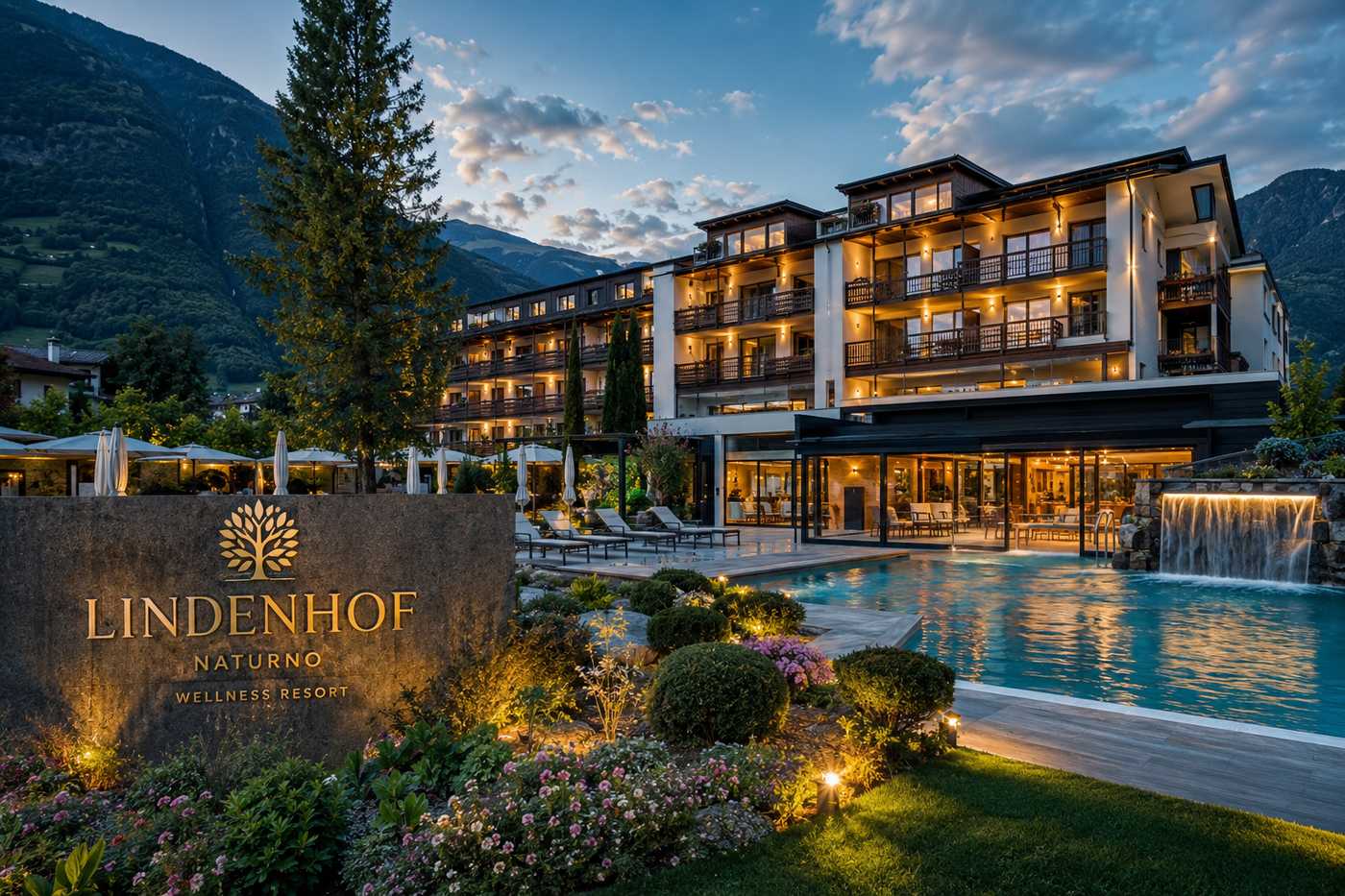
Hotel Lindenhof is a wellness resort located in Naturno, in one of South Tyrol’s most established tourism areas. The property features 80 rooms and offers an integrated hospitality proposition built around accommodation, wellness, outdoor activities, family services and local gastronomy.
The resort includes an extensive Spa & Wellness area with seven saunas and eight swimming pools, alongside family-oriented spaces, entertainment programmes and sports facilities, including a climbing gym.
These are not merely product features. They are investment drivers.
The alpine luxury wellness segment is one of the most resilient and attractive areas of leisure hospitality. It appeals to high-spending guests, supports longer average stays, strengthens ancillary revenue streams and reduces the property’s dependence on room revenue alone.
In this type of asset, value is not defined simply by the number of keys. It is driven by the hotel’s ability to generate a balanced combination of ADR, RevPAR, ancillary revenues, reputation, seasonality management and operating margin.
For a deeper understanding of hotel valuation and hotel management fundamentals, see the hotel guides by Roberto Necci:
https://www.robertonecci.it
South Tyrol: why alpine luxury remains an institutional-grade investment platform
South Tyrol continues to be one of Italy’s most attractive destinations for leisure hotel investment.
Its strength is not only scenic. The region combines destination quality, landscape identity, international reputation, wellness, outdoor activities, gastronomy, service standards and access to both domestic and international demand.
For investors, this means operating in a market where the destination itself directly contributes to the value of the hotel asset.
A well-positioned and professionally managed hotel in South Tyrol can benefit from several structural value drivers:
-
qualified leisure demand;
-
strong territorial identity;
-
lower dependence on a single season;
-
access to high-spending guests;
-
natural integration between hospitality, wellness and destination experience;
-
growing interest from specialist operators;
-
long-term resilience of prime hospitality assets.
However, strong destinations are also selective markets.
Buying a hotel in an attractive location is not enough. Investors need a credible, financially sustainable and operationally coherent hospitality strategy.
The Lindenhof transaction should therefore be read not as a mere transfer of ownership, but as a progressive value-enhancement project.
A sophisticated capital stack: preferred equity, mezzanine, junior equity and bank debt
One of the most relevant aspects of the transaction is its capital structure.
The Euregio+ Tourism Fund participates both as a preferred equity partner and as a mezzanine lender. This component is combined with junior equity investors and a banking pool led by Cassa Centrale Banca.
This multi-layered structure reflects the growing sophistication of hospitality finance.
The traditional model, based mainly on sponsor equity and senior bank debt, is not always sufficient for complex hotel transactions. When the objective is not only to acquire an asset, but to guide it through a new phase of growth, more flexible capital instruments may be required.
Preferred equity and mezzanine finance make it possible to structure a more articulated capital stack, allocating risk, return and priority across different participants.
In the Lindenhof case, finance is not a secondary component of the deal. It is part of the investment thesis.
It does not simply fund the acquisition.
It supports a value-creation trajectory.
The real question: what can the hotel become after transformation?
In hospitality investment, the central question is never only: what is the property worth today?
The more relevant question is: what could the hotel be worth after a coherent programme of investment, management and repositioning?
This is what distinguishes a real estate transaction from a true hotel investment.
Hotel value is created through the interaction of four dimensions.
1. The real estate asset
Location, physical quality, room inventory, common areas, maintenance condition, development potential and architectural coherence.
2. Operational performance
Revenues, costs, GOP, EBITDA, departmental profitability, productivity, labour efficiency and management control.
3. Commercial positioning
Brand, reputation, distribution channels, guest mix, direct sales capability, pricing power and source markets.
4. Value-enhancement strategy
Capex, operator entry, repositioning, ancillary revenue development, debt sustainability and potential exit value.
Hotel Lindenhof is compelling because it contains all these dimensions. It is not simply a property in a strong destination. It is an asset that can be moved into a higher-value phase through structured capital, professional management and a clear industrial vision.
The role of the Euregio+ Tourism Fund: patient capital and destination competitiveness
The participation of the Euregio+ Tourism Fund is particularly significant.
By acting both as preferred equity partner and mezzanine lender, the fund occupies a position that is not purely financial. Its role sits at the intersection of investment return and tourism destination development.
In hospitality, especially in territories with a strong identity such as South Tyrol, a well-structured hotel investment can generate effects beyond the boundaries of the single asset.
A more competitive resort can increase the visibility of the destination, strengthen the local ecosystem, attract international demand, raise the average standard of the accommodation offer and contribute to the broader reputation of the area.
This makes the Lindenhof case especially relevant. The investment does not concern only one hotel property. It fits into a broader logic of destination competitiveness and long-term hospitality value creation.
The 2027 entry of an international operator is the strategic turning point
The most important strategic element of the transaction is the planned entry of an international hotel operator in 2027.
This can materially change the profile of the asset.
An international operator does not bring only a brand. It brings standards, distribution, commercial discipline, access to foreign markets, revenue management systems, operational control and the ability to convert product quality into economic performance.
In the luxury and upper-upscale segments, the operator can influence several decisive variables:
-
perceived reputation;
-
international visibility;
-
direct sales capability;
-
access to high-spending clientele;
-
pricing power;
-
service quality;
-
process standardisation;
-
operating profitability;
-
staff attraction and training;
-
future asset value.
The fact that the operator’s entry is planned after a transition phase reflects a prudent and professional approach.
First, the asset is prepared.
Then, the right operator is introduced.
This is the correct sequence. A brand or international manager can create value only if the property is coherent, financially sustainable and operationally ready to absorb higher standards.
Management creates more value than the acquisition itself
In hospitality, the acquisition is only the starting point.
Value is created afterwards.
It is created through management discipline, cost control, guest experience, channel strategy, revenue management, staff quality, online reputation and the ability to transform the hotel’s identity into profitable demand.
A hotel can be acquired at the right price and still underperform if there is no clear operating strategy. Conversely, an asset with potential can significantly increase in value if it is placed within a coherent value-enhancement plan.
In the Lindenhof case, the combination of a wellness resort, a strong destination, structured capital and a future international operator indicates a clear move from passive ownership to active asset management.
This is where the market is heading.
Investors are no longer looking only for hotel real estate.
They are looking for hospitality operating platforms capable of growth.
Lessons for hotel owners and investors
The Lindenhof case offers highly relevant lessons for hotel owners, family offices, funds, operators and investors active in hospitality.
The first lesson is that hotel value is not the same as property value. The real estate component is essential, but the true value of a hotel comes from its ability to generate income, reputation and future growth.
The second lesson is that capital structure must be aligned with the business plan. Equity, preferred equity, mezzanine and bank debt are not neutral instruments. They must support a realistic value-creation strategy.
The third lesson is that the operator is a decisive variable. Especially in high-end leisure hotels, management quality can determine the difference between a good asset and an outstanding investment.
The fourth lesson is that investment must be targeted. Renovation alone is not enough. Investors must know which departments to strengthen, which guests to attract, which ADR to target, which services to enhance and which experience to build.
The fifth lesson is that hotel identity is an economic asset. Wellness, nature, family, sport, gastronomy and territory must form a clear, recognisable and monetisable positioning.
Why the Lindenhof case also matters for independent Italian hotels
Lindenhof is a high-end transaction, but its message is relevant to many independent hotels in Italy.
Many properties have location, history, clientele and potential, yet fail to express their full value because they lack capital, governance, management control, strategic vision or the ability to engage properly with investors and operators.
The market is becoming more selective.
Investors want credible numbers.
Banks look for debt sustainability.
International operators look for coherent products.
Hotel owners must increasingly think as asset owners, not only as hotel managers.
The decisive questions are straightforward:
-
what is my hotel worth today?
-
what could it be worth after a value-enhancement plan?
-
which investments are truly necessary?
-
what margins can the property generate?
-
is the current management model still competitive?
-
is the distribution strategy efficient?
-
is the brand aligned with the asset’s potential?
-
could a third-party operator increase value?
-
is the debt structure sustainable?
-
is there a growth or exit strategy?
The Lindenhof transaction shows that the market rewards assets capable of answering these questions with a concrete plan.
The role of advisors in complex hotel transactions
In the transaction, Scouting Capital & Family Advisors acted as exclusive financial advisor to the Euregio+ Tourism Fund, with a team composed of Attilio Conta, Executive Director, Giuseppe Pelliccioni, Managing Director, and Matteo Emiliozzi, Senior Analyst.
The presence of specialist advisors confirms that complex hotel transactions cannot be treated as ordinary real estate deals.
A hotel is a hybrid asset.
It is property, operating company, brand, commercial platform and experiential product.
For this reason, it requires integrated expertise: financial, real estate, hospitality, operational, tax, legal and commercial.
It is necessary to read the income statement, but also the positioning. It is necessary to assess capex, but also average rate potential. It is necessary to understand debt capacity, but also the hotel’s ability to generate demand.
In hospitality transactions, the advisor should not merely facilitate the deal. The advisor should help shape the investment logic.
A benchmark for the next phase of hospitality investment
The Lindenhof transaction can be considered a benchmark for the Italian market because it brings together many of the elements that will define hospitality investment in the coming years:
-
leisure asset in a strong destination;
-
wellness product aligned with international demand;
-
structured capital;
-
hybrid financial instruments;
-
local banking support;
-
investment plan;
-
scheduled entry of an international operator;
-
progressive asset enhancement;
-
connection between private investment and destination development.
Not every hotel will be involved in transactions of this complexity. But the direction of travel is clear.
The most attractive hospitality assets will be those capable of showing not only current performance, but also a credible future growth trajectory.
Conclusion: Hotel Lindenhof confirms the rise of institutional-grade hospitality assets
The acquisition of Hotel Lindenhof in Naturno by First Atlantic Real Estate and Signal, with the involvement of the Euregio+ Tourism Fund, is much more than a market news item.
It confirms that high-quality hotels, when supported by location, product, management and capital, are increasingly becoming institutional-grade operating assets.
But not every hotel qualifies.
The market rewards properties with clear identity, transparent numbers, growth potential, financial sustainability and the ability to attract qualified operators.
Hotel Lindenhof shows that the future of hospitality investment will not be driven by real estate logic alone, but by a broader value-creation model based on capital, management, brand, experience and destination.
For owners and investors, the message is clear: hotel value is not simply measured at the time of acquisition. It is built through discipline, vision and transformation capability.
Considering a hotel acquisition, disposal or value-enhancement strategy?
Hotel Management Group supports hotel owners, investors, funds and operators in the analysis, enhancement, development and strategic management of hospitality assets.
We advise on:
-
hotel and hospitality asset valuation;
-
feasibility studies;
-
value-enhancement plans;
-
operational potential analysis;
-
hotel repositioning;
-
operator search and selection;
-
acquisition and disposal support;
-
hospitality development projects.
To analyse a hotel investment, assess an asset or structure a development plan:
https://www.hotelmanagementgroup.it
Related insights and resources:
Hotel guides by Roberto Necci
https://www.robertonecci.it
Investimenti Alberghieri blog
https://investimentialberghieri.it/blog