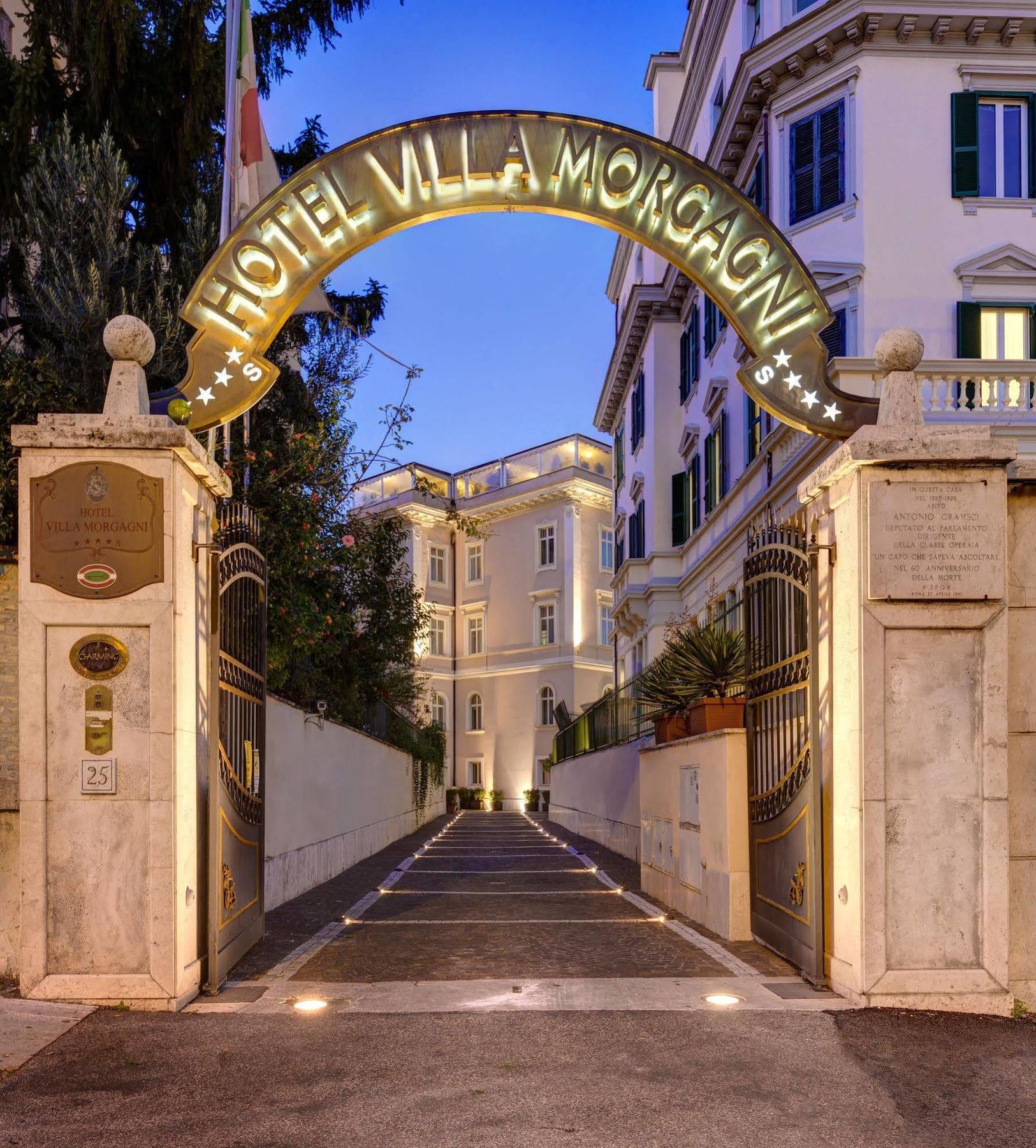
The company operating from the same address as the historic Rome hotel has been in judicial liquidation since May 2025. Its financial statements show zero operating revenue from 2021 onwards and, for four consecutive years, approximately €236,000–€242,000 per year in costs for the use of third-party assets. A historical cadastral extract, meanwhile, records the Vicariate of Rome as holding the entire property interest since March 2018. The contractual relationship between ownership and hotel operations, however, has yet to be fully reconstructed.
In hotel transactions, the name of the property can easily lead observers to assume that three legally and economically distinct elements are one and the same:
the real estate, the hotel business and the company operating it.
The case of Hotel Villa Morgagni in Rome provides a particularly useful example of why that assumption can be misleading.
The documentation now available allows the situation to be reconstructed with substantially greater precision than would be possible from online sources alone.
On one side is Hotel Villa Morgagni S.r.l. in liquidazione, the company subject to Judicial Liquidation Proceeding No. 405/2025 before the Court of Rome, opened on 29 May 2025. (portalecreditori.it)
On the other is a historical cadastral extract for the property at Via Giovanni Battista Morgagni 25, issued by the Italian Revenue Agency on 7 September 2026, which records a party other than the hotel company as holding the entire cadastral ownership interest since March 2018.
That distinction changes the way the case should be analysed.
The Property: What the Cadastral Records Actually Say
The historical cadastral extract identifies the property as:
Municipality of Rome – Sheet 594 – Parcels 13 and 14 – Subunit 501.
The address is Via Giovanni Battista Morgagni 25, and the property extends across the basement, ground, first, second, third and fourth floors.
Its cadastral category is D/2 – hotels and boarding houses, with a current cadastral income of €71,000.50.
Its hospitality use also has a documented history extending back more than twenty years.
On 23 January 2004, the cadastral records show a change of use expressly described as “RESIDENCE-HOTEL”, after which the property was classified in category D/2.
This is therefore not merely a property historically marketed under a hotel name.
From a cadastral perspective, the asset continues to be identified as a hotel property.
The Key Finding: Cadastral Ownership
The ownership history contained in the cadastral record provides the most significant piece of information in the dossier.
Between 14 February 2017 and 9 March 2018, the extract records:
Vicariate of Rome: 2/3
and
Orsola Del Favero: 1/3.
From 9 March 2018, however, the document records:
VICARIATE OF ROME – ownership interest 1/1.
The change derives from a deed of partition dated 9 March 2018, executed before Notary Carlo Cavicchioni, repertory No. 79,375 and recorded with the Rome 1 Land Registry.
This allows us to make one very precise statement:
The historical cadastral extract records the Vicariate of Rome as holding the entire cadastral ownership interest in the property at Via Giovanni Battista Morgagni 25 from 9 March 2018.
That should not, however, be converted automatically into a definitive legal opinion on current title.
To establish legal ownership conclusively, continuity of registrations must still be checked through the Italian Land Registry – Conservatoria dei Registri Immobiliari.
In a dossier involving insolvency proceedings, that distinction is not merely technical.
It is essential.
The Hotel Company Tells a Different Story
Hotel Villa Morgagni S.r.l., tax code and VAT number 13924211009, was incorporated in 2016, with its registered office at the same address — Via Giovanni Battista Morgagni 25 — and an ATECO classification of 55.10.00, covering hotels and similar accommodation services.
The creditors’ portal currently lists the company as Hotel Villa Morgagni S.r.l. in liquidazione, under Judicial Liquidation Proceeding 405/2025, opened on 29 May 2025.
Ettore Caratozzolo is listed as the insolvency trustee and Francesca Vitale as the delegated judge. At the date of our latest review, the portal did not contain publicly uploaded documents setting out the assets of the insolvency estate. (portalecreditori.it)
We can therefore document that:
the hotel company is in judicial liquidation.
We cannot, on that basis, state that:
the hotel real estate forms part of the judicial liquidation estate.
Those are two entirely different propositions.
Six Years of Financial Statements Show How the Business Deteriorated
The available corporate financial report provides data covering the period from 2018 to 2023.
| Year | Operating Revenue | EBITDA | Net Profit / Loss |
|---|---|---|---|
| 2018 | €961,270 | €62,220 | -€17,510 |
| 2019 | €873,940 | €84,150 | €8,030 |
| 2020 | €106,660 | -€372,400 | -€411,770 |
| 2021 | €0 | -€370,970 | -€302,710 |
| 2022 | €0 | -€112,590 | -€112,600 |
| 2023 | €0 | -€11,530 | -€11,770 |
Operating revenue therefore fell from almost €874,000 in 2019 to approximately €107,000 in 2020, before falling to zero in 2021, 2022 and 2023.
This corporate accounting evidence is considerably stronger than simply relying on legacy hotel listings that remain visible online.
From 2021 onwards, according to the financial statements reviewed, Hotel Villa Morgagni S.r.l. generated no operating revenue.
The €240,000-a-Year Line Item That Deserves Attention
The income statement contains an even more interesting figure.
The item “costs for the use of third-party assets” was recorded as follows:
2018: €236,370
2019: €241,900
2020: €236,940
2021: €236,600
before falling to:
2022: €38,430
2023: €0.
For four consecutive financial years, the company therefore incurred an extremely stable cost of between €236,000 and €242,000 per year, equivalent to approximately €20,000 per month.
What happened in 2021 is even more striking:
operating revenue: zero
while
costs for the use of third-party assets: €236,600.
That is a highly relevant accounting signal.
But it would be wrong to draw a conclusion that the available documentation does not yet support.
We cannot currently state that the €236,600 represented the rent paid for Hotel Villa Morgagni.
Under Italian accounting rules, “costs for the use of third-party assets” may include several different components, including leases, rentals, leasing arrangements and hire charges.
Determining the precise nature of that expenditure requires the notes to the financial statements and, ideally, the underlying contract.
Nevertheless, the combination of an exceptionally stable annual third-party-asset cost and a property cadastrally registered to a different entity makes the issue particularly worthy of further investigation.
OpCo and Real Estate: What We Can — and Cannot — Conclude
The documents now allow a much more precise interpretation.
The company generating the hotel revenue does not appear in the acquired cadastral extract as the registered holder of the property.
At the same time, that company recorded a material and recurring cost for the use of third-party assets.
These elements are consistent with a structure in which the hotel company operated as an OpCo using an asset belonging to a separate entity.
But “consistent with” is not the same as “proven”.
The contract governing the relationship has not yet been obtained.
It could have involved:
a real estate lease, a business lease, another contractual structure, or a combination of different arrangements.
Accordingly, this article does not attribute to the hotel company a contractual role that has not yet been established by documentary evidence.
The Company’s Balance Sheet Also Deteriorated Rapidly
The movement in shareholders’ equity is particularly significant.
Net equity declined from:
€222,880 in 2019
to
€140,490 in 2020
before turning negative:
-€62,330 in 2021
-€174,920 in 2022
and ultimately:
-€789,330 in 2023.
Total liabilities were approximately:
€599,000 in 2019
€486,000 in 2020
€683,000 in 2021
€782,000 in 2022
€809,000 in 2023.
The company’s economic and financial deterioration therefore clearly predates the opening of judicial liquidation proceedings in May 2025.
Those figures do not, however, establish the legal or economic causes of insolvency.
That question requires the insolvency documentation itself.
In 2023, the Fixed Assets Disappear
Another development deserves particular attention.
Tangible fixed assets were reported at:
€366,300 in 2018
€326,470 in 2019
€284,960 from 2020 through 2022
and finally:
€0 in 2023.
Intangible fixed assets similarly declined from €257,560 in 2022 to zero in 2023.
Total fixed assets therefore fell from €542,520 to zero in a single financial year.
This is clearly relevant.
But once again, a rigorous analysis must stop short of speculation.
Without the notes to the financial statements, it is not possible to determine whether the reduction resulted from:
disposals, write-downs, derecognition, termination of contractual relationships or other accounting events.
The explanation must come from the documents.
Not from assumption.
By 2023, Very Little Remained on the Asset Side of the Balance Sheet
At year-end 2023, the report shows total assets of approximately €19,880.
Total liabilities, meanwhile, were approximately €809,210.
Cash and cash equivalents were reported at just €26, while the current ratio stood at 0.03.
These numbers describe the deterioration of the company.
They do not describe the value or financial position of the real estate.
That may be the most important distinction in the entire Villa Morgagni case.
Liquidation of the Company Does Not Mean Sale of the Hotel
At the date of this analysis, we have identified no documented auction of the Hotel Villa Morgagni property.
The creditors’ portal confirms the judicial liquidation of the company, but currently publishes neither an inventory nor a liquidation programme from which the inclusion of Via Morgagni 25 in the insolvency estate could be inferred. (portalecreditori.it)
At the same time, the cadastral documentation reviewed records a different entity as the holder of the property.
It would therefore be incorrect to use expressions such as:
“Hotel Villa Morgagni up for auction”
or
“The Vicariate is selling Villa Morgagni.”
None of the documents currently available supports either statement.
The documented position is different:
the hotel operating company is in judicial liquidation, while the property is cadastrally registered to the Vicariate of Rome.
What happened to the contractual relationship between those two layers remains to be reconstructed.
What Is the Real Question Surrounding Villa Morgagni?
It is not:
“How much is the hotel worth?”
It is too early to answer that responsibly.
Nor is it:
“When will the hotel go to auction?”
No documented property auction currently exists.
The more appropriate question is:
What economic and contractual relationship existed between the owner of the real estate and the company operating the hotel, and what use could now be made of the property?
Answering that question requires four further pieces of documentation.
The first is a Land Registry search, necessary to confirm current legal title, continuity of registrations and any mortgages, attachments or other encumbrances.
The second is the deed of partition dated 9 March 2018, repertory No. 79,375, referred to in the cadastral extract.
The third consists of the notes to the financial statements, which are essential to understanding both the approximately €240,000 per year of third-party-asset costs and the disappearance of fixed assets in 2023.
The fourth is the inventory and liquidation programme for Judicial Liquidation Proceeding No. 405/2025, once available.
Only after those documents have been reviewed will it be possible to close the circle.
Why Real Estate and Hotel Operations Must Always Be Analysed Separately
The Villa Morgagni case illustrates a fundamental principle in hotel investment.
The failure of the operator does not automatically imply distress at the property-owning entity.
A management or operating company may incur losses, accumulate liabilities and ultimately become insolvent while the real estate remains legally and financially separate.
Equally, a hotel property can retain:
its location, its hospitality use and its economic potential
even after the previous operating business has ceased.
A proper analysis should therefore always separate:
real estate → ownership → contract → OpCo → hotel performance.
This is the approach applied to the transaction and special-situations analyses published by InvestimentiAlberghieri.it and to the industrial and turnaround work developed through Investhotel.it.
The operating sustainability and potential repositioning of an asset require a separate hospitality assessment, consistent with the work carried out by HotelManagementGroup.it.
Further analysis of the hotel industry, corporate governance and hospitality operating models is available at RobertoNecci.it.
Conclusion: The Documents Change the Story
At first glance, Villa Morgagni could have appeared to be simply another hotel associated with a company that later entered judicial liquidation.
The documents tell a more complex story.
Hotel Villa Morgagni S.r.l. is in judicial liquidation.
Its operating revenue has been zero since 2021.
For several years, the company recorded approximately €236,000–€242,000 per year in costs for the use of third-party assets.
The historical cadastral extract identifies the hotel property as category D/2 and records the Vicariate of Rome as holding the entire cadastral ownership interest from 9 March 2018.
These are separate facts.
And it is precisely by bringing them together — without conflating them — that the real question emerges.
What contractual relationship linked the property to the hotel operating company, and what is the future of Villa Morgagni?
The answer is not yet contained in the documents currently available.
But we now know precisely which documents are required to find it.
Methodological and Legal Notice
This article is a journalistic and professional analysis based on corporate, cadastral and judicial documentation reviewed as of the date of publication.
The reference to the Vicariate of Rome derives exclusively from the historical cadastral extract obtained and is therefore described as a cadastral registration. No definitive legal opinion is expressed as to current legal title, which would require verification through the Italian Land Registry.
The accounting item “costs for the use of third-party assets” is reported exactly as reflected in the available financial data and is not characterised as rent for the Hotel Villa Morgagni property, because neither the underlying contract nor the relevant notes to the financial statements have yet been reviewed.
This article does not state that the property forms part of the assets of Judicial Liquidation Proceeding No. 405/2025, does not state that the property is currently being marketed for sale and does not state that any real estate auction exists.
Any interpretation of the hotel company as an OpCo is presented solely as an economic and legal reading consistent with the documentation currently available and remains subject to verification of the underlying contractual arrangements.
All financial figures quoted relate to Hotel Villa Morgagni S.r.l. and should not be interpreted as either a valuation of the property or an indication of the financial position of the party cadastrally registered in respect of the real estate.
CONTACT
Hotel owners, investors, lenders, funds, servicers and operators interested in hotel assets, distressed situations, restructuring, turnarounds, UTP/NPL exposures and PropCo/OpCo structures may request a confidential analysis.
info@investimentialberghieri.it
DOCUMENTARY SOURCES
Italian Revenue Agency – Rome Provincial Office, Territory Division – Cadastral Services
Historical cadastral extract, application T306922/2026 dated 7 September 2026. Sheet 594, Parcels 13 and 14, Subunit 501. Category D/2.
Italian Revenue Agency – Historical Cadastral Ownership Records
Historical cadastral extract recording the Vicariate of Rome as holding the entire cadastral ownership interest from 9 March 2018, pursuant to the deed of partition referenced in the document.
ReportAziende – Hotel Villa Morgagni S.r.l.
Corporate and financial report covering 2018–2023, including income statement, balance sheet, financial indicators and corporate structure.
Creditors’ Portal – Judicial Liquidation Proceeding No. 405/2025
Hotel Villa Morgagni S.r.l. in liquidazione, Court of Rome, proceeding opened on 29 May 2025. (portalecreditori.it)