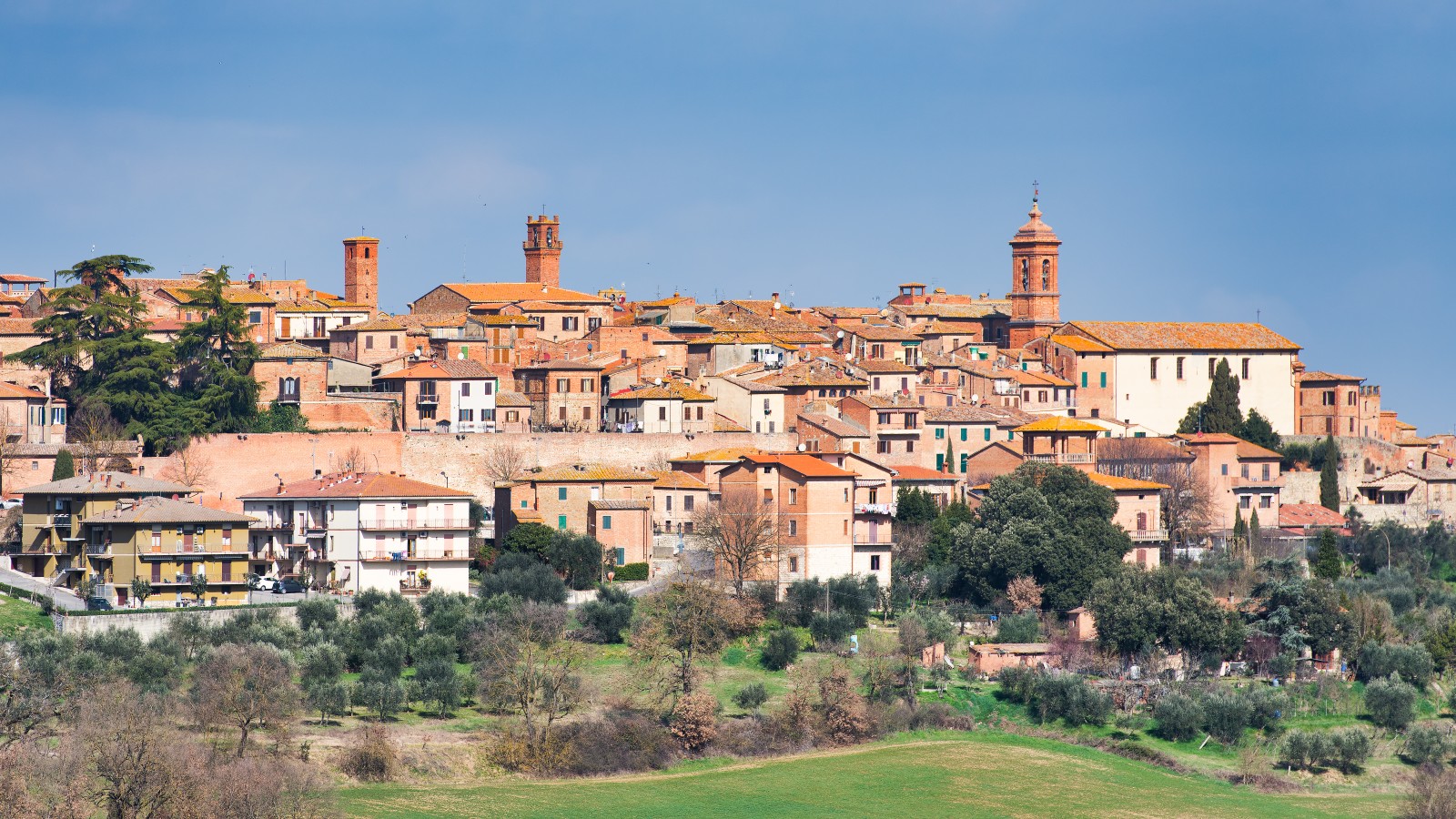
Nine rooms, restaurant and bar facilities, wellness space, a consecrated chapel and a medieval building in the heart of Tuscany. Minimum bid: €1.096 million.
A hospitality opportunity is coming to market in Torrita di Siena that cannot be assessed simply on a price-per-key basis.
The property at Passeggio Giuseppe Garibaldi 52, associated with the hospitality venue known as Il Convento, is being offered for sale as part of the judicial liquidation of Guastini & Scortichini S.r.l., opened by the Court of Siena on 3 October 2024.
The competitive sale is scheduled for 21 October 2026, with a reserve price of €1.461 million and a minimum bid of €1.096 million.
But the key issue is not the million euros required to enter the transaction.
The real question is:
what exactly is the investor acquiring?
A small B&B?
A historic property?
A restaurant with rooms?
A platform for events and experiential hospitality?
Or a combination of assets whose value lies precisely in their ability to work together?
That is where the real investment analysis begins.
Investment case at a glance
Asset: historic hospitality and F&B property
Location: Torrita di Siena, Tuscany
Address: Passeggio Giuseppe Garibaldi 52
Company in proceedings: Guastini & Scortichini S.r.l.
Proceeding: Judicial Liquidation no. 32/2024 – Court of Siena
Rooms: 9, including 3 with living area and kitchen
Facilities: restaurant, bar, professional kitchen, wellness area, lift and chapel
Reserve price: €1,461,400
Minimum bid: €1,096,050
Sale date: 21 October 2026
Investment profile: historic hospitality / value-add / experiential repositioning
An asset worth more than its nine rooms
The available documentation describes a historic property of medieval origin previously used for restaurant and bar operations, B&B accommodation and professional guesthouse activities.
The complex extends across several levels and includes:
-
nine guestrooms;
-
three units with a living area and kitchen;
-
professional kitchen;
-
bar area;
-
communal spaces;
-
wellness area with sauna and whirlpool;
-
lift;
-
consecrated chapel;
-
underground spaces;
-
historic architectural features;
-
movable assets included within the scope of the proceeding.
The property therefore combines hospitality, food & beverage, history and experiential spaces in a format that would be difficult to replicate.
And it is precisely this combination that makes a simple price-per-key calculation of limited value.
The first mistake would be to divide the price by nine rooms
Dividing the minimum bid of €1,096,050 by nine rooms produces a figure of more than €121,000 per key.
At first sight, that may appear high for a small property outside a prime hotel market.
But that would be an incomplete reading of the investment.
The rooms represent only one part of the proposition.
The investor is also acquiring:
-
an F&B platform;
-
event space;
-
ancillary areas;
-
wellness facilities;
-
a historic property;
-
an architectural identity that would be difficult to recreate elsewhere.
The relevant metric is therefore not:
Purchase Price / Rooms
but rather:
Total Investment Cost / Stabilised EBITDA.
At InvestimentiAlberghieri.it, we consistently make the same distinction: real estate value, operating value and income-generating capacity do not automatically coincide.
The real investment case is the revenue mix
With only nine rooms, it is difficult to envisage an economically sustainable operation based solely on RevPAR.
The real potential of the asset depends on the ability to create a diversified revenue mix.
The key question is not:
“How much revenue can nine rooms generate?”
It is:
“How much revenue can the entire hospitality platform generate?”
That is a fundamentally different proposition.
Value could be generated through:
-
accommodation;
-
restaurant operations;
-
events;
-
exclusive-use bookings;
-
retreats;
-
experiential stays;
-
destination-led activities.
The rooms may therefore be one component of the product rather than the product itself.
Three credible strategic scenarios
1. Boutique historic hospitality
The first scenario is a small-scale boutique hotel built around the historic identity of the property.
Its location provides access to a much broader Tuscan destination ecosystem encompassing Valdichiana, Val d’Orcia, Montepulciano and Siena.
The strategy would need to focus less on volume and more on:
-
authenticity;
-
design;
-
food and wine;
-
experience;
-
premium ADR.
The principal limitation is scale.
2. Hospitality + destination restaurant
This is arguably the most compelling scenario.
The economics of the property could become significantly stronger if the restaurant were able to generate demand independently of the guestrooms.
The investment thesis would shift from:
“a nine-room hotel”
to:
“a destination restaurant with nine integrated rooms.”
In such a model, hospitality and F&B reinforce one another, and total revenue per guest becomes more important than RevPAR alone.
3. Exclusive use, events & experiential hospitality
The nature of the property could also support:
-
intimate weddings;
-
private celebrations;
-
retreats;
-
family gatherings;
-
selected corporate events;
-
full-property buyouts;
-
bespoke stays.
For a property of this scale, selling the entire venue may at times be more efficient than selling individual rooms.
The combination of a professional kitchen, restaurant spaces, chapel and historic interiors makes this scenario particularly worthy of analysis.
The real risk: complex-property costs with micro-hotel revenues
This is where the central challenge lies.
A nine-room operation still has to carry a meaningful fixed-cost base:
-
housekeeping;
-
maintenance;
-
management;
-
marketing;
-
distribution;
-
administration;
-
kitchen operations;
-
restaurant service;
-
upkeep of a historic building.
If the business model remains predominantly room-led, the risk of operational inefficiency is significant.
The answer is not necessarily to reduce services.
It may be to monetise them more effectively.
That is why the operating model needs to become genuinely multi-revenue.
Real estate, operating platform and goodwill are not the same thing
This is arguably the most important point in the entire transaction.
Acquiring the property does not automatically mean acquiring the previous operating business.
An investor needs to distinguish between:
Real Estate
The physical property.
Operating Platform
Licences, systems, contracts, organisation and operating infrastructure.
Goodwill
Brand, reputation, customer database, distribution channels and commercial track record.
These are three separate components.
The historic presence of “Il Convento” should therefore not automatically be capitalised in the business plan as though the brand, reputation and customer base were unquestionably included and transferable.
This distinction is also central to the investment analysis carried out by Investhotel.it and the advisory work of Hotel Management Group.
A historic property cannot become an excuse for weak economics
The emotional appeal of the asset is significant.
Historic architecture, stone walls, underground spaces and a chapel provide obvious commercial differentiation.
But they can also create a familiar investment mistake:
falling in love with the building before validating the business model.
Architectural beauty is not a substitute for a business plan.
Before acquisition, the investor should assess at least:
-
demand;
-
achievable ADR;
-
occupancy;
-
F&B potential;
-
event revenues;
-
staffing costs;
-
maintenance;
-
CAPEX;
-
working capital;
-
distribution costs;
-
terminal value.
At Robertonecci.it, hotel value creation is consistently approached from this principle:
a property can be exceptional and still represent a mediocre investment if the business operating within it cannot generate sufficient cash flow.
The number that really matters is Total Investment Cost
The €1.096 million minimum bid is only the entry point.
On top of that, an investor must consider:
-
acquisition costs;
-
potential CAPEX;
-
FF&E requirements;
-
pre-opening expenditure;
-
marketing;
-
operating systems;
-
working capital;
-
cost of capital.
The correct equation is:
Acquisition + CAPEX + FF&E + Pre-opening + Working Capital + Financing Cost = Total Investment Cost
Only then should the other side of the equation be built:
Stabilised Revenue → GOP → EBITDA → Stabilised Asset Value.
If those figures are aligned, the investment may create value.
If they are not, the appeal of the property becomes economically irrelevant.
Our view
Il Convento in Torrita di Siena should not, in our view, be assessed as a conventional nine-room hotel.
It is an experiential hospitality platform.
Its potential value lies in the ability to combine:
hospitality + F&B + events + experiences + the uniqueness of the real estate.
The room component alone is unlikely to justify the entire investment.
But if the property can successfully monetise several revenue centres, its economic profile could change significantly.
This is why price per key tells us relatively little.
The more relevant measures are:
Total Investment Cost / Stabilised EBITDA
followed by:
Stabilised EBITDA / Exit Value
These relationships—not the judicial sale price—will ultimately determine the quality of the investment.
In one sentence
What is being sold in Torrita di Siena is not simply nine rooms: it is the opportunity to transform a historic property into a hospitality platform capable of monetising accommodation, F&B, events and experience.
That is where the true value of the transaction may lie.
Analysis and advisory
InvestimentiAlberghieri.it, together with Investhotel.it, Hotel Management Group and Robertonecci.it, analyses hotel investments, distressed assets, value-add transactions and turnaround opportunities through business planning, valuation, CAPEX analysis, due diligence and repositioning strategies.
For confidential analysis of hotel assets and investment opportunities:
info@investimentialberghieri.it