Rimini enters Kerten Hospitality’s radar
Kerten Hospitality’s interest in Rimini is not just another piece of tourism news. It is a market signal.
According to Il Resto del Carlino, after Cloud7 Rome and its project in the Orobie Alps, the international hospitality group has also turned its attention to Rimini, listing the city among several Italian destinations of interest, alongside Florence, Sicily and Forte dei Marmi.
The most relevant point, however, is another one: in Rimini, the group has reportedly already identified a property suitable for bringing its holiday concept to life.
That detail changes the way the news should be read.
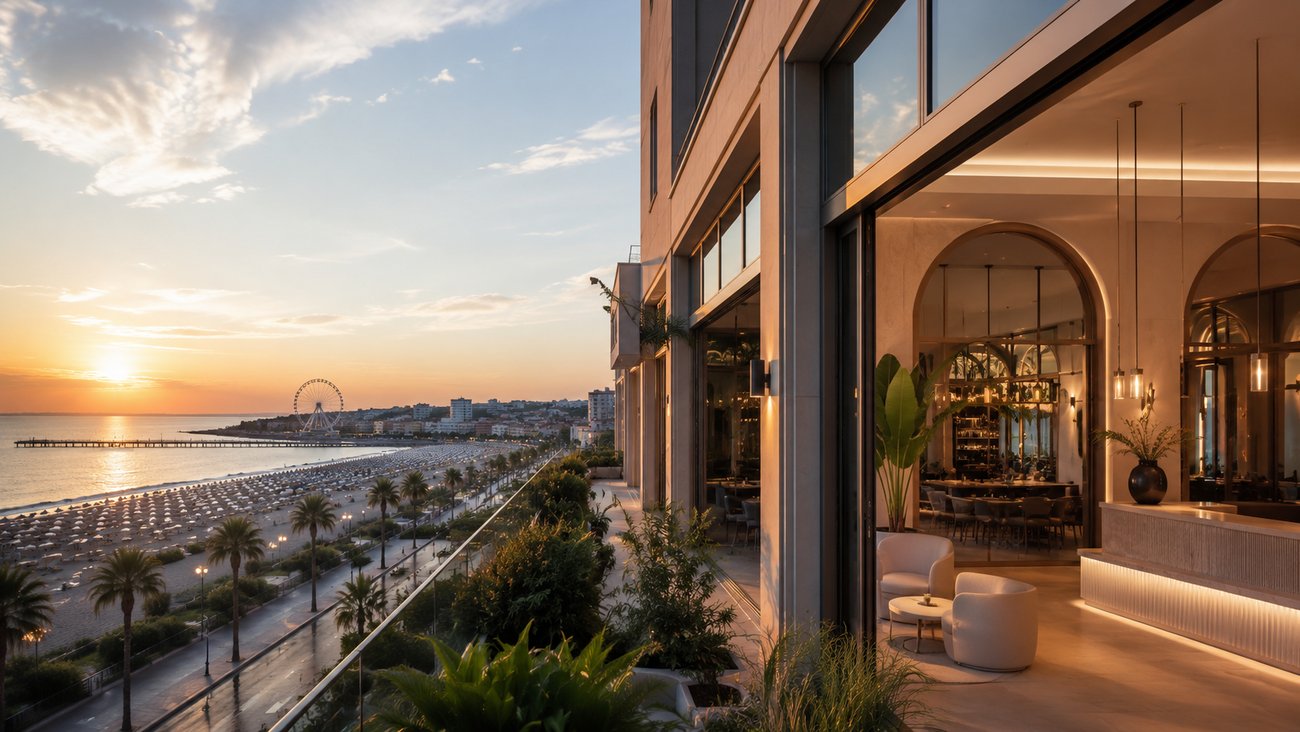
It suggests that Rimini is no longer being viewed only as a historic seaside destination, but as a potential platform for a new lifestyle hospitality project. One capable of combining hotel regeneration, product repositioning, international management and real estate value creation.
For the hotel investment market in Rimini, this is an important signal.
To explore further hotel transactions, market trends and investment dynamics, visit the Investimenti Alberghieri blog.
Why This News Matters for the Hotel Market
Whenever an international operator looks closely at a destination, the market should always ask why.
In Rimini’s case, the answer is far from obvious.
The city has a powerful hotel tradition, strong brand awareness and a very extensive accommodation base. At the same time, however, it represents one of the major themes in Italian hospitality: the need to evolve part of the existing hotel supply.
Many hotels on the Riviera are still operating, often in good locations, but they are not always aligned with the expectations of today’s demand. Some properties need new concepts, new standards, new operating models and a different positioning strategy.
This is precisely where value can be created.
A hotel is not worth only what it generates today. It is also worth what it can become if it is reimagined correctly.
That is the logic investors are interested in: not simply buying a property, but transforming a hotel asset into a product capable of generating revenue, reputation, margins and long-term capital value.
Who Is Kerten Hospitality and What Model Could It Bring to Italy?
Kerten Hospitality is an international group headquartered in Dubai, with Irish roots. According to press reports, it currently manages eleven properties and has a significant pipeline of projects that could expand its presence across several continents, including the Middle East, Africa and Europe.
But the key point is not only the size of the group.
The key point is the model.
Kerten appears to move in a different direction from large-scale standardised hospitality. Its interest does not seem to focus exclusively on large properties, extensive room counts or formats that can be replicated uniformly everywhere. Instead, the model appears to favour projects with identity, character, experience quality and a strong connection with the destination.
In other words: less “hotel as a container”, more hotel as a recognisable experience.
This approach is consistent with a trend that is now clearly visible across the international market. The value of a hotel no longer derives only from the number of rooms, its location or its official category. It increasingly depends on the ability to create a product that is marketable, memorable, narratively strong and aligned with more sophisticated demand.
A smaller hotel, if properly conceived, can generate more value than a larger property with no clear identity.
Can Rimini Become a Lifestyle Destination?
The central question is this: can Rimini become an attractive destination for upper-end tourism?
The answer is yes, but on one condition: it should not try to imitate destinations with a completely different history.
Rimini is not Capri. It is not Portofino. It is not Forte dei Marmi. And it does not need to become any of them.
Its potential strength lies elsewhere: in its ability to develop its own idea of evolved hospitality — more contemporary, more informal, more experiential.
Hotel luxury today is no longer defined only by marble, formality, grand lobbies and five-star classifications. Contemporary luxury can mean design, authenticity, wellbeing, personalised service, sleep quality, food and beverage, connection with the local area, local experiences and the freedom to enjoy a destination in a less conventional way.
From this perspective, Rimini has far more potential than a superficial reading might suggest.
It has the sea, strong recognisability, an established tourism system, infrastructure, events, popular culture, collective memory, nightlife, restaurants and a hotel stock that can be reinterpreted.
The challenge is to turn these elements into a coherent product.
The Real Theme Is Hotel Regeneration
Kerten Hospitality’s interest in Rimini brings a decisive issue to the centre of the discussion: hotel regeneration.
Across many Italian destinations, there are hotels that still have market appeal, location and potential, but are no longer able to fully express their value. These properties were often created for a different kind of demand, at a time when tourism was more standardised, distribution was less complex and international competition was less aggressive.
Today, the market has changed.
Guests compare destinations, experiences, reviews, images, services and prices in real time. A hotel no longer competes only with the properties on the same street, but with national and international alternatives.
For this reason, a simple aesthetic refurbishment is not enough.
Hotel regeneration requires an integrated vision: destination analysis, demand assessment, asset evaluation, concept definition, investment planning, business planning, operating model, commercial strategy, distribution, brand positioning and margin control.
Value is created through the combination of these elements.
And this is precisely why the interest of an international operator in Rimini matters: it signals the possibility of transforming existing properties into new hotel products that are more competitive, more profitable and more relevant to contemporary demand.
For those wishing to explore hotel management, development, positioning and asset enhancement in greater depth, the hotel guides by Roberto Necci are also available.
Hotels for Sale in Rimini: Value Is Not Just About Price
The news also opens up a broader reflection on hotels for sale in Rimini and, more generally, on the valuation of hotel real estate in mature destinations.
In a market such as Rimini, the price of a hotel cannot be interpreted solely through traditional real estate metrics. Square metres, number of rooms and proximity to the beach are not enough.
A sophisticated investor looks above all at potential.
A hotel may have limited value when analysed on the basis of its current operation, but far greater value if it is included in a repositioning project. Conversely, a property that appears attractive at first sight may be less interesting if it requires excessive investment, is affected by planning constraints, has an inefficient layout or does not allow for a product aligned with target demand.
The real question, therefore, is not simply: how much does the hotel cost?
The real question is: what can this hotel become?
Can it become a lifestyle hotel? Can it operate beyond the beach season? Can it attract international guests? Can it increase ADR and RevPAR? Can it generate sustainable margins? Can it become a more liquid and more attractive asset in the market?
These are the questions that determine real value.
What This Means for Owners and Investors
For hotel owners, the message is clear: a hotel should not be evaluated only on the basis of its current performance, but also on its transformation potential.
For investors, Rimini shows that opportunities are not found only in destinations already positioned at the luxury end of the market, but also in mature markets where there are assets ready to be regenerated.
For hotel operators, this news confirms that the future lies in the ability to create recognisable products, not simply refurbished rooms.
For tourism destinations, the message is even broader: hotel redevelopment can become a tool for territorial repositioning.
Why International Operators Look at Mature Destinations
Mature destinations such as Rimini present an apparent contradiction.
On the one hand, they are complex markets, with dated properties, strong competition, seasonality and a reputation often linked to past tourism models. On the other hand, these very characteristics can create opportunity.
Where a market has already been fully repositioned, prices are often high and the scope for value creation may be more limited. Where, instead, there is hotel stock to be reimagined, investors may find room to create value through transformation.
This is the principle of regeneration: not simply buying what already works, but identifying what could work better.
From this point of view, Rimini has an interesting characteristic. It is a known, well-infrastructured destination with an established demand base. It does not need to be invented from scratch. It needs, where appropriate, to be repositioned for specific segments.
That makes the city potentially attractive to operators capable of introducing new standards, new brands and new forms of hospitality.
Luxury Tourism in Rimini: Opportunity or Overstatement?
Speaking of luxury tourism in Rimini may, at first glance, seem like an overstatement.
In reality, it depends on what we mean by luxury.
If luxury means absolute exclusivity, low density, isolation and formality, Rimini is probably not the most natural destination. But if luxury is understood in a more contemporary sense — experiential, accessible, informal and lifestyle-driven — then the perspective changes.
A segment of international tourism does not necessarily look for rigid, overly formal destinations. It looks for places that are lively, recognisable, authentic, well serviced and supported by a well-designed hotel product.
Rimini could intercept precisely this type of demand, especially if certain assets were reimagined with a more international logic.
This is not about replacing traditional tourism. It is about adding new, higher-spending segments alongside it.
That is the strategic point: value growth does not necessarily come from abandoning the destination’s historic identity, but from evolving it.
The Seasonality Challenge
Every hotel project in Rimini must, however, address one fundamental issue: seasonality.
The seaside remains an important demand driver, but on its own it is not enough to sustain complex investment projects, especially when significant capex and higher quality standards are involved.
A lifestyle or upscale project must therefore ask one essential question: how can demand be generated beyond the summer months?
There are several possible answers: events, wellness, food and beverage, corporate leisure, long weekends, cultural tourism, small meetings, local experiences, partnerships with the territory, community building and digital content.
Economic sustainability will depend on the ability to build a model that does not rely solely on the peak season.
This is what separates a simple restyling exercise from a genuine hotel investment project.
The Role of Brand and Concept
One of the most important elements in any hotel regeneration project is the definition of the concept.
A repositioned hotel cannot simply offer renovated rooms. It needs a clear promise.
What type of guest does it want to attract? What experience does it want to offer? Which rate segment does it want to occupy? What role will food and beverage, design, wellbeing, technology and services play? What relationship will it have with the destination? What story will it take to market?
Without clear answers, the risk is to make significant investments without creating any real competitive difference.
In this sense, the brand is not just a logo. It is a strategic synthesis. It is the way the hotel is perceived, chosen, described and remembered.
An international operator can bring precisely this: method, standards, distribution, vision and the ability to build a product that is legible to the global market.
Rimini as a Laboratory for Italian Hospitality
Rimini could become an interesting case not because it is a perfect destination, but because it contains many of the contradictions of Italian hospitality.
It has a great hotel tradition, but part of its supply needs to evolve.
It has strong tourism demand, but needs to increase average value.
It has international awareness, but needs to update its positioning.
It has many properties, but not all are suited to future demand.
It has a strong identity, but must turn that identity into contemporary value.
These characteristics make it a laboratory.
If operators such as Kerten Hospitality were to actually invest in or develop projects in the destination, the effect could go beyond a single hotel. It could help redefine the quality benchmark and stimulate further redevelopment projects.
In mature destinations, one successful project is often enough to change how the market perceives the entire area.
The Signal for the Italian Hotel Market
This news confirms a broader trend: Italy remains one of the most attractive destinations for international hospitality operators.
But interest is no longer limited to Rome, Milan, Venice, Florence or the most established luxury locations. Increasing attention is being paid to destinations where there is an interesting balance between awareness, tourism potential, asset availability and repositioning opportunities.
This applies to Rimini, but it may also apply to other coastal areas, mid-sized cities, spa destinations, evolved villages, lake destinations and territories with a strong identity but still fragmented hotel supply.
The future of hotel investment in Italy will be shaped, to a large extent, by the ability to read existing assets not for what they used to be, but for what they can become.
Conclusion: Kerten in Rimini Is a Clue to the New Hotel Cycle
Kerten Hospitality’s interest in Rimini should not be interpreted as an isolated episode. It is a clue to the new cycle of the Italian hotel market.
A cycle in which value will not be generated only by new developments or trophy hotels in iconic destinations, but also by the intelligent regeneration of existing properties in high-potential markets.
Rimini represents this possibility well.
It is a known, strong, popular destination, yet still capable of evolving. It has properties to reimagine, demand to segment and an identity that can be reinterpreted through a lifestyle lens.
For owners and investors, the message is clear: hotel value is not always visible in today’s numbers. It is often hidden in the possibility of transforming an ordinary asset into an extraordinary product.
And that is precisely where true hotel investment is created.
Looking to Assess or Reposition a Hotel Asset?
If you own, manage or are evaluating a hotel to acquire, sell, lease or reposition, Hotel Management Group can support you in analysing its potential, defining the concept, assessing the financial feasibility and building a value creation strategy.
From hotel due diligence to business planning, from product repositioning to identifying the most suitable operating model, the objective is to transform the property into a sustainable, competitive project aligned with the market.
Learn more at hotelmanagementgroup.it.