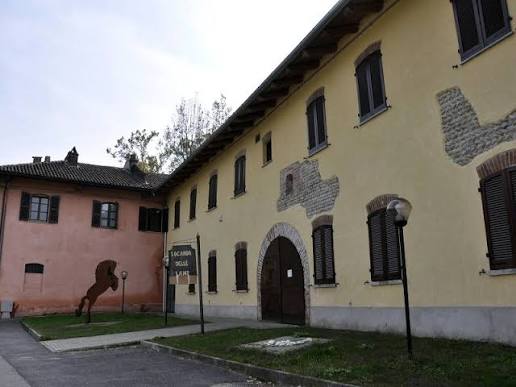
€400 per month to take over the operation of a hospitality property with guestrooms, restaurant and bar, set within a historic country building surrounded by the Piedmont countryside.
At first glance, the search for a new operator for Locanda delle Lame, in Albano Vercellese, may appear to be one of those opportunities where the principal competitive advantage is an exceptionally low real estate cost.
Yet that is precisely the figure most likely to be misunderstood.
The Management Authority for the Protected Areas of the Ticino and Lake Maggiore published an expression-of-interest notice on 29 August 2026 to identify a new tenant for the property, located at Via XX Settembre 8/10, close to the Lame del Sesia Natural Park.
The base rent is:
€400 per month.
Equivalent to:
€4,800 per year,
plus any applicable taxes and charges.
Expressions of interest must be submitted by 12:00 noon on 25 September 2026.
But treating €4,800 per year as the “cost of operating the property” would be financially misleading.
Because the true entry cost is not the rent.
It is the Total Operating Commitment required to turn the property into a hospitality business capable of generating a sustainable margin.
First Clarification: This Is a Lease, Not a Service Concession
This distinction matters.
The official documentation expressly states that the procedure concerns the lease of the property and does not constitute either a public-service concession or the outsourcing of a public service.
The future tenant will therefore conduct the business:
independently, under its own responsibility and assuming the associated costs and risks.
From an investment perspective, what may appear to be a legal distinction fundamentally changes the underwriting.
The public-sector owner provides the asset.
The operator must build the business.
The structure can therefore be summarised as follows:
public ownership of the property
↓
lease to a private operator
↓
operating risk transferred to the tenant
↓
revenue from rooms + restaurant + bar
↓
OPEX
↓
operator profit.
Locanda delle Lame should therefore be assessed as a genuine operating investment opportunity within hospitality.
What Does Locanda delle Lame Include?
The official documentation identifies two principal components.
The ground floor contains the areas intended for:
-
bar operations;
-
restaurant operations.
The first floor contains the accommodation component, consisting of guestrooms.
The property also includes ancillary areas and additional spaces identified in the technical documentation.
Historically, the provincial register of tourist accommodation classified Locanda delle Lame as a three-star hotel with 7 rooms and 17 beds.
However, as that information dates back to 2018, the current configuration should be independently verified before using it in a 2026 business plan.
That is one of the first matters a serious prospective operator should investigate during the property inspection.
€400 per Month: The Figure That Attracts Attention but Does Not Measure the Investment
The rent is unquestionably low.
On an annual basis:
€400 × 12 = €4,800.
But nominal property cost is only one component of the economics.
Under the terms of the notice, the future tenant will be directly responsible for at least:
-
utilities and consumption;
-
cleaning;
-
security and supervision;
-
routine maintenance;
-
administrative authorisations;
-
licences and SCIA filings;
-
health and hygiene compliance;
-
workplace and operational safety;
-
fire-safety requirements;
-
any required insurance;
-
all other costs arising from the operation of the business.
The correct equation is therefore not:
€400 = monthly cost of the opportunity.
It is:
€400 + OPEX + payroll + utilities + maintenance + compliance + marketing + working capital = true operating cost.
That is a significant difference.
And it is precisely the type of distinction that should underpin the opportunities analysed by InvestimentiAlberghieri.it.
From Rent Cost to Total Operating Commitment
The investment should therefore be analysed through a broader metric:
Total Operating Commitment
which can be expressed as:
rent
payroll
utilities
food cost
maintenance
housekeeping
insurance
administration
marketing and distribution
working capital
any initial investment
=
total operating capital required.
This is the figure that needs to be compared with potential revenue.
Not €400.
There Is Also an “Economic Rent” Above the Nominal Rent
The documentation imposes additional obligations.
The tenant will be required to provide the Authority with 30 complimentary overnight stays per year, under arrangements to be defined in the final contract.
The operator must also ensure that the property remains open throughout the year on a reservation basis, apart from limited closure periods agreed with the Authority.
Those closures cannot include major demand periods such as Easter, spring public-holiday weekends, summer months, Christmas or New Year.
Any weekly closing day must fall on a weekday and cannot be Saturday or Sunday.
The actual economics of occupancy therefore include:
cash rent
complimentary stays
opening obligations
service requirements.
In other words:
contractual rent is €400 per month, but the economic occupancy cost is higher.
That does not necessarily make the opportunity unattractive.
But it needs to be quantified.
The 30 Complimentary Nights Belong in the Business Plan
Consider a simple methodological example without assuming an ADR for the property.
If the future operator achieves an average room rate of X, the maximum theoretical opportunity cost of the 30 complimentary stays would be:
30 × ADR.
The real economic cost would naturally depend on when those rooms are used.
A complimentary room on a night when the property would otherwise have been empty carries a low marginal cost.
A complimentary room on a night when the hotel would otherwise have been sold out creates genuine displacement cost.
It may appear to be a minor detail.
It is not.
This is precisely how professional hospitality underwriting should be constructed.
The Real Question: How Much Demand Can a Small Country Inn Generate?
This is the most important issue.
A low rent reduces break-even.
But it does not create demand.
Locanda delle Lame is located in a natural setting close to the Lame del Sesia Natural Park.
The property could therefore potentially target:
-
nature tourism;
-
cycling tourism;
-
hiking;
-
weekend leisure;
-
slow tourism;
-
families;
-
small groups;
-
food and wine tourism;
-
local restaurant customers;
-
events;
-
territory-based experiences.
The challenge is turning those potential demand segments into:
room nights + restaurant covers + average spend.
That is where tourism description ends and investment analysis begins.
Guestrooms Alone May Not Be Enough
In a small hospitality property, limited room inventory can significantly constrain accommodation revenue.
The combination of:
guestrooms + restaurant + bar
may therefore be fundamental to the business model.
The restaurant should not necessarily be regarded merely as an amenity for hotel guests.
It could become a genuine standalone revenue centre, capable of attracting:
-
local residents;
-
walkers and cyclists;
-
visitors to the Park;
-
customers from the surrounding area;
-
events;
-
small groups.
For a small rural inn, the relationship may therefore work in reverse compared with a conventional hotel:
guestrooms do not necessarily feed the restaurant.
The restaurant may help feed demand for the guestrooms.
The Business Model Needs to Be Destination-Led
Locanda delle Lame is unlikely to compete through:
-
scale;
-
international branding;
-
MICE;
-
corporate travel.
It needs a different proposition:
destination + experience + food + nature.
The future operator should therefore answer a very straightforward question:
Why should somebody specifically choose this property?
The answer cannot simply be:
“because it is inexpensive to operate.”
Low rent matters to the operator.
It does not matter to the customer.
The guest needs a reason to travel to Albano Vercellese.
Low Rent Can Free Up Capital to Generate Demand
This is where the €400 monthly rent becomes genuinely interesting.
A hotel carrying a high property lease must allocate a meaningful proportion of revenue to the landlord.
Here, potentially, a greater share of cash flow can be allocated to:
-
marketing;
-
product enhancement;
-
staffing;
-
food quality;
-
maintenance;
-
distribution;
-
guest experiences.
A low fixed rent can therefore become a competitive advantage.
But only if the capital saved on rent is used to create demand.
Cheap rent without demand is not an investment strategy.
It is simply an inexpensive property to operate.
Break-Even Is the Critical Metric
Before submitting an expression of interest, a prospective operator should build a proper break-even model.
The starting formula is simple:
Fixed Costs
divided by
Contribution Margin %
equals
Break-even Revenue.
Fixed costs should include at least:
-
permanent staff;
-
rent;
-
insurance;
-
administration;
-
software;
-
scheduled maintenance;
-
fixed utility costs;
-
marketing;
-
professional fees.
The business should then be divided into at least two operating units:
Rooms
and
Food & Beverage.
Revenue and contribution margin should be assessed independently for each.
The Biggest Risk May Be Labour, Not Rent
Annual rent of €4,800 may be immaterial when compared with the payroll required to operate:
-
guestrooms;
-
housekeeping;
-
reception;
-
kitchen;
-
restaurant;
-
bar;
-
year-round opening.
This creates an interesting paradox.
The opportunity may initially appear to be real estate-driven.
But its principal risk may be entirely operational.
In other words:
landlord risk is low.
Labour risk may be high.
Particularly if the operator must ensure business continuity throughout the year.
Year-Round Opening: Opportunity or Cost?
The owner requires the property to remain open throughout the year on a reservation basis.
From the destination's perspective, this is understandable.
From the operator's perspective, it requires careful analysis.
A seasonal business can flex:
-
staffing;
-
utilities;
-
purchasing;
-
maintenance;
-
inventory.
A year-round operation must maintain a minimum operating platform even during weaker demand periods.
The operator therefore needs to measure:
Winter Contribution Margin.
If the contribution generated during low-season months is lower than the incremental cost required to remain open, the model has a problem.
The business plan—not the rent—must solve it.
Lease Duration Will Be Critical
The notice contains another important point.
The final lease term has not yet been definitively established.
The Authority refers to Italian commercial lease legislation and indicates minimum statutory durations of:
6 years for commercial activities;
9 years where the property is used for hotel activities.
The final contractual duration will be determined in subsequent documents according to the legal classification of the hospitality activity ultimately carried out.
For an investor, this is fundamental.
Because:
the more CAPEX the tenant must deploy, the longer the period required to recover it.
CAPEX and Contract Duration Must Be Underwritten Together
Suppose the inspection identifies a need to invest in:
-
kitchen equipment;
-
guestrooms;
-
furnishings;
-
technology;
-
outdoor areas;
-
operating equipment;
-
initial marketing.
The question should not be:
“Can we afford the investment?”
It should be:
“Can we recover it within the economically available contract period?”
The framework becomes:
Initial Investment
↓
Annual Free Cash Flow
↓
Payback Period
↓
Remaining Contract Life
↓
IRR.
A very low rent does not automatically compensate for a contract term that is too short relative to the capital invested.
The Site Inspection Matters More Than the Rent
The Authority allows interested parties to inspect the property and assess:
-
characteristics;
-
size and layout;
-
maintenance condition;
-
equipment;
-
operating conditions.
This may be the most important stage of the entire process.
Before making any offer, the prospective operator should carry out an:
Operational & Technical Due Diligence.
Using a very practical checklist:
What condition are the guestrooms in?
What is the condition of the kitchen?
Are the technical systems compliant and adequate?
What FF&E is missing?
What does reopening actually cost?
Which licences and approvals are still required?
Is there any deferred maintenance?
How much working capital is required for the first six months?
Without these answers, the €400 headline means very little.
The Real Entry Price Is the Restart Cost
For an existing hospitality property that needs to be returned to full operation, a second metric becomes critical:
Restart Cost.
This includes:
equipment
minor CAPEX
FF&E
licences
opening inventory
recruitment
launch marketing
working capital
=
capital required to reach the first day of trading.
That is the real entry ticket.
Not the first month's rent.
The Selection Process Is Also Worth Noting
The notice does not necessarily provide that the winning operator will simply be the party offering the highest rent.
If multiple expressions of interest are received, the Authority may also consider:
-
proposed rent;
-
quality of the proposed use;
-
experience in hospitality and food service;
-
initiatives aimed at enhancing the property;
-
ability to contribute to the wider development of the area.
This is potentially positive.
Because it creates scope to compete not only on price, but on the:
quality of the business plan.
For a property of this nature, that could be decisive.
The Right Investor Is Probably Not a Passive Investor
Locanda delle Lame does not appear to be an opportunity suited to a purely financial investor.
A more appropriate profile may be:
-
hotel entrepreneur;
-
restaurateur with hospitality capabilities;
-
entrepreneurial couple or family;
-
small regional operator;
-
outdoor hospitality specialist;
-
slow-tourism operator;
-
business capable of integrating accommodation and F&B.
Because this is an opportunity in which return will be driven primarily by:
entrepreneurial capability.
Capital helps.
Execution matters more.
Low Rent Can Create Significant Operating Leverage
There is nevertheless an interesting financial advantage.
A dramatically reduced property cost can lower the minimum revenue required to reach break-even.
This creates a form of:
operating leverage advantage.
If the product is positioned correctly and demand is generated effectively, a low fixed-rent component may allow the operation to produce margin at revenue levels that would be insufficient for a similar property subject to a substantially higher market rent.
That is the real reason why Locanda delle Lame deserves analysis.
Not because it costs €400 per month.
But because those €400 can fundamentally alter the economics of the business.
The Risk Is Falling in Love with the Rent
This is one of the most common mistakes in hospitality investment.
An investor sees:
low rent
or:
low auction price
or:
a property made available almost free of charge
and immediately concludes that the opportunity must be attractive.
But the underlying principle remains unchanged.
An asset is not cheap simply because the entry price is low.
It is cheap when it generates an adequate return on the total capital that needs to be committed.
This is why the analysis developed on RobertoNecci.it consistently distinguishes between the value of the real estate and the ability of the hospitality business to generate sustainable profitability.
The Real Underwriting of Locanda delle Lame
The opportunity should be tested through at least three scenarios.
Base Case
Local and tourist demand develops broadly as expected, the restaurant attracts external customers, weekend occupancy is healthy and the operation is efficiently managed.
Downside Case
Weak weekday room demand, F&B revenue below expectations and higher-than-forecast labour costs.
Stress Case
Low occupancy, limited external restaurant demand, greater marketing expenditure and an operation that must nevertheless maintain year-round availability.
Only after running these scenarios can the real question be answered:
Is €400 per month cheap?
The answer may be yes.
But the figure may also prove almost irrelevant.
It depends on the rest of the P&L.
The P&L Comes Before the Excitement
A prospective operator should build at least the following model:
Rooms Revenue
F&B Revenue
Other Revenue
=
Total Revenue
minus
Payroll
Food Cost
Utilities
Maintenance
Distribution
Marketing
Administration
Rent
=
Operating EBITDA.
Only at this point does the true attractiveness of the opportunity become visible.
Rent would probably be one of the smallest lines in the entire income statement.
From “Operator Wanted” to Hospitality Investment Opportunity
This is precisely why opportunities such as Locanda delle Lame belong within the scope of InvestimentiAlberghieri.it.
Investing in hospitality does not necessarily mean acquiring a hotel.
An investor or operator can enter the business through:
-
real estate acquisition;
-
operating-company acquisition;
-
business lease;
-
property lease;
-
concession;
-
management agreement;
-
joint venture;
-
turnaround.
The legal structure and capital requirement change.
The fundamental question does not:
Are the capital and risks assumed adequately remunerated by future cash flows?
The Investment Lesson from Locanda delle Lame
This relatively small Piedmont hospitality opportunity contains a lesson that applies equally to much larger transactions.
When a hotel or hospitality property is offered at an exceptionally low rent, three different figures should be distinguished.
Nominal Rent
The amount paid to the landlord.
In this case:
€400 per month.
Effective Occupancy Cost
Rent plus economically quantifiable obligations arising from the use of the property.
Total Operating Commitment
The total capital required to actually operate the business.
The third figure determines whether the investment works.
€400 per Month Could Be an Exceptional Opportunity. But Only After the Business Plan.
Locanda delle Lame has a number of potentially attractive characteristics.
A historic country property.
A natural destination.
Guestrooms.
Restaurant.
Bar.
An exceptionally low nominal property cost.
But none of these factors alone guarantees an adequate return.
Value will depend on the future operator's ability to transform:
destination
hospitality
food
experiences
marketing
into:
profitable demand.
The final question should therefore not be:
“Where can I find a hotel for €400 per month?”
It should be:
“How much capital do I actually need to invest, what revenue can the business generate, and how much EBITDA remains after meeting every operating obligation?”
Only then can we determine whether €400 truly represents a bargain.
The Final Framework
The case can be summarised as follows:
The property defines the opportunity.
Rent determines only part of the cost.
Restart Cost determines the initial capital requirement.
Demand determines revenue.
OPEX determines break-even.
Management determines EBITDA.
And it is EBITDA—not rent—that ultimately determines whether Locanda delle Lame represents a compelling hospitality investment.
InvestimentiAlberghieri.it | Hospitality Investment Analysis
Hospitality opportunities should never be assessed solely on the basis of acquisition price or rent.
A complete investment analysis needs to integrate:
real estate + contract + CAPEX + Restart Cost + demand + OPEX + operations + EBITDA.
InvestimentiAlberghieri.it analyses acquisitions, leases, concessions, conversions and special situations across the Italian hospitality market.
For hotel valuation, hospitality economics and operating sustainability analysis: RobertoNecci.it.
For extraordinary transactions, turnarounds, asset repositioning, UTP/NPL situations and hospitality transaction structuring: Investhotel.it.
For business planning, organisation, management control and operating performance: HotelManagementGroup.it.
For investment analysis, hospitality management opportunities, hotel leases and special situations:
info@investimentialberghieri.it
The official expression-of-interest process closes at 12:00 noon on 25 September 2026. The Authority also states that it may proceed even if only one expression of interest is received, subject to verification of suitability, economic convenience and compliance with the required conditions.
Official documentation: Management Authority for the Protected Areas of the Ticino and Lake Maggiore — Locanda delle Lame, Albano Vercellese.