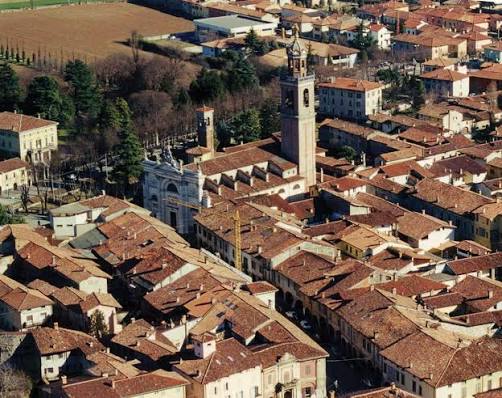
In Martinengo, in the province of Bergamo, an unfinished hotel is returning to the market with a reserve price of €650,751 and a minimum bid of €488,063.25. Less than a year ago, the starting price exceeded €1.54 million. The repricing is significant. But with unfinished hotels, the acquisition price is not the cost of the investment. It is merely the entry ticket.
That is the key through which this transaction should be assessed.
An unfinished hotel cannot be valued in the same way as an operating property.
Its investment case depends primarily on how much additional capital will be required to transform the building into a commercially viable hospitality product capable of generating revenue, operating profit and an adequate return on invested capital.
The unfinished hotel in Martinengo, in the province of Bergamo, is particularly interesting for precisely this reason.
Located at 49 Via Vallere, the property is described as a hotel under construction, currently at shell stage, extending across two basement levels, the ground floor and the first floor.
The total gross area reported in the available marketing material is approximately 3,350 sqm.
The next sale attempt is scheduled for 22 October 2026, as part of real estate enforcement proceeding no. 295/2024 before the Court of Bergamo.
The transaction at a glance
Initial reserve price: €1,542,521.40
Current reserve price: €650,751
Reduction: approximately 58%
Minimum bid: €488,063.25
Indicative gross area: approximately 3,350 sqm
Indicative configuration: approximately 26 rooms
Parking spaces: approximately 30
The figure that inevitably attracts the most attention is the minimum bid.
Less than half a million euros for a hotel property exceeding 3,000 sqm may, at first glance, appear to represent an exceptional opportunity.
But this is precisely where professional investment analysis should begin.
Not end.
From more than €1.54 million to €650,000
The sequence of previous sale attempts provides considerably more information than the current asking price alone.
Published reserve prices have progressively declined:
-
4 December 2025: €1,542,521.40;
-
12 March 2026: €1,156,891;
-
25 June 2026: €867,668;
-
22 October 2026: €650,751.
In less than a year, the reserve price has therefore fallen by approximately 58%.
The market did not absorb the asset at the previous price levels.
That is the first signal investors should interpret.
Because in hotel investment, a falling acquisition price does not automatically translate into a rising return.
The critical question is whether the repricing is sufficient to compensate for:
CAPEX + completion risk + timing + cost of capital + the commercial sustainability of the finished hotel.
What is actually being acquired?
This is not an existing hotel requiring refurbishment.
It is an unfinished hospitality development.
That distinction fundamentally changes the investment case.
Available documentation describes a multi-level building containing:
-
parking spaces across the basement levels;
-
technical rooms;
-
storage areas;
-
service spaces;
-
a reception area;
-
rooms intended for guest accommodation;
-
corridors;
-
balconies;
-
ancillary areas.
Commercial listings indicate an overall configuration of approximately 26 rooms and around 30 parking spaces.
The investor is therefore not acquiring an operating hotel.
The investor is acquiring the opportunity to complete one.
Economically, these are two very different propositions.
Price per key can be misleading
Using 26 rooms as an indicative basis, the current reserve price equates to approximately €25,000 per key.
At the minimum bid, the apparent price per room would be even lower.
On paper, that figure may look highly attractive.
But comparing it with the price per key of an operational hotel would be methodologically incorrect.
Those 26 rooms are not yet revenue-generating hotel rooms.
Before a single room can be sold to a guest, additional investment may be required for:
-
construction works;
-
mechanical and electrical systems;
-
HVAC;
-
lifts;
-
fire safety systems;
-
bedrooms;
-
bathrooms;
-
flooring;
-
FF&E;
-
lighting;
-
reception;
-
public areas;
-
potential F&B facilities;
-
technology;
-
PMS;
-
access-control systems;
-
security;
-
energy-efficiency measures;
-
external works;
-
professional fees;
-
permits;
-
commissioning;
-
pre-opening expenditure.
The real cost per key will only become clear once the acquisition price has been combined with everything required to bring the property into operation.
The number that matters is Total Investment Cost
The relevant equation is not:
Acquisition Price = Investment Value
It is:
Acquisition Cost + CAPEX + Soft Costs + Financing Costs + Pre-opening + Working Capital = Total Investment Cost
That figure must then be compared against:
Stabilised EBITDA + final asset value + potential exit value.
This approach sits at the heart of the investment analysis carried out by Hotel Management Group and of the hotel transaction assessments published by Investhotel.
Otherwise, investors risk making one of the most common mistakes in distressed hospitality:
confusing a real estate discount with a hotel investment return.
A 58% price reduction does not mean a 58% discount
This is arguably the most important point in the entire transaction.
The reserve price has fallen from more than €1.54 million to €650,751.
But that does not necessarily mean that the investment has become proportionately more attractive.
Its ultimate viability will also depend on:
-
the actual condition of the existing works;
-
potential deterioration of completed structures;
-
planning and zoning compliance;
-
validity of existing building permits;
-
whether the original design remains suitable;
-
completion costs;
-
construction cost inflation;
-
financing costs;
-
construction timeline;
-
permitting requirements;
-
pre-opening costs;
-
initial working capital;
-
local demand;
-
and the market’s ability to support the required ADR.
A discount on the acquisition price can be absorbed very quickly by higher-than-expected CAPEX.
This is why:
distressed does not automatically mean cheap.
First question: what hotel should this become?
Once the technical issues have been addressed, the most important strategic question emerges:
what type of hospitality product can work economically in Martinengo?
Simply completing the original project is not enough.
The investor must first determine whether that concept remains aligned with current market demand.
A property of approximately 26 rooms requires a highly focused positioning.
Potential alternatives might include:
-
a business hotel;
-
a limited-service property;
-
an aparthotel;
-
an extended-stay product;
-
a hybrid hospitality/residential concept;
-
a hotel focused on local corporate demand;
-
a highly automated independent hotel.
Each format has a direct impact on:
CAPEX, staffing, ADR, occupancy, GOP and break-even.
Completing the property before defining the commercial product would reverse the correct investment sequence.
The logic should be:
demand → concept → business plan → design → CAPEX → construction.
Not the other way around.
The risk of overbuilding
The relationship between approximately 3,350 sqm of gross floor area and an indicative 26-room configuration also deserves careful examination.
In hospitality, every square metre should serve an economic purpose.
A hotel can be inefficient not only because it has too few rooms.
It can also suffer because it contains too much non-revenue-generating space relative to its room count.
Basements, corridors, technical areas, public spaces and ancillary areas all carry costs relating to:
-
construction;
-
heating and cooling;
-
lighting;
-
maintenance;
-
cleaning;
-
insurance;
-
energy consumption.
If those spaces do not contribute directly or indirectly to revenue generation, they become immobilised capital.
An investor should therefore complement the technical due diligence with a genuine space-efficiency analysis.
The business plan must come before construction
The biggest mistake would be to acquire the property, complete the works and only then ask how much revenue the hotel can generate.
The sequence must be reversed.
The analysis should begin with:
Available Rooms × Occupancy × ADR = Room Revenue
Any ancillary revenue can then be added.
Operating costs must subsequently be deducted, including:
-
payroll;
-
housekeeping;
-
utilities;
-
maintenance;
-
distribution;
-
commissions;
-
administration;
-
marketing;
-
technology;
-
insurance;
-
other operating expenses.
This produces the hotel’s potential GOP.
And it is the GOP that ultimately indicates how much capital the project can economically support.
The professional question is therefore not:
“How much does it cost to buy the property?”
It is:
“How much total capital can be invested while maintaining a return consistent with the level of risk?”
Completion costs may matter more than the purchase price
Assume the acquisition price represents only a relatively small proportion of the total investment.
In that scenario, achieving an additional €100,000 or €200,000 reduction in the purchase price may have a smaller impact on the final return than a similar variance in CAPEX.
That is what makes unfinished hotels particularly sensitive to the quality of due diligence.
The analysis must simultaneously cover:
real estate + technical + planning + hospitality + financial considerations.
A purely property-focused assessment is not enough.
This is the same approach adopted by InvestimentiAlberghieri.it in its analysis of distressed assets, unfinished developments and value-add hotel opportunities.
Alternatives to hotel use should at least be assessed
Another strategic question concerns the property’s possible highest and best use.
Any alternative use would, of course, first need to be assessed from a planning, regulatory and permitting perspective.
But a rational investor should not automatically assume that the existing hotel concept is the only economically viable option.
The analysis could compare:
Scenario A – completion as a hotel
with, where legally and technically feasible,
Scenario B – alternative use.
The objective is not to preserve the original development concept.
The objective is to identify the use capable of generating the strongest risk-adjusted economic value.
With unfinished assets, that analysis can materially alter the entire investment thesis.
Why has the market not absorbed the asset yet?
The sequence of unsuccessful sale attempts contains information that should not be ignored.
When an asset is repeatedly repriced yet continues to attract insufficient demand, the market is expressing a view on risk.
That does not necessarily mean the property has no value.
It means that a gap still exists between:
the asking price and the risk perceived by investors.
That gap may reflect:
-
CAPEX;
-
completion complexity;
-
timing;
-
location;
-
hotel demand;
-
financing costs;
-
operating risk;
-
uncertainty surrounding the completed asset’s value.
An opportunity exists only if an investor can assess and price those risks more accurately than the market.
Not simply because the property can be acquired more cheaply.
The real deal is not buying it for €488,000
The minimum bid of €488,063.25 is inevitably the most eye-catching number.
But it is not the decisive one.
The figure that really matters is:
Total Investment Cost.
How much capital will be required from the date of acquisition until the first guest walks through the door?
And immediately after that:
how much EBITDA will that capital be capable of generating?
Only by comparing these two variables can an investor determine whether Martinengo represents a genuine opportunity.
The Martinengo lesson
Unfinished hotels are among the most interesting — and potentially most deceptive — categories within hospitality investment.
They can offer entry at significantly compressed real estate values.
But they also require investors to create much of the future operating value themselves.
Martinengo perfectly illustrates this dynamic:
Approximately 3,350 sqm.
Around 26 potential rooms.
A reserve price reduced from more than €1.54 million to €650,751.
A minimum bid below €500,000.
The numbers immediately attract attention.
But a professional investor should resist the most intuitive question:
“How far has the price fallen?”
and replace it with the question that actually matters:
“How much additional capital will I need to invest, and what return can that capital ultimately generate?”
Because with an unfinished hotel, the acquisition price is not the cost of the investment.
It is only the entry ticket.
The true cost of the transaction will become clear only once investors understand how much capital is required to turn concrete, infrastructure and square metres into a hotel capable of generating EBITDA.
And that is precisely the difference between buying discounted real estate and making a sound hotel investment.
Further analysis of hotel investments, distressed opportunities, repositioning strategies and hospitality asset enhancement is available at RobertoNecci.it, Investhotel, InvestimentiAlberghieri.it and Hotel Management Group.
Hotel investment analysis
For preliminary acquisition assessments, feasibility studies, business plans, economic valuations, CAPEX analysis, repositioning strategies and hotel asset enhancement:
info@investimentialberghieri.it