Park Hyatt Beaver Creek: A $176 Million Deal
A 193-room resort sold for $176 million is more than a real estate transaction. It is a clear lesson in how the market prices income quality, brand strength, scarcity, destination appeal, and operating performance in the luxury hospitality segment.
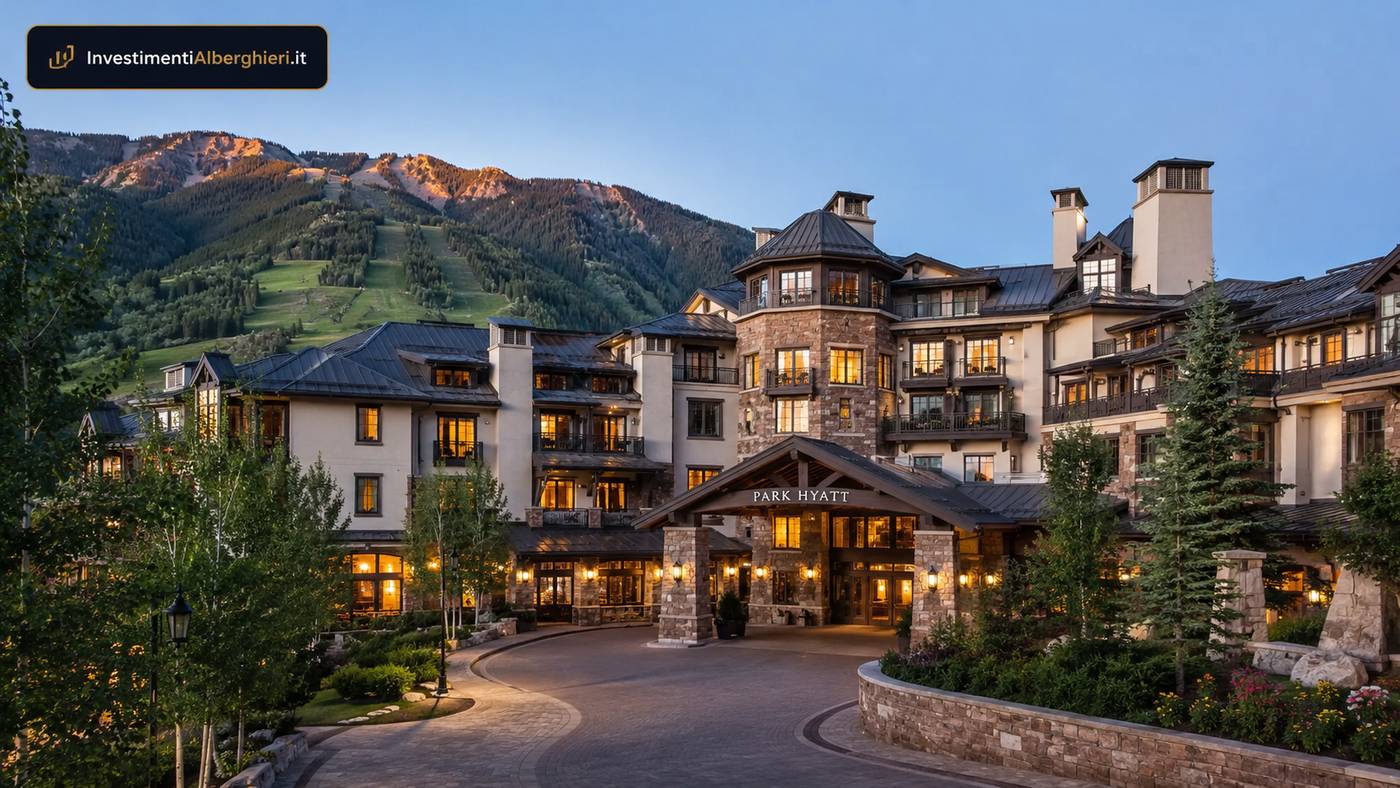
According to a statement released by Braemar Hotels & Resorts the company completed the sale of the Park Hyatt Beaver Creek Resort & Spa, a luxury resort in Colorado, for $176 million.
The unit value is especially striking: approximately $912,000 per room. That figure confirms that luxury resorts, when located in established destinations and supported by international brands, can command valuations far above the broader lodging market.
According to the company, the sale price represents a 4.6% cap rate on net operating income for the trailing twelve months ended March 2026. That is the core of the transaction: the buyer did not simply acquire a hotel property. It acquired an income stream perceived as rare, defensible, and high quality.
The key question, therefore, is not only how much Park Hyatt Beaver Creek sold for. It is this: why can a hotel be worth nearly one million dollars per room?
A Hotel’s Value Is Not in the Walls, but in the Income
One of the most common mistakes in hospitality real estate is valuing a hotel as if it were an ordinary property. That approach becomes even weaker when dealing with luxury hotels, resorts, branded assets, or properties with strong income-generating capacity.
The price of Park Hyatt Beaver Creek reflects at least five key factors:
-
the quality of the destination;
-
the strength of the Park Hyatt brand;
-
the ability to generate operating income;
-
the scarcity of comparable assets;
-
the potential to resell the property to institutional investors.
These factors explain why two properties with the same number of rooms can have completely different values.
A hotel with weak positioning, unstable margins, and poor financial documentation will be valued conservatively. A luxury resort in a strong destination, backed by an international brand and supported by demonstrable profitability, can instead be treated as a premium asset.
The difference is not in the square footage. It is in the quality of the income.
The Investimenti Alberghieri blog regularly analyzes transactions, market dynamics, and investment cases that help interpret hotel value from a real estate, operational, and financial perspective:
https://investimentialberghieri.it/blog
Value per Key: Why $912,000 per Room Matters
The figure of approximately $912,000 per room is one of the strongest indicators in the transaction.
Value per key allows investors to compare transactions quickly, but it should never be read in isolation. It must be interpreted alongside profitability, cap rate, future capital expenditure, product quality, brand strength, market fundamentals, and operating risk.
In the case of Park Hyatt Beaver Creek, this value tells us three things.
First, luxury resorts continue to attract capital when the underlying asset has characteristics that are difficult to replicate.
Second, brand matters. A property with an international flag, clear positioning, and a consistent customer base is perceived as more liquid and less risky.
Third, scarcity commands a premium. Luxury assets in established destinations are not easily replaceable. That is why the market is willing to pay higher multiples.
For an investor, value per room is not just a mathematical division. It is the synthesis of positioning, income, risk, and exit potential.
A 4.6% Cap Rate: The Price of Confidence
The 4.6% cap rate is the most sophisticated data point in the deal.
In simple terms, the cap rate measures the relationship between net operating income and sale price. The lower the cap rate, the higher the price the market is willing to pay for that income. This happens when an asset is perceived as solid, rare, well positioned, and capable of preserving value over time.
In the case of Park Hyatt Beaver Creek, the buyer did not purchase only immediate yield. It purchased stability, brand strength, destination quality, and long-term perspective.
This is a crucial point for the Italian market as well. Many hotels are still valued starting from location, historical cost, emotional attachment, or ownership expectations. Professional investors follow a different logic: they start from sustainable income, the profit and loss statement, operating risk, contractual structure, and required capital expenditure.
A hotel cap rate is not just a technical metric for specialists. It is the financial expression of the confidence the market places in a hotel.
From Acquisition to Exit: Value Is Built Over Time
Braemar acquired Park Hyatt Beaver Creek in 2017 for $145.5 million. The sale for $176 million, after roughly nine years, shows that the value of a hospitality investment must be measured across the full holding period.
A hotel does not increase in value simply because the market rises. It increases in value when operations, product quality, financial performance, and positioning move in the same direction.
During the holding period, value creation depends on precise levers:
-
rate growth;
-
cost control;
-
operating margin improvement;
-
targeted product investment;
-
stronger commercial positioning;
-
efficient debt management;
-
the right exit timing.
In hospitality, holding an asset is not a passive activity. It is a continuous asset management process.
This is equally true in Italy. A hotel may enjoy an excellent location, but if it does not produce clean data, if it does not properly document EBITDA, if it requires unplanned capital expenditure, or if its commercial strategy is weak, the market will apply a discount.
Value does not come from location alone. It comes from the ability to convert that location into demonstrable income.
The Sale as an Asset Management Decision
Another central element of the transaction is the use of proceeds.
Braemar stated that it repaid the $70.5 million mortgage loan secured by the property and retained approximately $104.5 million in net proceeds, after transfer taxes, transaction costs, and the release of the resort’s operating cash.
Part of the proceeds was also used to fully redeem the company’s 4.50% senior convertible notes, due or redeemable on June 1, 2026.
This matters because it clarifies an important point: selling a hotel does not necessarily mean the asset is no longer attractive. It may mean freeing capital, reducing debt, strengthening the balance sheet, and preparing for new allocations.
For a professional investor, selling does not always mean walking away. Often, it means reallocating.
In Braemar’s case, Park Hyatt Beaver Creek was converted into liquidity, lower leverage, and greater financial flexibility.
The Luxury Resort as a Complex Financial Asset
The Park Hyatt Beaver Creek case confirms an increasingly clear trend: luxury resorts are not simply hospitality properties. They are complex financial assets.
Their valuation requires an integrated analysis of real estate, operational, contractual, and financial factors:
-
rooms revenue;
-
food and beverage revenue;
-
GOP;
-
EBITDA;
-
NOI;
-
ordinary and extraordinary capital expenditure;
-
management or franchise agreements;
-
brand affiliation;
-
seasonality;
-
market risk;
-
underlying real estate value;
-
repositioning potential;
-
exit liquidity.
This complexity is what distinguishes hotel valuation from the valuation of traditional real estate.
A hotel is an operating business inside a real estate structure. Its value depends on its ability to produce economic results through daily management.
That is why the question “how much is a hotel worth?” can never have a standard answer. It depends on how the property generates revenue, how much margin it produces, what investments it requires, and how sustainable the market considers that income to be.
For further insights on these topics, see the hotel guides published on RobertoNecci.it:
https://www.robertonecci.it
What This Deal Teaches the Italian Market
At first glance, a hotel sale in Colorado may seem distant from the Italian market. In reality, the Park Hyatt Beaver Creek case offers very practical lessons.
First: investors pay for clarity. A hotel must be legible in its numbers, contracts, operations, and capital expenditure.
Second: brand can change the perception of risk. In the luxury segment, an international flag can increase liquidity, pricing power, and investor appetite.
Third: value is not claimed; it is demonstrated. It is not enough to say that a property is located in a strong destination. It must be shown that the destination produces income.
Fourth: a hotel should also be managed with future marketability in mind. This does not necessarily mean preparing to sell. It means making the asset organized, profitable, and understandable to capital.
Italy has an extraordinary hotel portfolio, often located in some of the world’s strongest tourism destinations. Yet many assets are not fully structured to attract professional investors.
The most recurring weaknesses are clear:
-
accounts that are difficult to interpret;
-
confusion between real estate ownership and hotel operations;
-
weak business plans;
-
unquantified capital expenditure;
-
inconsistent revenue management;
-
margins below potential;
-
incomplete documentation;
-
lack of a clear value creation strategy.
Comparing the Italian market with transactions such as Park Hyatt Beaver Creek helps clarify what international capital is really looking for.
Owning a good hotel is not enough. The asset must be able to speak the language of investors.
On these issues, the InvestHotel blog provides further insights into the hotel market, investment strategies, and hospitality opportunities:
https://www.investhotel.it/it/news.html
Asking Price vs. Demonstrable Value
One of the most delicate issues in hotel transactions is the gap between asking price and demonstrable value.
Many owners start from perceived value: location, history, cost basis, and future expectations. Professional investors start from results.
An investor asks very concrete questions:
-
how much revenue does the hotel generate?
-
what margin does it produce?
-
which costs can be optimized?
-
what investments will be required?
-
is staffing properly sized?
-
is the rate positioning sustainable?
-
does the brand create value?
-
is the management contract efficient?
-
is the business plan credible?
-
what return can be achieved?
-
who will buy the asset in the future?
The sale of Park Hyatt Beaver Creek shows that high valuations are possible, but only when price, income, quality, and risk are aligned.
Value is not declared. It is proven.
From Hotel Valuation to Value Creation
The Park Hyatt Beaver Creek case shows that hotel valuation is not a static exercise. It is the result of a process.
A hotel becomes more valuable when:
-
the profit and loss statement is solid;
-
revenue streams are diversified;
-
management is professional;
-
the brand is coherent;
-
the product is properly maintained;
-
debt is sustainable;
-
capital expenditure is planned;
-
positioning is clear;
-
documentation is transparent;
-
the exit strategy is credible.
These elements cannot be improvised at the time of sale. They are built over the years.
The mistake many owners make is to start thinking about hotel value only when they decide to sell. In reality, value creation should begin much earlier: in daily operations, financial control, product quality, distribution, commercial strategy, and the ability to make the property understandable to the market.
Conclusion: A Hotel Is Worth What the Market Believes About Its Numbers
The sale of Park Hyatt Beaver Creek Resort & Spa for $176 million is far more than a hotel transaction. It is a concrete case of hospitality investment, asset management, and luxury hotel value creation.
The price of approximately $912,000 per room, the 4.6% cap rate, debt repayment, and net proceeds show how a hotel can become a sophisticated capital management tool.
For the Italian market, the lesson is clear: hotel value does not depend only on the beauty of the property or the strength of the destination. It depends on the ability to transform those qualities into sustainable, documented, investor-readable income.
A well-managed, well-positioned hotel with clear numbers can attract capital. An opaque property, even if potentially interesting, risks being penalized.
The difference between a hotel property and a true investment asset lies here: in the ability to turn ownership into an income platform.
Hotel Management Group supports owners, investors, and operators in the analysis, value creation, development, repositioning, and strategic management of hotel assets.
To assess the potential of a hotel, analyze a hospitality investment, prepare an asset for sale, or build a value creation strategy, visit:
https://www.hotelmanagementgroup.it/
Roberto Necci - r.necci@robertonecci.it