A going-concern restructuring does not automatically mean that a hotel has ceased operations, nor does it, in itself, allow conclusions to be drawn about the underlying causes of the company’s financial position.
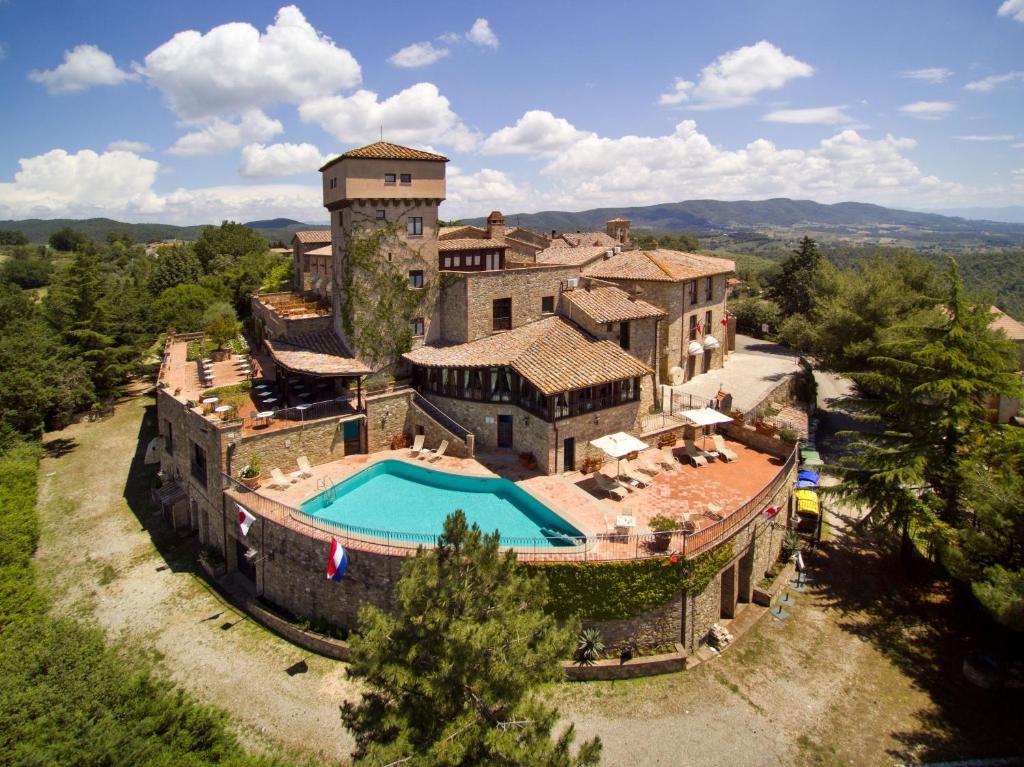
This is precisely what makes the case of Relais Il Canalicchio, located in Canalicchio di Collazzone, Umbria, particularly interesting.
The Italian Creditors’ Portal reports that Relais Il Canalicchio S.r.l. is subject to going-concern composition with creditors proceedings no. 1862/2025 before the Court of Rome, dated 15 September 2026. The public opening decree was uploaded on 17 September, while creditors are expected to vote between 12 and 16 January 2027.
At the same time, as of the date of our review, the Relais continues to maintain an active commercial presence online. The property’s website promotes stays, September and October 2026 offers, wellness facilities, F&B, swimming pools, weddings and meetings, with options to enquire about availability and make reservations.
This does not, by itself, certify the hotel’s day-to-day operating status.
It does, however, allow a narrower and verifiable statement to be made:
as of the date of our review, the hospitality product continues to be marketed while the company bearing the same name is subject to formal going-concern restructuring proceedings.
It is precisely this overlap that makes the case relevant from a hospitality special situations perspective.
The case at a glance
Property: Relais Il Canalicchio
Location: Canalicchio di Collazzone, Perugia – Umbria
Company in proceedings: Relais Il Canalicchio S.r.l.
VAT number: 02245360546
Proceeding: going-concern composition with creditors
Court: Rome
Case no.: 1862/2025
Date reported by the Creditors’ Portal: 15 September 2026
Creditors’ voting period: 12–16 January 2027
Commercial status verified: website and online sales channels visible as of the date of review
Editorial classification: Restructuring / Hospitality Special Situation
A further point of linkage comes from publicly accessible corporate databases, which associate Relais Il Canalicchio S.r.l., VAT no. 02245360546, with hotel operations and the relaiscanalicchio.it website.
For definitive corporate information, however, the relevant sources remain the Italian Companies Register and the official court documentation.
What “going-concern restructuring” actually means
The first requirement is to avoid overly simplistic interpretations.
A going-concern composition with creditors is a restructuring framework under Italian insolvency law through which business operations may continue under a restructuring plan subject to procedural requirements and creditor approval.
Its existence does not, by itself, mean:
-
that the hotel has closed;
-
that the real estate is being liquidated;
-
that the resort is about to be sold;
-
that any particular credit exposure has been classified as NPL or UTP;
-
that a specific bank financing is insolvent;
-
that the operating business has lost value;
-
that the property will ultimately be transferred.
None of these conclusions can automatically be inferred from the existence of the proceeding alone.
What can be stated on the basis of the publicly available documentation is narrower, but also more important:
the company is subject to proceedings officially classified as a going-concern composition with creditors.
Why the case matters to a hotel investor
For InvestimentiAlberghieri.it, the relevant issue is not to speculate about the causes of the restructuring.
The real question is how the value of an operating hospitality business may be preserved or reorganised during a restructuring process.
A hotel contains several distinct layers of value.
Real Estate
Buildings, land, systems and physical infrastructure.
Hotel Business
Rooms, food & beverage, wellness, events and ancillary revenues.
Operating Platform
Organisation, employees, suppliers, distribution, systems and licences.
Goodwill
Reputation, customer relationships, commercial presence and the ability to generate demand.
These components may all sit within the same legal entity, or they may be distributed across different entities.
In the Canalicchio case, the publicly available documentation reviewed is not sufficient to establish with certainty the ownership perimeter of the real estate, the existence of any PropCo/OpCo structure or the nature of any financial security package.
These are precisely the issues that a proper due diligence process would need to reconstruct.
The resort continues to be marketed
The official website presents the Relais as comprising both a Borgo Resort and a Country Resort, with accommodation within the historic village and additional Country Suites outside the original core.
The commercial offering also includes:
-
wellness facilities;
-
two swimming pools;
-
F&B;
-
meeting facilities;
-
weddings;
-
leisure stays;
-
promotional packages.
The Umbria regional tourism database also lists Relais Il Canalicchio at Via della Piazza 4 in Collazzone, under CIR 054014A101006301.
Different publicly available sources provide different figures for the total number of guestrooms or accommodation units.
For that reason, in the absence of direct verification of the current hospitality licence, we have chosen not to use a room count as a definitive figure within the investment case.
This is an important methodological precaution.
In distressed or restructuring situations, even apparently straightforward information such as the number of keys should be verified before being incorporated into a valuation.
The central question: does the hotel need fixing, or does the balance sheet need fixing?
This is arguably the most important question for a potential investor.
Broadly speaking, there are two very different situations.
Scenario 1 — Operating problem
The hotel business itself does not generate sufficient margins.
In this case, the turnaround must address:
-
positioning;
-
revenue;
-
ADR;
-
occupancy;
-
F&B;
-
staffing;
-
distribution;
-
costs;
-
CAPEX.
Scenario 2 — Predominantly financial problem
The hotel operation may instead generate market-consistent operating margins, while its financial or capital structure requires reorganisation.
Depending on the circumstances, the issue could relate to:
-
maturities;
-
cost of capital;
-
financing requirements;
-
capital structure;
-
the need for new financing or equity.
There is currently insufficient public information to place the Canalicchio case conclusively in either category.
That distinction matters.
Without access to the full restructuring plan, operating data and financial position, it would not be appropriate to draw conclusions about the specific causes behind the proceeding.
But this distinction is precisely what lies at the heart of the investment analysis.
Corporate distress and hotel quality are not the same thing
One of the most common mistakes in distressed investing is to assume that the legal or financial position of the company automatically reflects the economic quality of the underlying hotel.
That is not always the case.
A hotel may have a viable product but an unsustainable financial structure.
Alternatively, it may face both operating and financial challenges.
Or it may require repositioning while still owning real estate of strategic interest.
This is why the approach followed by Investhotel.it separates four dimensions:
Asset Quality
Operating Performance
Capital Structure
Ownership Structure
Only once these have been analysed independently should they be brought together into a single investment case.
The value of continuity
From a hotel operating perspective, maintaining commercial continuity may itself have value.
A prolonged interruption can affect:
-
employees;
-
bookings;
-
reputation;
-
distribution;
-
customers;
-
events;
-
relationships with tour operators and agencies;
-
reopening costs.
By contrast, keeping the product present in the market may help preserve part of the going-concern value.
That does not mean that continued operation is necessarily profitable.
It simply means that there is a material economic difference between restructuring a hospitality business that remains commercially active and restarting a closed property from scratch.
That is one reason why pre-auction situations can be particularly interesting.
What structures could an investor analyse?
The following scenarios are presented purely as analytical frameworks.
They should not be interpreted as elements of the Relais Il Canalicchio restructuring plan, nor as evidence of any known negotiations.
In general, a going-concern hospitality special situation may be assessed through several possible structures.
New Equity
An injection of fresh capital into the company.
New Money
Financing intended to support the restructuring plan and continued operations.
Financial Restructuring
A reorganisation of financial obligations in accordance with the restructuring plan and applicable law.
Business Lease or Business Sale
Entry of a new operating partner through the lease or transfer of the hotel business.
PropCo / OpCo Separation
Separation between ownership of the real estate and operation of the hotel business.
Integrated Transaction
An investment simultaneously involving both the real estate and the hotel operation.
We are not suggesting that any of these alternatives applies to Canalicchio.
They are simply structures that an investor might ordinarily assess after reviewing the court documents and defining the actual transaction perimeter.
The revenue mix may be critical
Commercially, the Relais is positioned as more than a rooms-only property.
Its website markets:
-
accommodation;
-
wellness;
-
F&B;
-
swimming pools;
-
weddings;
-
meetings;
-
destination experiences.
For an investor, room revenue would therefore represent only one component of the analysis.
The business should be broken down into individual revenue centres.
Rooms
Occupancy, ADR, RevPAR and seasonality.
Food & Beverage
Revenue, food cost, payroll and profitability.
Events
Weddings, meetings and utilisation of event spaces.
Wellness
Direct revenues and its ability to generate incremental demand.
Other Revenue
Packages, experiences and ancillary services.
A resort with multiple revenue streams may offer greater commercial opportunities.
But it may also carry a more complex cost structure.
This is why revenue alone tells only part of the story.
GOP and, ultimately, normalised EBITDA are the metrics that begin to reveal the economic quality of the operation.
The information required to assess the case properly
Before expressing an economic view on the investment, an investor would ideally need access to at least:
-
historical revenue;
-
monthly occupancy;
-
ADR;
-
RevPAR;
-
GOP;
-
normalised EBITDA;
-
payroll;
-
F&B margins;
-
event revenue;
-
historical CAPEX;
-
deferred maintenance;
-
working capital;
-
financial structure;
-
security and collateral;
-
ownership of the real estate;
-
any lease or business-lease arrangements;
-
the economic terms of the restructuring plan.
Without this information, it is possible to identify a special situation.
It is not yet possible to determine its value.
The next verifiable milestone: the creditors’ vote
The Creditors’ Portal indicates the period between 12 and 16 January 2027 for creditor voting.
This therefore represents one of the next publicly verifiable milestones.
Between now and then, the most relevant developments to monitor should be limited to documented facts, including:
-
any new filings;
-
publicly disclosed amendments to the proceedings;
-
any formally announced competitive processes;
-
developments relating to court approval;
-
official information regarding business continuity.
Any market rumours concerning investors, asset sales or creditors should instead be reported only where supported by reliable and verifiable sources.
Our view
Relais Il Canalicchio is interesting not because it can currently be stated that the hotel will be sold.
There is no basis for making that claim.
It is interesting because it provides a case study of a hospitality property that remains commercially present while the company bearing the same name is undergoing formal going-concern restructuring proceedings.
The question is therefore not:
“What is a distressed hotel worth?”
It is:
“Does the restructuring need to address the hotel business, the financial structure, or both?”
That is the question that turns a court proceeding into a genuine investment case.
At Robertonecci.it, hotel value creation is often approached through one fundamental distinction:
the financial position of the company and the industrial capacity of the hotel should be analysed separately before any conclusion is drawn about value.
This is particularly important in going-concern restructurings.
In one sentence
The Relais Il Canalicchio case does not demonstrate that the resort will be sold, nor does it allow the specific causes of the restructuring to be inferred: it shows why, in hospitality, the restructuring phase may be more relevant to investors than a later auction process.
As long as the product retains a commercial presence, the issue is not simply how much value can be recovered from the real estate.
It is how much going-concern value can be preserved, reorganised or potentially relaunched.
Methodological note
This article is based on publicly accessible sources available as of 28 September 2026.
Information regarding the court proceedings is derived from the Creditors’ Portal. Information concerning the resort’s commercial offering is derived from the property’s website, the Umbria regional tourism database and other publicly available channels reviewed at the time of publication.
This article:
-
does not attribute responsibility to any person or company;
-
does not express any view on solvency;
-
does not classify any exposure as NPL or UTP;
-
does not state that the real estate or hotel business is for sale;
-
does not identify the causes of the restructuring;
-
does not anticipate the outcome of the proceedings;
-
clearly distinguishes documented facts from analytical scenarios.
Any financial, industrial or corporate scenarios discussed are presented solely for the purpose of analysing hospitality restructuring transactions in general and should not be interpreted as information concerning the contents of the Relais Il Canalicchio restructuring plan unless expressly stated otherwise.
Analysis and advisory
InvestimentiAlberghieri.it, together with Investhotel.it, Hotel Management Group and Robertonecci.it, analyses hotel investments, restructuring situations, distressed assets and hospitality special situations through financial analysis, business planning, due diligence, turnaround strategies and repositioning.
For confidential analysis of hotel assets, restructuring situations and investment opportunities:
info@investimentialberghieri.it