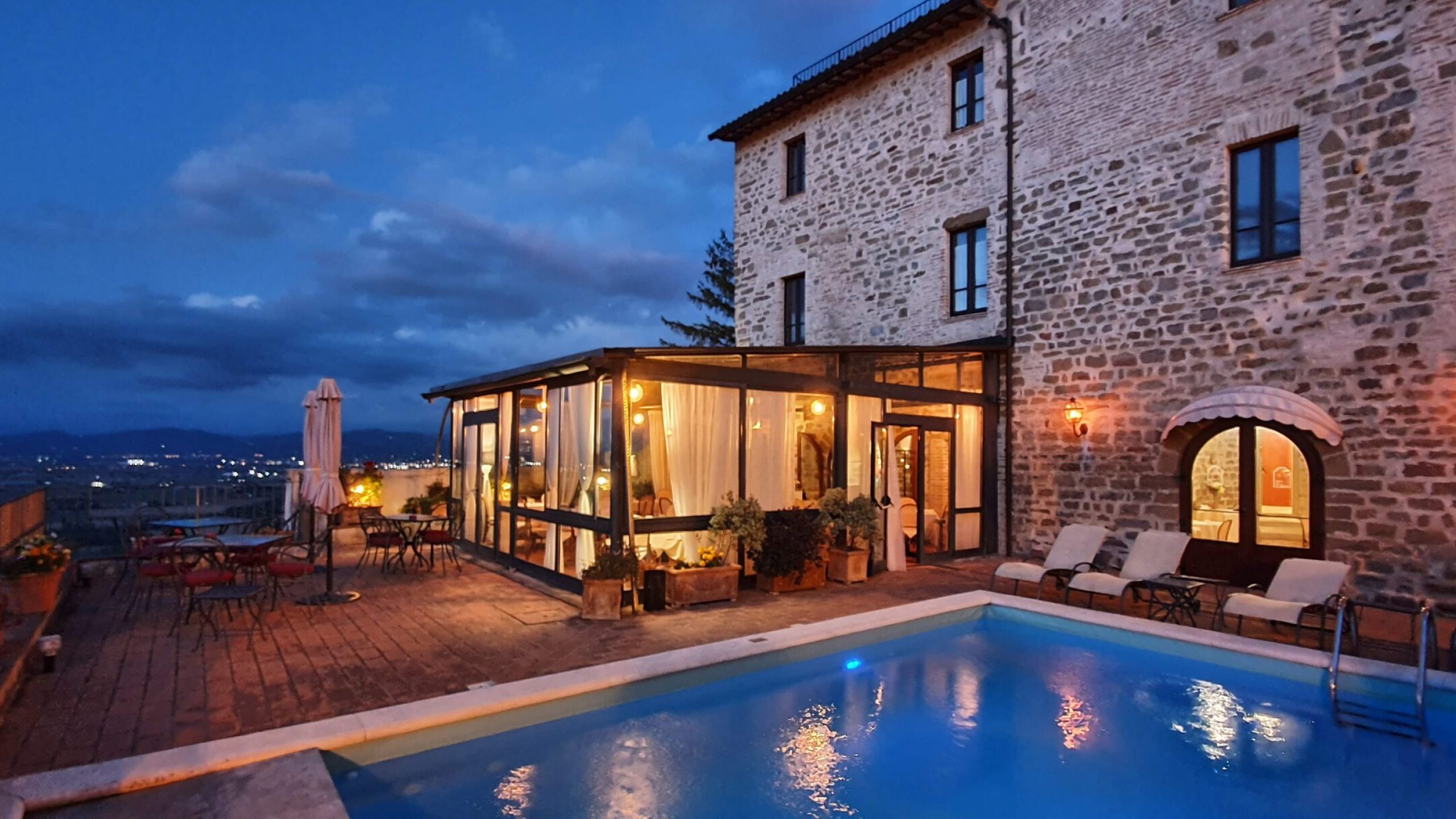
Thirty-nine rooms, restaurant, bar, wellness centre, swimming pool, fitness area and more than 2,100 sqm in the medieval heart of Bettona. Relais La Corte di Bettona is returning to market with a minimum bid of €669,572.58, compared with an initial reference value of €2.116 million. The headline is striking: approximately €17,200 per key and a reduction of more than 68%. But the more dramatically the price falls, the less useful the discount becomes as a standalone metric. The real question is how much capital will ultimately be required to turn the acquisition into a competitive hotel capable of generating sustainable EBITDA.
The Relais La Corte di Bettona, a four-star hotel located in the historic centre of Bettona, is scheduled for sale again on 20 October 2026 as part of Real Estate Enforcement Proceedings No. 18/2022 before the Court of Perugia.
The lot comprises full ownership of the hotel complex at Via degli Archi 10, arranged across several interconnected buildings with private outdoor areas.
The key terms of the current sale are:
Reserve price: €892,763.44
Minimum bid: €669,572.58
Minimum bid increment: €10,000
Sale date: 20 October 2026
Indicative commercial area: approximately 2,120 sqm
39 rooms: approximately €17,200 per key
The property is described as comprising 39 rooms, including standard rooms, junior suites and suites, together with:
-
restaurant;
-
bar;
-
wellness centre;
-
swimming pool;
-
fitness area;
-
parking.
Based on the minimum bid:
approximately €17,170 per key
On an area basis:
approximately €316 per sqm
These are exceptionally low figures for an already configured four-star hospitality asset.
And that is precisely why they need to be interpreted with caution.
At InvestimentiAlberghieri.it, the underlying principle is always the same:
a large discount in price does not automatically translate into a compelling investment.
From the original value to €669,000: the price has collapsed, but that is not how value is measured
The history of the sale process is one of the most interesting elements of the case.
The initial reference value was approximately:
€2.116 million
The current minimum bid is:
€669,572.58
The reduction is therefore greater than:
68%
That is a dramatic repricing.
But investors need to distinguish between:
price reduction
and
value creation.
A distressed sale process may progressively reduce the asking level for many reasons, including:
-
unsuccessful previous sale attempts;
-
a limited buyer pool;
-
CAPEX requirements;
-
operating complexity;
-
financing constraints;
-
uncertainty around the going concern;
-
management risk.
Therefore:
Price Reduction ≠ Value Creation
Value is created only if the total capital invested can generate an adequate return.
The real mistake would be to think this is a €669,000 hotel investment
This is the central point of the entire case.
The investor is not necessarily investing:
€669,572
That amount is the cost of entering the transaction.
The next question is how much additional capital will be required to bring the hotel to a competitive and sustainable operating standard.
The correct equation is:
**Purchase Price
-
Transaction Costs
-
Technical CAPEX
-
Rooms CAPEX
-
Spa CAPEX
-
F&B CAPEX
-
FF&E
-
Technology
-
Working Capital
-
Transition Costs
-
Financing Costs
= Total Investment Cost**
€669,000 is the entry price.
Total Investment Cost is the true capital at risk.
That distinction fundamentally changes the investment analysis.
KEY ISSUE — From a €669,000 asset to a competitive hotel
An investor should ask:
What does it cost to acquire?
€669,572.58 at the minimum bid.
What does it cost to refurbish?
To be established through technical due diligence.
What does it cost to bring the product back to a competitive standard?
Guestrooms, bathrooms, FF&E, Spa, swimming pool, restaurant, systems and technology.
What does it cost to preserve or restart the business?
Staffing, distribution, marketing and working capital.
How much capital will ultimately be tied up in the project?
That is the:
Total Investment Cost
Only after answering this question does it make sense to decide whether €669,000 is expensive or cheap.
€17,200 per key may be the most misleading number in the entire case
The calculation is correct.
But the real cost per key will be:
**Purchase Price per Key
-
CAPEX per Key
-
FF&E per Key
-
Transaction Costs per Key
-
Working Capital per Key
-
Financing Costs per Key**
If the property requires meaningful investment in:
-
guestrooms;
-
bathrooms;
-
Spa;
-
swimming pool;
-
building systems;
-
common areas;
-
energy efficiency;
the initial €17,200 figure quickly becomes secondary.
Auction price per key tells you how much it costs to get in.
It does not tell you how much it costs to reach the finished product.
The hotel still appears to retain a commercial presence
Another important element is that the Relais does not appear to be a fully abandoned hospitality asset.
The property continues to have a recognisable commercial identity through:
-
guestrooms;
-
suites;
-
restaurant;
-
wellness;
-
swimming pool;
-
online visibility.
This does not automatically establish:
-
who currently operates the hotel;
-
under which contractual structure;
-
who owns the operating business;
-
which assets transfer with the real estate;
-
whether the brand is transferable;
-
whether employees and forward bookings follow the acquisition.
But it does suggest that the commercial going concern may not be completely lost.
That can be extremely valuable.
The real issue is understanding who operates the hotel
The sale concerns the real estate.
That does not automatically mean that the operating business is included.
The investor therefore needs to reconstruct:
Property Owner
Business Owner
Operator
Employer
Brand Owner
Licence Holder
In hospitality, these roles can sit within one entity.
But they can also belong to completely different parties.
And that distinction may determine whether the investor is acquiring:
an operating hotel
or
a hotel property that still needs to be relaunched.
KEY ISSUE — Three separate perimeters
1. Real Estate
Potentially including:
-
buildings;
-
guestrooms;
-
restaurant;
-
bar;
-
Spa;
-
swimming pool;
-
technical areas;
-
outdoor spaces.
2. Operating Assets
Potentially including:
-
FF&E;
-
kitchen equipment;
-
plant;
-
systems;
-
wellness equipment.
3. Going Concern
Including:
-
employees;
-
brand;
-
website;
-
domain;
-
PMS;
-
booking engine;
-
OTA accounts;
-
reservations;
-
customer database;
-
suppliers;
-
operating procedures;
-
reputation;
-
know-how.
Acquiring the first perimeter does not automatically mean acquiring the other two.
That is where the real due diligence begins.
Historic real estate creates character — and CAPEX
The Relais occupies buildings embedded within the historic fabric of Bettona.
Commercially, this can be a major advantage:
-
authenticity;
-
character;
-
identity;
-
storytelling;
-
experiential hospitality.
But historic buildings may also require greater attention to:
-
plant and systems;
-
HVAC;
-
insulation;
-
windows;
-
roofs;
-
masonry;
-
water ingress;
-
accessibility;
-
fire safety;
-
energy efficiency;
-
planning or heritage restrictions.
Historic character can support ADR.
But technical complexity can absorb substantial capital.
Both sides of the equation need to be assessed together.
39 rooms across more than 2,100 sqm: every square metre needs to perform
The asset contains a meaningful amount of non-room space.
The operating model is therefore not simply:
Rooms
but rather:
Rooms + F&B + Wellness
This materially changes the underwriting.
The key question becomes:
does each business unit generate a positive contribution margin?
The restaurant needs to generate margin
The F&B component should be assessed separately.
The basic framework is:
F&B Revenue
– Food Cost
– Beverage Cost
– Payroll
– Utilities
– Operating Costs
= F&B Contribution Margin
A restaurant can improve:
-
guest experience;
-
ADR;
-
package value;
-
weddings;
-
events;
-
outside demand.
But it can also absorb disproportionate staffing and operating costs.
For a 39-room hotel, that balance is critical.
The Spa must justify its economics
The same applies to wellness.
The relevant framework should be:
Wellness Revenue
– Payroll
– Utilities
– Consumables
– Maintenance
= Wellness Contribution Margin
A Spa can:
-
support ADR;
-
increase length of stay;
-
enable package sales;
-
help reduce seasonality.
But only if it generates margin.
A Spa is not valuable simply because it exists.
It creates value if it generates EBITDA or supports room profitability.
The 68% discount can become a cognitive trap
When an investor sees:
€2.116 million
versus
€669,000
the natural reaction is:
“I am buying at a huge discount.”
But the investor is not remunerated by the discount.
The investor is remunerated by cash flow.
The correct question is therefore not:
“How much am I saving versus the previous value?”
It is:
“How much total capital must I invest to generate stabilised EBITDA?”
That is the question that transforms an auction into a genuine hotel investment case.
At Hotel Management Group, this distinction is fundamental: real estate value must always be tested against the operating business’s ability to remunerate invested capital.
KEY ISSUE — From Discount to Yield
The investment analysis should move through four stages.
1. Purchase Price
€669,572.58.
2. Total CAPEX
The capital genuinely required to bring the property back to a competitive standard.
3. Total Investment Cost
Purchase Price + CAPEX + FF&E + Costs + Working Capital + Financing
4. Stabilised EBITDA
The EBITDA the hotel can generate once the operation has been stabilised.
Only then does the key ratio become:
Stabilised EBITDA / Total Investment Cost
That is the number that matters.
The discount tells the story of the sale process.
The yield tells the story of the investment.
Bettona is not Assisi: destination underwriting matters
The Umbrian location is attractive.
The hotel may benefit from demand linked to:
-
Perugia;
-
Assisi;
-
Spello;
-
Umbrian hill towns;
-
cultural tourism;
-
weekend breaks;
-
weddings;
-
groups;
-
wellness.
But proximity to strong destinations is not enough.
The key question is:
how much demand does the hotel itself actually capture?
And, more importantly:
at what ADR?
The business plan should therefore reconstruct:
-
domestic vs international demand;
-
leisure vs business;
-
weekday vs weekend;
-
seasonality;
-
groups;
-
events;
-
weddings;
-
wellness demand;
-
booking window;
-
direct vs OTA mix.
Three scenarios
Scenario 1 — Preserve the Going Concern
The investor acquires the real estate and successfully preserves the existing operating platform.
Potential advantages:
-
lower disruption;
-
commercial continuity;
-
staff;
-
reputation;
-
OTA presence;
-
forward bookings.
The key question is:
what is the current normalised EBITDA?
Scenario 2 — Repositioning
The investor retains the overall concept but upgrades:
-
rooms;
-
FF&E;
-
Spa;
-
F&B;
-
distribution;
-
revenue management;
-
brand;
-
marketing.
The question becomes:
how much incremental EBITDA does each euro of CAPEX generate?
Scenario 3 — Full Turnaround
The product is materially reworked.
The project must then finance:
-
acquisition;
-
refurbishment;
-
pre-opening;
-
recruitment;
-
technology;
-
marketing;
-
distribution;
-
working capital.
At that point, the €669,000 purchase price may represent only a minority of the total investment.
That is the true risk of reading the auction price in isolation.
The critical due diligence
Before assigning a definitive value to Relais La Corte di Bettona, I would verify at least:
-
full appraisal report;
-
sale notice;
-
history of previous sale attempts;
-
title;
-
occupancy status;
-
any lease agreement;
-
any business lease;
-
enforceability of contracts;
-
current operator;
-
ownership of the operating business;
-
employees;
-
operating licences;
-
CIN;
-
brand;
-
domain;
-
website;
-
OTA accounts;
-
PMS;
-
booking engine;
-
forward bookings;
-
deposits;
-
customer database;
-
FF&E;
-
kitchen;
-
equipment;
-
Spa;
-
swimming pool;
-
plant and systems;
-
fire safety;
-
planning compliance;
-
restrictions;
-
energy consumption;
-
historic revenue;
-
occupancy;
-
ADR;
-
RevPAR;
-
F&B revenue;
-
wellness revenue;
-
payroll;
-
utilities;
-
GOP;
-
normalised EBITDA;
-
CAPEX;
-
working capital;
-
Total Investment Cost.
The real number is not -68%
That is the conclusion.
The most striking headline is:
from €2.116 million to €669,000.
But that is not the number that determines the investment case.
The investor must first answer three questions.
1. How much of the going concern am I actually acquiring?
Because the real estate does not automatically include the operating business.
2. How much additional capital will I need?
Because guestrooms, Spa, pool, F&B and building systems may require substantial CAPEX.
3. How much stabilised EBITDA can the property generate?
Because cash flow is what remunerates invested capital.
The real comparison is therefore not:
€2.116 million vs €669,000.
It is:
Total Investment Cost vs Stabilised EBITDA
The discount measures how far the price has fallen.
CAPEX measures how much capital is still missing.
Total Investment Cost measures how much money is genuinely at risk.
EBITDA measures how much value the hotel can return.
The final point is therefore simple:
€669,000 may buy the asset. It does not necessarily buy the finished investment.
Between acquisition and a genuinely competitive hotel may lie the most expensive part of the entire transaction.
And that is where the real investment case for Relais La Corte di Bettona will be decided.
Investimenti Alberghieri
InvestimentiAlberghieri.it monitors and analyses hotel investments, hospitality assets for sale, distressed situations, NPL/UTP exposures, restructuring transactions and special situations across the Italian hospitality market.
The publication of an investment opportunity is for information and analytical purposes only and does not constitute an assessment of its economic attractiveness.
Every acquisition requires dedicated:
real estate, corporate, contractual, legal, planning, technical, financial and hospitality due diligence.
For confidential analysis of hotel investment opportunities, valuations, business plans, industrial due diligence, Total Investment Cost assessments and distressed transactions:
info@investimentialberghieri.it
Further insights:
InvestimentiAlberghieri.it
Investhotel Capital Partners
Hotel Management Group
RobertoNecci.it