UPDATE — 30 September 2026
On 19 April 2026, InvestimentiAlberghieri.it published an analysis of Via Sicilia 57 entitled:
“Luxury Hotels in Rome: Will Via Sicilia 57 Become a Benchmark or an Unfinished Investment?”
The question deliberately mattered more than the announcement itself.
At the time, we knew that Castello SGR had acquired the property through the Rome Hotel Development Fund.
We knew that the capital came through an institutional structure involving the 1AM Rome Prime Real Estate Development Fund, with Gemini Grupė as lead investor alongside a pool of Nordic investors.
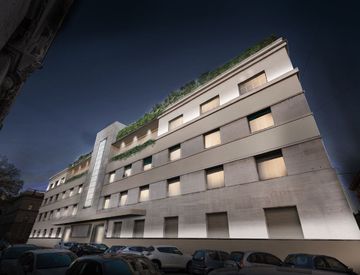
We knew that the objective was to transform the Via Sicilia 57 building, between Via Veneto and Piazza Barberini, into a five-star hotel.
We also knew that a leading international luxury hospitality operator, then not present in the Rome market, was being selected.
But one of the most important names in the entire equation was still missing:
the brand.
That name is now known.
Kimpton Hotels & Restaurants.
IHG Hotels & Resorts’ luxury lifestyle brand.
This update finally allows the analysis to move from:
“What could Via Sicilia 57 become?”
to:
“How much value can the model now taking shape actually create?”
The April Thesis Has Not Changed. It Has Become Testable.
In the original article, we highlighted a simple principle:
real estate prestige and hotel value are not the same thing.
Via Sicilia 57 unquestionably possesses the first.
Location.
Architecture.
History.
Theatre.
Centrality.
Scarcity.
Institutional capital.
But the second — hospitality value — still has to be created.
The arrival of Kimpton does, however, remove one of the project’s major uncertainties.
We now have:
Asset
Institutional Capital
Real Estate Fund
International Luxury Lifestyle Brand.
The project’s industrial structure is becoming increasingly clear.
From Historic Asset to Branded Luxury Hospitality
Via Sicilia 57 is not a neutral building.
It is a rationalist-era property incorporating the former Teatro delle Arti, closed for decades.
That component was already central to our April analysis.
Because in contemporary luxury hospitality, a historic theatre should not simply be regarded as:
space to be recovered.
It can become:
Experience Infrastructure.
If integrated properly into the product, it can support:
-
events;
-
cultural programming;
-
private dining;
-
corporate functions;
-
fashion events;
-
brand activations;
-
entertainment;
-
social programming;
-
banqueting.
The theatre can therefore become more than an identity feature.
It can become:
Revenue-Generating Heritage.
Kimpton Fits This Logic
The Kimpton positioning has historically been built around:
-
boutique hospitality;
-
design;
-
lifestyle;
-
F&B;
-
social interaction;
-
connection with the neighbourhood;
-
individuality of each property.
The choice therefore appears consistent with Via Sicilia 57.
Because the asset does not simply need:
an international flag.
It needs a brand capable of leveraging:
the uniqueness of the property.
That distinction is fundamental.
A brand can standardise.
A luxury lifestyle brand should instead be able to:
codify difference.
Brand Fit Before Brand Prestige
One of the most common mistakes in luxury hospitality is assessing a brand purely on reputation.
The better metric is:
Brand Fit.
Not:
Brand Fame.
The relevant question is:
Can Kimpton convert the architecture, theatre, micro-location and Roman identity of the asset into pricing power?
If it can, the brand creates value.
If it cannot, it primarily provides:
distribution.
And that is a major difference.
The Brand Reduces Commercial Risk, but It Does Not Eliminate Investment Risk
IHG can provide:
-
international distribution;
-
loyalty;
-
commercial systems;
-
brand recognition;
-
revenue infrastructure;
-
access to international demand;
-
luxury and lifestyle know-how.
All of this reduces part of the risk.
But it does not eliminate:
Development Risk
CAPEX Risk
Construction Risk
Timing Risk
Ramp-Up Risk
Operating Risk.
The brand signing is therefore an important milestone.
It is not yet:
Value Creation.
The Real Project Starts Now
The sequence can be read as follows:
Acquisition
↓
Fund Structure
↓
Capital
↓
Brand Selection
↓
Design & Construction
↓
Pre-opening
↓
Opening
↓
Ramp-up
↓
Stabilisation
↓
Value Creation.
Via Sicilia 57 has completed some of the early stages.
But the phases that will ultimately determine returns are still ahead.
Approximately 100 Rooms Change the Way the Asset Must Be Analysed
The project is expected to include around 100 rooms.
Within a property of significant size, that immediately suggests a different logic from a high-density urban hotel.
The relevant metric will not be:
Maximum Keys.
It will be:
Maximum Sustainable Value per Key.
Because in luxury lifestyle hospitality, productivity is not determined solely by room count.
It depends on the ability to monetise:
-
guestrooms;
-
suites;
-
F&B;
-
rooftop;
-
theatre;
-
events;
-
wellness;
-
ancillary revenue.
Historical Space ≠ Optimal Hotel Configuration
The property was originally designed for different functions.
The project should therefore not simply adapt the building to a hotel.
It should identify:
the economically optimal hotel for that building.
The correct sequence is:
Heritage
Planning Constraints
Guest Experience
Revenue Potential
=
Optimal Product Configuration.
The number of rooms comes later.
The Theatre Can Change the Economics per Square Metre
This is one of the most interesting aspects of the project.
A theatre occupies significant space.
Viewed solely through a traditional hotel-efficiency lens, it could be considered:
inefficient space.
In luxury lifestyle hospitality, however, the opposite may be true.
If it generates:
Events
F&B
Corporate Demand
Brand Activation
Local Community Traffic,
it can increase:
Revenue per sqm.
And, even more importantly:
Asset Differentiation.
A Historic Theatre Needs Its Own Business Plan
Restoration alone is not enough.
The theatre needs to be monetised in a way that is consistent with the positioning.
The relevant question is:
what incremental EBITDA can the theatre generate?
Not necessarily through ticket sales.
But through:
-
higher ADR;
-
events;
-
F&B;
-
buyouts;
-
corporate functions;
-
weddings;
-
fashion;
-
sponsorship;
-
experiential packages.
The theatre becomes economically relevant when it improves:
Total Hotel Economics.
Rome Does Not Simply Need Another Five-Star Hotel
That was true in April.
It is even more relevant today.
Rome is undergoing a profound expansion of its luxury hospitality segment.
The market is seeing or preparing for:
-
major international brands;
-
lifestyle hotels;
-
luxury boutiques;
-
branded residences;
-
new institutional capital.
The competitive set is therefore moving higher.
The question is no longer:
Can Rome absorb another luxury hotel?
It is:
Can Via Sicilia 57 establish a sufficiently distinctive position within an increasingly competitive luxury market?
The Real Benchmark Will Not Be the Star Rating
It will be the ability to generate:
ADR Premium
Quality Occupancy
F&B Spend
Event Revenue
GOPPAR
=
Sustainable EBITDA.
That should be the benchmark.
Not:
Five Stars.
Kimpton Needs to Create Property Pull
There are two broad forms of demand.
Destination Pull
The guest chooses Rome.
Then chooses the hotel.
But genuine luxury lifestyle hospitality should also aim to create:
Property Pull.
The guest chooses that specific hotel because they want:
-
that design;
-
that theatre;
-
that rooftop;
-
that restaurant;
-
that community;
-
that experience.
The stronger the Property Pull, the greater the potential:
Pricing Power.
Distribution Power + Property Pull
This may be the true potential of the agreement.
IHG can provide:
Distribution Power.
Via Sicilia 57 can provide:
Property Pull.
The ideal combination is:
International Distribution
Unique Asset
Local Experience
=
Sustainable Pricing Power.
This is how a historic property can become an income platform.
The Mini Stress Test: What Do Approximately 100 Rooms Need to Produce?
Total CAPEX has not been disclosed.
It is therefore impossible to construct a genuine business plan.
But three purely illustrative scenarios can help frame the scale of productivity required.
With approximately 100 rooms, theoretical annual inventory is:
100 × 365
=
36,500 available room nights.
Consider three scenarios.
Scenario A — Conservative
Occupancy:
65%
ADR:
€450
Room nights sold:
23,725
Rooms Revenue:
approximately €10.68 million.
If F&B, rooftop, theatre, wellness and ancillary revenue were to add, purely for illustrative purposes, approximately 30%on top of rooms revenue:
Indicative Total Revenue:
approximately €13.9 million.
At an EBITDA margin of:
22%
Indicative EBITDA:
approximately €3.1 million.
Scenario B — Base Case
Occupancy:
72%
ADR:
€600
Room nights sold:
26,280
Rooms Revenue:
approximately €15.77 million.
Assuming non-room revenue equivalent to approximately 35% of rooms revenue:
Total Revenue:
approximately €21.3 million.
At an EBITDA margin of:
28%
EBITDA:
approximately €6.0 million.
Scenario C — High Performance
Occupancy:
78%
ADR:
€750
Room nights sold:
28,470
Rooms Revenue:
approximately €21.35 million.
Assuming non-room revenue equal to approximately 40% of rooms revenue:
Total Revenue:
approximately €29.9 million.
At an EBITDA margin of:
32%
EBITDA:
approximately €9.6 million.
These figures are not forecasts for the project.
They illustrate one principle:
the brand alone does not determine investment economics.
The real difference between one scenario and another is driven by:
ADR + Occupancy + Non-Room Revenue + Margin.
In a 100-Room Hotel, €100 of ADR Is Worth Millions
This sensitivity is significant.
At 72% occupancy, approximately 100 rooms generate:
26,280 room nights sold.
A difference of:
€100 in ADR
therefore represents approximately:
€2.63 million of annual rooms revenue.
A €150 ADR difference represents almost:
€3.94 million.
Pricing power is therefore not cosmetic.
It is a direct component of investment value.
Five Percentage Points of Occupancy Also Matter
With 100 rooms:
5 percentage points of occupancy
represent approximately:
1,825 room nights per year.
At an ADR of €600:
approximately €1.1 million of rooms revenue.
Ramp-up and the ability to stabilise occupancy quickly therefore have tangible financial value.
From Revenue to EBITDA: This Is Where Operator Quality Is Measured
A hotel can achieve high ADR and still produce weak EBITDA.
If:
-
payroll is excessive;
-
F&B is inefficient;
-
distribution costs rise;
-
utilities are uncontrolled;
-
maintenance is too expensive;
-
service delivery is structurally inefficient,
the pricing premium can simply be absorbed by operating costs.
The true relationship is:
Premium ADR
≠
Premium EBITDA.
What is required is:
Premium ADR
Cost Discipline
Operating Efficiency
=
Premium EBITDA.
From EBITDA to Stabilised Value
Once sustainable EBITDA has been achieved, the next stage is:
Stabilised Value.
In simplified terms:
Sustainable EBITDA
×
Market Multiple
=
Enterprise / Asset Value.
Or, under a real estate approach:
Sustainable Property Income
/
Market Yield
=
Stabilised Real Estate Value.
The methodology will depend on the structure of the transaction.
But the principle remains the same:
future value derives from sustainable income.
Not from the amount of CAPEX spent.
CAPEX Therefore Remains the Fundamental Financial Unknown
The project cannot be properly assessed by knowing only:
-
location;
-
brand;
-
floor area;
-
room count.
The key figure is:
Total Capital Employed.
The equation is:
Acquisition
Construction CAPEX
Restoration
FF&E
OS&E
Professional Fees
Financing Costs
Pre-opening
Working Capital
Contingency
=
Total Capital Employed.
True investment returns begin here.
Yield on Cost: The Metric Linking the Project to Capital
Once Total Capital Employed is known, it can be compared with stabilised EBITDA.
Methodologically:
Stabilised EBITDA
/
Total Capital Employed
=
Yield on Cost.
If the project generated, for example:
€6 million of EBITDA
on:
€100 million of total capital,
the operating return would be:
6%.
If EBITDA rose to €9 million:
9%.
Same hotel.
Same brand.
Same building.
A completely different investment.
Cost ≠ Value
This is a principle repeatedly emphasised by InvestimentiAlberghieri.it.
Spending heavily on an iconic asset does not automatically create value.
The correct sequence is:
CAPEX
↓
Better Product
↓
Higher ADR
↓
Higher Revenue
↓
Higher GOP
↓
Higher EBITDA
↓
Higher Value.
If any one of these links breaks:
CAPEX ≠ Value Creation.
The Real Stress Test Will Come After Opening
The first phase is:
Development.
But the project will ultimately be judged during:
Stabilisation.
The metrics to watch will include:
-
ADR;
-
occupancy;
-
RevPAR;
-
GOPPAR;
-
F&B capture;
-
event revenue;
-
payroll;
-
distribution costs;
-
EBITDA margin;
-
direct booking share;
-
international mix.
Only these numbers will reveal whether Kimpton Via Sicilia 57 has become:
a luxury asset
or:
a luxury investment.
They are not the same thing.
Franchising, Capital and Operations: Separating the Functions
The transaction illustrates an increasingly important feature of institutional hospitality.
Value creation is distributed across different functions.
Capital
funds.
Fund
owns and governs the asset.
Brand
provides identity and distribution.
Operator
generates performance.
Asset Management
protects returns on invested capital.
This separation allows investors to identify:
who creates value
and:
who carries risk.
It is one of the key frameworks through which Investhotel.it analyses hotel acquisitions, developments, turnarounds and value-creation strategies.
The Brand Does Not Replace the Operator
This is another crucial distinction.
An international brand can provide:
-
standards;
-
distribution;
-
marketing;
-
loyalty;
-
technology.
But the daily P&L is built through:
Operations.
Payroll.
Turnover.
Housekeeping.
F&B.
Energy.
Maintenance.
Service delivery.
Revenue management.
Operational execution will therefore remain decisive even with Kimpton.
This is precisely where HotelManagementGroup.it focuses on organisation, revenue management, business planning and performance control.
The Brand Reduces Distribution Risk. It Does Not Eliminate Operating Risk.
The formula is:
Strong Brand
≠
Strong EBITDA.
The latter requires:
Brand
Product
Management
Cost Discipline
Revenue Discipline
=
Sustainable EBITDA.
That is the real equation.
Time Will Continue to Matter
In a complex conversion project, the execution timeline directly affects returns.
Every delay can mean:
-
additional capitalised interest;
-
higher CAPEX;
-
larger contingency;
-
delayed revenue;
-
delayed stabilisation.
Therefore:
Time Is Capital.
Especially when institutional capital is tied up in the project.
The April Article Asked a Question. Today We Have the First Part of the Answer.
The question was:
“Will Via Sicilia 57 become a benchmark or an unfinished investment?”
Today, one important piece has been added.
Kimpton appears consistent with:
-
the historic character of the asset;
-
lifestyle positioning;
-
the theatre component;
-
the central location;
-
international ambitions.
The risk of creating a project without a clear identity therefore:
decreases.
But the harder questions remain:
How Much CAPEX?
What ADR?
What GOPPAR?
What EBITDA?
What Yield on Cost?
What Stabilised Value?
That is where success will ultimately be measured.
The Benchmark Will Not Be Kimpton. It Will Be Kimpton’s Economics.
This is perhaps the most important conclusion.
The brand announcement attracts attention.
But the brand is not the outcome.
It is a tool.
The real benchmark will be:
ADR Premium
Strong Occupancy
Non-Room Revenue
GOP Discipline
Capital Discipline
=
Sustainable Value Creation.
If that equation works, Via Sicilia 57 may genuinely become a benchmark for Rome.
If the capital required grows faster than the cash flow:
the prestige of the transaction will not be enough.
From Real Estate Prestige to Hospitality Enterprise Value
The path that still needs to be completed can be summarised as follows:
Historic Asset
↓
Institutional Acquisition
↓
Rome Hotel Development Fund
↓
International Capital
↓
Kimpton / IHG
↓
Luxury Lifestyle Product
↓
Theatre + F&B + Rooftop + Wellness
↓
Pricing Power
↓
GOPPAR
↓
EBITDA
↓
Yield on Cost
↓
Stabilised Value
↓
Hospitality Enterprise Value.
This is the transformation we identified back in April.
The project has now taken an important step in that direction.
Conclusion: In April, the Brand Was Missing. Today, the Economic Proof Is Missing.
Six months ago, Via Sicilia 57 was primarily:
a major asset with a major ambition.
Today it also has:
a major brand.
But that does not close the case.
It makes it more interesting.
Because almost all the strategic elements are now becoming visible:
Institutional Capital
Historic Real Estate
International Brand
Luxury Lifestyle Positioning
Experiential Infrastructure.
What still needs to be built is the element that matters most:
Sustainable Cash Flow.
That is why the question from the original article remains surprisingly relevant.
Will Via Sicilia 57 become a benchmark?
Kimpton increases the probability that the property will have identity, distribution and international recognition.
But a hospitality benchmark is not created when the brand is announced.
It is created when:
the capital invested produces a return commensurate with the risk taken.
The final equation is therefore:
Brand Creates Attention.
Distribution Creates Demand.
Operations Create EBITDA.
EBITDA Supports Value.
Value Remunerates Capital.
Only then will we know whether Via Sicilia 57 has become:
a great hotel
and, at the same time:
a great hotel investment.
InvestimentiAlberghieri.it | Hospitality Investment & Value Creation
The Via Sicilia 57 update demonstrates why a luxury hospitality investment needs to integrate:
Real Estate + Institutional Capital + Brand + Product + CAPEX + Operations + ADR + Occupancy + GOPPAR + EBITDA + Yield on Cost + Stabilised Value.
The original analysis of the project is available here:
Luxury Hotels in Rome: Will Via Sicilia 57 Become a Benchmark or an Unfinished Investment?
For analysis of hotel economics, governance, positioning and value: RobertoNecci.it.
For acquisitions, development, turnarounds, value creation and extraordinary hospitality transactions: Investhotel.it.
For business planning, organisation, revenue management and performance control: HotelManagementGroup.it.
For hotel investment analysis, acquisitions, development and hospitality asset value creation: