Terme di Sciacca: not just a reopening, but a new hospitality investment case
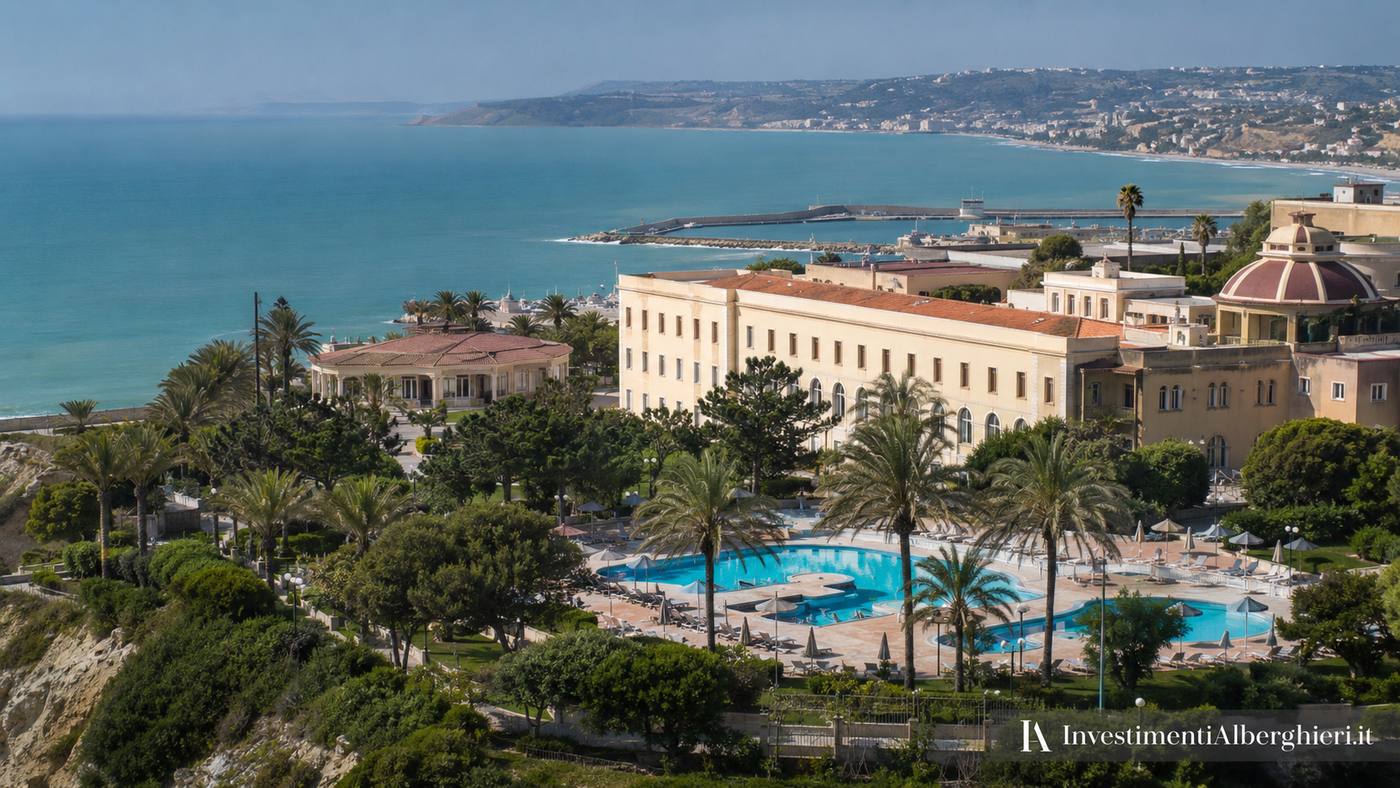
The Terme di Sciacca thermal complex is entering a new industrial phase. Terme & Spa Italia, a company connected to the group that also controls Terme di Saturnia, has been awarded the Sicilian thermal complex through a tender promoted by the Regional Government of Sicily.
This is not simply the reactivation of a historic spa facility. It has the potential to become one of Southern Italy’s most interesting examples of tourism regeneration, real estate value creation and integrated hospitality development.
The announced recovery plan is worth approximately €90 million, with around €40 million expected to come from the Regional Government of Sicily and the remaining amount from private investors. The aim is to restore the Terme di Sciacca to their original therapeutic function while expanding the offer into a broader platform combining wellness, leisure, high-end accommodation, congresses, events and tourism services.
For the hotel investment market, this is a significant development because it confirms a clear trend: successful tourism assets are no longer merely properties to be renovated. They are experience-led platforms capable of generating operational, territorial and financial value.
What the Terme di Sciacca relaunch plan includes
The relaunch plan aims to transform the complex into a modern thermal and wellness destination, integrating several complementary functions.
Based on the information currently available, the project includes:
-
the recovery of the original therapeutic function;
-
a medical and wellness spa developed under the Terme di Saturnia brand;
-
high-end accommodation facilities;
-
dedicated congress and event spaces;
-
an accessible thermal park;
-
wellness and leisure services;
-
an estimated 250 direct jobs, in addition to the wider impact on the local tourism and services economy.
The employment figure is important, but it does not fully capture the potential value of the operation. If properly executed, a project of this nature can generate impact on several levels: visitor flows, local spending, seasonality reduction, capital attraction, destination reputation and the overall quality of the accommodation supply.
Sciacca, in this respect, has three strategic strengths: a recognised thermal tradition, a strong tourism location and a western Sicily market that still holds considerable untapped potential.
Why the operation matters to the hotel investment market
From the perspective of InvestimentiAlberghieri.it, the Terme di Sciacca case is particularly relevant because it brings together four decisive dimensions:
tourism real estate, hotel operations, the wellness economy and territorial development.
The value of a thermal complex is not determined solely by its square metres, location or historical background. It depends above all on the ability to build a sustainable operating model.
A spa asset may have considerable appeal, but without a solid industrial plan it risks remaining an expensive structure: difficult to maintain, complex to manage and unable to generate adequate profitability. Conversely, when placed within an integrated hospitality strategy, it can become a genuine value generator.
The central issue is therefore not simply “reopening the spa”. The real challenge is to build a destination capable of attracting guests, generating revenue, supporting adequate rates, reducing seasonality and positioning itself credibly in the national and international wellness market.
For further insight into the economic and managerial interpretation of hotel assets, the hotel management guides by Roberto Necci are available at www.robertonecci.it, covering operations, positioning, revenues, organisation and hotel business development.
The value is not in the property alone: it is in the operating model
The Sciacca case confirms a fundamental principle of contemporary hospitality: value is not created by the walls themselves, but by the ability to turn those walls into a marketable product.
A historic thermal complex may represent an extraordinary asset, but its potential becomes real only when five elements are properly aligned.
1. Clear positioning
The destination must have a precise identity. Being “a spa” is not enough. The strategic choice is whether to become a medical wellness destination, a luxury resort, a destination spa, a congress venue, an international retreat or an integrated hospitality platform.
2. Professional management
The complexity of a thermal asset requires specialist expertise: hospitality, spa management, revenue management, management control, marketing, maintenance, healthcare professionals and ancillary services.
3. Coherent target demand
The product must be designed for specific segments: leisure guests, high-spending senior travellers, preventive health tourism, corporate retreats, events, international markets, long stays, families or premium clients.
4. Economic sustainability
Thermal facilities carry significant operating costs. Energy, plant systems, maintenance, qualified staff, marketing and specialist services all require a robust economic plan.
5. Territorial integration
A project of this scale works only if it connects with the destination, local restaurants, transport, culture, training, local businesses and institutions.
Without these elements, even a major investment may fail to produce the expected returns.
Sciacca can become a wellness destination, not just a spa town
The real challenge will be to transform Sciacca from a historic spa town into a contemporary wellness destination.
This distinction is crucial. A spa town relies mainly on its natural resource and historical tradition. A wellness destination, by contrast, creates value through experience, brand, hospitality, treatments, services, storytelling, accessibility, operational quality and commercial strength.
The international wellness market is moving towards concepts that go far beyond traditional thermalism: prevention, longevity, medical wellness, nutrition, fitness, mental wellbeing, detox, nature, silence, retreats and personal regeneration.
In this scenario, Sciacca has an important opportunity. Sicily has enormous tourism appeal, yet many areas of the island still need products capable of extending the season, attracting qualified demand and increasing guest spending.
A well-positioned thermal project can help achieve exactly that: less dependence on the summer beach season, more experiential tourism, higher room value, broader service revenues and longer average stays.
The role of Terme di Saturnia: expertise, brand and transfer of know-how
The involvement of Terme di Saturnia is one of the most significant aspects of the operation. Saturnia is one of Italy’s most recognisable brands in the thermal and wellness segment, with a strong history, high-end positioning and established reputation.
However, success will not come from simply replicating the Saturnia model.
Sciacca should not become a copy of Saturnia. It must build its own identity, rooted in Sicily, in the territory, in the history of its waters, in the landscape and in the local tourism potential.
Saturnia’s know-how could be decisive in three areas:
-
service standards;
-
design of the wellness experience;
-
positioning of the product in the national and international market.
The challenge will be to transfer expertise without diluting the destination’s identity. In other words, the project should use the experience of a strong brand to build an autonomous and distinctive product.
Public investment and private capital: opportunities and risks
The €90 million plan, with a significant public component and the involvement of private investors, raises a central question: governance.
Public-private tourism operations can create substantial value, but they require clear objectives, defined timelines, precise responsibilities and constant performance measurement.
The main factors to monitor will be:
-
planning and authorisation timelines;
-
capital structure;
-
agreements between the public entity and private operators;
-
operating model;
-
economic sustainability of the project;
-
quality of the accommodation product;
-
commercial capability;
-
employment impact and benefits for the wider local economy.
The main risk in operations of this kind is that real estate logic prevails over operational logic. Yet in modern hospitality, real estate value creation is driven by management, not the other way around.
A hotel, resort or thermal complex does not increase in value simply because it has been renovated. It increases in value when it becomes a sellable, recognisable, profitable and defensible product over time.
On the intersection of hotels, investment, profitability and real estate repositioning, the InvestHotel.it blog offers further insights for operators and investors in the sector.
A possible new asset class: thermal resorts, wellness hotels and medical hospitality
The relaunch of the Terme di Sciacca fits into a broader trend: the growth of hybrid assets combining hospitality, health and wellbeing.
The hotel market is showing increasing interest in properties that do not merely sell overnight stays, but high-value experiences. These include:
-
wellness resorts;
-
medical spas;
-
destination spas;
-
thermal resorts;
-
longevity retreats;
-
wellness centres integrated with hotels;
-
hybrid structures combining hospitality and low-intensity medical wellness.
These assets can generate revenue from multiple sources: rooms, treatments, restaurants, events, memberships, health programmes, corporate packages, day spa access, retail, specialist consultations and ancillary services.
Revenue diversification is one of the most attractive features for investors. A traditional hotel depends largely on rooms and food and beverage. A well-managed wellness complex can instead build a more diversified economic model.
Naturally, greater complexity also means greater operating risk. This is why these assets require higher-level management expertise than standard hotel operations.
Key issues to monitor over the coming months
The operation has strong potential, but also several critical points that should be monitored carefully.
The first is timing. A €90 million intervention on a complex asset may face design, administrative or financial delays.
The second is positioning. The wellness market is attractive, but also competitive. Declaring a premium offer is not enough: architectural quality, service, people, brand, pricing and international distribution must all be coherent.
The third is profitability. Thermal facilities carry significant fixed costs. To support the model, the project will need year-round occupancy, strong average revenues, service sales and tight operational control.
The fourth is accessibility. A destination may have an excellent product, but if it is not easy to reach, it loses competitiveness against national and international alternatives.
The fifth is territorial integration. The success of the Terme di Sciacca will not depend only on what happens inside the property, but on the ability to build a tourism ecosystem around the project.
What this operation can teach hotel investors
The Sciacca case offers several lessons for those looking at the Italian hospitality market.
The first is that complex assets can become attractive again when approached with an industrial logic. Thermal complexes, convents, historic buildings, former seaside colonies, publicly owned assets and incomplete resorts can all become valuable products, but only if supported by a credible operating project.
The second is that wellness is no longer an ancillary service. In many cases, it can become the core of the hotel positioning.
The third is that Southern Italy still offers significant potential for tourism regeneration projects, especially where natural resources, local identity and real estate assets can be enhanced.
The fourth is that capital alone is not enough. Without management, marketing, management control and commercial vision, even the most ambitious projects risk remaining unfinished.
The fifth is that investors are increasingly looking for assets capable of telling a story. And Sciacca has a strong story: thermal waters, Sicily, the sea, wellbeing, culture and rebirth.
Why this news goes beyond Sciacca
The acquisition of the Terme di Sciacca is not only about one Sicilian town. It is a signal for the entire Italian hospitality sector.
Many tourism assets in Italy remain underused. They have location, history, charm and potential, but not yet a contemporary economic model. The Sciacca case shows that the market may once again look at these assets, provided there is capital, governance and competent operators.
The future of Italian hospitality will increasingly depend on the ability to transform heritage into product. It is not enough to own beautiful properties. They must be made alive, desirable, profitable and consistent with market demand.
From this perspective, the Terme di Sciacca could become a case study not only for the thermal sector, but for the entire hotel investment market.
For more analysis of deals, acquisitions, real estate value creation and hospitality strategies, visit the InvestimentiAlberghieri.it blog.
Conclusion: Sciacca could become a strategic asset for Italian wellness hospitality
The relaunch of the Terme di Sciacca is one of the most interesting operations in the Italian tourism and hotel landscape.
The €90 million plan, the involvement of Terme & Spa Italia, the connection with Terme di Saturnia, the role of the Regional Government of Sicily and the destination’s potential all make this project particularly significant.
But success will not be determined by investment alone. It will be determined by execution.
The decisive questions are: What will the final positioning be? Which operating model will be adopted? Which clientele will the project target? What level of accommodation will be developed? What will the international commercial strategy look like? How will the project integrate with Sciacca and the wider Sicilian territory?
If the answers are coherent, the Terme di Sciacca can become much more than a renovated thermal facility. It can become a new strategic asset for Italian wellness hospitality.
Do you own or manage a hotel, resort or tourism asset that needs to be repositioned?
Turning a tourism property into a profitable hotel product requires vision, method and specialist expertise.
Hotel Management Group supports owners, investors and operators with advisory, hotel development, turnaround plans, positioning, management, marketing and value creation.
Discover the group’s activities at www.hotelmanagementgroup.it.
For further insight into hotel management and hospitality investment:
FAQ
Who acquired the Terme di Sciacca?
The Terme di Sciacca complex was awarded to Terme & Spa Italia, a company connected to the group that also controls Terme di Saturnia, through a tender promoted by the Regional Government of Sicily.
How much is the Terme di Sciacca relaunch plan worth?
The announced relaunch plan is worth approximately €90 million, with around €40 million expected to come from the Regional Government of Sicily and the remaining amount funded by private investors.
What does the Terme di Sciacca project include?
The project includes the recovery of the original thermal function, a medical and wellness spa, high-end accommodation facilities, congress areas, event spaces, leisure services and an accessible thermal park.
Why is the operation important for the hotel sector?
The operation is important because it shows how a historic thermal asset can be transformed into an integrated platform combining hospitality, wellness, tourism, events and real estate value creation.
How many jobs could the project create?
Based on the information available, the plan could generate approximately 250 direct jobs, in addition to wider economic impact across tourism, services, restaurants, maintenance and local businesses.
Will the Terme di Sciacca become a hotel?
The project does not appear to be limited to a hotel. The objective seems broader: to create an integrated thermal and wellness destination with accommodation, medical wellness, congress and leisure components.
What is the role of Terme di Saturnia?
Terme di Saturnia represents an important industrial and operational reference point for the project, particularly in terms of wellness expertise, service standards and thermal product positioning.
What are the main risks of the operation?
The main risks concern delivery timelines, economic sustainability, public-private governance, commercial positioning, operating costs and the ability to attract demand throughout the year.
Why is wellness increasingly important in hotel investment?
Wellness enables hotels and resorts to increase the value of the guest experience, diversify revenues, reduce seasonality and attract customer segments with higher spending potential.
Could the Terme di Sciacca become a case study?
Yes. If the project is executed with operational, financial and commercial coherence, the Terme di Sciacca could become a relevant case study in tourism regeneration and hotel value creation in Southern Italy.