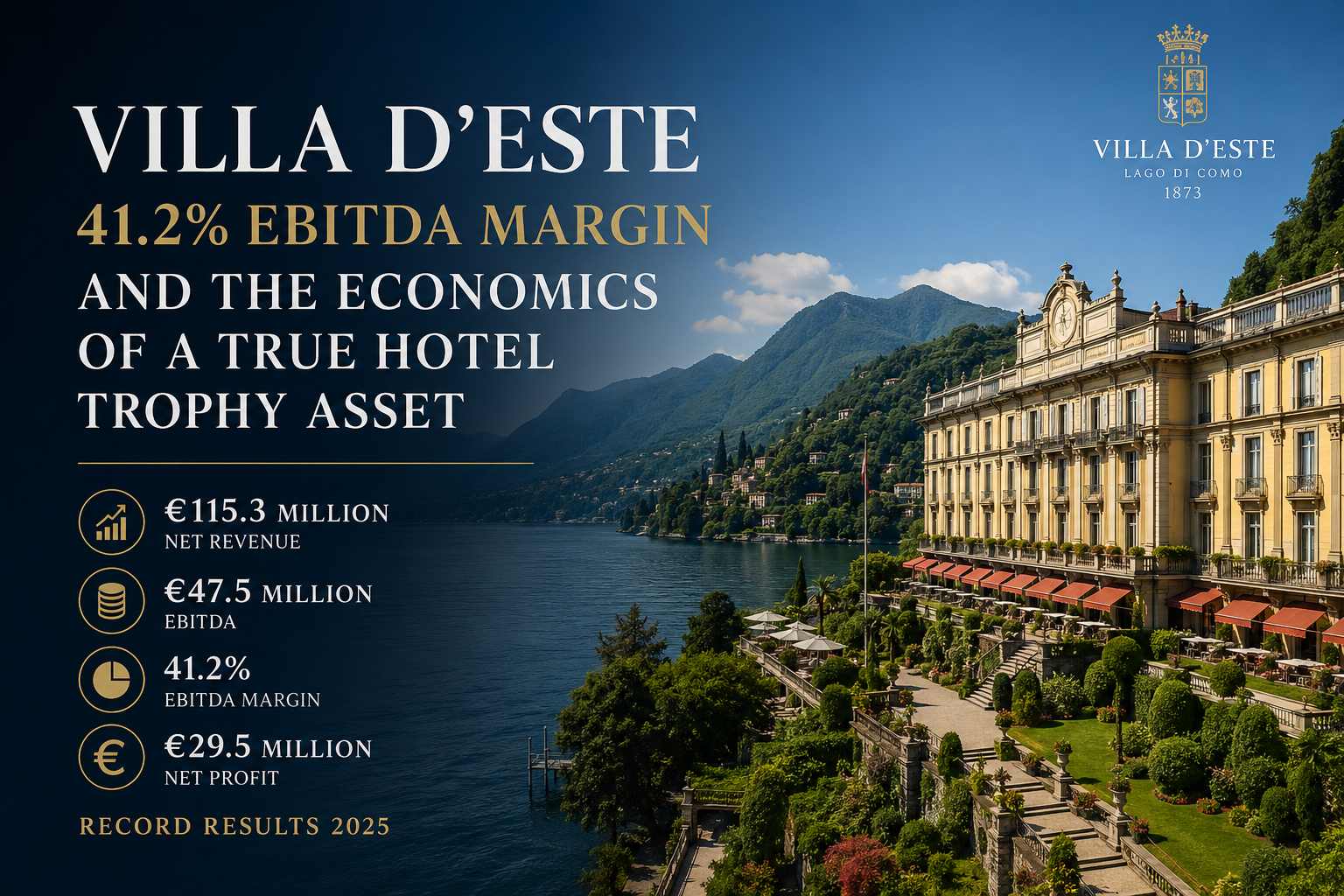
Key 2025 figures
| Indicator | 2025 figure |
|---|---|
| Net revenue | €115.3 million |
| EBITDA | €47.5 million |
| EBITDA margin | 41.2% |
| Net profit | €29.5 million |
| Revenue growth vs 2024 | +13.6% |
| EBITDA growth vs 2024 | +18.6% |
| Net profit growth vs 2024 | +22.9% |
Villa d’Este closed 2025 with net revenue of €115.3 million, EBITDA of €47.5 million, an EBITDA margin of 41.2%and net profit of €29.5 million. According to the company’s official financial statements, 2025 was the best year in Villa d’Este’s history since the company was founded in 1873.
Villa d’Este’s record year is not just a hotel success story
Villa d’Este’s 2025 results should not be read simply as the outstanding performance of one of Italy’s most iconic luxury hotels. They should be read as a case study in how value is created at the very top end of the hospitality market.
At first glance, the story is straightforward: the Villa d’Este group delivered record revenue, stronger margins and higher net profit. But for a hotel investor, the real question is not only how much revenue a property generates. The real question is how that revenue is produced, how much of it is converted into operating profit, how defensible that performance is and how effectively it translates into long-term asset value.
In Villa d’Este’s case, the most important figure is not the fact that revenue exceeded €115 million. The strategically important number is the 41.2% EBITDA margin.
An operating margin at this level shows that the asset is not relying only on prestige, heritage or reputation. It shows that the business model is highly efficient, that the brand has genuine pricing power, that the destination supports premium rates and that management is able to convert a substantial share of revenue into operating profitability.
In luxury hospitality, this is what separates a prestigious hotel from a true trophy asset.
Why the 41.2% EBITDA margin matters more than revenue
In hospitality, revenue often receives most of the attention. That is understandable, but it is not enough. Revenue measures the scale of the business. EBITDA measures the economic quality of the operation.
In 2025, Villa d’Este generated €47.5 million of EBITDA on €115.3 million of net revenue. In other words, more than four euros out of every ten euros of revenue became gross operating profitability.
That is an exceptional performance for a hotel business, especially in the luxury segment, where operating complexity is high: qualified labour, constant maintenance, service standards, food and beverage, events, heritage assets, energy costs, ongoing capital expenditure and destination seasonality.
The financial statements also show an improvement in profitability ratios: ROS increased to 37.2%, ROI to 7.2% and ROE to 8.4%.
These figures tell a clear story: Villa d’Este is not only an icon. It is a high-performing economic engine capable of producing institutional-grade profitability within a real estate and reputational context of exceptional value.
For hotel investors, this is a fundamental lesson. The value of a hotel asset does not depend only on location, architectural quality or brand recognition. It depends on the ability to combine these elements into an operating model that produces solid, defensible and repeatable cash flows.
Villa d’Este shows what a trophy asset really is
In real estate investment language, a trophy asset is not simply a beautiful, rare or expensive property. It is an asset that is difficult to replicate, located in a market with extreme scarcity, capable of attracting international demand and able to preserve value across market cycles.
Villa d’Este has all these characteristics.
It is a historic asset. It is located on Lake Como, one of the most recognisable luxury destinations in the world. It has its own brand identity, independent of any global hotel chain. It attracts a global clientele. It has a long-established reputation. Most importantly, it has proved capable of turning all these elements into profitability.
Lake Como, in this respect, is no longer just a prestigious tourist destination. It has become a genuine luxury hospitality asset class. Scarcity of supply, planning and landscape constraints, strong international demand and the concentration of iconic properties make the Lake Como market fundamentally different from many other Italian hotel markets.
For an investor, this means that value is not created only by the hotel itself. It is created by the ecosystem in which the hotel operates.
A luxury hotel on Lake Como does not simply sell rooms. It sells access to a destination narrative: privacy, landscape, heritage, reputation, experience and status. When these elements are managed with operational discipline, they become margin.
The real strategy: not a hotel, but a destination platform
The most relevant aspect of the Villa d’Este case is not only the income statement. It is the strategy.
In 2025, the group strengthened its control of Immobiliare Bosco Montorfano, owner of the Golf Villa d’Este complex, reaching 73.1% of the share capital as of 31 December 2025. It also incorporated Regina Olga Srl, acquiring the Hotel Regina Olga real estate complex with the aim of transforming it into a luxury four-star hotel by the 2027 season.
Also in 2025, through Lario Trieste Srl, the group acquired 100% of Palazzo Venezia Srl, the company into which the business units of Hotel Terminus and Hotel Vista Lago di Como had been contributed.
These transactions reveal a very clear strategy: Villa d’Este is not merely managing a great hotel. It is building a luxury hospitality platform across Lake Como.
The difference is substantial.
A single hotel, however prestigious, is an asset. An integrated network of hotels, complementary real estate, golf, restaurants, residences, services, training facilities and destination control is a platform. And in the hospitality market, platforms tend to be worth more than the sum of their individual assets.
They create economies of scale.
They support cross-selling.
They reinforce positioning.
They improve control over human capital.
They allow the group to capture different segments of luxury demand.
They enable an operator to secure strategic territory before competitors do.
That is the real strategic message behind Villa d’Este’s 2025 results.
Human capital is becoming part of hospitality asset management
One of the most interesting aspects of the Villa d’Este model concerns people. In many Italian luxury destinations, access to qualified staff has become a structural constraint.
An iconic hotel is not enough. High room rates are not enough. International demand is not enough. Without the ability to attract, train and retain the right people, service quality weakens, and with it the pricing power of the hotel.
In its 2024 financial statements, Villa d’Este described the Lake Como Hospitality Campus, designed not only as employee accommodation, but also as an environment for professional development, training and career growth in hospitality and food and beverage.
This point is crucial for investors.
In contemporary luxury hospitality, employees are no longer simply a cost item. They are part of the productive infrastructure of the hotel. In destinations where the cost of living is high, housing supply is limited and service standards are demanding, the ability to provide accommodation, training and career development becomes a competitive advantage.
In other words, even employee housing can become part of the value creation thesis.
Not because it directly generates hotel revenue, but because it protects the hotel’s ability to deliver quality, operational continuity and margin.
What Villa d’Este teaches hotel investors
The Villa d’Este case offers at least five clear lessons for those who invest in, value or manage hotel assets.
The first is that high-end Italian luxury remains one of the strongest segments of the market, but only when it is supported by truly international destinations and assets that are difficult to replicate.
The second is that margin does not automatically come from luxury. It comes from the combination of pricing power, operating control, brand strength and quality of demand.
The third is that the value of a hotel can no longer be separated from the value of its destination. In the case of Lake Como, the destination is part of the product and part of the valuation multiple.
The fourth is that the best assets do not simply perform: they aggregate, control and develop. Villa d’Este’s expansion through golf, Regina Olga, Hotel Terminus and Vista Lago confirms a platform-based logic.
The fifth is that human capital has become a real estate variable. Where staff cannot live, even the most beautiful hotel can lose competitiveness.
Not all luxury hotels are created equal
Villa d’Este’s 2025 results also allow for a broader reflection on the Italian hotel market.
In recent years, many investors have looked at luxury hospitality as an almost automatically attractive sector. But luxury alone is not enough. Some hotels are expensive to acquire and complex to operate, yet fail to generate adequate margins. Some properties are prestigious but operationally fragile. Some destinations are well known but not sufficiently liquid. Some brands are strong but difficult to scale.
Villa d’Este is different because it combines four rare dimensions.
Iconic asset
The property and its history create a reputational barrier that is extremely difficult to replicate.
Global destination
Lake Como is internationally recognised and benefits from consolidated luxury demand.
Profitable operation
A 41.2% EBITDA margin proves operational excellence, not just prestige.
Coherent expansion strategy
The transactions involving the golf club, Regina Olga, Hotel Terminus and Vista Lago point to a long-term territorial vision.
This combination is rare. And it is precisely rarity that creates value.
The lesson for the Italian hospitality market
For the Italian hotel market, Villa d’Este is a particularly relevant model because it shows that Italy can compete in luxury hospitality not only as a place of beauty, but as a serious investment platform.
Too often, Italian hotel assets are described only in aesthetic terms: historic palaces, villas, lakes, coastlines, art cities and villages. But the investment market requires a different language: EBITDA, CapEx, cash flows, returns, multiples, positioning, governance, operational sustainability and human capital.
Villa d’Este brings these two dimensions together.
On one side, there is the power of the destination narrative: Lake Como, heritage, luxury and Italian hospitality.
On the other, there is economic discipline: margins, net profit, control of assets, acquisitions, investment and people development.
That combination is what makes the case so relevant.
A luxury hotel is no longer merely an asset to own or a brand to celebrate. It is a complex platform in which real estate, operations, human capital, reputation and destination must work together.
The value is not in the hotel. It is in the system the hotel can control
Villa d’Este’s 2025 results describe an exceptional year, but above all they reveal where luxury hospitality is heading.
The future of the sector will not be determined only by those who own the best properties. It will be determined by those who can transform those properties into integrated value platforms.
Villa d’Este shows that a hotel can become much more than a hotel: a territorial stronghold, an international brand, a cash-flow engine, a catalyst for further real estate value creation, a human capital infrastructure and a reference point for an entire destination.
For hotel investors, the lesson is clear.
The best assets are not necessarily those with the lowest acquisition price, nor those with the highest room count. They are the assets that can transform scarcity, reputation, operational discipline and territorial control into durable profitability.
In Villa d’Este’s case, 2025 is not just a record financial year. It is confirmation that in luxury hospitality, true value is created when real estate becomes a platform, the brand becomes the destination and management becomes long-term strategy.
For investors assessing hotel acquisitions, value creation strategies, luxury hospitality assets or repositioning opportunities, the Villa d’Este case confirms a central principle: a hotel should not be valued only for what it is today, but for its ability to generate long-term value through positioning, margin, operational control and integration with the destination.
hotelinvestments.it analyses the hospitality market from a financial, real estate and operational perspective, helping investors, owners and operators read hotels not only as accommodation businesses, but as complex economic assets.
Roberto Necci - r.necci@robertonecci.it