Villa Peragallo could become one of the most distinctive heritage hotels in the Florence area.
Or it could remain, for years to come, a magnificent historic property unable to achieve economic viability.
The difference between those two outcomes does not depend on the beauty of the building.
It depends on CAPEX, heritage restrictions, planning permissions, the hospitality concept, achievable room rates and the stabilized value of the completed asset.
That is the right starting point for analysing Villa Peragallo — formerly Villa Vespasiana and, before that, Villa Matilde — an extraordinary historic estate in Calenzano Alto, just outside Florence.
The real question is not:
Can Villa Peragallo accommodate hotel rooms?
The right question is:
Can it become a hospitality business capable of generating a return on the capital required to bring it back to life?
The answer is: potentially yes, but only under certain conditions.
And certainly not through the logic of a conventional real estate conversion.
Villa Peragallo would need to become a destination in its own right.
An estate that extends far beyond the main villa
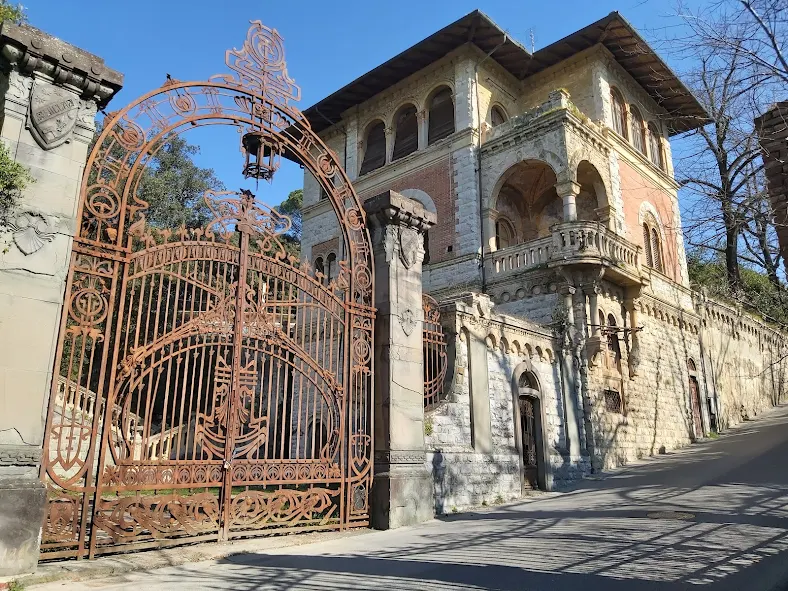
The property is located in Calenzano Alto, on the hill of San Niccolò, overlooking the Florentine plain.
Its present configuration is largely the result of the radical transformation commissioned in the early twentieth century by Florentine lawyer Giuseppe Targioni, who appointed architect Enrico Dante Fantappiè to redesign the estate.
Works began in 1901 and continued until 1907, although the overall project was never fully completed.
What remains, however, is a remarkably complex architectural ensemble.
There is far more to the estate than the main villa.
The property includes a chapel, a private theatre, greenhouses, a monumental arch, two smaller villas, stables, ancillary buildings and towers, an artificial grotto, water features, terraced gardens and an unusual underground passage running beneath via del Castello and connecting different sections of the estate.
It is precisely this variety of buildings and spaces that makes Villa Peragallo far more interesting, from a hospitality perspective, than a conventional historic residence.
The product would not simply consist of guestrooms.
The entire estate could become the product.
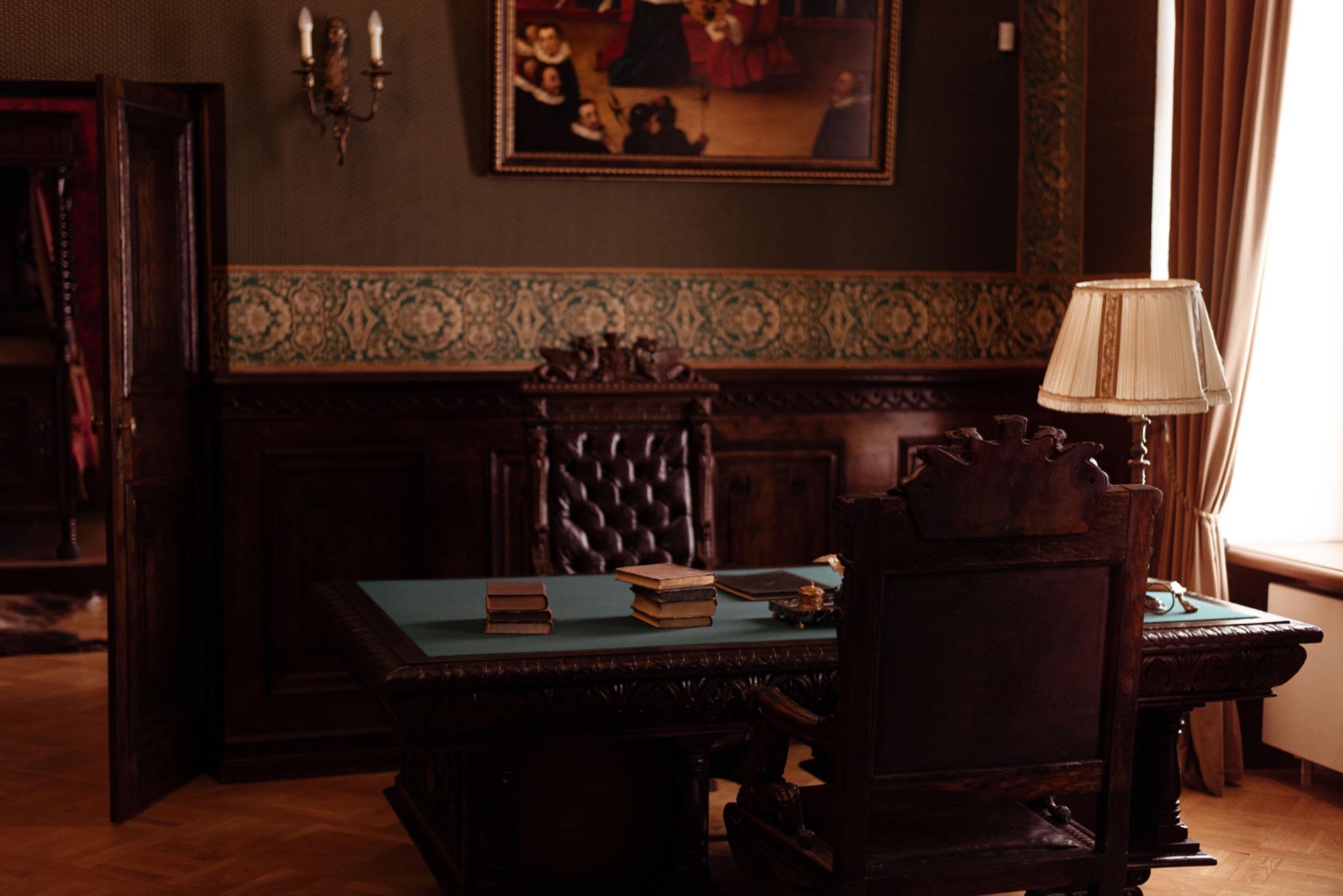
The interiors are already part of the positioning
Villa Peragallo is not merely a large historicist villa.
Its interiors were conceived as an integrated decorative environment, combining paintings, stucco work, flooring, built-in furnishings and architectural ornament.
Each room has its own distinct identity.
The ground floor historically accommodated the dining room, library, music room, an Oriental-inspired smoking room, billiard room and several formal reception spaces.
The decorative programme includes works by artists such as Annibale Brugnoli, Giulio Bargellini and Ezio Giovannozzi.
The upper floor contains bedrooms and a particularly notable bathroom decorated with floral frescoes.
In today's hospitality market, this gives the estate something exceptionally valuable:
there is no need to invent a story in order to create a positioning. The story already exists.
The challenge would be not to dilute it.
The first mistake would be to create too many rooms
A conventional hotel development process might begin with an apparently logical question:
How many rooms can we fit into the property?
In the case of Villa Peragallo, I would start from the opposite premise:
How few rooms can we create while still making the project economically viable?
In a heritage asset, maximising density can destroy value.
More rooms can mean more bathrooms, more mechanical and electrical systems, more vertical circulation, greater fire-safety complexity, larger back-of-house requirements, more invasive interventions within historic interiors and, inevitably, higher CAPEX.
Villa Peragallo should probably focus on the value of each room rather than the number of rooms.
Large suites.
Irreplaceable interiors.
Memorable public spaces.
Highly personalised service.
Private experiences.
The objective should not be to turn Villa Peragallo into a hotel.
It should be to make Villa Peragallo the reason guests choose the hotel.
The most coherent concept: a heritage luxury estate
Among the possible development scenarios, the one that appears strategically most coherent is a heritage luxury estate.
A relatively small hotel in relation to the overall size of the property, supported by multiple ancillary revenue streams capable of significantly increasing total spend per guest.
The main villa could form the core of the hotel.
Subject to planning and technical feasibility, the smaller villas could become independent suites, private villas or long-stay accommodation.
The greenhouses could potentially accommodate food and beverage or event functions.
The theatre could be restored as a venue for private gatherings, concerts, presentations, selected events and small-scale MICE activity.
The chapel has obvious potential within the destination-wedding market.
The park should become an integral part of the guest experience.
Under this model, the P&L would not rely solely on room revenue.
The revenue mix should include:
Rooms + Food & Beverage + Events + Weddings + MICE + Wellness + Experiences + Buyouts.
For this type of asset, Total Revenue per Guest may be just as important as ADR and RevPAR.
Calenzano is not Florence
A serious feasibility study must avoid one of the most common mistakes made when valuing assets in the wider Florence metropolitan area:
assuming that being geographically close to Florence is equivalent to being in Florence.
It is not.
Villa Peragallo cannot automatically be underwritten using the room rates achieved by luxury hotels in Florence's historic centre.
Guests would need a compelling reason to choose Villa Peragallo over Florence itself.
That reason must be the product.
Privacy.
Landscaped grounds.
Space.
History.
Gastronomy.
Experiences.
Weddings.
Events.
The possibility of taking over the entire estate exclusively.
Its real competitive set would therefore not be the hotels of Calenzano, nor necessarily the city hotels of Florence.
It should include resorts, historic villas, country estates and luxury retreats across the Florence area and the wider Tuscan market.
This distinction is fundamental because it affects achievable ADR, occupancy, seasonality, average length of stay and the property's ability to generate destination-led demand.
Before discussing the hotel, one must establish whether a hotel is actually feasible
Commercial potential is not the same as planning feasibility.
Villa Peragallo is a protected cultural asset.
Any significant intervention would therefore need to comply with heritage restrictions and be approved by the relevant heritage authorities.
At the same time, the planning status of each individual building must be verified.
It is not enough to conclude that a hotel use would make commercial sense.
The real question is what can actually be authorised within this specific property.
Before considering an acquisition offer, partnership or development plan, I would build a data room containing, at a minimum:
-
cadastral and land-registry searches;
-
the 2020 acquisition deed;
-
the formal heritage designation and exact scope of protection;
-
historic and recent planning and building permits;
-
permitted use of each individual building;
-
a complete measured survey;
-
structural assessment;
-
geological assessment and analysis of retaining walls;
-
preliminary fire-safety review;
-
accessibility assessment;
-
parking and traffic analysis;
-
utilities and infrastructure capacity;
-
restrictions affecting the grounds and landscaping;
-
the legal position arising from the 2021 wall collapse.
De-risking comes first. The business plan comes afterwards.
The same principle should apply to any transaction assessed through InvestHotel.it: acquiring a hotel or a building for hotel conversion without first quantifying the unknowns simply means converting those unknowns into capital at risk.
The 2021 wall collapse is not a footnote
On 5 October 2021, part of the estate's perimeter wall collapsed along via Dietro Poggio.
Federica Pastacaldi, aged 49, lost her life in the incident.
The collapse led to legal proceedings involving representatives of the local authority, municipal technicians and the owner of the villa.
According to the information available, in January 2025 former mayor Riccardo Prestini and two municipal officials were committed for trial, while the owner's position had been separated from the main proceedings because of issues relating to the translation of documents served on him.
Before any transaction, it would therefore be essential to verify the current status of the proceedings, any civil-law implications, possible compensation claims, insurance coverage and any outstanding safety obligations.
For an investor, the relevant question is not simply who may ultimately be held responsible for a past event.
The question is:
which economic, technical and legal liabilities could enter the transaction, directly or indirectly?
That issue belongs in the due diligence process before the valuation itself.
The real price of the villa is not the purchase price
In the market for historic properties, attention often focuses on the asking price.
For Villa Peragallo, that may be one of the least important figures.
The number that really matters is:
Total Project Cost.
In other words:
**acquisition price
-
transaction costs
-
structural consolidation
-
restoration
-
hotel conversion
-
MEP systems
-
landscaping
-
infrastructure
-
design and professional fees
-
permitting costs
-
interest during construction
-
pre-opening costs
-
working capital
-
contingency.**
Only once these items are added together can an investor understand the true amount of capital at risk.
The villa has been unoccupied for decades.
Some parts of the estate have suffered significant deterioration.
The theatre is particularly compromised.
The park, perimeter walls, external works and infrastructure also represent meaningful components of the investment.
This is where many apparently attractive transactions cease to work.
Not because the property itself is too expensive.
But because the cost of transforming it becomes too high relative to what the completed asset can ultimately be worth.
The most important number is residual value
Before discussing the price of Villa Peragallo, I would build the financial model backwards.
Step one
Define the hospitality concept.
Step two
Estimate ADR, occupancy, ancillary revenues and operating costs at stabilization.
Step three
Determine stabilized EBITDA.
Step four
Capitalise that income using a yield consistent with the asset's risk profile, location, operating structure and quality.
This produces the stabilized value of the completed hotel.
From that value, an investor must then deduct:
-
construction and restoration costs;
-
professional fees;
-
financing costs;
-
pre-opening costs;
-
contingency;
-
the cost of time;
-
development risk;
-
the investor's required return.
What remains is the maximum theoretical value that can be attributed to the asset today.
This is the logic of Residual Value.
And it is far more meaningful than price per square metre.
If the resulting value falls below the owner's expectations, the transaction is not viable unless at least one variable changes:
price, CAPEX, room count, rates, ancillary revenues, financing structure or the overall use concept.
It would be wrong to invent a room count today
It would be easy to make this article more dramatic by putting forward a number:
30 rooms.
40 rooms.
50 rooms.
And then attaching a theoretical CAPEX figure.
That would be methodologically weak.
Without certified floor areas, measured surveys, a detailed breakdown of each building, existing layouts, heritage-authority requirements and fire-safety analysis, such a number would have limited value.
In a professional hotel investment analysis, it is better to state clearly what still needs to be verified than to turn an editorial assumption into a financial datapoint.
The first genuine feasibility study should therefore produce three scenarios.
Conservative scenario
Lower room count, maximum preservation of the historic layout, high CAPEX per key and greater exclusivity.
Base scenario
A balance between conservation, room count and the use of ancillary buildings.
Expansion scenario
Greater use of secondary buildings, a stronger residential and events component, and greater planning complexity.
Only by comparing IRR, Equity Multiple, funding requirements and stabilized value across the three scenarios could one determine which model genuinely creates value.
The theatre could be worth more than several guestrooms
One of the most interesting aspects of the estate concerns precisely those spaces that may initially appear less productive.
An investor might be tempted to view the theatre, chapel, greenhouses and park as areas that absorb CAPEX without generating enough direct revenue.
That could be a mistake.
In luxury hospitality, pricing power often depends on what a hotel offers beyond the guestroom.
A historic salon.
A private theatre.
A monumental garden.
A chapel.
A unique event venue.
An estate available for exclusive buyout.
These elements create additional occasions for spend and, more importantly, make the property difficult to compare directly with a conventional hotel.
Villa Peragallo should therefore be assessed by distinguishing between:
directly revenue-generating areas
and
areas that increase the value of the revenue-generating areas.
A theatre that does not produce revenue every day can still support higher ADR, create opportunities for buyouts, attract weddings and events and strengthen the property's international positioning.
Weddings, yes. A wedding factory, no
Villa Peragallo has almost all the natural ingredients for the wedding market:
a chapel, landscaped grounds, strong architectural character, historic reception rooms, greenhouses, independent spaces and proximity to Florence.
But turning it primarily into a wedding venue would probably be a strategic mistake.
Weddings should enhance the hotel's revenue base.
They should not replace the hotel business.
Too many events could reduce privacy and exclusivity and create conflicts with the expectations of luxury leisure guests.
The more coherent strategy would be based on:
fewer events, higher average spend, strong exclusivity and full-estate buyout opportunities.
MICE could also create meaningful value
The theatre and formal reception spaces also suggest another potential segment:
executive retreats, board meetings, leadership meetings, product launches, incentives and small high-value corporate events.
A heritage hotel close to Florence but removed from the urban environment could be attractive to groups seeking privacy and focus.
Again, the competitive advantage would not be size.
It would be exclusivity.
The foreign ownership is worth monitoring
The estate was acquired in 2020 by a US investor.
According to the information available, the new owner had expressed an intention to carry out a substantial conservation-led restoration.
Subsequent events, however, appear to have slowed that process.
Several years after the acquisition, an asset of this kind deserves to be monitored from the perspective of the ownership cycle as well.
This does not mean Villa Peragallo is currently for sale.
It simply reflects a recurring dynamic in large heritage assets:
the cost of holding an inactive property can gradually alter an owner's strategic priorities.
An investor may choose to develop the project directly.
They may seek a local partner.
They may contribute the property into a special-purpose vehicle.
They may create a joint venture with an operator.
Or they may decide to exit the investment.
For that reason, Villa Peragallo is an asset worth watching.
A joint venture could be more efficient than an outright sale
The scale of the CAPEX may make a structure in which one party acquires, restores and operates the property entirely on its own relatively inefficient.
One potential structure could involve:
Property Company
owner of the real estate and responsible for the property investment;
Operating Company
responsible for the hotel business;
brand or operator
through a management agreement, franchise or soft brand;
equity partner
providing development capital.
Alternatively, the current owner could contribute the property into a joint venture rather than selling it outright.
The agreed value of the estate could then become part of the equity invested in the development vehicle.
This can be particularly effective where an owner controls an exceptional property but does not wish to fund the entire transformation independently.
For projects of this nature, Hotel Management Group can act as the point of coordination between ownership, concept development, operating model, operator selection and the economics of the transaction.
International brand or independent operation?
I would not automatically assume that Villa Peragallo needs to join a major international hotel group.
A global brand could provide distribution, loyalty, reputation and access to international demand.
But it could also require dimensional standards that are difficult to meet, higher CAPEX, substantial service areas, significant fees and interventions that may be poorly suited to a protected historic building.
I would therefore assess several options in parallel:
-
management agreement;
-
franchise;
-
soft brand;
-
specialist independent operator;
-
professionally structured owner-operation.
The key question is not:
Which name would look most prestigious on the façade?
The key question is:
Which model generates the highest asset value after accounting for all required investment and fees?
The right development roadmap
If I were asked to assess the investment, I would not begin with the final architectural design.
I would begin with a precise sequence of decisions.
Phase 1 — de-risking
Planning, heritage, structural, cadastral, legal, accessibility, parking and fire-safety analysis.
Phase 2 — market study
Competitive set, demand, ADR, occupancy, weddings, MICE, F&B and seasonality.
Phase 3 — concept
Room count, room categories, services, use of secondary buildings and guest journey.
Phase 4 — feasibility
Ten-year P&L, EBITDA, CAPEX, financing, stabilized value, IRR and Equity Multiple.
Phase 5 — operator search
Comparison between independent operation, management agreement, franchise and soft brand.
Phase 6 — design and approvals
Only once the economics have demonstrated that the concept can work.
This sequence matters.
Designing before understanding the business model means risking the creation of the wrong project extremely well.
Heritage restrictions can become a barrier to entry
Heritage restrictions are normally entered on the risk side of the investment case.
But Villa Peragallo also offers another perspective.
Protection makes the asset harder and more expensive to transform.
At the same time, it helps make the property irreplaceable.
No competitor can build another Villa Peragallo tomorrow.
No newly developed hotel can reproduce its authenticity, decorative interiors and history.
Heritage restrictions can therefore represent both:
higher CAPEX
and
a higher barrier to entry.
In the luxury segment, the second element can become an important part of the investment case.
The real challenge is to reach the point at which the cost of preserving the asset's uniqueness remains lower than the economic value created by that uniqueness.
Marketing should begin during the restoration
A project like this should not begin its commercial positioning only a few months before opening.
The story can start during the restoration itself.
The construction site.
The artisans.
The frescoes.
The theatre.
The park.
The transformation.
The relationship with Florence and Tuscany.
Villa Peragallo already has everything required to build a compelling international narrative.
The strategy could therefore begin during the development phase through a dedicated positioning and content programme developed with Hotel Marketing Lab.
The mistake would be to wait until opening and simply photograph attractive guestrooms.
The real story is the revival of a historic estate.
What is Villa Peragallo worth today?
The correct answer is:
we do not yet know.
Anyone assigning a precise figure without having at least verified the usable areas, permitted uses, CAPEX and projected business plan is largely valuing the emotional appeal of the property.
For a hotel investor, value is instead a function of:
future stabilized value
minus the cost required to achieve it
minus risk
minus the required return on capital.
Only the result of that equation tells us what an investor can afford to pay today.
Everything else is an asking price.
Not necessarily value.
That distinction lies at the heart of the analysis published by Investimenti Alberghieri, the professional insights available on RobertoNecci.it and the advisory work carried out by InvestHotel.it.
Could Villa Peragallo really become a hotel?
Yes.
But not just any hotel.
A conventional hotel may struggle to justify the amount of capital required.
Villa Peragallo makes sense only if the project can monetise the qualities that make it impossible to replicate:
the park, the interiors, the theatre, the chapel, the greenhouses, the history, the relationship with Florence and the sense of exclusivity.
The property's past should not be treated as a limitation to be forced into a standard hotel format.
It should become the raw material of the new hospitality product.
The real investment is not buying Villa Peragallo
Acquiring the property would only be the first step.
The capital truly at risk would come afterwards:
restoration, structural consolidation, design, approvals, hotel conversion, financing, pre-opening and operations.
That is precisely why Villa Peragallo represents such an interesting case for anyone involved in hotel investment.
It is the type of asset where real estate valuation, hotel strategy and financial structuring cannot be separated from one another.
The heritage already exists.
The economic value still has to be proven.
Villa Peragallo is not, today, a hotel to buy. It is a project to prove.
And the decisive question is whether the capital required to transform it will be lower than the value that transformation can ultimately create.
If that equation works, today's deterioration can become tomorrow's opportunity.
If it does not, even one of the most fascinating historic properties in the Florence area will not automatically become a sound hotel investment.
For acquisitions, disposals, feasibility studies, hotel valuations, operator searches, repositioning and hospitality development projects, further expertise is available through Necci Hotels, Hotel Management Group, Hotel Marketing Lab, Vertex Executive Search and Roberto Necci Academy.
If you are considering the acquisition, conversion or repositioning of a hotel, historic villa or complex hospitality asset, the time to establish whether the investment truly creates value is before committing the capital.
Direct contact: r.necci@robertonecci.it