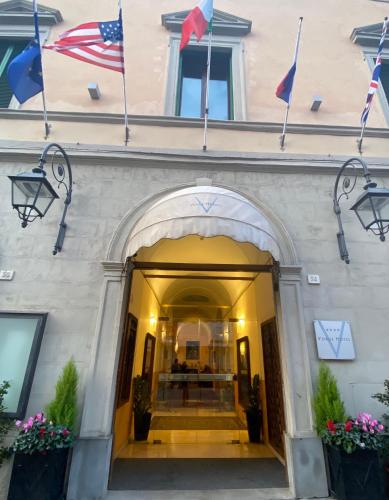
The four-star boutique hotel on Via Guido Monaco is officially on the market with an asking price of €3 million. Local media are now reporting negotiations with a prominent Arezzo-based entrepreneur. No closing has yet been publicly confirmed, but the transaction presents one particularly interesting feature for investors: the marketing materials combine “Freehold” ownership with a “Share Deal” structure. And this is precisely where the price of the hotel stops being automatically synonymous with the value of the investment.
The Vogue Hotel in Arezzo may be entering a decisive phase.
The property, a four-star hotel with 26 rooms and suites in the heart of the city, was formally brought to market in April 2026 by Christie & Co together with Coldwell Banker Commercial Realty Advisory.
A local media report now claims that negotiations have developed in recent weeks with a well-known entrepreneur from Arezzo.
The information is significant, but it should also be treated with appropriate caution.
At present, there is no publicly documented closing, nor is there sufficient evidence to attribute the acquisition with certainty to any specific buyer.
There is, however, enough verified information to analyse the transaction from an investor’s perspective.
And that is where the story becomes considerably more interesting.
The Asking Price: €3 Million
The public marketing materials for the Vogue Hotel indicate an asking price of €3,000,000 for a property comprising 26 rooms and suites.
This implies an indicative value of approximately €115,000 per key.
That is a useful first benchmarking metric, but it would be a mistake to conclude from it alone that the hotel is either expensive or attractively priced.
In hospitality real estate, price per key is not a valuation.
It is simply one indicator.
Two hotels with the same number of rooms and the same acquisition price may have radically different values depending on EBITDA, required capex, property quality, contractual arrangements, achievable ADR, leverage, destination characteristics, corporate structure and exit potential.
These are precisely the variables examined by Investimenti Alberghieri, drawing on the specialist expertise of Investhotel Capital Partners and the wider Hotel Management Group platform.
The Detail That Changes the Transaction: “Freehold” and “Share Deal”
The marketing documentation contains an indication that deserves considerably more attention than the headline asking price.
The investment is presented as Freehold, while the transaction structure is expressly described as a Share Deal.
If confirmed in the sale documentation, this combination is highly significant.
It suggests that the investor may not simply be acquiring a hotel property, but rather purchasing the equity of the corporate vehicle through which the asset is owned or the transaction is structured.
The question therefore ceases to be simply:
“What is the Vogue Hotel worth?”
It becomes:
“What is the equity I am acquiring actually worth, and which assets, liabilities, obligations and risks are embedded within the target company?”
The distinction is fundamental.
In a share deal, the underlying real estate value is only one component of the equation.
The analysis must also include net financial debt, tax exposure, contractual obligations, receivables and payables, litigation, employment relationships, guarantees, licences, related-party transactions and potential latent tax liabilities.
For this reason, an asking price of €3 million does not necessarily mean an Enterprise Value of €3 million, nor an Equity Value of €3 million.
Without understanding the actual transaction structure, simply comparing the asking price with the estimated real estate value could result in a materially incomplete assessment.
Vogue Hotel Arezzo: Investment Snapshot
| Item | Data / Assessment |
|---|---|
| Location | Via Guido Monaco, central Arezzo |
| Category | Four-star boutique hotel |
| Rooms and suites | 26 |
| Published asking price | €3,000,000 |
| Indicative price per key | Approx. €115,000 |
| Transaction structure indicated | Share Deal |
| Ownership description | Freehold |
| Property type | Historic building |
| Potential investment thesis | Repositioning / value-add |
| Transaction status | Asset marketed; negotiations reported by local media |
| Closing | Not publicly confirmed |
| Buyer | Not publicly identified with sufficient certainty |
This snapshot immediately shows why the transaction warrants a more sophisticated analysis than the asking price alone might suggest.
The Real Investment Thesis Is Not About Buying 26 Rooms
The potential value of the transaction lies primarily in the ability to transform a difficult-to-replicate asset into a hotel product capable of generating superior returns.
Its central location provides an important defensive characteristic.
A historic building in the centre of Arezzo cannot simply be replicated by purchasing a site and developing another hotel.
That scarcity may create value.
But the same feature can also become a risk if the property requires substantial investment or if heritage restrictions limit changes to layouts, building services, room count or the scope for repositioning.
The central issue therefore becomes the capex-adjusted return.
It is not enough to know how much the hotel costs.
An investor needs to understand the total amount of capital that must be deployed before the asset reaches the level of profitability assumed in the business plan.
Scenario 1: Retain the Existing Positioning and Improve Performance
The first strategy would be to maintain the existing hotel positioning while improving operational performance.
In this scenario, value could be generated through revenue management, distribution optimisation, tighter cost control, demand segmentation, increased direct bookings and better monetisation of higher-value room categories.
The investor would nevertheless need to determine a normalised EBITDA, stripping out non-recurring items and assessing the level of profitability the hotel can genuinely sustain.
An acquisition price may initially appear attractive but become considerably less compelling once tested against the EBITDA the property can realistically generate.
Scenario 2: Reposition the Hotel Into a Higher Segment
This is potentially the most strategically interesting scenario.
A centrally located boutique hotel within a historic building can potentially compete not on room count, but on the quality of the guest experience and its ability to command a higher ADR.
The key question is therefore not how many rooms the Vogue Hotel has.
It is:
How much incremental RevPAR can be generated for each euro of capex invested in the repositioning?
If the upgraded product can materially increase ADR and margins, the economic value of the asset may rise by more than the amount invested in the physical refurbishment.
Conversely, if the required capex is substantial and the local market is unable to absorb the targeted rate increase, the same strategy may destroy returns.
Scenario 3: Brand, Soft Brand or Management Agreement
Another potential strategy would involve bringing in an operator or distribution platform capable of increasing the hotel’s international visibility.
This would not necessarily require a conventional franchise.
Given the size and characteristics of the Vogue Hotel, a boutique collection or soft-brand strategy could potentially be more appropriate, preserving the identity of the property while providing access to a wider commercial and distribution platform.
But once again, the decision must be driven by numbers.
Expected improvements in ADR, occupancy and RevPAR should be compared against:
management or franchise fees, marketing contributions, reservation fees, brand-required capex and the cost of complying with applicable brand standards.
A brand creates value only when the incremental EBITDA generated exceeds the total cost of joining and operating within the brand system.
Scenario 4: Separating Property Ownership From Hotel Operations
An investor could also assess a PropCo/OpCo structure, separating ownership of the real estate from operation of the hotel business.
Such a configuration could appeal to property investors whose risk profile differs from that of a hotel operator.
There is currently insufficient public information to suggest that this is the structure being negotiated for the Vogue Hotel.
It nevertheless represents one of the scenarios that should be modelled when assessing the strategic value of the asset.
A robust hotel investment analysis should not only establish what a hotel is worth today.
It should also determine which ownership and operating structure is most capable of maximising its value.
Asking Price and Value Are Not the Same Thing
The Vogue Hotel case illustrates one of the fundamental principles of hotel investment.
The asking price is the seller’s number.
Value is the investor’s conclusion.
The two figures may differ substantially.
A professional valuation should reconstruct at least:
normalised revenues, GOP, EBITDA, FF&E reserves, initial capex, cost of debt, capital structure, required return on equity and exit value.
Those assumptions should then be stress-tested.
What happens if ADR grows less than expected?
What happens if occupancy falls short of the business plan?
What if capex overruns by 20%?
What if financing costs remain elevated?
What if the exit multiple contracts?
It is often in the downside scenario, rather than in the base-case business plan, that the true quality of an investment becomes apparent.
The advisory work undertaken through Investhotel.it and HotelManagementGroup.it follows precisely this principle: testing the resilience of a transaction before translating expectations into value.
The Specific Risk of a Share Deal
If the transaction is ultimately completed through the acquisition of company shares, the due diligence process will necessarily need to go considerably further.
The buyer will not only have to investigate the hotel.
It will need to investigate the history of the company being acquired.
Tax due diligence, legal due diligence, financing arrangements, social security and employment liabilities, potential litigation, existing contracts and guarantees therefore become particularly important.
An excellent property can still sit inside an inefficient or risky corporate structure.
This is why, in a share deal, the value of the bricks and mortar is the beginning of the analysis — not the end.
The Exit Question: Who Will Buy Tomorrow What Is Being Acquired Today?
The Vogue Hotel also raises another important question.
Arezzo does not offer the same transaction liquidity as Rome, Milan, Venice or Florence.
That does not necessarily make the investment less attractive.
It does, however, mean that the exit strategy should be considered at the time of acquisition, not several years later.
An investor should ask:
Who could buy the Vogue Hotel in five or seven years?
A family office?
A hotel operator?
A real estate investor?
An international group following repositioning?
A local entrepreneur?
The clearer the potential future buyer universe, the more robust the investment thesis becomes.
The risk is not simply paying too much when acquiring the hotel.
It is also creating a product that has too few natural buyers when the time comes to exit.
Negotiations With an Arezzo Entrepreneur: Caution Until Closing
Local media are now reporting that the Vogue Hotel is the subject of negotiations with a prominent entrepreneur from the area.
This is relevant because it would suggest that the process has moved beyond straightforward marketing and into a more advanced negotiation stage.
However, negotiations are not the same as a completed acquisition.
Between an expression of interest and closing there may be a letter of intent, exclusivity period, due diligence, financing arrangements, warranty negotiations, conditions precedent and final documentation.
Investimenti Alberghieri therefore does not currently attribute the acquisition to any specific party.
The transaction should only be considered completed once adequate documentary evidence or official announcements become available.
This distinction is particularly important in hotel transactions, where the identity or interest of a prospective buyer may emerge well before the actual transfer of ownership.
Why the Vogue Hotel Is Relevant to the Wider Italian Hotel Investment Market
The transaction also tells a broader story.
The search for hotel investment opportunities is no longer limited exclusively to major gateway cities.
Smaller assets located in art cities and secondary destinations can become attractive where four factors are present:
a difficult-to-replicate location, a repositionable product, a sustainable total investment requirement and a credible opportunity to increase EBITDA.
This is where secondary markets can offer opportunities.
But also where they can produce costly mistakes.
In less liquid destinations, the market has less ability to correct an acquisition made at an excessive price.
Investors therefore cannot rely solely on general market growth to rescue an imperfect investment decision.
They need to create value operationally.
This is one of the themes regularly explored on RobertoNecci.it, through analysis of the hotel sector and the economic dynamics that determine both profitability and asset value.
Investimenti Alberghieri Assessment
The Vogue Hotel in Arezzo combines several characteristics worthy of attention: boutique scale, central location, historic real estate, a transparent asking price and apparent repositioning potential.
The approximate figure of €115,000 per key may appear attractive, but it is not sufficient in itself to reach any professional conclusion regarding the merits of the acquisition.
The critical variables remain:
normalised EBITDA, independent real estate value, required capex, share-deal structure, net financial debt, post-repositioning ADR potential and exit value.
Only by bringing these elements together can an investor establish the Maximum Purchase Price that can be paid without undermining the required return.
And that is the central point.
The question is not whether €3 million is high or low.
The real question is:
How much total capital must be invested, what cash flow will that capital generate, and what will the asset be worth at exit?
That is the difference between buying a hotel and making a hotel investment.
Confidential Investment Dossiers for Investors, Banks, Funds and Hotel Owners
Investimenti Alberghieri supports investors, banks, lenders and hotel owners with independent assessments of hospitality assets and transactions.
Our work may include asset valuation, normalised EBITDA analysis, business-plan review, benchmarking, debt sustainability, capex assessment, repositioning scenarios, turnaround strategies, PropCo/OpCo structures, management or lease alternatives, sale scenarios and exit strategies.
The objective is not simply to establish what a hotel might be worth today, but to identify where value exists, which risks may compromise it, and which transaction structure can best maximise that value.
For a confidential hotel investment dossier or professional scouting mandate:
info@investimentialberghieri.it
InvestimentiAlberghieri.it · Investhotel.it · HotelManagementGroup.it · RobertoNecci.it