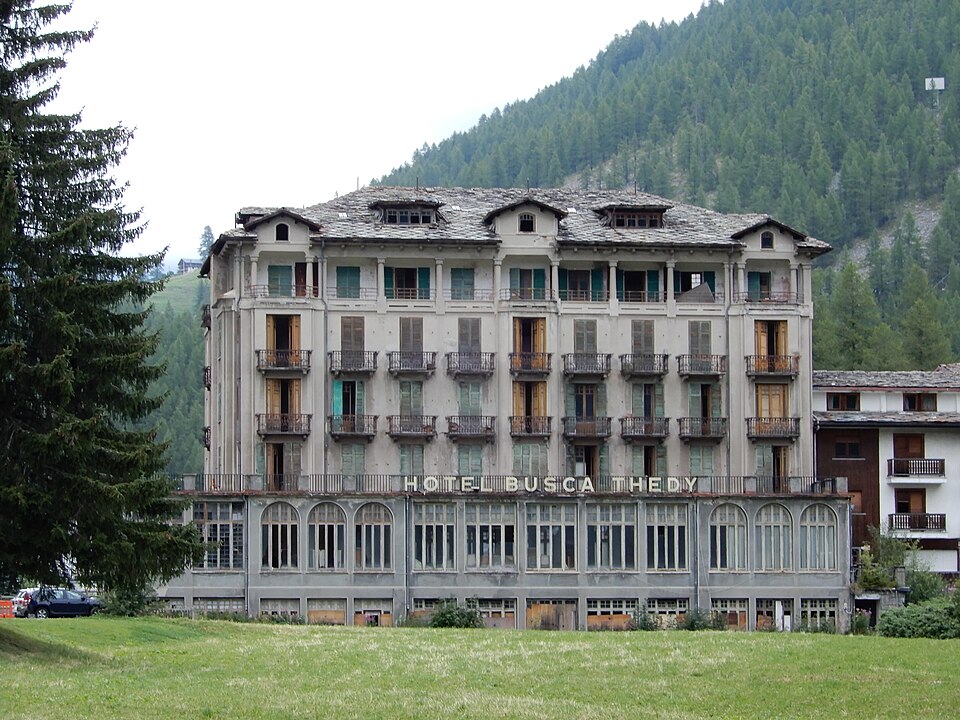
The Grand Hotel Busca Thedy in Gressoney-La-Trinité has been closed since a fire in 2004. In March 2024, local media reported that the property had been sold, although neither the buyer’s identity, the purchase price nor the redevelopment plan can currently be independently verified through public sources. Six thousand square metres, two buildings, ninety historic rooms and a potential planning uplift that, if still applicable to the specific asset, could allow expansion of up to 40%. This is why the property may be worth far more than its current condition suggests — and where the risk capable of undermining the entire business plan really lies.
The asset
The Grand Hotel Busca Thedy is one of the most significant historic hotels in the Italian Alps.
It stands in Tache, the main village of Gressoney-La-Trinité, in the Aosta Valley, at approximately 1,635 metres above sea level.
Its history dates back to 1880, when Pension Thedy opened on the site of an earlier alpine dining facility.
The Thedy family operated the property until the early twentieth century, when management passed to the Busca brothers from Settimo Vittone.
Following their acquisition of the hotel in 1916, the complex was progressively expanded.
A dépendance and garage were added in 1921.
In the early 1930s, a second building was constructed with sixty rooms and facilities that were remarkably sophisticated for the period.
At its peak, the complex offered:
-
approximately 90 rooms;
-
hot and cold running water;
-
apartments with private bathrooms;
-
a lift;
-
bar;
-
ballroom with orchestra;
-
telephone and telegraph;
-
three tennis courts;
-
landscaped gardens;
-
medical services;
-
mountain guides and porters.
Ninety rooms.
In 1930.
At 1,635 metres.
In a municipality that today has little more than three hundred permanent residents.
That single figure illustrates the scale and tourism importance Gressoney had already achieved almost a century ago.
This was never a marginal mountain destination.
From 1889 to 1923, Queen Margherita of Savoy regularly stayed in the area, helping establish Gressoney as one of Italy’s recognised alpine destinations.
Then came 2004.
A fire damaged the western wing.
The hotel closed.
And more than two decades of abandonment began.
Legambiente subsequently included the property in its survey of disused high-altitude buildings, describing a two-building hotel complex covering approximately 6,000 square metres, with architecture combining elements of Italian Rationalism and Belle Époque design.
The FAI heritage organisation also listed it among its Luoghi del Cuore, describing the property as an abandoned Liberty-style landmark in urgent need of restoration.
Gressoney-La-Trinité’s own planning documents identify the Busca Thedy as one of the municipality’s architectural assets to be preserved and enhanced.
But the development that truly reopened the investment case came in March 2024.
La Stampa reported that the property had been sold.
At the time of writing, however, public sources do not appear to provide independently verifiable information on:
-
the buyer;
-
the transaction price;
-
the redevelopment plan;
-
the proposed operating model;
-
the expected timetable.
It is therefore essential to separate two things.
One is the asset.
The other is the transaction that may now be taking place around it.
This analysis concerns the first.
The lever that could completely change the asset’s value
A Legambiente report on abandoned mountain properties contains a particularly important reference: under the regional framework cited at the time, the property could potentially qualify for redevelopment support and a planning uplift of up to 40%.
That could be transformative.
But it must be treated with considerable caution.
The document dates from 2021.
Before assigning any economic value to a potential 40% uplift, an investor would need to establish that the relevant provision remains in force, applies specifically to the Busca Thedy and can actually be implemented under current planning rules and constraints.
Only then can a theoretical development opportunity be treated as usable planning capacity.
With that qualification firmly in place, the scale remains worth examining.
The development potential
The existing complex covers approximately:
6,000 sq m.
If the full 40% uplift were still available and applicable to the project, theoretical built area could rise to approximately:
8,400 sq m.
In hospitality, however, square metres only create value if they can be converted into a product that the market can support.
A four- or five-star mountain hotel offering:
-
spa;
-
restaurants;
-
generous public areas;
-
ski room;
-
guest services;
-
technical areas;
-
back of house;
can require approximately 60–70 gross square metres per key, and sometimes more for a genuine luxury product.
Applying those ratios on a purely theoretical basis suggests potential capacity of around 120–140 keys.
With larger rooms and more generous public areas, the project might still reasonably accommodate approximately 90–100 keys.
And this is where the first major strategic characteristic of the Busca Thedy emerges.
There are relatively few alpine hotels of this scale in Italy.
Within a destination connected to the Monterosa Ski area, an asset capable of supporting something approaching or exceeding 80–100 rooms could potentially enter the radar of institutional investors and international operators for whom scale is often a critical consideration.
That does not mean international operators are uninterested in hotels below 80 rooms.
In luxury hospitality, an exceptional 40- or 60-key property can be extremely attractive.
The point is different.
Busca Thedy’s potential scale allows investors to consider industrial models that are simply unavailable to many smaller alpine hotels.
That changes the investment case.
This is not merely an abandoned historic hotel.
Potentially, it is a sizeable hospitality platform within an established alpine destination.
The second lever: public support
The Aosta Valley has historically used various instruments to support the redevelopment and modernisation of hospitality properties.
Depending on the measures available at any given time, these can include:
-
capital grants;
-
subsidised financing;
-
instruments delivered through the regional financial system;
-
energy-efficiency incentives;
-
measures linked to maintaining or expanding hospitality capacity.
For an investment requiring tens of millions of euros, this component can fundamentally change the financial structure.
If a project requires €30 million of CAPEX, the difference between:
€30 million entirely at investor risk
and
€30 million with a meaningful portion supported by public or subsidised financing
is not marginal.
It can be the difference between an uneconomic project and an investable one.
But again, methodology matters.
Percentages, ceilings, eligibility requirements, lock-in periods and permitted uses need to be verified against the regulations and funding programmes in force at the time of investment.
A 2026 business plan cannot responsibly be built on the basis of a 2021 information sheet.
This is exactly the kind of analysis that should precede the acquisition of a disused hotel.
At Investhotel.it, redevelopment opportunities are assessed by looking at the asset, restrictions, CAPEX, available incentives, sustainable scale and operating model together before attributing value to the real estate itself.
CAPEX: the first variable, but not the most dangerous one
Busca Thedy has been closed since 2004.
Its western wing was damaged by fire.
The complex sits at 1,635 metres.
For more than twenty years, the buildings have been exposed to:
-
snow;
-
freeze-thaw cycles;
-
water infiltration;
-
major temperature fluctuations;
-
roof deterioration;
-
potential structural degradation.
Then there is logistics.
An alpine construction site does not operate under the same conditions as an urban project.
The productive construction window may be limited.
Material transport, specialist labour availability and weather all affect costs.
For a full redevelopment of this nature, a very preliminary benchmark might fall in the region of:
€250,000–350,000 per key.
Across 100 rooms, that would imply:
€25–35 million
before fully accounting for:
-
acquisition price;
-
professional fees;
-
infrastructure;
-
financing costs;
-
pre-opening;
-
working capital;
-
contingencies.
Total investment could therefore move relatively easily into the €30–40 million range, and potentially higher if structural problems prove significant.
But today, that figure should not be treated as a valuation.
It is only an order-of-magnitude assumption.
The first investment should not be the rendering
This is arguably the most important point for any investor assessing the property.
After more than twenty years of abandonment at high altitude, CAPEX cannot be established by looking at photographs, floor plans and gross area.
The project requires genuine technical due diligence.
The first capital deployed should be used to investigate:
-
foundations;
-
load-bearing structures;
-
floors;
-
masonry;
-
roofs;
-
damage to the fire-affected western wing;
-
water penetration;
-
moisture;
-
existing MEP systems;
-
potential asbestos;
-
remediation requirements;
-
the long-term effects of repeated freeze-thaw cycles.
Diagnostic work represents only a small fraction of the overall investment.
But what it reveals can change CAPEX by several million euros.
This is one of the recurring mistakes made in the redevelopment of historic hotels.
The property is acquired because the headline price appears attractive.
A masterplan is commissioned immediately.
Renderings are produced.
A brand is approached.
Only when construction begins does the investor discover that the actual building bears little resemblance to the assumptions used in the business plan.
By then, capital has already been committed.
The correct sequence is the opposite:
diagnostics → feasibility → product → business plan → design.
Not the other way around.
The real constraint: seasonality
This is where Busca Thedy becomes particularly interesting.
The main problem may not be the cost of rebuilding it.
It may be how much hotel capacity the destination can economically absorb over the course of a year.
Gressoney-La-Trinité has two genuine seasons.
Winter, driven by Monterosa Ski.
Summer, supported by hiking, outdoor activities, mountain tourism and climate.
But the strongest demand periods remain relatively concentrated.
A prudent scenario could identify:
December to April
as the core winter season;
and
July and August
as the summer peak.
June and September can contribute.
But they cannot automatically be treated as high-demand months.
For a large hotel, the commercially meaningful operating year could therefore be concentrated within approximately 160–190 days.
That number must be considered alongside the amount of real estate available for development.
Because large floor area is only an advantage when there is sufficient demand to remunerate it.
The economics of a 100-room hotel
Let us construct a purely analytical scenario.
Assume:
-
100 rooms
-
365 theoretical available days;
-
annualised occupancy of 38%
-
approximately 13,900 occupied room nights
-
ADR of €280
Room revenue would be approximately:
€3.9 million.
Adding:
-
food and beverage;
-
spa;
-
bar;
-
outdoor activities;
-
ski-related services;
-
events;
-
other ancillary revenues;
total turnover might theoretically reach approximately:
€6.5–7.5 million.
Under a particularly efficient operating structure, a GOP margin of approximately 25–30% could produce an indicative GOP in the region of:
€1.6–2.2 million.
Depending on the operating structure, further deductions would then be required for:
-
management fees;
-
corporate costs;
-
insurance;
-
FF&E reserve;
-
other below-GOP expenses;
-
items required to reach EBITDA and actual distributable cash flow.
Against hypothetical total investment of €30–40 million, the relationship between operating GOP and capital invested would range, at the theoretical extremes, from approximately 4% to 7%.
A more prudent central case would probably sit closer to 4–6%.
That is not necessarily an inadequate return.
But it becomes compelling only if several of the following conditions are met:
-
part of the CAPEX is supported by incentives;
-
the acquisition price is low;
-
ADR exceeds the base case;
-
occupancy performs better;
-
the operating season becomes longer;
-
spa and F&B make a strong contribution;
-
the cost structure is genuinely seasonal.
This leads directly to the central conclusion.
The problem with Busca Thedy is not whether 100 rooms can be built.
It is whether those rooms can generate enough revenue for enough days each year.
One hundred rooms may be too many
That is the paradox of the asset.
Greater development potential can increase theoretical real estate value.
At the same time, it can make the hotel economics worse.
A larger hotel means:
-
more employees;
-
more energy consumption;
-
more maintenance;
-
more FF&E;
-
more working capital;
-
more rooms to fill;
-
greater exposure in shoulder periods.
Building everything that planning regulations may allow is not the same as building what the market can support.
The most rational scheme may therefore be a hybrid model.
For example:
50–70 genuine hotel rooms, supported by:
-
a recognised brand;
-
a properly scaled spa;
-
strong F&B;
-
ski services;
-
a meaningful summer outdoor proposition;
combined with a managed accommodation component such as:
-
serviced apartments;
-
tourism residences;
-
branded residences where legally compatible;
-
other ownership or usage structures integrated within the hospitality model.
The objective would be twofold.
Reduce the capital tied up in the conventional hotel component.
And monetise part of the remaining development potential through structures capable of generating upfront proceeds or a different return profile.
But one major condition applies.
It cannot simply become second homes
The Aosta Valley provides meaningful protection to hospitality use.
Funding instruments supporting hotel redevelopment may also impose long-term use restrictions.
The possibility of introducing residential units, branded residences or comparable products therefore needs to be assessed case by case.
Buying a large abandoned hotel, benefiting from hospitality incentives and later converting the property into a conventional second-home development cannot be treated as the default strategy.
If a hybrid scheme is legally and planning-wise feasible, it needs to be designed within the managed hospitality framework, rather than in opposition to it.
That distinction matters.
Because the use with the highest theoretical real estate value is not necessarily the use that can obtain approval.
And the use that can obtain approval is not necessarily the one that is financially sustainable.
The correct investment exists only where these three elements intersect:
planning + market + operating economics.
The real upside: extending the season
If the constraint is season length, then value creation does not necessarily depend on increasing the room count.
It depends on increasing the number of economically productive days.
This is where operations become more important than development volume.
Winter is obvious.
Skiing.
Monterosa.
Snow.
But the real business case may lie in summer.
Gressoney can offer:
-
hiking;
-
mountaineering;
-
trail running;
-
e-biking;
-
nature;
-
wellness;
-
climate;
-
Walser culture;
-
food and wine;
-
retreats;
-
sport.
If the summer mountain product can achieve ADR and demand levels that begin to approach winter performance, the economics of the asset change materially.
And if June and September become genuinely sellable months, productive operating days can increase without constructing a single additional square metre.
This is where a project developed through HotelManagementGroup.it around revenue management, seasonal staffing, multi-season sales and management control can create more value than a physical extension.
Because in an alpine hotel:
the most valuable room is not necessarily the new one.
It may be the existing room that can be sold for thirty additional nights each year.
Busca Thedy and the four risks of complex hotel assets
Through real-world cases, InvestimentiAlberghieri.it is building a practical framework for understanding the risks embedded in complex hospitality assets.
Portofino Kulm illustrates timing risk.
The capital may be available.
The asset may be exceptional.
But if time-to-cash extends too far, IRR is progressively eroded.
Sammezzano illustrates business-model risk.
A monumental heritage property cannot be assessed by simply dividing total investment by the number of hotel rooms.
Museum admissions, events, hospitality and patrimonial value form part of the same ecosystem.
Marinella di Nervi illustrates tenure risk.
The acquisition price matters less than the duration of the right, the CAPEX obligations and the value that remains with the investor when the concession expires.
Busca Thedy introduces a fourth category:
scale risk.
More precisely:
the risk that real estate capacity expands faster than the commercial season available to support it.
That is a particularly important issue across the Italian alpine hotel market.
The wider problem facing Italy’s abandoned alpine hotels
The Italian Alps contain numerous large historic hotels built for a different tourism era.
Substantial buildings.
Generous floor areas.
Recognised destinations.
Valuable architecture.
But often also:
-
short seasons;
-
high energy costs;
-
difficult logistics;
-
limited availability of seasonal staff;
-
substantial CAPEX requirements;
-
highly concentrated demand.
These assets can look extraordinarily cheap when analysed on a price-per-square-metre basis.
But hotels do not remunerate square metres.
They remunerate:
rooms sold × ADR + ancillary revenues − operating costs.
This is why the analysis published on RobertoNecci.it rarely begins with the question:
“What is the building worth?”
The question that comes first is:
“What industrial model can generate enough cash to justify the capital required to restore it?”
Only then can real estate value be discussed seriously.
Why Busca Thedy may be undervalued
Based on currently available public information, we do not know the price at which the reported 2024 sale took place.
We do not know the identity of the buyer.
We do not know the redevelopment plan.
It is therefore impossible to say whether the specific transaction represents good value.
What we can analyse is the asset itself.
And the asset combines:
scale.
history.
recognition.
access to the Monterosa Ski area.
potential additional development capacity, subject to verification.
potential regional support, subject to verification.
the possibility of creating an upper-upscale or luxury hospitality product.
That combination is rare.
The challenge, therefore, is not a lack of potential.
It is avoiding the mistake of converting theoretical real estate potential into excessive hotel capacity.
Busca Thedy may ultimately be worth more with:
60 highly profitable rooms
than with:
120 rooms that are difficult to fill.
That is the central investment thesis.
The model comes before the square metres
Anyone assessing Busca Thedy today should proceed in the following order:
1. Technical due diligence
Establish what physically exists and what it will actually cost to restore.
2. Planning due diligence
Verify existing areas, permitted uses, potential development uplifts and restrictions.
3. Incentive review
Establish which support measures are actually available today and what obligations they create.
4. Demand analysis
Winter, summer, source markets, segments and sustainable ADR.
5. Product sizing
Not how many rooms can be built.
How many rooms should be built.
6. Operating model
Direct management, management agreement, lease, franchise or soft brand.
7. Business plan
Only at this stage can sustainable CAPEX be determined.
8. Real estate value
Asset value comes at the end of the process.
Not at the beginning.
This is the methodology applied to advisory work described at Investhotel.it.
One of the Italian Alps’ most overlooked hotel assets?
It is deliberately a strong thesis.
But Busca Thedy has characteristics that justify serious attention.
If the reported 2024 sale is confirmed and a concrete redevelopment project emerges, it will become possible to assess the transaction itself.
For now, only the property’s underlying potential can be analysed.
And that potential is substantial.
Six thousand square metres.
Potential expansion, subject to verification.
Almost a century and a half of hospitality history.
An established destination.
Access to Monterosa Ski.
The possibility of creating a product with meaningful scale.
But above all, one extremely clear industrial problem to solve:
development capacity must be sized around the commercial season.
Not the other way around.
An investor capable of combining:
the right scale + the right brand + spa + winter + summer + seasonal cost discipline + available incentives + patient capital
may do more than restore a historic hotel.
They could demonstrate a model capable of being replicated across a significant part of Italy’s abandoned alpine hospitality stock.
And that is what makes Busca Thedy much more interesting than an abandoned building.
We will continue to follow the case, with particular attention to the identity of the new ownership, any redevelopment plan that may be filed and the regulatory framework actually applicable to the project.
The analysis does not end here
At InvestimentiAlberghieri.it we continuously map and analyse closed hotels, abandoned hospitality assets, conversion opportunities, M&A transactions and hotel redevelopment projects, with particular attention to cases where real estate value needs to be tested against the future operating business.
If you are considering acquiring a disused historic hotel, an alpine hospitality asset or a property requiring substantial redevelopment, Investhotel.it outlines our advisory services covering:
-
asset screening;
-
due diligence;
-
valuation;
-
CAPEX analysis;
-
business planning;
-
sustainable scale assessment;
-
revenue-mix analysis;
-
incentive review;
-
planning and operational restrictions;
-
PropCo/OpCo structuring;
-
operating-model selection;
-
negotiation of management agreements and leases.
For the operational component — seasonal organisation, USALI-based management control, revenue management, pre-opening, staffing design and management selection — visit HotelManagementGroup.it.
Further hospitality analysis, publications and professional insights are available at RobertoNecci.it.
Are you assessing a disused historic hotel, an alpine hospitality asset or a property requiring redevelopment and want to understand what scale and operating model can make the investment economically sustainable?
Contact info@investimentialberghieri.it for an initial assessment of the asset and to discuss a potential advisory mandate.
Methodology and sources
This article has been prepared exclusively on the basis of publicly available information available as of the publication date, including La Stampa, Aosta edition (21 March 2024); Ascosi Lasciti (20 March 2024); publicly available documentation concerning the property; Legambiente’s research on abandoned high-altitude properties and the Nevediversa report; the FAI Luoghi del Cuore census; and the tourism development programme of the Municipality of Gressoney-La-Trinité.
The identity of the buyer, the consideration paid in the sale reported in 2024 and the proposed redevelopment plan cannot currently be independently verified through public information. This article therefore analyses the characteristics of the asset and does not provide an assessment of any specific transaction currently underway.
References to a potential planning uplift of up to 40% and to regional incentive schemes derive from earlier documentation and must be verified against current legislation, planning instruments and funding programmes at the time of investment. No uplift or incentive is treated as an acquired right.
All figures relating to CAPEX, room count, ADR, occupancy, revenues, GOP, investment returns and product sizing are independent analytical assumptions prepared by InvestimentiAlberghieri.it solely for analytical purposes. They do not represent company data, forecasts by the ownership or figures contained in any official development plan.
The owners and any parties mentioned in this article may request corrections, clarifications or documentary updates at any time by contacting the editorial team.