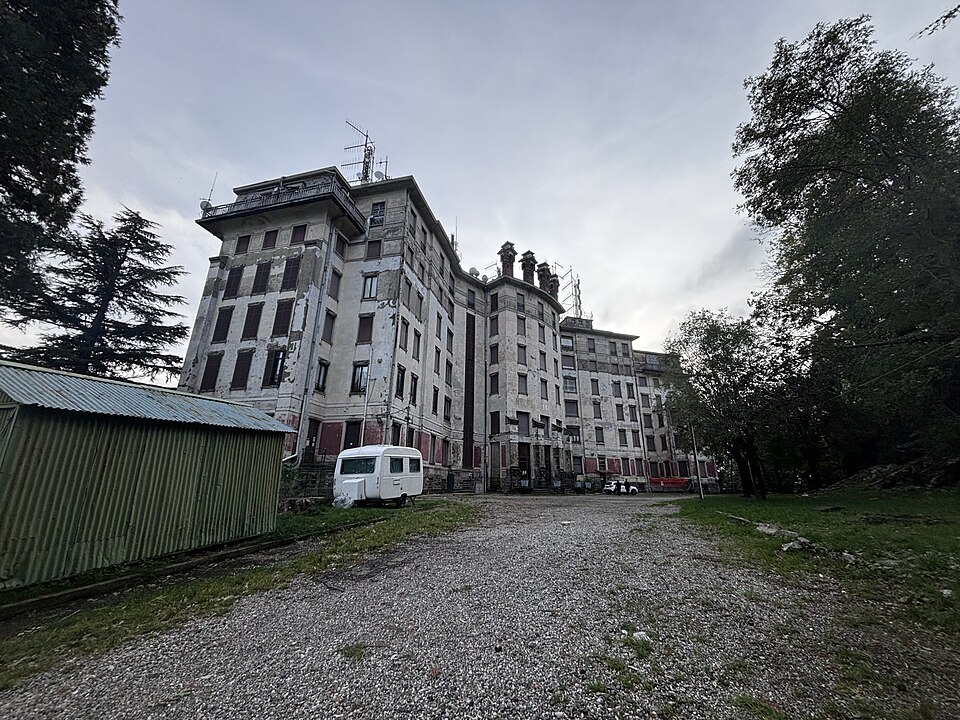
The Grand Hotel Campo dei Fiori in Varese, a Liberty-style masterpiece by Giuseppe Sommaruga that has been closed since 1968, now has a preliminary 65-room redevelopment plan backed by owners who understand the business of historic hotels. On paper, both the sizing and the operating economics are more convincing than those of many of Italy’s major restoration projects. The dominant risk, however, lies outside the property itself: accessibility and the telecommunications equipment on the roof.
The facts
In July 2025, Mauro Morello publicly confirmed the existence of a preliminary redevelopment plan for the Grand Hotel Campo dei Fiori in Varese.
The concept envisages a hotel of approximately 65 rooms, retaining part of the original furnishings and offering a high standard of hospitality, while being positioned differently from the Palace Grand Hotel, which is already undergoing a gradual repositioning towards five-star status.
The property is controlled by Mauro Morello and Elisabetta Gabri, who over the years have assembled not only the Grand Hotel itself but also significant parts of the surrounding complex:
-
the former restaurant;
-
the church;
-
the former holiday-colony buildings;
-
other properties capable of supporting the wider regeneration of the site.
That matters.
But the owners’ industrial background matters even more.
Gabri and Morello are hotel entrepreneurs and founders of I Palazzi – Historic Experience Hotels.
They are therefore not approaching Campo dei Fiori as a pure real estate play.
They already understand:
-
hotel operations;
-
historic-building restoration;
-
positioning;
-
pre-opening;
-
the operational complexity of listed properties.
A feasibility study has formally been launched.
The owners have also made clear that they do not intend to pursue invasive new development, but rather to work within the existing architectural and landscape constraints, in dialogue with the heritage authority, the Campo dei Fiori Regional Park, the Province and the Region.
That approach already distinguishes this project from many other historic hotel redevelopments where the hospitality strategy is only defined after the real estate has been acquired.
From 200 rooms to 65: the number that shows the economics have been considered
The Grand Hotel Campo dei Fiori dates back to the early twentieth century.
In 1907, the Società Anonima dei Grandi Alberghi Varesini commissioned Giuseppe Sommaruga, one of the leading figures of Italian Liberty architecture, to design an integrated tourism complex on Monte Tre Croci.
The scheme included:
-
a hotel of around 30 rooms, later converted into the Belvedere restaurant;
-
the funicular stations;
-
a second, much larger hotel with approximately 200 rooms.
The Grand Hotel was built between 1910 and 1912.
Two hundred rooms then.
Sixty-five in the current redevelopment concept.
At first glance, that may look like a dramatic reduction.
In reality, it is probably one of the most technically sensible decisions in the entire project.
Belle Époque hotels were built to completely different standards.
Many rooms were small.
Bathrooms could be shared.
There were no:
-
modern building services;
-
air-conditioning systems;
-
contemporary acoustic standards;
-
current accessibility requirements;
-
modern back-of-house facilities;
-
spas;
-
large technical areas.
Bringing a 1912 hotel up to present-day standards often means combining two or three historic rooms to create one modern key.
It also means reallocating substantial floor area to:
-
corridors;
-
bathrooms;
-
lifts;
-
MEP systems;
-
back office;
-
kitchens;
-
wellness;
-
F&B;
-
public areas.
This is why reducing the historical inventory from approximately 200 rooms to 65 keys should not be interpreted as a loss of potential.
It reflects proper product sizing.
In a major historic hotel restoration, that decision is worth more than many architectural renderings.
One of the recurring mistakes we analyse at InvestimentiAlberghieri.it is precisely the assumption that the historic room count can still be reproduced economically and technically today.
It cannot.
Why these economics are different from other major hotel restorations
In recent dossiers, we have analysed several major Italian hospitality assets.
In many cases, the central challenge is finding an operating model capable of remunerating the capital required for redevelopment.
At Campo dei Fiori, the situation appears different.
The main reason has little to do with the building itself.
It is the demand catchment.
Portofino Kulm has a meaningful seasonal component.
Busca Thedy has to contend with alpine seasonality.
Marinella di Nervi combines limited scale with direct exposure to the sea.
Campo dei Fiori sits within a completely different economic and demographic system.
Varese lies between:
Milan.
Malpensa Airport.
Canton Ticino.
Lake Maggiore.
Lombardy’s industrial base.
The potential guest does not necessarily need to spend an entire week on holiday at Campo dei Fiori.
Demand can come from:
-
weekend breaks;
-
wellness stays;
-
destination dining;
-
weddings;
-
events;
-
meetings;
-
incentive travel;
-
conferences;
-
short breaks;
-
pre- or post-flight stays;
-
cultural experiences.
That is an enormous industrial advantage.
The project is not dependent on a single season. It depends on its ability to capture different demand segments throughout the year.
The potential market
Commercial risk therefore appears, at least on paper, less critical than in several other major historic hotel redevelopment cases.
That does not mean the hotel is guaranteed to succeed.
No hospitality business plan should make that assumption.
It means there are multiple demand segments that could potentially be activated.
Local and regional leisure
Milan and Lombardy represent an enormous market for short breaks, weekend travel, wellness and gastronomy.
Canton Ticino
Proximity to Switzerland provides access to another affluent catchment area.
MICE
Varese and the corridor between Milan, Malpensa and the Swiss border form one of Europe’s most densely industrialised business regions.
Weddings
A monumental Liberty building with panoramic terraces overlooking the Varese landscape is an unusually strong wedding venue.
Malpensa
Proximity to the international airport can generate complementary demand if the property is positioned correctly.
Destination F&B
This may become one of the most important revenue streams.
A panoramic restaurant inside a major Liberty monument can attract customers regardless of hotel occupancy.
And this is where the business model becomes particularly interesting.
The operating model
Let us build a purely analytical scenario.
This is not the owners’ business plan, which is not public.
It is an independent exercise by InvestimentiAlberghieri.it designed solely to understand the potential scale of the economics involved.
Assume:
-
65 rooms
-
annualised occupancy: 60%
-
approximately 14,200 occupied room nights
-
average ADR: €260
Room revenue would be approximately:
€3.7 million.
Additional revenue could come from:
-
restaurant;
-
bar;
-
banqueting;
-
weddings;
-
events;
-
spa;
-
day use;
-
other ancillary services.
In an asset of this kind, F&B should not be treated merely as a service supporting the rooms.
It can become an independent profit centre.
Under a strong operating scenario, total revenue could therefore move into an indicative range of:
€7–8.5 million.
With efficient management, a GOP margin of approximately 32–37% could generate theoretical GOP in the region of:
€2.2–3.1 million.
Depending on the operating structure, further deductions would then need to be considered for:
-
management fees;
-
corporate overhead;
-
insurance;
-
FF&E reserve;
-
below-GOP expenses;
-
other items required to calculate EBITDA and actual distributable cash flow.
The distinction matters.
GOP and EBITDA are not the same thing.
They should remain separate in any proper hotel investment analysis.
How much capital could the project require?
For a full redevelopment of a protected Liberty building of this quality, a preliminary benchmark could reasonably fall in the region of:
€250,000–350,000 per key.
Across 65 keys:
€16–23 million.
But this would not capture the entire investment requirement.
Further expenditure would need to include:
-
restoration of ancillary buildings;
-
works across the wider complex;
-
accessibility;
-
external areas;
-
technical systems;
-
professional fees;
-
pre-opening;
-
FF&E;
-
working capital;
-
contingencies.
Total investment could therefore move into an indicative range of:
€20–30 million.
Using approximately €25 million simply as a central analytical scenario, operating performance of €2.2–2.8 million would imply an operating-result-to-investment ratio of approximately 9–11%.
That is not an IRR.
It is not the investor’s net return.
It is a preliminary operating metric before:
-
cost of debt;
-
taxation;
-
depreciation;
-
reserves;
-
potential management fees;
-
cost of equity.
Nevertheless, it remains a meaningful signal.
Because unlike several other large historic redevelopments, the underlying economics here do not appear to require extreme assumptions before they begin to make sense.
The owners are also hotel operators
There is another important factor.
The ownership already has direct hospitality expertise.
That does not eliminate risk.
But it reduces some of the uncertainties that commonly affect projects of this kind.
A pure real estate developer, after restoring the building, still needs to:
-
identify a brand;
-
appoint an operator;
-
define operating standards;
-
build the commercial structure;
-
select management;
-
execute the pre-opening.
Here, many of those capabilities already exist within the ownership perimeter.
Through I Palazzi – Historic Experience Hotels, Gabri and Morello have experience in positioning and operating historic hospitality properties.
That does not guarantee Campo dei Fiori’s success.
But it does mean that a meaningful part of hotel execution risk is being addressed by owners who already understand the sector.
That is a significant advantage.
The real risk lies outside the hotel
If the sizing, demand potential and operating concept are all reasonably credible, why is the project not already under construction?
Because two decisive variables are at least partly outside the owners’ direct control.
The first concerns telecommunications equipment on the roof.
The second is accessibility.
This is where the investment becomes particularly interesting.
First external variable: the antennas
For decades, the roof of the Grand Hotel has hosted antennas and telecommunications repeaters.
While the property remained unused, those installations generated income.
The owners have stated that specialist consultants have already been appointed to assess the relocation of some equipment.
Not everything necessarily needs to be moved.
Some installations may remain.
Others may have to be renegotiated.
From an investment perspective, the problem is fascinating.
The antennas represent what might be called bridge income.
While the property is closed, the rental income helps cover:
-
taxes;
-
security;
-
maintenance;
-
carrying costs.
But when the building has to return to hotel use, that same income can become an obstacle:
physical;
contractual;
technical;
architectural.
This is a classic example of a cash flow that is useful during an asset’s dormant phase but becomes incompatible with its transformation.
The solution does not depend solely on the owner.
It requires:
-
agreements with telecom operators;
-
technical compatibility;
-
alternative sites;
-
potentially, institutional cooperation.
For that reason, the issue should be resolved before the executive design stage, not during construction.
Second external variable: accessibility
This is the more important issue.
Morello himself has identified the funicular and road access as central to the project.
The reasoning is sound.
A 65-room upper-upscale or luxury hotel cannot rely on a fragile access system.
Guests need to be able to arrive by:
-
private car;
-
taxi;
-
private transfer;
-
chauffeur service;
-
shuttle;
-
public transport where available;
-
ideally, a restored funicular.
But two concepts need to be separated.
The funicular would be a major accelerator for the project.
It is not necessarily the only scenario under which the hotel can operate.
An accessibility model could potentially be built around:
road access + parking + private transfers + shuttle services, with the funicular acting as an additional attraction and connection to the city.
The feasibility study should therefore answer a fundamental question:
what is the minimum level of accessibility required for the hotel to remain economically sustainable without treating a future public infrastructure project as certain?
That is essential.
A bankable business plan should not place an infrastructure project outside the investor’s control into the base case as though delivery were guaranteed.
But the history of the funicular cannot be ignored
None of this means its importance should be underestimated.
Quite the opposite.
The history of the Grand Hotel shows how structural accessibility can be.
The funicular was an integral part of the original tourism system.
Its upper station dates from 1911.
It connected the hotel complex with the city.
After the funicular closed in 1953, tourist flows progressively declined.
The Grand Hotel and restaurant eventually closed in 1968.
In other words:
the hotel has already experienced, in its own history, the extent to which accessibility can change the economics of a destination.
That precedent matters.
But precisely because of that history, the new project should be designed so that it does not depend exclusively on one infrastructure asset.
Financially attractive, structurally dependent
That is perhaps the best way to describe Campo dei Fiori.
Financially attractive.
Structurally dependent.
Based on the assumptions considered here, market risk appears less problematic than in several other major hotel restorations.
There is:
-
a correctly sized product;
-
a substantial catchment area;
-
a plausible pricing opportunity;
-
meaningful F&B potential;
-
wedding demand;
-
MICE potential;
-
hospitality expertise within the ownership.
The dominant risk therefore shifts to external variables.
And that is exactly where an investor or lender should focus the underwriting process.
Not only:
“How much EBITDA could the hotel generate?”
But:
“How much of that result depends on conditions the investor cannot control?”
That question changes the business plan completely.
Three ways to reduce the risk
1. Phase the investment
It may not be necessary to reopen every component simultaneously.
One possible approach would be to restore first the activities capable of operating under the existing accessibility conditions:
-
panoramic restaurant;
-
events;
-
weddings;
-
cultural activities;
-
day use.
The hotel rooms could follow in a second phase.
This could:
-
begin generating revenue;
-
test demand;
-
reactivate the destination;
-
build public support;
-
reduce capital at risk;
-
allow accessibility solutions to evolve progressively.
This is not necessarily the owners’ intended strategy.
It is simply one possible risk-mitigation structure.
2. Turn public dependency into an agreement
If part of the project’s feasibility depends on public infrastructure or intervention, the relationship with public authorities should not remain an informal expectation.
Where possible, it should become a formal framework of commitments, responsibilities and timelines.
A public-private agreement could connect:
private investment
with
accessibility and territorial infrastructure improvements.
When €20–30 million of private capital is being mobilised, reducing institutional uncertainty can create almost as much value as reducing CAPEX.
This is also part of the logic behind the advisory work described at Investhotel.it: before capital is committed to a project dependent on external variables, those variables need to be assigned a value, a probability and, where possible, a contractual structure.
3. Resolve the antenna issue before the final design
Relocating or reorganising the telecommunications infrastructure should not be treated as a secondary matter to be solved during construction.
It is a design precondition.
Before finalising:
-
rooms;
-
roof configuration;
-
building services;
-
terraces;
-
spa;
-
technical areas;
the project team needs to know which systems will remain and which must move.
Otherwise, there is a risk of designing twice.
And in major historic restorations, designing twice means consuming both time and capital.
A fourth form of capital: public support
There is another variable that will never appear in a spreadsheet.
The petition supporting the reopening of the Grand Hotel collected almost 2,000 signatures.
That does not change planning law.
It does not finance the funicular.
It does not issue a permit.
But for a project requiring dialogue with:
-
the Municipality;
-
the Province;
-
the Region;
-
heritage authorities;
-
the Regional Park;
-
infrastructure operators;
public support is a real variable.
It is not financial capital.
It is territorial and political capital.
And in major restoration projects, it can matter when institutions and private investors need to converge on a viable solution.
Campo dei Fiori and the five risks of major hotel redevelopments
The dossiers published on InvestimentiAlberghieri.it are now beginning to form a practical taxonomy for understanding complex Italian hospitality assets.
Portofino Kulm: timing risk
The issue is time-to-cash.
An extraordinary asset can destroy returns if capital remains tied up for too long before opening.
Sammezzano: business-model risk
Rooms are not necessarily the business.
Museum use, events, hospitality and patrimonial value must be analysed as one ecosystem.
Marinella di Nervi: tenure risk
Entry price is not enough.
The investor needs to understand what right is being acquired, for how long, and how much value remains at the end of the term.
Busca Thedy: scale risk
Development volume must match the length of the commercial season.
More rooms do not automatically create more value.
Campo dei Fiori: dependency risk
The project may be correctly designed and the operating economics may work, while a decisive part of the investment case remains dependent on external parties.
This fifth category is particularly relevant.
It occurs frequently in major Italian development projects.
The hardest risk to model is the one you do not control
CAPEX can be estimated.
ADR can be stress-tested.
Occupancy can be modelled.
Labour costs can be forecast.
Interest rates can be subjected to sensitivity analysis.
A public-sector decision does not behave in the same way.
If an investment depends on:
-
a road;
-
parking;
-
a funicular;
-
an approval;
-
infrastructure;
-
relocation of technical equipment;
-
an agreement with a public body;
the business plan needs to distinguish between:
controllable scenarios
and
dependent scenarios.
That is one of the principles that also underpins the analysis published on RobertoNecci.it:
an uncontrolled variable should never be treated as a certainty in the base case.
It should instead become:
-
a scenario;
-
a probability;
-
a condition precedent;
-
a later phase;
-
an agreement;
-
a contingency.
That is what transforms a business plan from a theoretical exercise into an investment tool.
Campo dei Fiori’s real advantage
Paradoxically, the strength of this case is that its main problem appears identifiable.
Based on the publicly available information, there is no obvious contradiction between:
product sizing
and
potential demand.
Sixty-five rooms appear credible.
The catchment area is substantial.
The product is unique.
The owners understand hospitality.
F&B, events and weddings can diversify revenues.
None of this guarantees profitability.
But it suggests that many of the principal variables directly controlled by ownership appear to have been approached with a coherent industrial logic.
The challenge therefore shifts to the surrounding ecosystem.
And that is precisely why Campo dei Fiori is such an interesting case study.
A hotel does not end at the property gate
The proposed restoration of the Grand Hotel Campo dei Fiori demonstrates a simple principle.
A hotel is not merely:
rooms + restaurant + spa.
It sits within a system.
It requires:
-
accessibility;
-
parking;
-
connections;
-
infrastructure;
-
services;
-
destination appeal;
-
institutional relationships.
This is why the operational work developed through HotelManagementGroup.it — product definition, revenue management, organisation and pre-opening — has to begin with what the market can actually access and use, not simply with what the architectural plan can accommodate.
Hotel profitability begins outside the hotel.
The rule Campo dei Fiori leaves investors with
The final lesson is straightforward.
When the feasibility of a hotel investment depends materially on infrastructure or a decision controlled by another party, that dependency needs to be addressed before the main capital is committed.
It does not always need to be eliminated.
Often, that is impossible.
But it must be:
identified.
priced.
contractualised where possible.
stress-tested in the business plan.
kept outside the base case when it cannot be controlled.
That is the difference between building a project that works only if everything goes right and building one that can survive even when an external variable arrives late.
The Grand Hotel Campo dei Fiori has something rare among Italy’s major historic hotel restoration projects:
the principal challenge does not appear to be finding a way to make the hotel itself work.
It is creating the conditions around the hotel that allow that model to be executed.
If ownership and public institutions can align accessibility, telecommunications infrastructure and investment timing, Campo dei Fiori could become one of the most interesting historic hotel restorations in Italy.
Not merely because it would return a landmark to Varese.
But because it could demonstrate that architectural preservation and sustainable hotel economics can belong in the same business plan.
We will continue to follow the project, focusing in particular on the feasibility study, the solution for the telecommunications infrastructure and the evolution of the accessibility strategy.
The analysis does not end here
At InvestimentiAlberghieri.it we analyse major hotel restorations, closed hotels, historic properties, insolvency-related assets and redevelopment projects, with the aim of distinguishing perceived real estate value from genuine economic sustainability.
If you are considering the redevelopment of a historic property for hospitality use, or an investment whose feasibility depends on infrastructure, permits or agreements with public authorities, Investhotel.it outlines our advisory activities covering:
-
feasibility studies;
-
due diligence;
-
product sizing;
-
CAPEX analysis;
-
business planning;
-
sensitivity analysis;
-
valuation;
-
investment phasing;
-
PropCo/OpCo scenarios;
-
operating-model selection;
-
management agreements;
-
hotel leases.
For industrial implementation — product definition, rooms/F&B/events revenue mix, USALI-based management control, revenue management, organisation, pre-opening and management selection — visit HotelManagementGroup.it.
Further professional analysis, publications and hospitality-sector insights are available at RobertoNecci.it.
Are you assessing a hotel redevelopment project and want to know whether the business plan genuinely works before committing capital?
Contact info@investimentialberghieri.it for an initial assessment of the opportunity and to discuss a potential advisory mandate.
Methodology and sources
This article has been prepared using publicly available sources available as of the publication date, including Varese7Press (4 July 2025), La Provincia di Varese (4 July 2025), La Prealpina (5 July 2025), VareseNews (July 2025, February 2026 and July 2026), ComoZero, Spazi Indecisi, the FAI Luoghi del Cuore material relating to the funicular, and publicly available documentation concerning the property.
Statements attributed to Mauro Morello and Elisabetta Gabri derive from the podcast Il Grand Hotel Campo dei Fiori di Varese – Storia del simbolo di una città by Giacomo Mastrorosa and Matteo Ramelli and subsequent press coverage.
The project remains at preliminary stage and a feasibility study has been launched. At the time of writing, no final development plan, full timetable or official economic data appear to be publicly available.
All figures relating to CAPEX, room count, ADR, occupancy, revenue, GOP, EBITDA and operating-return-to-investment ratios are independent analytical assumptions prepared by InvestimentiAlberghieri.it solely for analytical purposes. They do not represent company data, the owners’ business plan or official forecasts.
Some secondary sources have attributed the original project to “Paolo” Sommaruga; established historical literature and the relevant sources identify Giuseppe Sommaruga.
The owners and any parties mentioned in this article may request corrections, clarifications or documentary updates at any time by contacting the editorial team.