At Campo Imperatore, the issue is no longer simply about restoring publicly owned buildings. The real challenge is to turn the Hostel, the historic Hotel, the cable car and the surrounding services into a single tourism ecosystem capable of generating demand, revenues and sustainable operating economics at more than 2,100 metres above sea level.
Construction works at Campo Imperatore are entering a decisive phase.
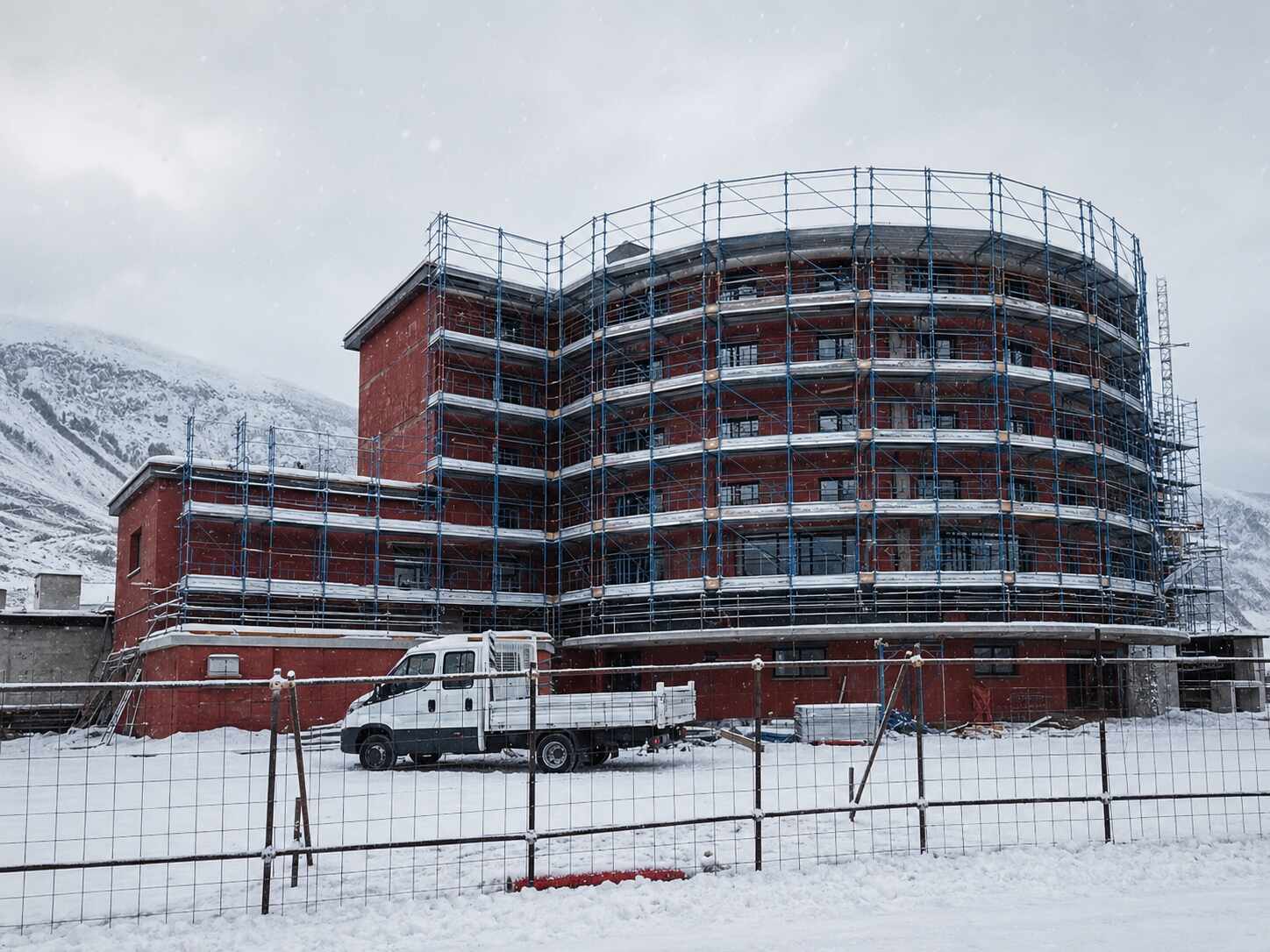
As of 1 September 2026, extraordinary maintenance and redevelopment works on the Hostel and on the tunnel connecting the upper cable-car station to the Campo Imperatore Hotel had reached approximately 80% completion.
The programme represents an investment of around €1.03 million and, in parallel, the Municipality of L’Aquila and the Centro Turistico del Gran Sasso are working on a new tender for the management of the Hostel, with the stated objective of having the property operational in time for the next winter season.
Read the original report by Il Capoluogo
As regards the historic Campo Imperatore Hotel, the approved redevelopment programme involves an investment of approximately €3.8 million, covering building systems, interiors and approximately 80 beds, as well as a wellness centre, indoor swimming pool, sauna, steam room and additional guest facilities.
Taken together, the two known projects therefore amount to more than €4.8 million of public CAPEX directed towards the regeneration of the main hospitality infrastructure at Campo Imperatore.
This is precisely what makes the project particularly relevant from an hotel investment perspective.
From Construction Site to Profitability: The Most Important Transition Has Yet to Take Place
The immediate news concerns the progress of the construction works.
For an investor or hotel operator, however, a much more important question follows:
How much economic value will these properties actually be capable of generating once the construction works are completed?
That distinction is fundamental.
Redevelopment creates the physical conditions required for an asset to return to the market.
It does not, by itself, guarantee profitability or operational sustainability.
Hotel value is created through the interaction of:
asset + demand + positioning + management + accessibility + operating season + cost structure.
This is one of the recurring principles underpinning the analysis published by InvestimentiAlberghieri.it: real-estate value and hotel business value are not necessarily the same thing.
Campo Imperatore provides an almost textbook illustration of this distinction.
The First Real Test Will Be the Tender for the Hostel
The preparation of a new tender for the management of the Hostel is arguably the most significant economic development in the current phase.
The success of the operation will depend substantially on the ability of the tender structure to achieve an appropriate balance between the public interest and the economic sustainability required by a private operator.
Any prospective operator should assess at least:
-
concession or lease duration;
-
fixed and variable rent components;
-
residual investment obligations;
-
ordinary and extraordinary maintenance responsibilities;
-
effective operating days;
-
dependency on cable-car operations;
-
labour costs;
-
energy costs;
-
procurement and logistics;
-
available accommodation capacity;
-
achievable ADR;
-
occupancy;
-
F&B and ancillary revenues;
-
operating break-even.
An apparently modest rent can become economically burdensome when measured against a short operating season and a structurally high fixed-cost base.
Similarly, an apparently attractive concession may ultimately prove difficult to finance if its contractual duration is insufficient to amortise the capital expenditure required from the operator.
The question, therefore, is not simply whether an operator can win the Hostel tender. The real issue is whether the property can be operated while generating a sustainable economic return.
The Investment Case: The Numbers an Operator Should Model
Before submitting an offer, a professional investor or operator should build at least three scenarios:
Downside Case – Base Case – Upside Case.
The model should begin with the actual number of rooms or beds available for sale and ultimately lead to operating cash flow.
In simplified terms:
Available Room Nights × Occupancy × ADR = Room Revenue
Food and beverage revenues, outdoor activities, rentals, experiences and other ancillary income should then be added.
From total revenues, an operator would need to deduct:
labour + energy + maintenance + distribution + procurement + insurance + marketing + rent or concession fees + other operating expenses.
The key output would therefore not simply be turnover, but GOP and, ultimately, cash flow available after recurring capital expenditure.
For a high-altitude property, the model should also include a specific stress test on the number of days during which the business can actually operate.
A hotel can achieve strong ADR and good occupancy during its opening periods while still producing weak annual profitability if the commercial season is too short.
This type of analysis should precede any investment or management decision and lies at the core of the restructuring and turnaround approach developed by Investhotel.it.
The Historic Hotel: Around €3.8 Million of CAPEX, but Value Cannot Be Measured Solely on a Per-Key Basis
The Campo Imperatore Hotel presents an even more compelling investment case.
The approximately €3.8 million redevelopment programme envisages around 80 beds, reportedly distributed across approximately 30 rooms under the original project.
Assuming roughly 30 rooms, the announced public investment alone would represent an indicative order of magnitude of approximately €127,000 of CAPEX per room.
This figure should, however, be treated purely as a reference point.
It represents neither the hotel’s market value nor the all-in cost of developing the operation.
What it does demonstrate is that regenerating a historic hotel asset in a high-altitude environment requires substantial capital before the operating phase even begins.
Future operating performance will therefore have to be consistent with the quality level ultimately achieved by the refurbished product.
Campo Imperatore Has Something CAPEX Cannot Create
The Hotel’s most compelling feature, however, lies elsewhere.
The property combines a number of characteristics that are exceptionally difficult to replicate:
altitude, history, landscape, visibility, cable-car accessibility and an extraordinary relationship with one of central Italy’s most iconic mountain environments.
The historic building was also the place where Benito Mussolini was held prisoner in 1943 before the military operation that resulted in his release.
This creates a genuine element of scarcity value.
An investor can build another hotel.
An investor can acquire a brand.
An investor can finance a spa.
An investor can spend millions on marketing.
What cannot easily be replicated is the history and the location.
It is precisely this uniqueness that could allow the Campo Imperatore Hotel to become something significantly more valuable than a conventional mountain hotel.
The Right Positioning Is Not Simply “A Ski Hotel”
One of the principal strategic mistakes would be to build the business plan primarily around skiing.
Skiing can certainly form part of the product, but it should not define the entire product.
The more compelling positioning would be that of a genuine destination hotel, capable of monetising the Campo Imperatore experience across multiple periods of the year.
Potential demand drivers include:
trekking, nature, cycling, astronomy, wellness, Abruzzo cuisine, photography, twentieth-century history, international tourism, small exclusive events, outdoor experiences and immersive stays.
Guests should not simply be buying a room at 2,100 metres.
They should be buying the experience of staying at Campo Imperatore.
The distinction is substantial.
A conventional hotel sells accommodation.
A destination sells an experience, a narrative and a memory.
And it is the second category of product that has the potential to support materially higher ADR.
The Tunnel Is Not Merely an Infrastructure Detail
The redevelopment of the tunnel connecting the cable-car station to the Hotel is also strategically relevant.
The project envisages the involvement of the Academy of Fine Arts of L’Aquila, with the aim of turning the tunnel into an environment capable of communicating the identity and story of the wider territory.
From a hospitality perspective, this is a sound concept.
In a true destination hotel, the guest experience does not begin at the reception desk.
It begins when the customer enters the destination ecosystem.
The cable car, tunnel, arrival experience, landscape, architecture, check-in process and guest room all form part of the same customer journey.
Turning a purely functional passageway into a storytelling environment therefore enhances the asset’s ability to build a distinctive identity.
And in contemporary hospitality, identity can translate directly into pricing power.
The Real Asset Is Not the Hotel: It Is the Campo Imperatore Ecosystem
This is arguably the strategic key to the entire project.
Treating the Hotel, Hostel, cable car and ski infrastructure as separate businesses could ultimately create four separate operational challenges.
The more compelling approach would be the opposite.
Campo Imperatore should be managed as an integrated tourism platform.
Its economic value derives from the interaction between:
cable car + Hotel + Hostel + restaurants + outdoor activities + ski infrastructure + mobility + natural heritage + historical heritage.
Each component affects the economic value of the others.
An excellent hotel that is difficult to reach loses competitiveness.
An efficient cable car without sufficient accommodation generates predominantly day-trip traffic.
A Hostel operating independently from the wider service ecosystem risks remaining heavily seasonal.
An integrated system, by contrast, can increase:
arrivals, average length of stay, occupancy, guest expenditure and ancillary revenues.
From Public Asset to Economically Productive Destination
The public sector can finance the regeneration of buildings.
It can construct infrastructure.
It can refurbish spaces.
It can structure concessions and tenders.
But the ongoing creation of value ultimately depends on professional management.
The critical disciplines will therefore include:
revenue management, distribution, marketing, management control, workforce organisation, planned maintenance, procurement, ancillary revenue development and continuous KPI monitoring.
These are precisely the areas in which real-estate assets are transformed into functioning hotel businesses and form part of the advisory and management activities developed by HotelManagementGroup.it and the professional hospitality analysis published on RobertoNecci.it.
The KPIs That Will Determine Whether the Investment Has Really Worked
Completion of the construction works will undoubtedly represent an important milestone.
It will not, however, prove that the project has been successful.
That assessment will come later, when it becomes possible to measure:
Occupancy
ADR
RevPAR
GOP
GOPPAR
effective operating days
average revenue per guest
ancillary revenue penetration
average length of stay
international guest share
labour cost as a percentage of revenue
energy cost per occupied room
ability to extend the operating season.
These metrics, rather than simply the nominal amount invested in redevelopment, will show whether public capital has actually created sustainable new economic value.
Campo Imperatore’s Real Challenge Begins When the Construction Work Ends
Campo Imperatore already possesses something that many destinations spend millions trying to create:
an immediately recognisable identity.
Public capital is rebuilding the physical infrastructure.
The next stage must build the product.
The stage after that must build the market.
If the Hotel, Hostel, cable car, infrastructure, historical heritage and natural environment are ultimately integrated within a single strategic framework, Campo Imperatore could become far more than the restoration of two accommodation properties.
It could emerge as a compelling Italian case study in destination-led hotel regeneration driven by public capital, private-sector management and territorial value creation.
The key question is therefore no longer simply when the final scaffolding will be removed.
It is how much value can be created once it has gone.
Are you evaluating a hotel, publicly owned hospitality property, concession opportunity or tourism asset requiring repositioning?
InvestimentiAlberghieri.it analyses hotel investment opportunities from a real-estate, operational and financial perspective, assessing economic sustainability, valuation, management scenarios and investment potential.
Contact: info@investimentialberghieri.it