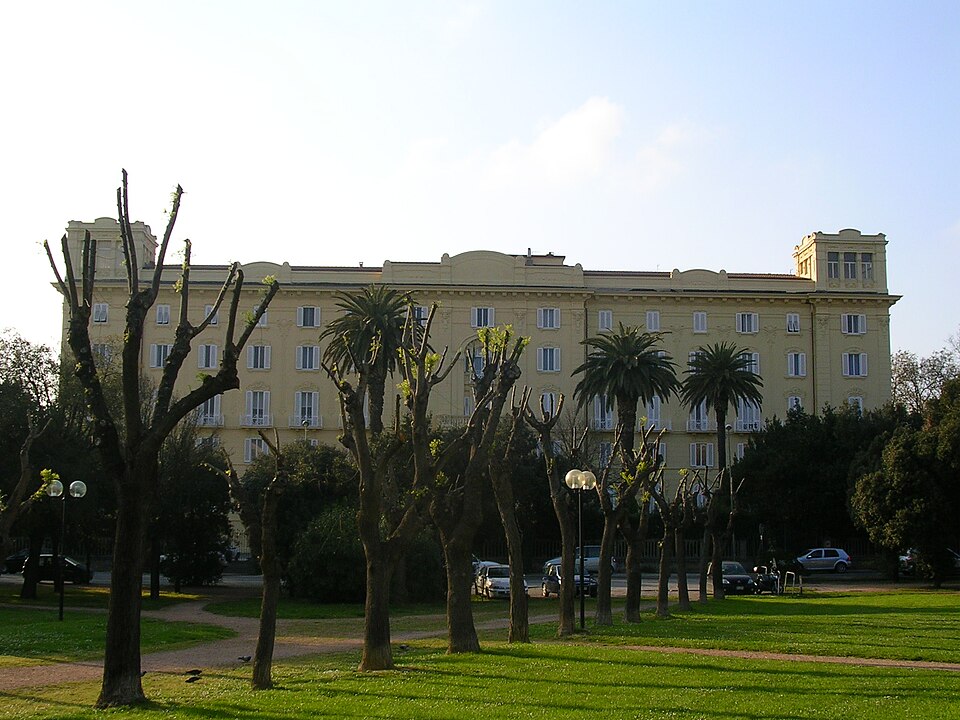
A three-star hotel of approximately 1,800 sqm, with more than 50 rooms, restaurant, bar, garden and parking, is coming to auction in Chianciano Terme with a base price of just €89,000 and a minimum admissible bid of €67,000. The value indicated at the outset of the proceedings was €996,000. The repricing exceeds 90%, but this is not merely a distressed real estate case: Hotel Rinascente is also one of the properties included in the municipality’s urban regeneration programme for the spa town. The real question is therefore not how little it costs to acquire, but what economic role the asset can realistically play in Chianciano’s next tourism cycle.
There are auctions where the price falls so far that it risks distorting the entire perception of the investment.
The sale of Hotel Rinascente in Chianciano Terme, at 119 Viale Guido Baccelli, is one of them.
The headline figures are immediate:
€89,000 base price.
€67,000 minimum admissible bid.
The sale is scheduled for 29 September 2026 at 11:00 a.m., with bids to be submitted by 11:59 p.m. on 28 September.
The property is being sold under Real Estate Enforcement Proceeding No. 89/2021 before the Court of Siena, as a single lot.
The sale will take place through an asynchronous online auction process.
But the truly significant figure emerges from the auction history:
| Auction Round | Base Price |
|---|---|
| 3 December 2024 | €996,000 |
| 11 March 2025 | €747,000 |
| 9 June 2026 | €158,000 |
| 29 September 2026 | €89,000 |
In less than two years, the base price has fallen from €996,000 to €89,000.
A reduction of approximately:
91%
If the current minimum admissible bid of €67,000 is considered, the gap versus the original figure exceeds:
93%
That is an extraordinary repricing.
But in distressed hospitality, the question is never simply:
“How far has the price fallen?”
The correct question is:
“How much capital will be required to create a hotel business capable of generating sustainable income again?”
The Asset: Hotel Rinascente, a Three-Star Property in Chianciano Terme
The property is identified as Hotel Rinascente, a long-established three-star hotel located at 119 Viale Guido Baccelli.
The sale documentation indicates a floor area of approximately:
1,791 sqm
together with a front garden and a rear area currently used for parking.
The building is arranged over several levels and includes:
-
boiler room;
-
kitchen;
-
dining rooms;
-
television lounge;
-
laundry;
-
lobby and reception;
-
sitting areas;
-
bar;
-
guestrooms with private bathrooms;
-
ancillary rooms;
-
roof terrace;
-
garden;
-
parking.
The accommodation layout indicates more than 50 rooms in total.
Historical commercial sources referring to Hotel Rinascente indicate 51 rooms, while the property documentation also refers to certain rooms that may have served staff or ancillary functions.
This may appear to be a minor detail.
In reality, it is the first example of what any investor should verify before building a business plan:
the actual number of saleable keys.
Because the room count, average room size, room mix and usable space directly affect:
ADR, RevPAR, revenue potential and investment cost per key.
€67,000 for an Entire Hotel: A Figure That Is Almost Misleading
If the minimum bid is divided by approximately 51 commercial rooms, the result is:
€67,000 / 51 ≈ €1,314 per key
The base price equates to approximately:
€89,000 / 51 ≈ €1,745 per key
These figures are almost paradoxical.
But economically, they have limited relevance.
No professional investor is really acquiring an operating hotel at €1,314 per room.
What is being acquired is:
a property + the issues that need to be solved + the CAPEX + the capital required to bring the hotel business back to market.
This is one of the fundamental principles behind the analysis published on InvestimentiAlberghieri.it:
Acquisition Price ≠ Total Investment Cost
Even €37 per Square Metre Can Be Too Expensive
The same reasoning applies to the floor area.
At approximately 1,791 sqm:
€89,000 / 1,791 sqm ≈ €50/sqm
At the minimum admissible bid:
€67,000 / 1,791 sqm ≈ €37/sqm
Again, the number appears extraordinary.
But a hotel does not generate a return simply because it was acquired for €37 per square metre.
It generates a return if:
Total Investment Cost < Stabilized Value
and if:
Stabilized EBITDA / Total Investment Cost
produces a return commensurate with the risk.
The real estate price is only one component of the equation.
From €996,000 to €89,000: What Is the Market Actually Saying?
The progression:
€996,000 → €747,000 → €158,000 → €89,000
indicates a clear difficulty in clearing the asset at previous pricing levels.
This does not necessarily mean that the property has no value.
It may simply mean that the market does not place sufficient value on the existing hotel product in its current configuration.
For a distressed hotel, it is useful to distinguish between at least three concepts:
Real Estate Value
the physical value of the property;
Going Concern Value
the value of the operating hotel business;
Repositioned Value
the potential value of the asset following an industrial transformation.
In the case of Hotel Rinascente, it may be the Repositioned Value that matters most.
Hotel Rinascente Also Tells the Story of Chianciano’s Structural Hotel Crisis
Hotel Rinascente is included in the Carta dell’Abbandono, the municipality’s mapping of abandoned properties prepared as part of Chianciano Terme’s Integrated Urban Regeneration Project.
It is identified as:
Hotel Rinascente — ID 51
This changes the perspective.
The issue is no longer confined to a single property.
It concerns the evolution of an entire destination.
Chianciano has a significant volume of hotel stock developed around a tourism model that has changed profoundly over the past few decades.
The question therefore becomes:
what should be done with hotels built for a demand profile that no longer exists at the same scale or in the same form?
Not Every Former Hotel Should Become a Hotel Again
Where a destination has structurally more hotel capacity than underlying demand can support, the answer cannot simply be to reopen every closed property.
The more relevant question is:
which assets should remain in hospitality and which could create more value through alternative uses?
This is effectively a question of destination asset allocation.
Potential uses may include:
-
hospitality;
-
wellness;
-
medical hospitality;
-
senior living;
-
serviced apartments;
-
staff housing;
-
student housing;
-
residential;
-
mixed-use;
-
healthcare;
-
education;
-
demolition and urban regeneration.
Not every former hotel necessarily needs to become a hotel again.
In the Rinascente Case, However, the Masterplan Retains a Hospitality Use
This is where the opportunity becomes particularly interesting.
In the 2026 economic and financial feasibility study associated with the municipal Masterplan, Hotel Rinascente is analysed individually.
The property is identified as:
privately owned;
suitable for building refurbishment;
intended to retain a hospitality use.
This does not replace a current planning and permitting due diligence process.
But it does provide an important strategic signal.
Within the city’s regeneration vision, Hotel Rinascente is still considered a potentially viable hospitality asset.
The question therefore becomes more sophisticated:
what type of hotel would make sense inside this building today?
The Biggest Risk Would Be Rebuilding Yesterday’s Hotel Rinascente
A €67,000 entry price may lead to an apparently logical conclusion:
“It is so cheap that we can simply refurbish it and reopen.”
That could be precisely the mistake to avoid.
A traditional three-star hotel of around 50 rooms must now compete with:
-
new travel patterns;
-
shorter lengths of stay;
-
digital distribution;
-
alternative accommodation;
-
the evolution of wellness demand;
-
greater emphasis on experience;
-
pricing pressure on commodity products;
-
labour costs;
-
energy costs;
-
the need for year-round demand.
Recreating the previous product could mean investing capital to reproduce the same business model that the market has already struggled to support.
At RobertoNecci.it, one principle repeatedly underpins hotel valuation:
the value of a hotel is not determined by what it used to be, but by its future ability to generate income.
Concept First. Architecture Second.
For an asset such as Hotel Rinascente, the decision-making sequence should be:
1. Market Analysis
2. Concept
3. Business Plan
4. Maximum Sustainable CAPEX
5. Technical Design
Not the other way around.
Refurbishing a building first and only afterwards deciding how to position it is one of the most expensive mistakes in hotel investment.
The architectural solution should follow the business model.
Three Potential Investment Theses
Scenario 1 — Budget / Value Hotel
Retain a relatively high room count, maintain strict CAPEX discipline and pursue a value-for-money positioning.
Potential demand segments might include:
-
groups;
-
tours;
-
sports;
-
local demand;
-
price-sensitive customers;
-
short stays.
Advantage: potentially lower initial investment.
Risk: limited ADR and a heavy reliance on occupancy.
A low-rate strategy must compensate through volume.
And volume creates operating costs.
Scenario 2 — Repositioned Lifestyle / Wellness Hotel
Undertake a deeper refurbishment, improve room quality, enlarge selected units, upgrade public areas and create a more contemporary identity.
The property could potentially connect with:
-
thermal tourism;
-
wellness;
-
Val d’Orcia;
-
Montepulciano;
-
wine tourism;
-
cycling;
-
outdoor experiences;
-
food tourism.
Under this scenario, Chianciano is no longer marketed solely as a spa destination.
It becomes a gateway to the wider Southern Tuscany experience.
Scenario 3 — Hybrid Hospitality
A third option could involve a hybrid model:
hotel + extended stay + wellness + long stay + healthcare/corporate accommodation
Diversifying demand generators could reduce reliance on any single segment.
Planning and permitting feasibility would of course need to be verified.
But this is precisely the type of analysis that should take place before design work begins.
When €67,000 Becomes Almost Economically Irrelevant
Consider three purely illustrative scenarios:
| Scenario | Total Investment Cost | 51 Keys | Cost per Key |
|---|---|---|---|
| Light Turnaround | €2.0M | 51 | €39,200 |
| Full Repositioning | €3.5M | 51 | €68,600 |
| Deep Redevelopment | €5.0M | 51 | €98,000 |
In a €3.5 million project, the difference between buying the property for €67,000 or €89,000 becomes almost marginal.
This is one of the paradoxes of deeply distressed hospitality:
the lower the acquisition price falls, the more important underwriting becomes relative to the purchase price itself.
The initial discount creates room.
It does not automatically create returns.
This is the same framework used for turnaround and special situations analysed by Investhotel.it.
Maximum Sustainable CAPEX: The Figure That Really Matters
The process should start with the future economics of the hotel.
For example:
Rooms Available × Occupancy × ADR = Rooms Revenue
Then add:
-
F&B;
-
wellness;
-
ancillary revenues;
-
other potential revenue centres.
This produces:
Total Revenue
less operating costs, resulting in:
GOP
and ultimately:
Stabilized EBITDA
Only at that point can a Stabilized Value be estimated.
The logic becomes:
Stabilized EBITDA
×
Appropriate Market Multiple
=
Stabilized Value
From this value, the investor must deduct:
-
required investor return;
-
financing costs;
-
transaction costs;
-
soft costs;
-
contingency;
-
pre-opening;
-
working capital.
The residual amount represents:
Maximum Sustainable CAPEX
This is the figure that really matters before bidding.
Not €67,000.
The Same Property Can Be Excellent or Poor Depending on EBITDA
Assume, again purely for illustration, that the repositioned hotel could generate:
EBITDA of €300,000
With a Total Investment Cost of €2.5 million:
EBITDA Yield on Cost = 12%
At €4 million:
7.5%
At €5 million:
6%
The same property, still acquired for €67,000, could therefore become:
an excellent investment,
an average investment,
or
an economically unsustainable investment
depending entirely on CAPEX and operating performance.
This is why:
Deep Discount ≠ High Return
The Location Also Introduces a Potential Upside Component
Hotel Rinascente is located in the southern part of Chianciano, an area characterised by a significant concentration of closed or disused hotels and along one of the main approaches to the town.
This creates another potential investment angle.
The future value of the property may depend partly on the regeneration of the surrounding urban context.
If the area remains characterised by a high concentration of vacant hotels, repositioning a single property may prove more difficult.
If the wider regeneration programme gradually produces new investment, new functions, better services and improved perception, the value of private assets could also change.
But this should be treated as:
upside
rather than as part of the base case.
A prudent underwriting should not capitalise today on benefits that remain uncertain.
Hotel Rinascente Is Therefore Also a Bet on Chianciano’s Transformation
This is perhaps the most interesting aspect of the case.
An investor would not merely be acquiring:
a hotel for €67,000.
They would be entering a destination that is trying to address one of the most complex challenges facing Italian hospitality:
how to convert or reposition hotel stock that has become structurally obsolete following a fundamental change in demand.
This is not only a Chianciano issue.
It affects many destinations:
-
spa towns;
-
coastal resorts;
-
mountain destinations;
-
secondary business locations;
-
towns shaped by family-run hotels developed between the 1960s and 1990s.
The buildings still exist.
The rooms still exist.
The real question is:
does a business model still exist that can remunerate the capital required to use them?
The Seven Analyses Required Before Bidding
At a minimum, an investor should complete:
1. Technical Due Diligence
Structure, façades, roofs, guestrooms, bathrooms, building systems, kitchen, lifts, fire safety and energy efficiency.
2. Urban Planning & Cadastral Due Diligence
Compliance, permitted use, restrictions and redevelopment potential.
3. Hotel Market Study
Competitive set, ADR, occupancy, RevPAR, segmentation, seasonality and demand generators.
4. Concept Study
Define which product actually makes sense before designing the refurbishment.
5. CAPEX Plan
Detailed cost estimate with an appropriate contingency.
6. Financial Underwriting
Total Investment Cost, EBITDA, cash flow, debt capacity, DSCR, IRR and exit value.
7. Operating Model
Direct management, lease, management agreement, independent operator or brand affiliation.
The operational component is critical.
Acquiring the building does not automatically create a functioning hotel.
The business still requires:
-
management;
-
revenue management;
-
staff;
-
distribution;
-
procedures;
-
management control;
-
marketing;
-
sales;
-
organisational structure.
These are precisely the issues addressed by HotelManagementGroup.it in hotel management, turnaround and repositioning projects.
The Low Entry Price Remains a Major Advantage
None of this means the auction is unattractive.
Quite the opposite.
An acquisition cost of €67,000 materially reduces one component of the Total Investment Cost.
That potentially creates more headroom for:
-
CAPEX;
-
contingency;
-
repositioning;
-
pre-opening;
-
investor return.
If an investor can:
-
acquire at a deep discount;
-
identify the right concept;
-
maintain CAPEX discipline;
-
generate sustainable EBITDA;
-
benefit from any wider destination recovery;
then the distressed entry price can become a genuine source of value creation.
The equation becomes:
Deep Entry Discount
Correct Repositioning
Disciplined CAPEX
Operational Turnaround
Destination Upside
=
Potential Value Creation
That is the real investment thesis.
Conclusions
Hotel Rinascente in Chianciano Terme is a far more sophisticated case than its auction price might suggest.
The figures are extreme:
three-star hotel
more than 50 rooms
approximately 1,791 sqm
garden and parking
initial value of €996,000
base price of €89,000
minimum admissible bid of €67,000
auction on 29 September 2026
The repricing exceeds 90%.
But that is not the central point.
Hotel Rinascente belongs to a segment of hotel stock that the town itself is trying to rethink through a wider regeneration strategy.
The property is still envisaged as hospitality.
That makes the opportunity potentially compelling.
But it raises a much more important question than:
“Is it worth buying a hotel for €67,000?”
The real question is:
“Which business model can generate enough EBITDA to justify the millions that may ultimately be required to bring this hotel back to life?”
If there is a convincing answer, the near-symbolic entry price could represent an extraordinary advantage.
If there is not, even €67,000 may be too much.
That is one of the fundamental rules of hospitality special situations:
A near-symbolic price does not eliminate risk.
It simply creates more financial room to solve it.
And in the case of Hotel Rinascente, the real investment is not about acquiring a hotel for €67,000.
It is about determining whether there is still a business model capable of justifying the capital required to make it viable again.
InvestimentiAlberghieri.it monitors and analyses hotel auctions, distressed assets and hospitality investment opportunities; Investhotel.it focuses on turnarounds and extraordinary transactions; RobertoNecci.it addresses hotel valuation, strategy and governance; while HotelManagementGroup.it focuses on management, repositioning and operational performance.
Are You Assessing a Hotel Auction or a Distressed Hospitality Asset?
Before submitting an offer, it is essential to determine:
Total Investment Cost, Maximum Sustainable CAPEX, prospective EBITDA, operating model and Stabilized Value.
For preliminary investment analysis, hotel valuations and due diligence:
info@investimentialberghieri.it
SEO BOX
SEO Title
Chianciano Terme: Hotel Rinascente at Auction for €89,000
Meta Description
Hotel Rinascente in Chianciano Terme is going to auction for €89,000, with a minimum bid of €67,000 versus an initial €996,000. Analysis of CAPEX, turnaround potential and real investment value.
Suggested Slug
chianciano-terme-hotel-rinascente-auction-89000-euros
Primary Keyword
Hotel Rinascente Chianciano Terme auction
Secondary Keywords
Chianciano Terme hotel auction, Hotel Rinascente auction, hotel auction Tuscany, distressed hotel Tuscany, three-star hotel auction Italy, hospitality investment Chianciano, hospitality special situations Italy, hotel redevelopment Tuscany, Siena hotel auction, hotel turnaround Chianciano
Recommended H1
Chianciano Terme: Hotel Rinascente at Auction for €89,000 — From €996,000 to a €67,000 Minimum Bid, But the Real Question Is What to Do With It
Excerpt
Hotel Rinascente in Chianciano Terme, with more than 50 rooms, approximately 1,800 sqm, restaurant, garden and parking, is coming to auction with a base price of €89,000 and a minimum bid of €67,000 versus an initial €996,000. The repricing exceeds 90%, but the real question is which business model can justify the capital required to reposition the property within the destination’s next tourism cycle.
Focus Keyphrase
Hotel Rinascente Chianciano Terme auction
Search Intent
hotel auction Italy / distressed hospitality / hotel turnaround / Chianciano regeneration / Tuscany hospitality investment