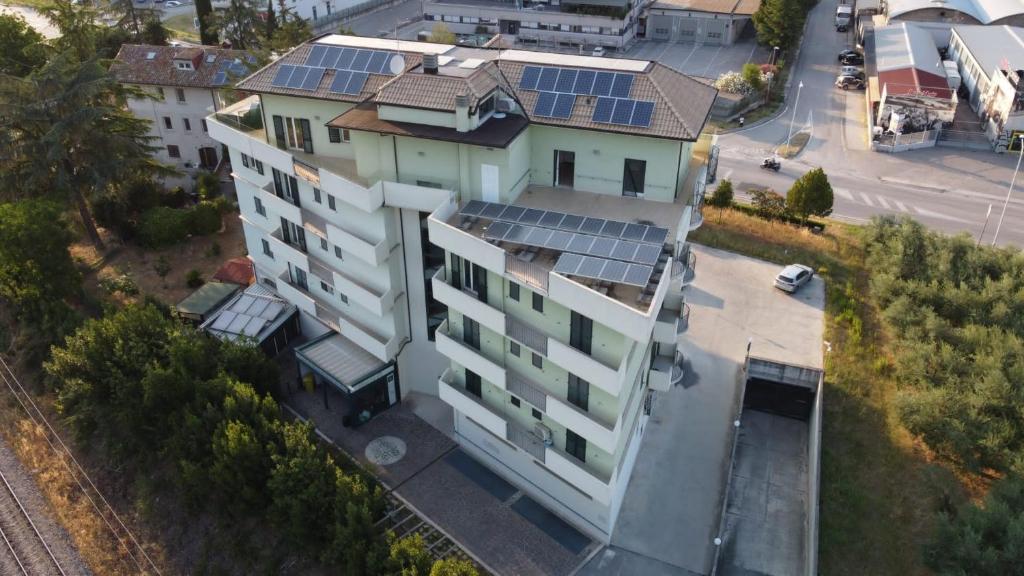
In Città Sant’Angelo, in the province of Pescara, an approximately 3,285 sqm property originally developed as a hotel and subsequently operated as a senior living facility is returning to auction with a minimum bid of just €429,675. That equates to approximately €131 per sqm and makes the headline discount immediately apparent. But treating the opportunity as a straightforward low-basis real estate acquisition would be a mistake. Available documentation identifies widespread signs of foundation settlement. The real investment case therefore depends on the asset’s future Highest & Best Use, the cost of technical remediation and the ability to convert an exceptionally low entry basis into a property that is once again financeable, operational and ultimately saleable.
Investment Snapshot
Location: Città Sant’Angelo, Pescara – Abruzzo, Italy
Address: Via Selva del Moro 16
Asset: property originally developed as a hotel and subsequently operated as a senior living facility
Approximate area: 3,285 sqm
Base price: €572,900.35
Minimum bid: €429,675.26
Entry basis at minimum bid: approximately €131/sqm
Minimum bidding increment: €5,000
Bid submission deadline: 15 September 2026 at 12:00 p.m.
Auction: 16 September 2026 at 11:00 a.m.
Proceeding: Court of Pescara – Real Estate Enforcement Proceeding No. 241/2024 – Single Lot
Critical technical issue: available documentation reports widespread evidence of foundation settlement.
The opportunity is particularly relevant for InvestimentiAlberghieri.it because it represents a different type of hospitality special situation.
The primary question here is not:
“What is the hotel worth?”
It is:
“What is the highest-value economic use for this property today, how much capital is required to restore it and what value can it generate once normalised?”
This is fundamentally a Highest & Best Use exercise rather than a conventional hotel valuation.
From Hotel to Senior Living: The Property’s History Already Points to Embedded Optionality
The building was reportedly developed in the early 1990s as a hotel and subsequently operated as a senior care facility.
That transition matters.
It demonstrates that the property has already supported at least two distinct operating models:
hospitality
and
senior living.
Although the property continues to be classified within the hotel and lodging category in the auction documentation, its operating history suggests that a prospective investor should not automatically assume that restoring the original hotel use is the optimal strategy.
The real investment thesis should instead begin with the question:
which use currently generates the highest risk-adjusted economic value?
Significant Repricing: From More Than €1 Million to €572,900
The auction history also deserves attention.
Published information indicates:
14 January 2026 — base price €1,018,489.50
10 June 2026 — base price €763,867.13
16 September 2026 — base price €572,900.35
The current base price is therefore approximately 43.8% below the January 2026 level.
The current minimum bid stands at:
€429,675.26.
The repricing is substantial.
But, as with every special situation, the discount needs to be interpreted carefully.
Because here, the reduction in price coexists with a material technical risk.
€131 per sqm Looks Exceptionally Low. But It Is the Wrong Number to Look at in Isolation
Dividing the minimum bid of €429,675 by the approximately 3,285 sqm of reported area produces an acquisition basis of around:
€131/sqm.
At first glance, that appears exceptionally low.
And this is precisely where price anchoring can become dangerous.
Economic value should not be assessed through:
Purchase Price / sqm
but rather:
Total Investment Cost / sqm usable after remediation and repositioning.
If the building requires significant structural works, regulatory upgrades, replacement of building systems, internal reconfiguration or comprehensive repositioning, the actual investment cost per square metre could be several times the auction acquisition price.
The correct question is therefore not:
“What does each square metre cost today?”
It is:
“What will each productive square metre cost once the building is genuinely usable again?”
The Critical Issue: Foundation Settlement
Available documentation describes the property as being in generally reasonable condition while identifying widespread evidence of foundation settlement.
For an investor, this issue should become the first workstream in the due diligence process.
Before the concept.
Before the business plan.
Before financing.
Before even determining economic value.
The investor needs to establish:
the nature of the settlement;
its extent;
its underlying causes;
whether the movement has stabilised;
the structural works potentially required;
the cost of remediation;
the execution timetable;
insurance implications;
the impact on occupancy permits and usability;
the implications for the property’s future use.
Without these answers, any valuation exercise remains premature.
Acquisition Basis vs Cost to Cure
This is where the central concept of the transaction emerges.
An asset can have a very low Acquisition Basis while simultaneously carrying a very high Cost to Cure.
The investment becomes attractive only where:
reduction in entry price > remediation costs + execution risk + required return.
This is a core principle in distressed transactions of the type analysed by Investhotel.it.
The market does not reward an investor simply for acquiring a building at €131/sqm.
It rewards the investor if that €131/sqm entry basis can be transformed into a stabilised asset worth materially more than the total capital invested.
There Is No Single Business Plan: At Least Three Are Required
In this case, immediately building a hotel business plan would be the wrong approach.
Different use scenarios need to be tested first.
Scenario A — Return to Hospitality
Restoration of the property’s original hospitality use.
The investor would need to assess:
hotel demand;
micro-location;
recoverable room count;
positioning and category;
ADR;
occupancy;
F&B;
capex;
distribution;
seasonality.
The fundamental question would be:
can a new hotel in this location generate sufficient EBITDA to justify both remediation and repositioning capex?
Scenario B — Senior Living / Care Home / Assisted Living
Restoration or reconfiguration of the building for senior living or assisted accommodation.
Its previous use as a senior care facility makes this scenario particularly relevant.
But historical use alone is not enough.
Investors would need to assess:
licensing requirements;
facility configuration;
number of authorised beds;
regional regulations;
staffing requirements;
pricing model;
potential accreditation;
healthcare-related capex;
local demand;
operator availability.
The economic model changes completely.
The underwriting no longer revolves around:
ADR × Occupancy
but rather around:
authorised beds × occupancy × average rate
with an entirely different staffing and operating cost structure.
Scenario C — Alternative Use
Subject to planning, technical and regulatory constraints, investors should also test alternative uses.
These could potentially include:
specialist residential accommodation;
student or senior housing;
serviced accommodation;
medical hospitality;
rehabilitation facilities;
mixed-use concepts;
other configurations compatible with the building and local market.
This does not mean that every option will be feasible.
It means they should be tested before assuming that the historical use remains the optimal use.
Highest & Best Use: Four Tests Must Be Satisfied
A proper Highest & Best Use analysis requires the future use to be simultaneously:
legally permissible
physically possible
financially feasible
maximally productive.
These are four separate filters.
A use may be commercially attractive but impossible to authorise.
It may be legally permissible but technically too expensive.
It may be technically achievable but incapable of generating an adequate return.
Only the configuration that passes all four tests can legitimately be regarded as the property’s Highest & Best Use.
Hotel or Senior Living? This Is a Financial Decision, Not an Ideological One
The obvious question is:
hospitality or senior living?
But the answer should not be determined by the building’s history.
It should be determined by the numbers.
For each alternative, investors should calculate:
Total Investment Cost
time to stabilisation
stabilised EBITDA
recurring capex
working capital
staffing costs
required yield
exit value
exit liquidity.
The appropriate use is the one that produces the strongest:
Risk-Adjusted Return on Invested Capital.
A Large Floor Area Can Be an Opportunity — or a Liability
Approximately 3,285 sqm represents a significant amount of space.
But once again:
sqm ≠ value.
Space creates value only when it produces income.
A building that is oversized relative to underlying demand can generate:
utilities;
maintenance;
staffing;
cleaning;
capex;
insurance;
property taxes;
without generating sufficient revenue in return.
The investor should therefore measure the asset’s productive density.
In other words:
how much EBITDA can each square metre generate once the asset has been stabilised?
That is a far more useful metric than acquisition price per square metre.
Technical Capex Comes Before Repositioning Capex
In many hotel acquisitions, discussions begin with guestrooms, concept, branding or FF&E.
That would be premature here.
The correct sequence should be:
1. Structural Remediation
2. Regulatory Compliance
3. Building Systems
4. Space Reconfiguration
5. Product Capex
6. FF&E
7. Commercial Relaunch
The asset must first be made structurally safe and usable.
Only then should investors decide how best to monetise it.
The distinction between Technical Capex and Repositioning Capex is therefore fundamental.
Total Investment Cost Could Completely Change the Perception of Value
The minimum bid is €429,675.
But Total Investment Cost could include:
**acquisition price
-
taxes
-
transaction costs
-
structural remediation
-
engineering
-
compliance works
-
building systems
-
internal reconfiguration
-
FF&E
-
potential medical equipment
-
pre-opening costs
-
marketing
-
working capital
-
professional fees
-
financing costs
-
contingency.**
It is easy to see how the Purchase Price could ultimately represent only a relatively small component of the total capital required.
That is why €429,675 is an interesting number.
But it is not the decisive one.
The Real Denominator: Stabilised Usable Space
The price per square metre should therefore be recalculated only after establishing:
how much space will genuinely be usable;
for which purpose;
following what level of capex;
with what income-generating capacity.
Conceptually:
Effective Basis per Productive sqm = Total Investment Cost / Stabilised Productive Area.
That is the relevant comparable metric.
Not €131/sqm.
Maximum Bid Price Must Incorporate Technical Risk
In a conventional transaction, Maximum Bid Price may be derived by taking Stabilised Value and deducting capex and transition costs.
Here, an additional layer is required.
Conceptually:
Stabilised Value
– Structural Remediation
– Repositioning Capex
– Working Capital
– Transaction Costs
– Financing Costs
– Contingency
– Technical Risk Reserve
– Execution Risk Discount
= Maximum Bid Price.
The Technical Risk Reserve is particularly important.
Where structural due diligence cannot establish remediation costs with a high degree of certainty, the Maximum Bid Price should incorporate a larger margin of safety.
A Base Case Is Not Enough: A Structural Downside Case Is Required
The reported foundation issues make downside stress testing essential.
An investment committee should consider at least:
Base Technical Case
Remediation scope clearly defined, costs reasonably predictable and execution timetable controlled.
Downside Technical Case
Higher-than-expected costs, additional works and delayed reopening.
Severe Downside Case
Structural issues materially exceed initial assumptions, resulting in significantly higher capex and a longer stabilisation period.
The investment should not work only under the Base Case.
It should be capable of surviving a reasonable downside scenario.
Time Is Capital
Another variable frequently underestimated in redevelopment projects is time.
If 18, 24 or 36 months are required before the property can begin generating cash flow, capital remains tied up throughout that period.
Investors therefore need to incorporate:
carrying costs
interest during construction
professional fees
security
insurance
property taxes
opportunity cost of equity.
Project cost does not increase only when capex rises.
It also increases when the time required to reach stabilisation extends.
The Financing Structure May Be More Complex Than Usual
An asset with structural issues and no stabilised cash flow may be more difficult to finance.
A lender may require:
higher equity contribution;
lower LTV;
a dedicated capex facility;
larger contingency reserves;
drawdowns linked to certified progress;
additional guarantees;
technical monitoring;
pre-leasing or an agreement with a future operator.
The transaction’s bankability therefore becomes an integral part of the valuation exercise.
An asset can appear economically compelling while remaining difficult to finance efficiently.
A Hospitality Strategy Must Prove That the Market Can Support the Investment
If the preferred strategy were to restore the property to its original hotel use, a comprehensive commercial due diligence would be required.
The analysis should cover:
demand in Città Sant’Angelo;
Pescara and the wider metropolitan area;
corporate demand;
leisure demand;
events;
proximity to the coast;
accessibility;
competitive supply;
ADR;
occupancy;
seasonality;
optimal room count;
F&B;
potential meeting facilities.
The objective would be to establish the future hotel’s Revenue Ceiling.
Only then can investors determine how much capex is economically justified.
Senior Living Requires an Entirely Different Underwriting Framework
If Highest & Best Use instead points toward senior living, the analysis should focus on:
demographic demand;
catchment area;
bed capacity;
rates;
licensing framework;
potential accreditation;
operators;
staffing ratios;
stabilised occupancy;
EBITDAR;
operator contract structure.
The property may therefore need to be valued more as operational real estate than as a hotel.
That represents a fundamental shift in perspective.
PropCo / OpCo: A Potential Structure for Reducing Operating Risk
A real estate investor may not wish to operate either a hotel or a senior living facility directly.
One potential structure would separate:
PropCo — owner of the real estate;
OpCo — specialist operating company.
The value of the property could then depend on the ability to secure:
a lease;
a management agreement;
an operating contract;
a long-term agreement with a qualified operator.
This could improve bankability and broaden the future exit buyer universe.
But only if the operating contract itself is sustainable.
The Operator Agreement Can Become Part of the Real Estate Value
In operational real estate, a vacant building and the same building backed by a credible tenant or operator can command radically different values.
A sustainable lease can create:
cash-flow visibility;
bankability;
yield-based valuation;
greater exit liquidity.
Part of the value creation may therefore come not only from refurbishing the building.
It may come from creating an investable operating platform.
Stabilised Value – Total Investment Cost = Value Creation Potential
The decisive metric remains:
Stabilised Value – Total Investment Cost = Value Creation Potential.
But Stabilised Value will vary depending on the selected use.
Hospitality
Value may be derived from normalised EBITDA and a market-consistent multiple or yield adjusted for location and liquidity.
Senior Living
Value may depend on property-level cash flow, the strength of the operator agreement and the yield required by investors.
Alternative Use
Value may be derived from unit values, NOI or another methodology appropriate to the selected use.
The real analytical exercise therefore consists of comparing different scenarios on a consistent basis.
Risk-Adjusted Entry Basis Must Reflect the Full Risk Stack
The €429,675 minimum bid appears extremely aggressive.
But an investment committee should determine whether that price adequately compensates for:
**structural risk
-
planning risk
-
regulatory risk
-
capex risk
-
construction risk
-
operating risk
-
financing risk
-
execution risk
-
exit risk.**
Only after these risks have been quantified can the entry basis genuinely be described as attractive.
Ten Questions That Must Be Answered Before Bidding
Before participating in the auction, a professional investor should have clear answers to at least ten questions:
1. What is the true nature and extent of the foundation settlement?
2. What is the Structural Remediation Cost?
3. Which uses are legally and technically permissible?
4. What is the property’s Highest & Best Use?
5. How much capital does each scenario require?
6. How long will each strategy take to reach stabilisation?
7. What EBITDA or NOI can each use generate?
8. Which operator could manage the asset?
9. What is the risk-adjusted Maximum Bid Price?
10. Who could acquire the stabilised asset at exit?
Without answers to these questions, €429,675 is merely an acquisition price.
It is not yet an investment.
Due Diligence Should Follow a Different Sequence from a Conventional Acquisition
This opportunity requires a disciplined order of analysis.
Phase 1 — Structural Due Diligence
First, define the technical risk.
Phase 2 — Planning & Legal Due Diligence
Then determine what can legally and physically be done with the property.
Phase 3 — Highest & Best Use Study
Compare the alternative uses.
Phase 4 — Commercial / Operational Due Diligence
Determine the revenue and margin potential of each viable strategy.
Phase 5 — Financial Underwriting
Build Total Investment Cost, cash flow and return scenarios.
Phase 6 — Bid Strategy
Only then determine the Maximum Bid Price.
Reversing this sequence would mean starting with price instead of risk.
Where Value Could Be Created
This special situation presents at least five potential value-creation levers.
Acquisition Repricing
A significantly compressed purchase basis compared with previous auction rounds.
Technical Resolution
Resolving a problem that currently limits the pool of potential buyers.
Highest & Best Use Arbitrage
Identifying a use that creates greater economic value than the one currently perceived by the market.
Operator Structuring
Introducing a qualified operator capable of making future cash flows visible and financeable.
Exit Repricing
Selling a stabilised asset that has been technically remediated and has a clearly defined economic use.
This final point is particularly important.
The complexity suppressing the asset’s price today could become the source of return for an investor capable of resolving it.
It Is a Special Situation Precisely Because the Problem Is Part of the Value Proposition
A standard asset is easy to understand.
A problematic asset carries greater uncertainty.
Greater uncertainty reduces the number of potential buyers.
Reduced competition can compress the acquisition price.
If an investor has the expertise and capital required to resolve the underlying problem more effectively than competing buyers, complexity can become a competitive advantage.
That is the essence of special-situations investing.
The hotel valuation framework developed on Robertonecci.it views hospitality value through the asset’s ability to support a viable economic model and generate sustainable earnings.
Città Sant’Angelo requires one additional step:
before determining how much income the property can generate, investors must first determine which operating business the building should accommodate.
The Operating Model Will Be Critical Regardless of the Selected Use
Whether the preferred strategy is hospitality, senior living or another operational use, the building must ultimately be assessed together with the business that will occupy it.
From a hospitality perspective, the approach developed by HotelManagementGroup.it would therefore need to assess not only hotel feasibility, but the ability to construct an operating model consistent with the property’s scale, demand profile, staffing requirements and capex.
The same principle applies — with the appropriate specialist expertise — to alternative use scenarios.
The real estate alone is not enough.
It needs an economically sustainable operating business.
Conclusion: At €429,675 the Price Is Low. But the Investment Still Has to Be Built
Città Sant’Angelo is perhaps one of the most deceptive types of auction headline.
Approximately 3,285 sqm.
A minimum bid of €429,675.
Around €131/sqm.
Significant repricing compared with previous auction rounds.
These numbers immediately attract attention.
But the decisive issue lies elsewhere.
Available documentation identifies foundation-related issues.
The property has already supported at least two different operating lives.
And its future use cannot simply be determined by looking at its past.
The correct sequence is:
understand the technical risk;
quantify the Cost to Cure;
determine which uses are legally and physically feasible;
identify the Highest & Best Use;
calculate Total Investment Cost;
estimate Stabilised Value;
determine the Maximum Bid Price.
Only then can €429,675 be judged as an investment entry point.
The real arbitrage is not acquiring a building at approximately €131/sqm.
It is acquiring complexity at a sufficiently low basis, resolving that complexity and transforming the property into an asset that is once again:
usable, bankable, income-producing and liquid.
In this transaction, perhaps more than in many others, one fundamental rule of special-situations investing applies:
the problem is not necessarily what destroys value. It may be precisely what allows a capable investor to create it.
For further analysis of auctions, distressed assets, conversions and hospitality special situations: InvestimentiAlberghieri.it.
For hotel acquisitions, turnarounds, value enhancement and extraordinary transactions: Investhotel.it.
For hotel valuations, strategic analysis and hospitality market insights: Robertonecci.it.
For operational due diligence, hotel operating models, positioning and performance improvement: HotelManagementGroup.it.
For further information and investment enquiries: info@investimentialberghieri.it
This article is provided solely for informational and analytical purposes and does not constitute an offer, investment recommendation or solicitation. All information relating to the procedure should be independently verified against the official auction documentation. Particular attention should be given to structural, technical, planning, regulatory, legal, tax, financial and operational due diligence before any investment decision is made.