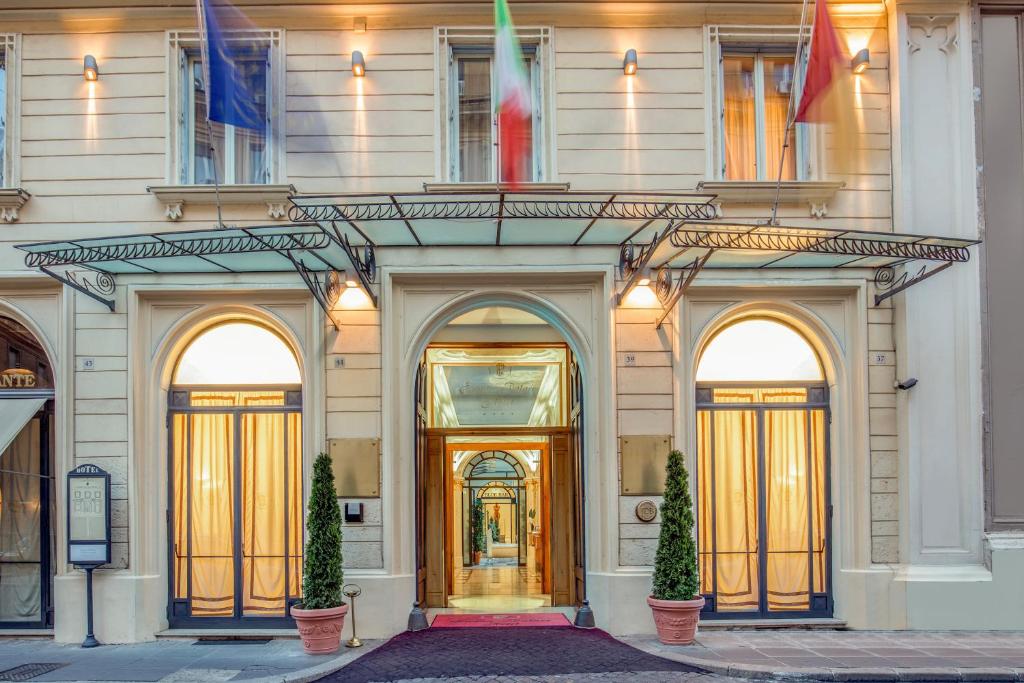
The Empire Palace Hotel at Via Aureliana 39 in Rome was offered for sale on 21 May 2026 as part of the liquidation composition with creditors proceeding No. 67/2019 involving Pimm Int’l S.r.l., with both the reserve price and the minimum acceptable offer set at €20 million. The transaction covers 100% of the hotel real estate: approximately 5,693 sqm of gross floor area, 110 rooms, restaurant, bar, internal courtyard and conference facilities in the Via Veneto–Repubblica–Termini area. But this is not the typical distressed hotel acquisition involving the purchase, refurbishment and reopening of a vacant property. The hotel is operational, currently marketed as UNA Hotels Empire Roma, and leased to Gruppo UNA S.p.A. under a 9+9-year contractual structure commencing on 1 January 2021. The lease provides for a minimum guaranteed annual rent of €491,163 or, if higher, a variable component equal to 23% of reference revenue, subject to the detailed contractual provisions. This is therefore a very different special situation from the vacant-possession opportunities typically found in distressed hospitality: Distressed Seller ≠ Distressed Hotel. The buyer does not immediately acquire the GOP generated by 110 rooms. The buyer acquires a hospitality PropCo with an operating tenant, contractual cash flow and, critically, embedded future optionality over the full strategic control of the asset.
The first distinction is:
Real Estate Acquisition
≠
Hotel Business Acquisition.
The second is even more important:
110 Hotel Rooms
≠
110 Rooms Under Buyer Operating Control.
The initial valuation equation therefore becomes:
Present Value of Contractual Rent
Present Value of Reversion
−
Owner CAPEX
−
Lease Risk
−
Execution Risk
=
Investment Value.
But the Empire Palace case requires one further dimension:
Value at Acquisition
≠
Value at Reversion.
That is where the true:
Lease-to-Reversion Arbitrage
begins.
Investment Snapshot
| Item | Data |
|---|---|
| Asset | Empire Palace Hotel / UNA Hotels Empire Roma |
| Address | Via Aureliana 39, Rome |
| Proceeding | Composition with Creditors No. 67/2019 – Pimm Int’l S.r.l. |
| Court | Rome |
| Interest Offered | 100% freehold ownership of the hotel real estate |
| Reserve / Minimum Price | €20,000,000 |
| Rooms | 110 |
| Gross Floor Area | Approx. 5,693 sqm |
| Declared Commercial Area | Approx. 3,469 sqm |
| Category | 4-star |
| Status | Operational / income-producing property |
| Tenant | Gruppo UNA S.p.A. |
| Lease | 9 + 9 years from 1 January 2021 |
| Minimum Guaranteed Rent | €491,163 per annum |
| Variable Rent | 23% of reference revenue, subject to the lease terms |
This is therefore not merely:
a hotel acquisition.
It is:
a leased hospitality real estate investment with embedded reversion optionality.
Competitive Sale within a Composition with Creditors ≠ Ordinary Judicial Auction
The transaction originates from:
Liquidation Composition with Creditors No. 67/2019
involving Pimm Int’l S.r.l.
The asking threshold was:
€20,000,000
and offers could not be submitted below that figure.
The transaction therefore did not follow the typical mechanism seen in Italian enforcement auctions, where the minimum admissible bid may be 75% of the reserve price.
Here:
Reserve Price = Minimum Acceptable Bid.
The required deposit was at least:
10% of the offer.
At €20 million, this means:
€2 million of capital committed at the bidding stage.
This is:
Bid Capital Commitment.
Auction Award ≠ Final Acquisition
Winning the competitive process does not automatically mean:
ownership.
Legal title is completed through:
the final transfer deed.
Therefore:
Highest Bid
≠
Title Transfer.
And:
Auction Success
≠
Investment Success.
The distinction may appear procedural.
In reality, it is economic.
Any gap between:
bid;
award;
closing;
effective control
creates:
execution risk.
Distressed Seller ≠ Distressed Hotel
This is the defining feature of the case.
The seller is subject to:
an insolvency proceeding.
The hotel, however, is:
operational;
marketed;
bookable;
managed by a major national hospitality operator.
Therefore:
Seller Distress
does not automatically imply:
Asset Distress.
And, more importantly:
Corporate Insolvency
does not mean:
Hotel Operating Failure.
The investor must therefore determine:
where the distress actually sits.
This Is a PropCo Special Situation
The buyer does not necessarily acquire:
the brand;
employees;
customer relationships;
working capital;
the hotel operating business;
hotel GOP.
The buyer acquires:
the hotel real estate.
Subject to:
the existing lease.
The transaction is therefore much closer to:
income-producing hospitality real estate
than to:
hotel turnaround.
PropCo Sale ≠ OpCo Sale
The structure can be separated into two layers.
PropCo
Owns:
the Hotel Real Estate.
OpCo / Tenant
Operates:
the hotel business.
Commercialises:
110 rooms.
Generates:
revenue;
GOP;
EBITDAR.
Pays:
rent.
The buyer of the property therefore acquires:
PropCo Cash Flow.
Not:
Hotel Operating Cash Flow.
Hotel Revenue Drives Rent. Rent Drives PropCo Value.
For the operator:
ADR × Occupancy = RevPAR.
Then:
Revenue − Operating Costs = Operating Profit.
For the property owner:
Rent − Owner Costs = Property Cash Flow.
Therefore:
Hotel Revenue Drives Rent
→
Rent Drives PropCo Value.
But over the longer term:
Reversion Drives Strategic Optionality.
The €20 Million Price
At:
€20,000,000
across:
110 rooms
the simple metric is:
approximately €181,818 per Physical Key.
Across:
5,693 sqm of gross floor area
this equates to approximately:
€3,513/sqm.
Across:
3,469 sqm of stated commercial area
it equates to approximately:
€5,765/sqm.
But in this case:
Price per Key
is a secondary metric.
Because the buyer is not acquiring:
110 rooms available for immediate operation.
The buyer is acquiring:
a lease-backed real estate position.
Price per Key Is Secondary When the Buyer Is Buying Rent, Not Rooms
This is one of the central principles of the Empire Palace case.
For a vacant hotel:
Price per Key
can be a core entry-valuation metric.
For a leased hotel:
the initial metric should instead be:
Price per Euro of Sustainable Rent.
Because:
€181,818 per key
does not mean:
€181,818 per key under buyer control.
The Lease with Gruppo UNA Is a Core Component of Value
The lease has a:
9 + 9-year
structure commencing on:
1 January 2021.
The investor must therefore distinguish:
Nominal Lease Term
from:
Secure Income Term.
Because:
9 + 9
≠
18 Years of Guaranteed Income.
The due diligence must test:
break options;
termination rights;
renewal provisions;
notice periods;
default events;
change-of-control provisions;
assignment rights;
guarantees;
performance obligations.
Contractual Duration ≠ Secure Income Duration
For an investment committee, the correct question is not:
“How long is the lease?”
It is:
“For how many years can the rent reasonably be underwritten without assuming a renewal?”
This produces:
Secure Income Years.
And that is considerably more important than simply reading:
9+9.
Minimum Guaranteed Rent: €491,163
The contract provides for:
Minimum Guaranteed Rent
of:
€491,163 per annum.
Against a €20 million acquisition price:
€491,163 ÷ €20,000,000 = approximately 2.46%.
Therefore:
Minimum Guaranteed Rent Yield ≈ 2.46%
This is a critical number.
Not because it necessarily represents the effective investment yield.
But because it represents:
the contractual income floor disclosed in the transaction documentation.
Minimum Rent Yield ≠ Investment Yield
The 2.46% should not be interpreted as:
the hotel yield.
There is also a:
Variable Rent Component.
However, it immediately demonstrates that:
€20 million cannot be justified solely by the minimum guaranteed rent.
A significant portion of investment value must therefore derive from:
variable rent;
tenant covenant;
Rome real estate value;
future rental growth;
reversion;
hospitality optionality.
Variable Rent: 23% of Reference Revenue
Annual rent is structured as the higher of:
Minimum Guaranteed Rent
and:
Variable Rent.
Variable Rent is equal to:
23% of Reference Revenue.
Therefore:
Annual Rent
=
MAX (€491,163 ; 23% × Reference Revenue).
This is an interesting structure because it combines:
Downside Income Floor
Revenue Participation.
When Does Variable Rent Exceed Minimum Rent?
The mathematical crossover point is:
€491,163 ÷ 23% ≈ €2,135,491.
Accordingly, on a purely mathematical reading of the formula:
once Reference Revenue exceeds approximately:
€2.14 million
Variable Rent becomes greater than the guaranteed minimum.
The full lease documentation must nevertheless be analysed to clarify:
definitions;
inclusions;
exclusions;
thresholds;
potential caps;
potential brackets.
The €3,913,043 Reference
The contractual documentation also refers to:
€3,913,043
within the definition or mechanics of Reference Revenue.
Mathematically:
23% × €3,913,043 ≈ €900,000.
Against a €20 million price:
€900,000 ÷ €20,000,000 = 4.50%.
This is a particularly relevant relationship.
But:
Observed Numerical Relationship
≠
Proven Valuation Methodology.
The precise contractual mechanics must be understood.
Rent Yield Sensitivity
| Annual Rent | Yield on €20M |
|---|---|
| €491,163 | 2.46% |
| €600,000 | 3.00% |
| €700,000 | 3.50% |
| €800,000 | 4.00% |
| €900,000 | 4.50% |
| €1,000,000 | 5.00% |
| €1,100,000 | 5.50% |
| €1,200,000 | 6.00% |
This table changes the nature of the question entirely.
Not:
What Is Contract Rent?
But:
What Is Sustainable Rent?
Contracted Rent ≠ Sustainable Rent
A tenant may be contractually required to pay:
X.
But if the hotel generates:
insufficient EBITDAR
that rent can become:
economically unsustainable.
This is why the investor needs to calculate:
Rent Coverage Ratio.
The formula is:
Hotel EBITDAR
÷
Rent
=
Rent Coverage Ratio.
Owner Yield ≠ Tenant Sustainability
There is an inherent tension.
Higher rent:
increases:
PropCo Cash Flow
but reduces:
OpCo Margin.
If rent becomes excessive:
the short-term value of the PropCo may appear stronger,
while:
tenant default risk
also increases.
Therefore:
Maximum Contract Rent
≠
Maximum Sustainable Property Value.
Rent Burden
A second important metric is:
Rent ÷ Hotel Revenue = Rent Burden.
But an even more meaningful test is:
Rent ÷ Hotel EBITDAR.
Because the tenant must first absorb:
payroll;
utilities;
distribution;
F&B;
maintenance;
sales;
marketing;
administration
and then:
pay rent.
Gruppo UNA: Operator Scale ≠ Tenant Covenant Strength
The scale and recognition of the operator are:
positive.
But they cannot replace:
credit analysis.
The investor needs to review:
financial statements;
cash generation;
net debt;
guarantees;
lease obligations;
payment history.
Therefore:
Strong Operator Brand
≠
Strong Lease Covenant.
Hotel Due Diligence ≠ Tenant Credit Due Diligence
These are separate exercises.
Hotel Due Diligence
Analyses:
ADR;
occupancy;
RevPAR;
GOP;
EBITDAR;
market positioning.
Tenant Credit Due Diligence
Analyses:
solvency;
liquidity;
leverage;
guarantees;
payment history;
lease obligations.
An Empire Palace buyer needs:
both.
Twelve Questions About the Tenant
Who is legally liable for payment of the rent?
Are there corporate guarantees?
Are there bank guarantees?
What is the tenant’s payment history?
Are there any rent arrears?
Have any waivers been granted?
What break options exist?
Which events permit termination?
How is Reference Revenue certified?
Does the landlord have audit rights?
Which revenue streams are excluded?
What happens at the first contractual expiry date?
The answers can change:
millions of euros of investment value.
The Full Contract Stack Must Be Reconstructed
Due diligence should not stop at:
Owner → Tenant.
The full chain must be reconstructed:
Real Estate Ownership
→
Lease
→
Operating Rights
→
Hotel Licence
→
Operator
→
Brand
→
FF&E Ownership.
Because:
Tenant Name
≠
Complete Operating-Control Structure.
First Strength: Operating Continuity
Many distressed hotels require:
reopening;
new staffing;
distribution reset;
reputation reset;
working capital;
pre-opening expenditure.
Here, the hotel is:
operational.
This creates:
Operating Continuity Value.
The property owner potentially benefits from active cash flow:
from day one after closing.
Open Hotel ≠ Strong Rent Coverage
Operational status alone is not sufficient.
The question is whether the tenant generates:
enough EBITDAR to comfortably cover the rent.
Therefore:
Open Hotel
≠
Profitable Hotel
≠
Strong Tenant Covenant.
Second Strength: Rome
Rome offers:
deep leisure demand;
international demand;
corporate demand;
MICE;
weekend demand;
event-driven demand.
This creates:
Destination Depth.
But:
Rome Demand
≠
Tenant Profitability.
The chain remains:
Market Demand
→
Demand Capture
→
Revenue
→
EBITDAR
→
Rent Capacity.
Third Strength: Central Urban Location
Via Aureliana benefits from a central location between:
Via Veneto;
Repubblica;
Barberini;
Villa Borghese;
Termini.
This allows the property to target:
leisure;
corporate;
international;
MICE demand.
But:
Central Rome
≠
Ultra-Prime Rome.
It is not the same micro-market as:
Trevi;
Spanish Steps;
Pantheon;
Piazza Navona.
That distinction affects:
ADR ceiling;
future repositioning;
exit yield.
Fourth Strength: Scale
110 rooms
represent meaningful scale.
Theoretical annual room capacity is:
110 × 365 = 40,150 Available Room Nights.
This critical mass can support:
professional revenue management;
groups;
corporate demand;
international distribution;
MICE;
operating leverage.
Fifth Strength: Ancillary Revenue
The hotel includes:
restaurant;
bar;
courtyard;
meeting facilities.
These areas can generate:
F&B;
events;
meetings;
ancillary revenue.
And because Variable Rent is linked to Reference Revenue:
Ancillary Revenue
may translate into:
Incremental PropCo Income.
Ancillary Revenue ≠ Ancillary Profit
But there is a potential conflict.
For the owner:
More Revenue → Potentially More Rent.
For the tenant:
More Revenue − Cost = Contribution.
An F&B operation with high turnover but poor margins may:
increase rent
without creating sufficient:
tenant profitability.
This is an important:
landlord-tenant alignment issue.
The Lease Transfers a Significant Share of Maintenance to the Tenant
The contractual framework allocates to the tenant:
ordinary maintenance;
significant non-structural extraordinary maintenance;
building systems;
insurance,
while the owner retains exposure to:
structural components.
This creates a relatively:
landlord-light
structure.
But:
Landlord-Light
≠
CAPEX-Free.
Tenant-Paid CAPEX ≠ Zero Owner CAPEX
The building has significant historic and physical characteristics.
The buyer still needs to assess:
structure;
roof;
façade;
foundations;
waterproofing;
vertical elements;
potential seismic works;
building envelope.
The real equation is:
Contractual CAPEX Transfer
−
Residual Structural Exposure
=
Actual Landlord CAPEX Protection.
Structural CAPEX Is the Main Real Estate Risk
For a:
5,693 sqm
asset, a major structural intervention can materially affect:
cash yield;
IRR;
exit value.
The investor therefore needs a:
10-Year Owner CAPEX Plan.
Current condition alone is not enough.
Current Condition ≠ Future CAPEX Requirement
Even an asset currently regarded as being in:
acceptable condition
may carry:
significant future liabilities.
Therefore:
Current Maintenance Status
≠
Life-Cycle CAPEX.
The buyer should establish:
structural reserve;
roof reserve;
façade reserve;
major systems interface reserve;
contingency.
Planning Risk: The Conference Facility
The property documentation requires particularly careful review in relation to:
planning compliance.
This includes:
the permitting history of the conference facility;
any historic amnesty or regularisation applications;
cadastral status;
occupancy certification;
consistency between authorised plans and the current physical state.
Because:
Regularisation Application
≠
Regularisation Completed.
Operating Hotel ≠ Perfectly Regular Real Estate
This distinction matters.
A hotel can be:
open;
licensed;
commercially successful
and still contain:
legacy planning issues.
For a €20 million buyer, these can affect:
financing;
exit;
insurance;
future redevelopment;
valuation.
The Real CAPEX Risk Also Emerges at Reversion
So far, we have considered:
CAPEX during the lease.
But there is a second layer:
Reversion CAPEX.
At lease expiry, the owner may receive:
a turnkey hotel;
a hotel requiring refurbishment;
a materially obsolete hotel.
Therefore:
Lease Expiry
≠
Turnkey Hotel Reversion.
FF&E Ownership Changes Reversion Economics
The buyer must determine who owns:
beds;
casegoods;
kitchen equipment;
IT;
operating equipment;
fixtures;
OS&E.
If these belong to the tenant and are removed at expiry:
the landlord receives:
real estate
but not necessarily:
an operating hotel.
Therefore:
Reversion Real Estate Value
≠
Reversion Going-Concern Value.
Reversion Condition Risk
The lease should clarify:
handover condition;
repair obligations;
replacement obligations;
fair wear and tear;
FF&E ownership;
brand removal;
signage;
technology;
licence transfer.
These issues determine:
Future Cost-to-Control.
Two Underwriting Models, Not One
The Empire Palace requires two distinct valuation engines.
Model A — Lease Investment
Analyses:
rent;
tenant;
lease duration;
guarantees;
owner CAPEX;
rent growth;
exit yield.
Model B — Hospitality Reversion
Analyses:
future key count;
future ADR;
future occupancy;
future CAPEX;
future operator;
GOP;
stabilised value.
The combined value is therefore:
Lease Value
Reversion Option Value.
Lease Investment Value
The equation is:
PV of Sustainable Rent
−
PV of Owner Costs
−
PV of Structural CAPEX
−
Tenant Default Risk
PV of Reversion
=
Investment Value.
This is fundamentally:
a DCF problem.
Not simply:
€20M ÷ 110 rooms.
The Key Insight: Lease-to-Reversion Arbitrage
This is what may make the Empire Palace particularly interesting.
Today, the buyer acquires:
contractual income
without immediately obtaining:
operational control.
Tomorrow, the buyer may obtain:
full hospitality optionality.
Value therefore changes over time.
The equation is:
Current Lease Value
Embedded Rent Upside
Reversion Value
−
Owner CAPEX
−
Control Delay
−
Reversion CAPEX
=
Lease-to-Reversion Investment Value.
This is:
time-dependent value creation.
Value at Acquisition ≠ Value at Reversion
At closing, the buyer owns:
a leased hotel.
At reversion, the buyer may own:
an unencumbered hospitality platform.
Economically, these are:
two different assets.
Today:
Income Asset.
Tomorrow:
Strategic Hospitality Asset.
Therefore:
Same Building + Different Time = Different Investment Value
Control Delay Has a Cost
Future strategic optionality must be discounted for:
time.
If the buyer sees significant repositioning potential but cannot implement it for several years:
that potential is:
worth less today.
Conceptually:
Future Strategic Value
discounted for:
Time + Risk
=
Present Reversion Option Value.
Therefore:
Future Optionality
≠
Present Value at 100%.
Control Delay Discount
We can define:
Control Delay Discount
as the loss of present value caused by the inability to implement immediately:
rebranding;
repositioning;
new operator;
new room mix;
new F&B;
new CAPEX strategy.
For a strategic hotel investor:
Existing Lease
may therefore represent:
a temporary control discount.
Tenant in Place = Premium or Discount?
It depends on the buyer.
Income Investor
Values:
cash flow;
low operating exposure;
covenant;
lease duration.
For this buyer:
Tenant in Place = Potential Premium.
Strategic Hotel Buyer
Values:
immediate operational control;
repositioning flexibility;
operator selection;
CAPEX control.
For this buyer:
Tenant in Place = Potential Control Discount.
Therefore:
Same Lease + Different Buyer = Different Investment Value.
Buyer-Specific Value
For an income investor:
Lease Cash Flow
Covenant Quality
Reversion
=
Investment Value.
For a strategic investor:
Future Unencumbered Hotel Value
−
Control Delay
−
Reversion CAPEX
=
Strategic Value.
Hence:
One Asset
≠
One Maximum Bid.
Embedded Rent Upside
There is also a potential source of value during the lease.
If:
hotel revenue increases;
variable rent increases;
the Rome market strengthens,
the owner may receive:
higher contractual income before reversion.
Therefore:
Lease Value
is not necessarily static.
The equation is:
Minimum Rent Floor
Variable Rent Growth
=
Embedded Rent Upside.
Reversion Optionality: What Can the Owner Do?
At the end of the contractual period, the owner may:
renew the existing lease;
renegotiate the rent;
appoint another tenant;
enter into a management agreement;
franchise the hotel;
operate through a new OpCo;
reposition the asset;
sell the hotel subject to a lease;
sell with vacant possession.
These options have:
economic value.
Reversion Optionality ≠ Reversion Certainty
But the buyer should not assign full value to every option.
They will depend on:
future market conditions;
building condition;
operator availability;
future CAPEX;
planning;
interest rates;
the future brand landscape.
Therefore:
Option Value
must be:
risk-adjusted.
Reversion Maximum Value
The investor should therefore calculate:
Reversion Maximum Value.
The sequence is:
Future Sustainable ADR
→
Future Occupancy
→
Future RevPAR
→
Future GOP
→
Future Stabilised Value
−
Reversion CAPEX
−
Reopening / Transition Cost
=
Reversion Maximum Value.
That value must then be discounted back to the present through:
risk-adjusted present value.
Lease-to-Reversion Spread
We can define:
Lease-to-Reversion Spread
as:
PV of Reversion Value
−
Implied Reversion Value Embedded in the Acquisition Price after Lease Cash Flows.
If positive and sufficiently wide:
there may be:
embedded strategic upside.
If negative:
the buyer is effectively paying today for:
tomorrow’s optionality in advance.
Do Not Pay Today for All of Tomorrow’s Value
This may be the most important rule.
A buyer should not pay:
full future vacant-possession value
for an asset that:
is not under immediate operating control;
will require time;
may require CAPEX;
contains uncertainty around future reversion.
Therefore:
Future Strategic Value
must be:
discounted for time, execution and CAPEX.
Minimum Rent Capitalisation Sensitivity
If we capitalised only the:
€491,163 Minimum Guaranteed Rent
as a purely illustrative exercise:
| Hypothetical Yield | Capitalised Value |
|---|---|
| 4.0% | €12.28M |
| 4.5% | €10.91M |
| 5.0% | €9.82M |
| 5.5% | €8.93M |
| 6.0% | €8.19M |
This is not:
the hotel valuation.
It simply demonstrates:
Minimum Rent Alone Does Not Explain €20M.
Variable Rent Sensitivity
At:
€900,000 of annual rent
the sensitivity becomes:
| Hypothetical Yield | Capitalised Value |
|---|---|
| 4.0% | €22.50M |
| 4.5% | €20.00M |
| 5.0% | €18.00M |
| 5.5% | €16.36M |
| 6.0% | €15.00M |
Hence:
Variable Rent Can Move Valuation by Millions.
Contracted Rent ≠ Invoiced Rent ≠ Collected Rent
These are three separate metrics:
Contracted Rent
Invoiced Rent
Collected Rent.
The buyer needs to know:
all three.
The most important historical verification metric is:
Cash Rent Actually Collected.
PropCo Underwriting Requires OpCo Due Diligence
Even if the buyer acquires only:
the real estate,
it still needs access to:
occupancy;
ADR;
RevPAR;
hotel revenue;
GOP;
EBITDAR.
Because:
the tenant’s hotel economics support the owner’s rent.
Therefore:
PropCo Underwriting
without:
OpCo Analysis
is incomplete.
At Least 36 Months of Hotel Performance Should Be Analysed
The buyer should obtain:
monthly Occupancy;
ADR;
RevPAR;
Rooms Revenue;
F&B Revenue;
Meeting Revenue;
Total Revenue;
GOP;
EBITDAR;
Rent Accrued;
Rent Paid.
The waterfall should be:
Hotel Revenue
→
GOP
→
EBITDAR
→
Rent
→
Tenant Cash Flow after Rent.
Sustainable Rent Is the Core Metric
The formula may be:
Stabilised Hotel EBITDAR
÷
Required Rent Cover
=
Maximum Sustainable Rent.
Therefore:
if:
Contract Rent > Sustainable Rent
there is:
Lease Risk.
If:
Contract Rent < Sustainable Rent
there may be:
Reversionary Rent Upside.
Lease Reset Optionality
Over time, a sophisticated owner may also negotiate:
new rent;
new term;
new guarantee package;
new CAPEX obligations;
an extension.
The formula is:
Higher Sustainable Rent
Longer Secure Income
Stronger Guarantees
−
Landlord Incentives
=
Lease Reset Value Creation.
WAULT Matters Almost as Much as Rent
An investor needs to understand the effective:
Weighted Average Unexpired Lease Term
of genuinely secure income.
Because:
High Rent + Short Secure Term
may be worth less than:
Moderate Rent + Long Secure Term.
The amount that should be capitalised is not simply:
nominal lease duration.
It is:
risk-adjusted secure income duration.
The Financing Case
For a lender, underwriting should begin with:
tenant covenant;
rent;
rent coverage;
lease term;
LTV;
DSCR;
owner CAPEX;
reversion value.
The equation is:
Net Property Cash Flow
÷
Debt Service
=
Property DSCR.
But the lender should also stress-test:
tenant default;
rent reduction;
lease expiry;
structural CAPEX.
Hotel Debt Underwriting ≠ Generic Real Estate Lending
The collateral is:
real estate.
But the cash flow comes from:
hotel economics.
Therefore:
Property DSCR
depends indirectly on:
Hotel EBITDAR.
This is precisely why hospitality requires:
sector-specific credit underwriting.
Three Investment Scenarios
Downside Case — Minimum Rent Trap
Acquisition:
€20M.
Variable rent remains weak.
Cash yield stays close to the contractual floor.
Structural CAPEX emerges.
Secure income duration shortens.
Reversion requires significant investment.
Result:
Prime Rome Real Estate + Low Cash Yield + High Future CAPEX = Return Compression.
Base Case — Sustainable Income Property
Tenant remains financially sound.
Variable rent remains comfortably above the minimum.
Maintenance obligations are respected.
Owner CAPEX remains controlled.
Rome demand stays robust.
The lease can be renewed or the property can be re-let on sustainable terms.
Result:
Stable Hotel Income + Strong Residual Real Estate Value.
Upside Case — Lease-to-Reversion Arbitrage
Disciplined entry basis.
Variable rent grows.
Owner leakage remains contained.
The tenant maintains the asset appropriately.
Over time, the buyer accumulates:
cash flow
while approaching:
full strategic control.
At reversion:
re-leasing;
management;
franchising;
repositioning;
vacant-possession sale
create additional options.
Result:
Income Today + Control Tomorrow + Repositioning Optionality = Multi-Layer Value Creation.
The Complete Value Structure
Empire Palace investment value can therefore be divided into four components:
1. Current Income Value
The value of existing rental cash flows.
2. Embedded Rent Upside
The value of potential growth in variable rent.
3. Reversion Real Estate Value
The future value of the property.
4. Reversion Hospitality Optionality
The value created by future control over the hotel business model.
The full equation is:
Total Investment Value
=
Current Income Value
Embedded Rent Upside
Reversion Real Estate Value
Hospitality Optionality
−
Owner CAPEX
−
Control Delay
−
Reversion CAPEX
−
Execution Risk.
This is the true:
investment architecture.
Maximum Bid: The Correct Method
The Maximum Bid should be built backwards.
Step 1
Forecast sustainable rent.
Step 2
Stress-test tenant covenant.
Step 3
Determine secure income duration.
Step 4
Deduct owner costs.
Step 5
Build a structural CAPEX reserve.
Step 6
Discount lease cash flows.
Step 7
Estimate reversion condition.
Step 8
Calculate reversion CAPEX.
Step 9
Model future hotel economics.
Step 10
Estimate risk-adjusted reversion value.
Step 11
Discount reversion value to present value.
Step 12
Deduct transaction costs, financing and contingencies.
The result is:
Maximum Bid.
Maximum Bid Formula
PV of Sustainable Lease Cash Flows
PV of Embedded Rent Upside
PV of Risk-Adjusted Reversion Value
PV of Hospitality Optionality
−
PV of Structural CAPEX
−
PV of Reversion CAPEX
−
Transaction Costs
−
Financing Costs
−
Execution Contingency
=
Maximum Investment Value.
This is the most complete formula for the transaction.
The 30 Questions to Ask Before Acquisition
What is the definitive status of the sale?
What is the exact current contractual rent?
How much rent has actually been paid over the last 36 months?
How much Variable Rent has accrued?
How exactly is Reference Revenue defined?
How does the €3,913,043 reference operate?
Is there a cap?
Does the landlord have audit rights?
What is the first genuine break date?
What is the secure income duration?
What termination rights exist?
What guarantees are in place?
Are there rent arrears?
Are there waivers or side letters?
What is the hotel’s EBITDAR?
What is the Rent Coverage Ratio?
What is the Rent Burden?
Who owns the FF&E and OS&E?
What CAPEX has the tenant invested?
What is the maintenance backlog?
What does the 10-Year Structural CAPEX Plan show?
What is the status of historic planning matters?
In what condition must the hotel be returned?
How much Reversion CAPEX will be required?
What is the current subject-to-lease value?
What is the vacant-possession value?
What is the future Sustainable ADR?
What is the future Stabilised GOP?
What is the Risk-Adjusted Reversion Value?
What is the Lease-to-Reversion Spread?
These questions determine whether:
€20 million is cheap, fair or expensive.
Conclusion: At the Empire Palace, the Buyer Is Not Purchasing 110 Rooms. The Buyer Is Purchasing Income Today and Potential Hotel Control Tomorrow.
The Empire Palace was brought to market at:
€20 million.
The property includes:
110 rooms.
5,693 sqm of gross floor area.
Restaurant.
Bar.
Courtyard.
Meeting & Conference Space.
Central Rome.
But the buyer does not acquire:
immediate vacant possession.
The buyer acquires:
an income-producing hotel property.
With:
Gruppo UNA S.p.A.
as tenant
and a rental structure consisting of:
Minimum Guaranteed Rent
and:
Variable Rent.
Therefore:
€20M ÷ 110 Keys = €181,818 per Physical Key
but:
Price per Key Is Not the Investment Thesis.
The real equation is:
Tenant Covenant
Sustainable Rent
Secure Income Duration
Embedded Variable Rent Upside
Low Landlord Leakage
Rome Real Estate Value
Reversion Optionality
−
Structural CAPEX
−
Lease Risk
−
Control Delay
−
Reversion CAPEX
=
Investment Value.
Because:
Distressed Seller ≠ Distressed Hotel.
PropCo Sale ≠ OpCo Sale.
Hotel Revenue ≠ Owner Revenue.
Contracted Rent ≠ Sustainable Rent.
Minimum Rent Yield ≠ Investment Yield.
9+9 ≠ 18 Years of Guaranteed Income.
Tenant-Paid CAPEX ≠ Zero Owner CAPEX.
Operating Hotel ≠ Perfect Real Estate Compliance.
Lease Expiry ≠ Turnkey Reversion.
110 Physical Keys ≠ 110 Keys Under Buyer Control.
And above all:
Value at Acquisition ≠ Value at Reversion.
Today, the buyer may acquire:
contractual income.
Tomorrow, the buyer may obtain:
strategic hospitality control.
It is this transformation over time that creates:
Lease-to-Reversion Arbitrage.
The definitive underwriting sequence therefore becomes:
Composition with Creditors Disposal
→
Property Acquisition
→
Lease Due Diligence
→
Tenant Covenant
→
Sustainable Rent
→
Secure Income Period
→
Owner CAPEX
→
Embedded Rent Upside
→
Control Delay
→
Reversion Condition
→
Reversion CAPEX
→
Hospitality Optionality
→
Risk-Adjusted Reversion Value
→
Lease-to-Reversion Spread
→
Maximum Bid.
The buyer should therefore not ask only:
“What are 110 rooms in central Rome worth?”
The better question is:
“What are the contractual cash flows generated by those 110 rooms worth to me today, how sustainable are they for the tenant, and what will the asset be worth when I can once again decide how those rooms should generate value?”
Because the real asset is not only:
the building.
It is not only:
the hotel.
And it is not only:
the lease.
It is:
Income Today
Optionality Tomorrow.
And the ability to acquire both at the right price — without paying today for all of tomorrow’s value — is precisely where:
the investment opportunity in the Empire Palace may lie.
InvestimentiAlberghieri.it Advisory
InvestimentiAlberghieri.it analyses hotels for sale, compositions with creditors, judicial liquidations, hotel UTP/NPL situations, leased hotels, hospitality brownfields and special situations, always distinguishing between PropCo value, OpCo economics, contractual income and hospitality reversion value.
For hotel valuation, lease analysis, tenant covenant review, acquisition underwriting, PropCo/OpCo structuring, CAPEX analysis, rent sustainability, Reversion Value, Lease-to-Reversion analysis, business planning and Maximum Bid determination:
info@investimentialberghieri.it
Complementary expertise and insights:
Robertonecci.it — hospitality advisory, valuations and specialist guides covering hotel investment, contracts, governance, distressed hotels and asset management
Investhotel.it — hotel acquisitions, disposals, conversions, value-enhancement projects and restructuring transactions
HotelManagementGroup.it — hotel management, temporary management, revenue management, asset management and repositioning