Piacenza's municipal authorities are moving to consolidate ownership of the historic hotel once frequented by Giuseppe Verdi. The proposed redevelopment includes 23 guest rooms, a museum and cultural facilities. Yet the financial analysis raises a fundamental question: how can a landmark heritage property be transformed into an economically sustainable hospitality investment?
18 November 2026 | Investment Analysis by Roberto Necci – Investimenti Alberghieri
1. The Transaction: €1.13 Million to Consolidate Ownership, More Than €7 Million to Restore the Property
The future of the former Hotel San Marco has returned to the forefront of public debate in Piacenza.
One of the city's most historically significant properties, closely associated with the composer Giuseppe Verdi, has remained largely unused for more than two decades.
On 17 November 2026, Piacenza's municipal executive approved a proposed budget amendment designed to facilitate the acquisition of the ownership interest currently held by the local public healthcare authority, Azienda USL di Piacenza.
The objective is to bring the entire property under municipal ownership.
The proposed transaction has an estimated value of €1.13 million.
Its financial structure comprises:
-
€921,000 through a proposed property exchange involving the municipally owned building at Via Scotti 13, currently occupied by a public addiction treatment service operated by the local healthcare authority.
-
€209,000 from additional municipal budget resources.
The proposal is scheduled for consideration by the relevant council committee on 19 November, followed by the City Council on 23 November 2026.
The acquisition has not yet been completed.
From a hotel investment perspective, however, the most important distinction lies elsewhere.
Consolidating property ownership and financing the redevelopment are two fundamentally different transactions.
The first addresses the fragmented ownership structure that has complicated the property's future.
The second requires committed funding, regulatory approvals, detailed construction planning and an operating model capable of supporting the property over the long term.
A feasibility study presented in December 2025 estimated the total cost of restoration and adaptive reuse at approximately €7.36 million.
This raises the central investment question:
Who will provide the capital, and what economic returns can realistically be generated?
These are precisely the issues examined by Investimenti Alberghieri, which focuses on hospitality real estate, redevelopment opportunities, hotel conversions and investment projects involving complex financial and operational challenges.
2. Three Centuries of History: From the San Marco Inn to Giuseppe Verdi
The former Hotel San Marco is far more than a disused hospitality property awaiting redevelopment.
It represents an important chapter in Piacenza's architectural and cultural history.
Historical records trace the building's origins back to the sixteenth century.
By 1737, it belonged to the Chapter of the Collegiate Church of San Gervaso and operated as the Osteria di San Marco.
In 1782, the property hosted the future Russian sovereigns Paul Petrovich and Dorothea of Württemberg, who were travelling incognito as the Counts of the North.
In 1835, the then owner, Francesco Dosi, commissioned the reconstruction of the façade. An additional storey was added in 1877.
At the beginning of the twentieth century, the building acquired many of the architectural features that remain visible today.
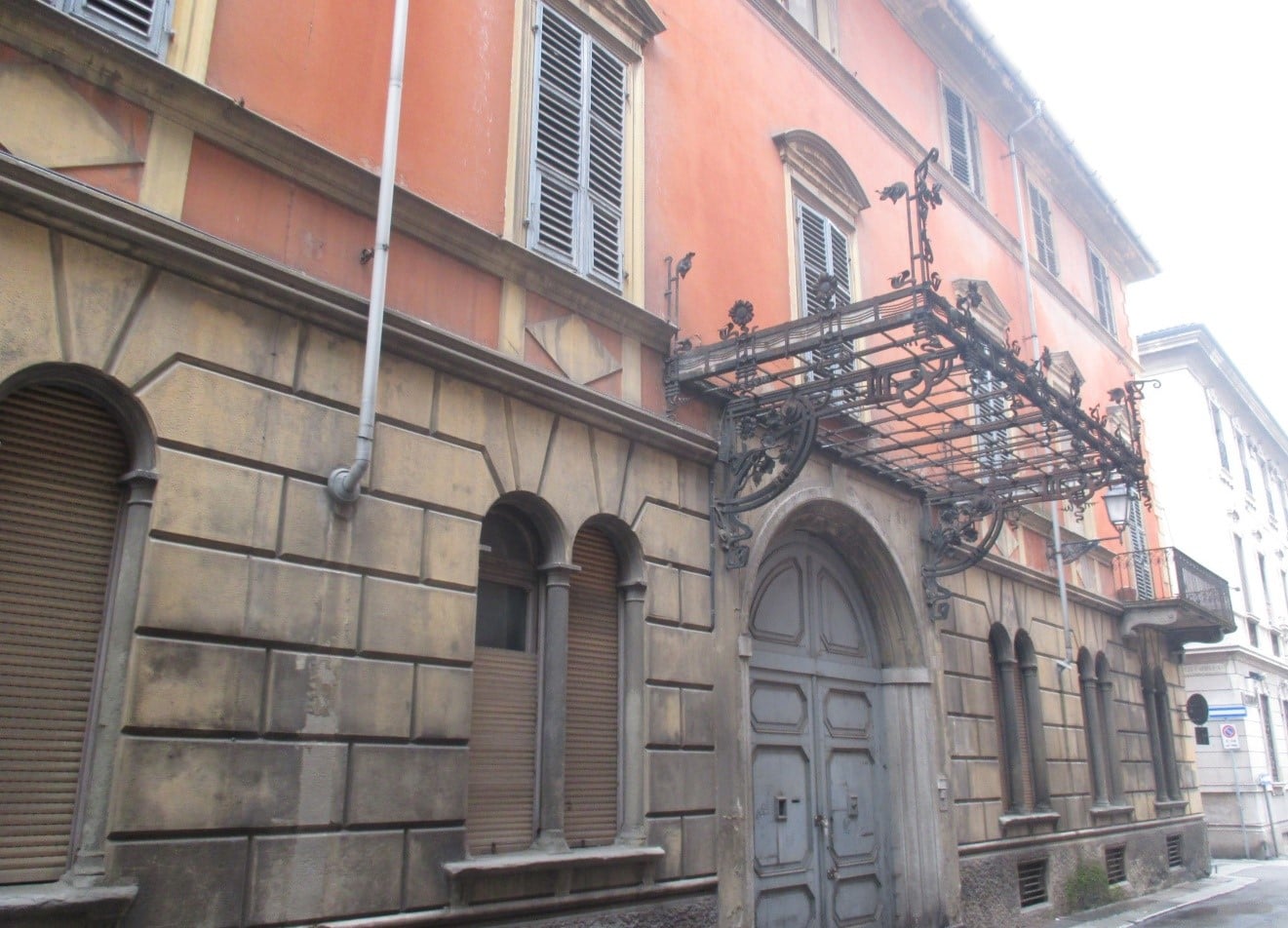
Its distinctive wrought-iron canopy, created by Angelo Conti in 1905, is among the property's most recognisable features.
Decorated with floral motifs, the canopy has lost its original polychrome glass covering.
Inside the building, surviving architectural elements include Art Nouveau decorations, a monumental staircase and rooms of considerable historic and artistic interest.
The property's reputation, however, is particularly associated with Giuseppe Verdi.
The composer regularly visited the hotel during his stays in Piacenza, reportedly using rooms on the first floor to work and meet colleagues and acquaintances.
Other notable guests included Vincenzo Gioberti and members of the House of Savoy.
The building ceased operating as a hotel around 1910.
During the twentieth century, it was subsequently adapted to accommodate public services, including healthcare offices and municipal police facilities.
The Italian Ministry of Culture records several heritage protection measures affecting the property, including those issued in 2008 and 2016.
These protections are central to any future redevelopment strategy.
They preserve the building's architectural significance while imposing technical, regulatory and financial constraints that must be incorporated into any credible investment appraisal.
3. Two Decades of Underutilisation: The Economic Cost of Stranded Real Estate Assets
The former Hotel San Marco illustrates a wider challenge affecting numerous heritage properties across Italy.
Such buildings may retain substantial architectural and cultural significance while failing to secure an economically viable long-term use.
In June 2009, the local healthcare authority launched a public auction involving its portions of the property, with a reserve price of €3.667 million.
The auction was unsuccessful.
Over the following years, various redevelopment proposals, cultural initiatives and potential disposal strategies were considered.
A study commissioned from architect Benito Dodi in 2011 explored alternative uses, including facilities associated with the Nicolini Conservatory.
None of these initiatives resulted in the property's comprehensive restoration.
In 2020, structural deterioration and safety concerns prompted emergency stabilisation works.
Further interventions involving part of the roof began in April 2021.
In October 2022, a valuation prepared by the Italian Revenue Agency was reported at approximately €1.4 million, while the municipality's ownership interest was described as 24%.
A simple comparison between the 2009 auction reserve and the 2022 valuation produces a difference of approximately 62%.
However, this figure should not automatically be interpreted as a 62% decline in the property's market value.
The two figures may reflect different ownership interests, cadastral boundaries, physical conditions and valuation assumptions.
A reliable comparison would require access to the original valuation reports.
The more significant issue is the economic impact of prolonged underutilisation.
An idle property does not merely forgo potential operating income.
It can also generate ongoing preservation costs, extraordinary maintenance liabilities, structural risks and progressive physical deterioration.
Over time, these factors may increase the capital expenditure required to return the asset to productive use.
The cost of inactivity is therefore not limited to lost revenue. It also includes the risk that the capital required to reactivate the property will continue to increase.
This is a critical consideration in professional real estate asset management.
4. The Redevelopment Proposal: 23 Guest Rooms, a Verdi Museum and Cultural Facilities
On 10 December 2025, a feasibility study prepared by engineer Paolo Milani was presented at the request of the municipal administration, with support from the Fondazione di Piacenza e Vigevano.
The proposal envisages restoring the building's original hospitality function while integrating cultural and public-facing uses.
The proposed development includes:
-
11 suites of approximately 38 sq m, each designed to accommodate up to four guests.
-
11 superior rooms of approximately 26 sq m, also configured for up to four guests.
-
One standard double room.
-
A museum dedicated to Giuseppe Verdi.
-
A multifunctional venue accommodating approximately 90 people for concerts and conferences.
-
A café or tea room within the historic Sala degli Stucchi.
The detailed accommodation programme therefore comprises 23 guest rooms with a theoretical capacity of 90 beds.
Some public communications have referred to 22 or 23 rooms. The final room count will need to be confirmed during subsequent design stages.
The architectural approach prioritises conservation of the building's monumental character and seeks to avoid alterations incompatible with its historic identity.
This is understandable from a heritage preservation perspective.
From an investment standpoint, however, feasibility will depend on the relationship between available space, the number of revenue-generating rooms, redevelopment expenditure and achievable operating performance.
A 23-room property operates under very different economies of scale from an 80- or 100-room hotel.
Its relatively limited accommodation capacity makes the financial structure of the redevelopment particularly important.
5. Redevelopment Costs: Approximately €320,000 per Room — But What Does That Really Mean?
The feasibility study presented in December 2025 estimates the total investment at €7,355,662.98, relating to a redevelopment programme covering approximately 1,800 sq m.
This corresponds to roughly €4,086 per square metre of the stated intervention area.
Dividing the total investment by the proposed 23 rooms produces an indicative figure of approximately €319,800 per room.
| Investment metric | Value |
|---|---|
| Estimated total investment | €7,355,663 |
| Stated redevelopment area | Approx. 1,800 sq m |
| Proposed guest rooms | 23 |
| Theoretical bed capacity | 90 |
| Total investment per room | €319,811 |
| Investment per sq m of intervention area | €4,086 |
| Investment per theoretical bed | €81,730 |
Source: Investimenti Alberghieri calculations based on publicly available information published by the Fondazione di Piacenza e Vigevano. These ratios relate to the overall redevelopment and should not be interpreted as costs attributable exclusively to the hotel component.
The investment-per-room figure requires particular caution.
The proposed development includes cultural and public-use facilities that should not automatically be treated as part of the hotel investment.
A professionally structured financial appraisal would distinguish three categories.
Hospitality capital expenditure: guest rooms, guest services, mechanical and electrical systems, furniture, fixtures, equipment and areas directly supporting hotel operations.
Cultural capital expenditure: museum facilities, exhibition spaces, the multifunctional venue and associated installations.
Shared heritage and structural expenditure: structural consolidation, façades, roofing, shared infrastructure and conservation works.
Without this allocation, it is impossible to establish how much capital must actually be remunerated by hotel-generated income.
Furthermore, historic properties carry specific development risks.
The investment appraisal should therefore assess potential construction contingencies, unforeseen restoration requirements, programme delays and additional regulatory approvals.
The estimated redevelopment budget should be treated as the starting point for financial due diligence, rather than an automatically guaranteed final project cost.
6. Piacenza's Tourism Market: Demand Is Growing, but Is There Room for an Upscale Heritage Hotel?
A credible hotel investment analysis must examine more than the physical asset.
It must also assess the market in which the proposed hotel would operate.
Final tourism statistics published by the Emilia-Romagna regional authorities for 2025 provide an initial indication of market activity.
| Tourism indicator, 2025 | City of Piacenza | Province of Piacenza |
|---|---|---|
| Tourist arrivals | 152,363 | 292,902 |
| Overnight stays | 331,400 | 638,027 |
| Year-on-year change in arrivals | +3.65% | +6.40% |
| Year-on-year change in overnight stays | +3.68% | +6.98% |
Source: Regione Emilia-Romagna, final 2025 tourism statistics, covering hotel and non-hotel accommodation.
These figures indicate positive growth in tourism demand.
They do not, however, establish that the local market can support a new upscale hotel at the rates required to justify a major heritage redevelopment.
Growth in overall visitor numbers must be distinguished from demand for a specific hospitality product.
For the former Hotel San Marco, a feasibility assessment should examine at least four potential demand segments.
Corporate travel: demand associated with Piacenza's industrial, commercial and professional sectors.
Cultural tourism: visitors attracted by Giuseppe Verdi, the city's heritage and the broader regional cultural offering.
Independent leisure travel: guests seeking distinctive, character-led accommodation rather than standardised hotel products.
Events and small groups: potential demand generated by meetings, private events and cultural activities, subject to the operational capacity of the property.
A full assessment would also require a properly defined competitive set.
Key indicators should include average daily rate (ADR), occupancy, revenue per available room (RevPAR), seasonality, demand segmentation, distribution channels, online reputation and the competitive positioning of comparable hotels.
Without verified market evidence, it would be inappropriate to present any particular ADR assumption as an established market benchmark.
This distinction is essential.
An attractive concept is not the same as demonstrated market demand.
7. How Much Revenue Could a 23-Room Hotel Generate? Three Financial Scenarios
To assess the relationship between the proposed hotel's operating capacity and the overall capital requirement, a scenario-based sensitivity analysis can be developed.
The purpose is not to forecast actual revenue.
It is to illustrate how financial performance changes under different assumptions for occupancy and average room rates.
The following assumptions are purely illustrative:
-
23 available rooms operating 365 days per year.
-
Occupancy ranging from 60% to 75%.
-
ADR ranging from €140 to €220.
-
Ancillary hotel revenue equivalent to 15% of rooms revenue.
-
Gross operating profit (GOP) equal to 30% of total hotel revenue.
-
An FF&E replacement reserve equal to 4% of total hotel revenue.
No independent revenue contribution is assumed for the museum or cultural facilities.
No public operating subsidies are included.
| Financial indicator | Conservative | Base case | Upside |
|---|---|---|---|
| Occupancy | 60% | 70% | 75% |
| ADR | €140 | €180 | €220 |
| RevPAR | €84 | €126 | €165 |
| Annual rooms revenue | €705,180 | €1,057,770 | €1,385,175 |
| Total hotel revenue | €810,957 | €1,216,436 | €1,592,951 |
| Illustrative GOP (30%) | €243,287 | €364,931 | €477,885 |
| FF&E reserve (4%) | €32,438 | €48,657 | €63,718 |
| Simplified operating cash flow | €210,849 | €316,273 | €414,167 |
Illustrative financial modelling by Investimenti Alberghieri. Simplified operating cash flow is calculated by deducting the assumed FF&E reserve from illustrative GOP. It does not represent net investment cash flow and excludes rent, taxation, debt service, additional capital expenditure and costs not already reflected in GOP.
The Challenge of Operating Scale
Under the base-case assumptions of 70% occupancy and an ADR of €180, the hotel would generate approximately €1.22 million in annual revenue.
The corresponding simplified operating cash flow would be approximately €316,000.
Even in the upside scenario, with 75% occupancy and an ADR of €220, the simplified annual operating cash flow would reach only around €414,000.
These figures do not prove that the redevelopment is financially unviable.
They do, however, highlight a structural challenge.
The earnings capacity of a 23-room hotel may be insufficient to support the full capital cost of a €7.36 million redevelopment.
The feasibility of the project will therefore depend heavily on which costs are allocated to the hospitality operation and which stakeholders ultimately finance them.
8. The Financial Stress Test: How Much Investment Could the Hotel Operation Support?
To examine this issue more closely, it is useful to move beyond headline revenue and consider the present value of the hotel's potential operating cash flows.
For illustrative purposes, assume:
-
A 25-year operating period.
-
A hypothetical annual discount rate of 7%.
-
Constant annual nominal operating cash flows.
-
No residual value attributable to the operator at the end of the period.
-
No rent, taxation, debt financing or capital expenditure beyond the FF&E reserve already deducted.
The 7% rate is not presented as a verified market yield or the project's actual cost of capital.
It is simply a modelling assumption selected to test the sensitivity of the investment proposition.
| Financial indicator | Conservative | Base case | Upside |
|---|---|---|---|
| Simplified annual operating cash flow | €210,849 | €316,273 | €414,167 |
| Present value of 25 years of cash flow at 7% | €2.46m | €3.69m | €4.83m |
| Estimated total redevelopment investment | €7.36m | €7.36m | €7.36m |
| Difference between present value and total investment | -€4.90m | -€3.67m | -€2.53m |
Simplified present-value analysis. These differences do not constitute a market valuation, certified net present value or calculation of the public funding required. The total investment includes cultural facilities and shared heritage restoration expenditure.
The Most Significant Finding
Under the base-case scenario, the present value of 25 years of simplified operating cash flows would be approximately €3.69 million.
The total estimated redevelopment cost, however, is approximately €7.36 million.
The resulting difference of approximately €3.67 million illustrates the theoretical gap between the overall project budget and the operating income that could be supported under the selected assumptions.
It does not mean that the municipality must necessarily provide €3.67 million.
Nor does it establish the project's actual funding gap.
The result is entirely dependent on the assumptions adopted and the allocation of redevelopment costs.
What it does demonstrate is the importance of distinguishing between capital expenditure supporting public cultural objectives and capital expenditure that can realistically be serviced by commercial hotel operations.
Furthermore, because the model excludes several potential costs and obligations borne by the operator, the calculated present value should not be interpreted as the amount a private investor would necessarily be willing to commit.
A bankable investment appraisal would require a comprehensive discounted cash flow model incorporating capital structure, financing costs, taxation, working capital, future refurbishment requirements, terminal assumptions and internal rate of return (IRR).
The purpose of this initial financial stress test is to identify potential structural weaknesses before substantial capital commitments are made.
9. Three Potential Redevelopment and Operating Models
Once the limitations of relying solely on hotel-generated cash flows are recognised, the choice of investment structure becomes central.
Three broad alternatives deserve consideration.
Model A — Publicly Funded Restoration with Private Hotel Operations
Under this approach, the public owner finances the restoration through municipal resources, institutional contributions or other eligible funding programmes.
Hotel operations are subsequently entrusted to a qualified operator through the appropriate selection process.
The principal advantage is the separation of heritage preservation obligations from commercial hotel management.
The main challenge is determining whether public expenditure can be justified by the combined economic, cultural and social benefits generated by the project.
This model would also require careful consideration of ongoing maintenance obligations and potential operating deficits.
Model B — A Public-Private Investment Structure
Under a mixed structure, conservation works and public cultural facilities would be financed primarily through public or institutional resources.
Private capital would be directed towards the hospitality-specific elements of the project.
A hotel operator could then manage the accommodation business under a long-term contractual arrangement.
This could create a more balanced relationship between privately invested capital and the cash flows available to remunerate it.
However, the structure would require a detailed allocation of responsibilities.
Key matters would include contract duration, initial investment obligations, maintenance responsibilities, access to shared facilities, rent or concession payments and risk allocation.
Model C — Predominantly Private Redevelopment and Operation
A private investor would undertake a substantial proportion of the restoration expenditure in exchange for long-term commercial rights over the property.
Of the three models, this would appear to require the most demanding financial scrutiny.
The capital commitment would be significant relative to the hotel's limited room inventory, while heritage restrictions could further constrain operational flexibility.
Financial viability would depend on achieving a strong market positioning, disciplined cost management and potentially additional revenue streams compatible with the property's protected status.
Which Structure Deserves Priority?
Based on the information currently available, an integrated public-private redevelopment model appears particularly worthy of detailed examination.
That does not mean it should automatically be considered the preferred solution.
Its value would need to be demonstrated through a structured comparison of financial costs, risk allocation, cultural benefits, operational sustainability and alternative uses.
The underlying principle is straightforward:
Capital commitments should be aligned with the economic or public benefits that each stakeholder can reasonably expect to obtain.
10. The Museum's Value: Why Cultural Benefits Cannot Be Measured Solely Through Hotel Profitability
A particularly important feature of the proposed redevelopment is the inclusion of a Verdi museum and public cultural facilities.
A museum can generate benefits that extend well beyond its own income statement.
It can strengthen the city's cultural identity, support tourism, preserve architectural heritage and create opportunities for educational and artistic activities.
Such benefits may have significant public value even where they do not produce financial returns comparable to those expected from a commercial hospitality investment.
The project should therefore be assessed from two distinct perspectives.
Financial feasibility: can the hotel operation generate sufficient cash flow to support the capital allocated to the commercial business?
Economic and social value: do the cultural, tourism-related and wider public benefits justify the resources committed to preserving and reactivating the property?
Neither perspective can replace the other.
Financial viability alone cannot capture the full value of heritage preservation.
Conversely, cultural significance cannot be used as a substitute for a sound operating model.
Separating these dimensions may be essential to creating a redevelopment strategy that preserves the property's historical identity without placing economically unrealistic expectations on the hotel operation.
11. A Critical Mistake to Avoid: Selecting the Operator Before Defining the Economics
Another important risk concerns the sequence in which investment decisions are made.
In hotel redevelopment projects, selecting an operator should generally follow a clear definition of the proposed product, the service concept, capital requirements and contractual structure.
The involvement of an established hotel brand does not, by itself, guarantee financial sustainability.
For the former Hotel San Marco, a preliminary operating assessment should address:
-
The customer segments that can realistically be targeted.
-
Achievable room rates relative to the competitive market.
-
An operating model suited to a 23-room property.
-
The integration or separation of hospitality and cultural activities.
-
Staffing requirements and departmental operating costs.
-
Maintenance obligations arising from the building's historic status.
-
The maximum sustainable rent or concession payment.
-
The contract duration required to recover any private capital expenditure.
The property may lend itself to an independent heritage hospitality concept, a specialist operator or a management structure capable of preserving its identity while delivering professional operating standards.
This is consistent with the approach promoted by Hotel Management Group, which places particular emphasis on hotel governance, financial control and operational performance.
The subject is also explored in Roberto Necci's analysis, Tailored Hotel Consulting: The Efficiency of Major Hotel Chains Without Sacrificing Your Hotel's Identity.
The principle is especially relevant to the redevelopment of historic hotels.
Rather than forcing a heritage property into a standardised operating model, the objective should be to design a hospitality business that protects the asset's distinctive character while generating sustainable financial performance.
12. Investment Due Diligence: What Must Be Verified Before Capital Is Committed?
The proposed redevelopment presents several areas of risk that should be examined by investors, lenders and public-sector stakeholders before binding decisions are taken.
| Due diligence area | Key assessment |
|---|---|
| Ownership and legal title | Ownership interests, title documentation, cadastral boundaries and completion of the acquisition |
| Heritage restrictions | Required approvals, conservation obligations and redevelopment limitations |
| Technical condition | Structural integrity, building systems, roofing and potential construction contingencies |
| Hotel market | Demand, occupancy, ADR, RevPAR and competitive positioning |
| Financial feasibility | Revenue, operating costs, GOP, capital expenditure and cash flow |
| Funding structure | Capital sources, grants, private equity contributions and debt costs |
| Operating contracts | Duration, payments, obligations and allocation of risk |
| Public-sector sustainability | Cultural benefits, ongoing costs and alternative uses |
The absence of one or more of these assessments does not necessarily make the project unviable.
It does, however, limit the ability of stakeholders to make fully informed investment decisions.
The due diligence process should also include sensitivity analyses addressing construction cost overruns, delayed opening, weaker-than-expected occupancy and lower achieved room rates.
For a protected historic building, execution risk can be just as important as operating performance.
Asset valuation, feasibility assessments, financial scenario analysis and strategic support for hospitality investment decisions are among the areas addressed by Investhotel Capital Partners.
13. Roberto Necci's Assessment: Heritage Value Is Not the Same as Investment Value
The former Hotel San Marco illustrates a fundamental distinction between three different concepts of value: cultural value, real estate value and hospitality business value.
Cultural value arises from the property's history, architecture, identity and contribution to the community.
Real estate value reflects its physical characteristics, legal rights, condition, restrictions and permissible uses.
Hospitality business value depends on the ability of the operating enterprise to generate sustainable revenue, profit and cash flow.
These dimensions are interconnected, but they are not interchangeable.
A building may possess exceptional historical importance while requiring an investment that cannot be fully recovered through commercial operations alone.
The question is not whether the former Hotel San Marco deserves restoration.
The question is how to develop a financial, contractual and operating structure that allows the property to be restored without creating a commercially unsustainable business.
This distinction also applies to many other hospitality assets across Italy.
Historic palaces, former hotels, monumental villas and disused real estate complexes are frequently promoted as investment opportunities based on their location, architectural appeal, floor area or tourism potential.
Yet these characteristics do not automatically translate into investment performance.
A real estate opportunity becomes an investable proposition only when capital requirements, operating risks and projected cash flows are aligned.
This principle underpins the advisory approach developed by Roberto Necci, covering hotel valuations, financial feasibility, governance and hospitality asset enhancement.
The purpose of professional advisory work is not simply to identify what a property could become.
It is to establish what the property can realistically support from an economic and financial perspective.
14. What Would Make the San Marco Redevelopment Investable?
Moving from a preliminary redevelopment concept to a properly structured investment will require several essential steps.
First, the proposed consolidation of ownership must be completed and the legal and cadastral position of the property confirmed.
Second, the redevelopment design must be advanced, with particular attention to heritage approvals, technical feasibility and construction cost verification.
Third, the project budget must distinguish hospitality-specific expenditure from cultural facilities and shared conservation works.
Fourth, a detailed hotel business plan should be developed using verified competitive market data, revenue scenarios, operating cost assumptions and cash flow projections.
Fifth, the financial and contractual structure must be selected in a manner consistent with the property's public-interest objectives and the potential participation of private investors.
Finally, the project should incorporate performance monitoring covering both redevelopment delivery and long-term operational outcomes.
Completing the building works would represent an important milestone.
It would not, in itself, demonstrate the success of the investment.
True sustainability must be assessed across the property's entire operating life.
Conclusion: €7.36 Million May Restore the Building. A Sound Business Model Will Be Needed to Secure Its Future.
The former Hotel San Marco is a valuable part of Piacenza's architectural and cultural heritage.
The municipality's proposal to consolidate ownership represents an important step towards resolving a fragmented ownership structure that has complicated previous attempts at redevelopment.
Nevertheless, the central investment questions remain unanswered.
How will the restoration be financed?
Which costs should be borne by public stakeholders, and which can reasonably be allocated to commercial operations?
What contractual structure would allow a hotel operator to manage the property sustainably?
And can a 23-room hotel generate sufficient cash flow to support the capital invested in its hospitality component?
The illustrative financial scenarios suggest that the hotel's operating income may struggle to remunerate the full redevelopment budget, even under comparatively strong occupancy and rate assumptions.
This is not a definitive finding of financial infeasibility.
It is a clear indication that the costs, funding sources and economic objectives of the different project components must be assessed separately.
A viable solution may emerge through a carefully structured combination of public funding, private capital, cultural objectives and commercial hospitality operations.
But that structure must be supported by rigorous financial analysis rather than assumed at the outset.
The greatest risk is not necessarily spending too much to preserve an important historic building. It is committing capital without first establishing who will bear the costs and how the property's future operations will be sustained.
The former Hotel San Marco has the potential to become a distinctive destination combining hospitality, culture and local identity.
Realising that potential will require more than architectural vision.
It will require an equally credible economic and financial strategy.
Restoration preserves the past. Investment discipline creates the conditions for that heritage to have a sustainable future.
Hotel Investment Advisory, Feasibility Studies and Asset Enhancement
Do you own a hotel requiring redevelopment, a historic property with hospitality potential, or an accommodation asset whose underlying investment value needs to be assessed?
Roberto Necci provides strategic hospitality advisory services designed to support property owners, investors, hotel companies and operators in evaluating and structuring investment decisions.
Areas of expertise include:
-
Hotel feasibility studies and financial assessments.
-
Hospitality business and real estate valuations.
-
Profitability and cash flow analysis.
-
Hotel business plans and asset enhancement strategies.
-
Capital expenditure assessment and investment sustainability.
-
Hotel lease and management agreement analysis.
-
Corporate governance, management control and operational performance improvement.
-
Strategic advisory for hotel conversions, repositioning and redevelopment projects.
Each assignment is designed to support informed decisions based on the asset's characteristics, ownership objectives and prevailing market conditions.
For a confidential consultation or preliminary investment assessment:
info@investimentialberghieri.it
Investimenti Alberghieri | Roberto Necci | Investhotel Capital Partners | Hotel Management Group
Sources and Methodology
This independent analysis draws on publicly available information as of 18 November 2026.
Principal documentary sources
-
Fondazione di Piacenza e Vigevano – Feasibility Study, 10 December 2025
-
PiacenzaSera – Proposed Acquisition of Full Ownership, 17 November 2026
-
Regione Emilia-Romagna – Final 2025 Tourism Statistics, Province of Piacenza
-
Libertà – Municipal Asset Disposal Programme and 2022 Valuation
Methodological disclaimer
Historical, administrative, development and tourism data have been distinguished from the author's independent financial calculations and assumptions.
The illustrative scenarios do not constitute a certified valuation, professional appraisal, commercial forecast or definitive investment feasibility study.
This article does not imply that any professional advisory mandate has been awarded by the municipality, the local healthcare authority or any other stakeholder involved in the project.