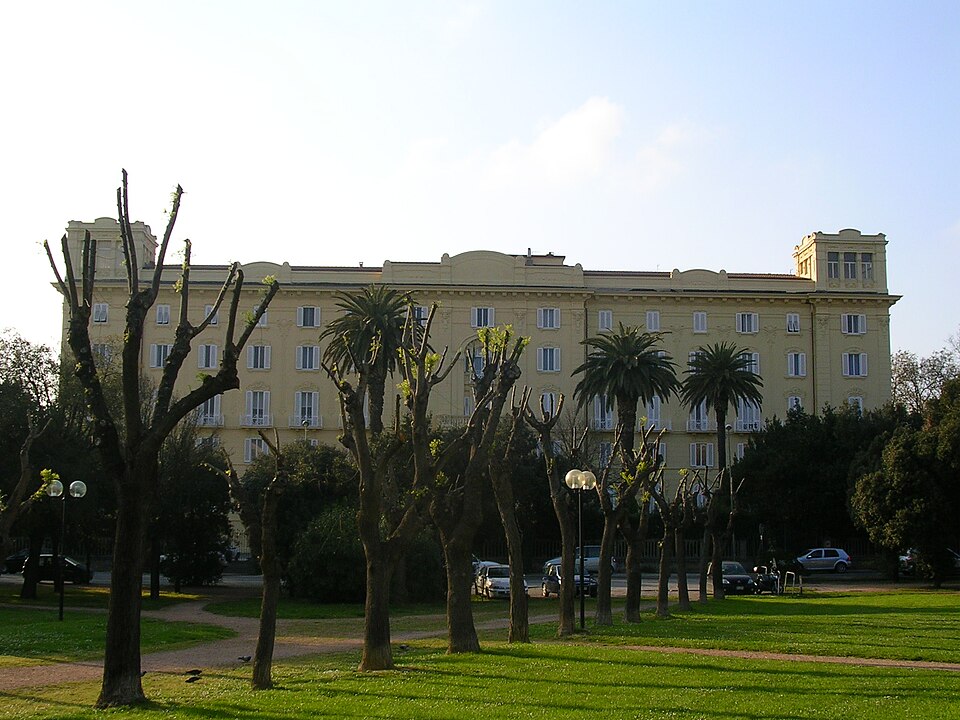
The historic Terminus Grand Hotel Corallo has entered a competitive sale process with a reserve price of €6.82 million. Approximately 10,000 sqm of built area, a 6,400 sqm park, 92 parking spaces and heritage protection. Yet the property is currently classified for tertiary and office use: for an investor, the real issue is not the acquisition price, but the economic and planning feasibility of its future repositioning.
€6.82 million for approximately 10,000 sqm of gross built area.
At first glance, the former Grand Hotel Corallo in Livorno immediately attracts attention.
But this is precisely where an investor's analysis should begin — not end.
Acquiring a large historic building does not automatically mean acquiring a viable hotel project.
And buying at a nominal value of approximately €682 per gross square metre does not necessarily mean buying cheaply.
The ultimate value of the asset will depend on what can actually be developed within the property, the constraints affecting it, the capital required to restore and reposition it and, above all, the ability of the future use to generate sufficient returns on the total amount of capital invested.
This is the fundamental difference between price and investment value.
And it is precisely this gap that makes cases such as the former Grand Hotel Corallo particularly relevant for InvestimentiAlberghieri.it.
The Asset: 10,000 sqm Embedded in Livorno's Hospitality History
The property is located between Piazza Dante 19-20 and Via Ugo Foscolo 2-2a-8, close to Livorno's main railway station.
The sale documentation describes it as:
“a real estate complex for tertiary and office use, formerly known as Terminus Grand Hotel Corallo.”
That wording is critical.
The building was originally developed as a hotel, but it is not currently an operating hotel.
Designed by engineer Angiolo Badaloni in the early twentieth century, the property was originally built in connection with the Acque della Salute spa complex, known today as the historic Terme del Corallo.
Over the course of the twentieth century, however, the property's use changed and its interiors were substantially altered, particularly following its conversion into an office complex.
According to the information published by the sale administrator, the property currently comprises:
-
approximately 10,000 sqm of gross covered area;
-
six floors above ground plus a basement;
-
55 office units;
-
two commercial units;
-
19 storage rooms and cellars;
-
approximately 6,400 sqm of parkland;
-
92 outdoor parking spaces;
-
four garages;
-
three lifts.
The property is also subject to historic and artistic heritage protection.
These figures alone explain why the Corallo should be assessed as a genuine real estate transformation opportunity, rather than a straightforward property acquisition.
The Sale Process: €6.82 Million and First Competitive Round on 23 October
The asset forms part of Judicial Liquidation Procedure No. 832/2025 before the Court of Rome.
The current sale terms provide for:
-
reserve price: €6,820,000;
-
minimum bid: €6,820,000;
-
minimum bid increment: €10,000;
-
deadline for submitting offers: 22 October 2026 at 12:00 noon;
-
opening of the competitive process: 23 October 2026 at 4:00 p.m.;
-
security deposit equal to 10% of the offer.
The sale is being managed by Gobid International Auction Group.
Local press reports have also referred to information requests from investment funds and banking groups.
These should be treated as expressions of market interest reported by the press, not as evidence of formal bids or an active competitive process between identified investors.
They are nevertheless useful as an indication that the asset is attracting attention.
€682 per Square Metre: An Interesting Number, but Potentially Misleading
Dividing the €6.82 million reserve price by approximately 10,000 sqm of gross covered area produces a purely arithmetical figure of approximately:
€682/sqm
It is an eye-catching number.
A professional investor, however, should almost immediately stop using it as the primary reference point.
There are at least four reasons.
First, the figure relates to gross built area, not necessarily to net revenue-generating space.
Second, the heritage protection affecting the property may materially influence both design flexibility and construction costs.
Third, the building has been unused for years and therefore requires a comprehensive technical assessment.
Fourth — and most importantly — value will depend on the future use that can actually be authorised.
A property acquired at €682/sqm that subsequently requires €2,000, €3,000 or more per square metre of development expenditure can produce an entirely different investment outcome from the one implied by the initial acquisition metric.
The relevant equation is therefore not:
Acquisition Price / sqm
but:
Acquisition Price + CAPEX + Soft Costs + Financing Costs + Contingency + Time Cost = Total Investment Cost
Returns must be calculated against the Total Investment Cost, not against the acquisition price alone.
Grand Hotel Corallo Is Not Currently a Hotel — and That Changes the Underwriting
The building's hotel history naturally creates a compelling idea:
restore it to its original hospitality use.
But an investment case cannot be built on sentiment.
It must be built on feasibility.
A hotel conversion would first require verification of:
-
planning compatibility;
-
current permitted use;
-
feasibility of a change or reinstatement of use;
-
heritage-related restrictions;
-
dimensional standards;
-
emergency exits and circulation;
-
fire safety;
-
accessibility;
-
building services;
-
vertical circulation;
-
room sizing;
-
common areas;
-
F&B facilities;
-
back-of-house requirements;
-
loading and logistics;
-
ratio between revenue-generating and non-revenue-generating space.
Only after these issues have been assessed would it be reasonable to begin discussing a hotel project.
This is a core principle in the investment analysis developed by Investhotel.it:
The bankability of a conversion does not depend on the appeal of the building. It depends on the ability of the completed project to generate sufficient cash flow relative to the total capital invested.
Scenario 1 — Return to Hospitality
This is probably the most compelling scenario from a storytelling perspective.
Reinstating the Corallo as a hotel would allow for a powerful investment narrative:
historic building + heritage + Livorno + hospitality + urban regeneration.
But the story must ultimately be supported by numbers.
A hotel developed across approximately 10,000 sqm could take very different forms depending on the concept, average space per key and the amount of space allocated to common areas.
The correct question should therefore not be:
“How many rooms can we fit?”
It should be:
“What combination of keys, ADR, occupancy and ancillary services produces the best return on capital?”
An upscale or luxury hotel would require more space per key, larger common areas and higher CAPEX.
An upper-midscale product might accommodate more keys, but would require extremely disciplined space planning.
A lifestyle concept could place greater emphasis on F&B, events and outdoor areas.
Each scenario would produce a different:
-
room count;
-
ADR;
-
RevPAR;
-
total revenue;
-
GOP;
-
EBITDA;
-
CAPEX per key;
-
stabilised enterprise value.
Before discussing a hotel conversion seriously, the asset requires a full hotel feasibility study.
Scenario 2 — Retaining or Rebuilding the Office Use
The second option may be less emotionally compelling, but not necessarily less profitable.
The property is currently configured and classified as a tertiary and office complex.
An investor could therefore assess whether a strategy consistent with that use offers the strongest risk-adjusted return.
The key variables would include:
-
local office demand;
-
average unit size;
-
quality of the space;
-
achievable rents;
-
vacancy;
-
refurbishment costs;
-
subdivision potential;
-
exit value.
A historic asset does not necessarily have to return to its original use in order to create value.
The correct use is the one that generates the best balance between:
risk + capital + time + return.
Scenario 3 — Mixed-Use
Subject to planning and regulatory feasibility, this is arguably the scenario that deserves the most preliminary attention.
A complex of this scale provides a degree of optionality that a conventional standalone hotel does not.
Depending on what is permitted, a future scheme could potentially combine:
-
hospitality;
-
serviced apartments;
-
offices;
-
F&B;
-
events;
-
wellness;
-
retail;
-
other compatible uses.
This does not mean that any of these uses are currently authorised.
It means that an investor should test whether a multi-use strategy could generate greater value than a single-use development.
This is the essence of highest and best use analysis.
And for a 10,000 sqm asset, it should be the investor's first strategic question.
Not:
“How much does it cost?”
But:
“What is the most economically productive legally permissible use of this real estate?”
The Park and Parking Areas Are Strategic Components of Value
The property includes approximately 6,400 sqm of landscaped area and 92 outdoor parking spaces, in addition to four garages.
For a large hospitality project, these elements can materially influence the investment case.
Parking can significantly improve the usability of an urban hotel.
Outdoor areas, subject to regulatory constraints, can potentially support:
-
F&B;
-
events;
-
outdoor hospitality;
-
leisure areas;
-
wellness;
-
corporate functions.
In other words, value is not contained only within the approximately 10,000 sqm of covered space.
It lies in the interaction between the building, its external areas, accessibility and future use.
Heritage Protection Can Be a Cost — or a Competitive Advantage
A common analytical mistake is to treat heritage protection automatically as a negative.
It is not necessarily so.
Heritage restrictions may increase:
-
design lead times;
-
approval complexity;
-
construction costs;
-
constraints on internal layouts.
But at the same time they can create something that a new-build property cannot buy:
uniqueness.
In international luxury hospitality, historic buildings can become a fundamental component of brand positioning.
The correct question is therefore not:
“Does the heritage restriction reduce value?”
It is:
“Is the premium achievable by the final product sufficient to compensate for the higher CAPEX and greater execution complexity?”
If the answer is yes, the heritage element can become part of the value proposition.
If the answer is no, it becomes a structural cost.
That is a financial assessment, not an aesthetic one.
The Real Risk: Buying Well and Developing Poorly
A complex asset can be acquired at an apparently attractive price and still become a mediocre investment.
Assume, purely as a methodological example and not as a valuation of the Corallo, that a property is acquired for €6.82 million.
The final investment cost will not be €6.82 million.
It will also include:
Acquisition Cost
-
taxes and transaction costs
-
design fees
-
construction works
-
building services
-
furniture, fixtures & equipment
-
OS&E
-
remediation costs, if any
-
professional fees
-
contingency
-
financing costs
-
pre-opening expenses
-
working capital
-
cost of time
Only then does the real denominator of the investment become visible.
This is why InvestimentiAlberghieri.it treats the acquisition price as only one variable within the wider investment case, rather than as a measure of opportunity.
If It Returns to Hospitality, Who Should Operate It?
Even if a hotel conversion proved technically and legally feasible, a second strategic question would remain:
Who should operate the property?
The principal alternatives would include:
Independent Hotel
Greater control over product and positioning, but the need to build distribution, reputation and demand independently.
Franchise
International brand and distribution support while retaining a greater degree of operational autonomy.
Management Agreement
Professional hotel operator remunerated through a base fee and incentive fee structure.
Lease
A larger share of operating risk transferred to the tenant, provided the rent remains economically sustainable.
The operating structure directly affects real estate value.
This is the area in which HotelManagementGroup.it focuses on the relationship between ownership, operators and hotel performance.
Because the same hotel can have materially different values depending on who operates it and under what contractual structure.
Livorno: The Market Must Justify the Project
The building's history cannot substitute for demand analysis.
Any future hospitality project would need to begin with a detailed assessment of:
-
corporate demand;
-
leisure demand;
-
port and cruise traffic;
-
ferry traffic;
-
events;
-
business travel;
-
cultural tourism;
-
seasonality;
-
direct competitors;
-
achievable ADR;
-
stabilised occupancy.
Only then would it be possible to determine the correct positioning.
The investment process should follow:
Market Analysis → Concept → Room Mix → ADR → Occupancy → RevPAR → Total Revenue → GOP → EBITDA → CAPEX → Return on Cost → Value
That is underwriting.
Everything else is real estate storytelling.
A Potential Urban Regeneration Case, Not Merely a Property Transaction
The Corallo has another characteristic that is difficult to replicate.
It forms part of Livorno's urban memory.
Originally developed as a grand hotel linked to the Terme del Corallo and inaugurated in the early twentieth century, it remains one of the city's most recognisable Liberty-era buildings.
The neighbouring thermal complex is now publicly owned, while the former hotel follows a separate ownership and redevelopment trajectory.
A future redevelopment could therefore have implications beyond the boundaries of the private property itself.
This does not imply the existence of any coordinated redevelopment plan that has not been announced.
It simply recognises that the long-term value of the property may also depend on the quality of the wider urban regeneration of the surrounding area.
On Robertonecci.it, transactions of this kind are analysed precisely at the intersection of tourism, cities, real estate capital and territorial transformation.
The Due Diligence Required Before Bidding
For an investor considering the asset, the process should begin with due diligence across at least seven areas.
1. Legal
Title, encumbrances, judicial procedure, easements, restrictions and the precise perimeter of the assets being transferred.
2. Planning
Current permitted use, alternative uses, feasibility of change of use and applicable planning requirements.
3. Heritage
Nature and extent of heritage protection and the approval process required for any intervention.
4. Technical
Structure, roofs, façades, MEP systems, lifts, fire safety, structural vulnerability and general condition.
5. CAPEX
Full investment budget with an appropriate contingency allowance for a historic building.
6. Market
Demand analysis for each potential use.
7. Financial
Business plan, equity/debt structure, DSCR, IRR, exit value and sensitivity analysis.
Only once these seven areas have been assessed can an investor determine a rational Maximum Bid Price.
Planning Irregularities: A Factor to Understand, Not Sensationalise
The sale documentation refers to certain internal discrepancies compared with the authorised condition of the property, including changes to internal layouts and partition walls.
The same documentation states that no demolition order is currently recorded and provides an estimated amount of approximately €20,000 for building and cadastral regularisation, already reflected in the valuation.
This information should be interpreted carefully.
The administrative cost of regularisation is not the same as the cost of the future redevelopment.
A professional investor would still need to carry out a complete building and planning due diligence before making any investment decision.
Price Is Not Value
The Corallo perfectly illustrates one of the most important principles in hospitality real estate.
The price is known. The value still has to be created.
€6.82 million represents the entry point of the current procedure.
It does not tell us:
-
how much it will cost to restore the building;
-
which use will generate the highest return;
-
how much space can actually generate revenue;
-
how long the redevelopment will take;
-
what ADR a hotel could achieve;
-
what rent an office scheme could support;
-
what leverage lenders would provide;
-
what return equity investors would require;
-
what the stabilised value will ultimately be.
Those are the variables that determine whether the opportunity is attractive.
Conclusion: The Corallo Is Not Simply a Hotel to Buy. It Is a Capital Allocation Problem to Solve.
That is precisely what makes the former Grand Hotel Corallo such an interesting case.
It does not offer an obvious answer.
It offers optionality.
A historic building.
Approximately 10,000 sqm.
6,400 sqm of parkland.
92 parking spaces.
A strategically located urban asset.
A reserve price of €6.82 million.
But also:
heritage constraints, CAPEX requirements, development time, permitted uses to be verified and significant execution complexity.
The real question is therefore not:
“Is it worth buying the former Grand Hotel Corallo for €6.82 million?”
It is:
“Which project can generate the highest sustainable value from this asset relative to the total capital invested?”
Hotel?
Office?
Mixed-use?
Another compatible use?
The answer must come from the numbers.
And that is precisely why analysis must come before investment.
InvestimentiAlberghieri.it | Advisory
InvestimentiAlberghieri.it analyses hotel and hospitality real estate opportunities for investors, property owners, operators, banks and family offices.
Our advisory work may include:
-
hotel investment screening;
-
feasibility analysis;
-
highest and best use studies;
-
business planning;
-
CAPEX analysis;
-
lease vs management assessment;
-
financial modelling;
-
debt sustainability;
-
DSCR and leverage analysis;
-
repositioning strategies;
-
stabilised value analysis;
-
acquisition and value-creation scenarios.
We do not start with the price and build a case to justify the investment.
We start with the numbers to determine what price the investment can actually support.
📩 info@investimentialberghieri.it
Ecosystem:
InvestimentiAlberghieri.it — Hospitality Real Estate & Investment Advisory
Investhotel.it — Hotel Finance, Debt & Investment Strategy
HotelManagementGroup.it — Hotel Operations, Management & Performance
Robertonecci.it — Hospitality Industry, Strategy & Market Analysis
Editorial and Legal Disclaimer
Information concerning the sale process, property characteristics, reserve price, timetable and asset configuration is based on publicly available sale documentation and journalistic sources reviewed as of 12 October 2026.
The property is described in the sale documentation as a tertiary and office complex formerly known as Terminus Grand Hotel Corallo.
Any reference to a potential hotel conversion, mixed-use redevelopment or alternative value-creation strategy represents analytical scenarios only and should not be interpreted as evidence that any such use is currently authorised or has been selected by the ownership, the insolvency procedure or any prospective investor.
Any expressions of interest reported by the press do not constitute formal bids and should not be interpreted as evidence of ongoing negotiations.
Any investment decision would require review of the complete transaction documentation and independent legal, planning, technical, tax, financial and commercial due diligence.