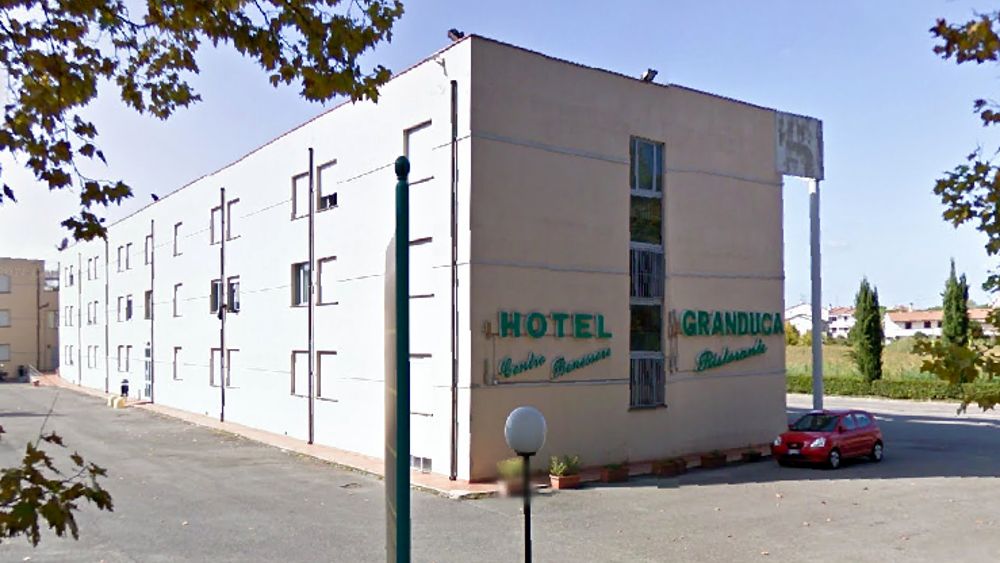
On 29 September 2026, a portion of the former Hotel Granduca in San Giuliano Terme will return to auction as part of Judicial Liquidation No. 28/2025 concerning Lucchese 1905 S.r.l. The lot includes 32 rooms providing 64 beds, restaurant areas, lobby, kitchen, lift and an exclusive external area of approximately 2,110 sqm used predominantly for parking. The price has fallen to €260,000 after three previous sale attempts in 2026 failed to attract a buyer: €780,000 on 19 February, €585,000 on 20 April and €438,750 on 18 June. At first glance, the new level equates to just €8,125 per room and approximately €134 per sqm of gross above-ground floor area. But that apparent cheapness contains the transaction’s greatest risk: the auction is not offering a functioning hotel. It is offering a hospitality brownfield asset that has been inactive for years, with a long history of operational discontinuity, deterioration and redevelopment plans that were never completed. The real investment is therefore not €260,000. It is the capital required to transform those walls back into a hospitality product capable of generating GOP — and, above all, to determine whether the stabilised value after CAPEX, financing costs and ramp-up will be sufficiently above Total Project Cost to compensate for development risk.
In the hotel investment market, there is a fundamental difference between:
Cheap Real Estate
and
Profitable Hospitality Investment.
The former Hotel Granduca illustrates that distinction perfectly.
Because:
Low Auction Price ≠ Low All-in Investment.
And, above all:
Repeated Failed Auctions ≠ Automatic Bargain.
First Distinction: This Is a Judicial Liquidation, but Not of a Hotel Company
The proceeding is:
Judicial Liquidation No. 28/2025
before the:
Court of Lucca.
The company subject to the proceeding is:
Lucchese 1905 S.r.l.
The judicial liquidation was opened in May 2025.
This is particularly important.
We are not dealing with the liquidation of:
a hotel operator.
We are dealing with a:
Hospitality Real Estate Asset
held within the estate of a company whose core business was entirely different.
Therefore:
Distressed Owner ≠ Distressed Hotel Business.
There is not necessarily an existing hotel EBITDA to preserve.
There is a hospitality property that needs to be:
re-underwritten.
The Asset Is Only a Portion of the Former Granduca Complex
The sale notice does not generically offer:
“Hotel Granduca.”
It offers:
full ownership of the western portion of the real estate complex designated for tourism and hotel use
together with an ownership share in a technical room used as an electrical substation.
This is a fundamental due-diligence point.
Historic Hotel Name ≠ Exact Sale Perimeter.
Before assigning value to the old Granduca, an investor needs to understand:
what exactly is included in the lot;
what may belong to other portions;
which services were historically shared;
which building systems are autonomous;
which accesses are exclusive;
how the shared electrical substation operates.
Price must be applied to the:
Legal Perimeter.
Not to the commercial memory of the historic hotel.
Three Failed Auctions Before 29 September
This is one of the transaction’s defining features.
The sales history shows:
19 February 2026 — €780,000 — no award
20 April 2026 — €585,000 — no award
18 June 2026 — €438,750 — no award
29 September 2026 — €260,000 — new sale attempt.
The market has therefore already had three separate opportunities to acquire the asset.
And it did not.
That should not automatically discourage an investor.
But it does need to be:
underwritten.
The Price Sequence Is Striking
The path is:
€780,000
→
€585,000
→
€438,750
→
€260,000.
From the first sale attempt to the next:
−66.7%.
The current price is approximately:
one-third of the initial level.
But the professional question is not:
“How much has the price fallen?”
It is:
“Why did the market not buy at the previous levels?”
A Failed Auction Is Information
One failed auction is:
information.
A second is:
more information.
A third may become:
a market signal.
Not necessarily a definitive judgement on value.
But a signal that may indicate:
high CAPEX;
transaction complexity;
an unattractive sale perimeter;
financing constraints;
planning uncertainty;
technical risk;
the absence of a convincing investment thesis.
The sequence is:
Failed Auction
→
Price Reduction
→
Failed Auction
→
Further Price Reduction
→
New Buyer Universe.
At €260,000, the target investor may be completely different from the one who might have considered the asset at €780,000.
Price Discovery ≠ Value Discovery
The progressive reductions are creating:
Price Discovery.
But they do not yet tell us:
Investment Value.
That depends on:
CAPEX;
timing;
permitted use;
revenue;
GOP;
financing;
execution risk;
exit value.
Therefore:
Auction Price Discovery ≠ Hospitality Value Discovery.
On 29 September, the Price Is €260,000
The next sale attempt is scheduled for:
29 September 2026.
The indicated minimum offer is:
€260,000.
This is therefore a genuine:
Pre-Auction Special Situation.
There is still time to complete:
Technical DD;
Planning DD;
Legal DD;
Market DD;
CAPEX underwriting;
Business Planning;
Development Return Analysis.
But the work must be completed:
before the bid.
Not after acquisition.
Thirty-Two Rooms for €260,000
The documentation describes:
32 rooms
distributed across:
16 rooms on the first floor
and
16 rooms on the second floor
providing a total of:
64 beds.
That immediately generates a headline metric:
€260,000 ÷ 32 = €8,125 per key.
It is an exceptionally low number.
And exceptionally dangerous when viewed in isolation.
€8,125 per Room Is Not the Cost of the Room
It is only:
Acquisition Basis per Physical Key.
Still missing are:
renovation;
building systems;
bathrooms;
FF&E;
OS&E;
fire safety;
lift;
technology;
Wi-Fi;
access control;
reception;
kitchen;
furniture;
pre-opening;
staffing;
marketing;
working capital;
financing costs.
The real number will be:
All-in Cost per Reopened Key.
Not:
Auction Price per Key.
Almost 2,000 sqm of Built Area. But the Correct Surface Metric Still Matters
The available documentation indicates gross above-ground floor area of approximately:
1,943 sqm.
In addition, the property includes an:
exclusive external area of approximately 2,110 sqm
used predominantly for parking.
This means the investor must always distinguish among:
Built Area
Land Area
Cadastral Area
Commercial Weighted Area.
Therefore:
Land Area ≠ Built Area ≠ Commercial Area.
Approximately €134 per sqm Looks Extraordinary
Using the gross above-ground built area:
€260,000 ÷ 1,943 sqm ≈ €134/sqm.
That is an extremely low acquisition basis.
But:
Low €/sqm ≠ Low Redevelopment Cost.
If the property requires a deep renovation, the purchase price may become almost irrelevant relative to the total capital required.
CAPEX Could Be Many Times the Acquisition Price
This is the core investment thesis for the former Granduca.
At €260,000, a buyer may instinctively think:
“the downside is limited because the purchase price is low.”
Not necessarily.
If CAPEX is several times the acquisition basis, the real economic risk sits:
after the auction.
The equation is:
Acquisition Price
Hard CAPEX
MEP CAPEX
FF&E
OS&E
Professional Fees
Compliance
Pre-opening
Working Capital
Financing Costs
=
Total Project Cost.
That is the number the future hotel must remunerate.
CAPEX Sensitivity: The Number That Changes Everything
Without a current technical due diligence, it would be incorrect to assign a specific CAPEX figure to Granduca today.
But it is useful to illustrate how sensitive the project is.
Purely methodological example:
€30,000 per key × 32 rooms = €960,000
€50,000 per key × 32 rooms = €1,600,000
€70,000 per key × 32 rooms = €2,240,000.
These are not estimates of the required works.
They demonstrate one fundamental principle:
in a €260,000 hospitality brownfield, CAPEX can quickly become the dominant investment variable.
The decision cannot therefore be based on auction price alone.
The Asset’s History Requires Caution
The Granduca complex has a long history of operational discontinuity.
Hotel operations ceased years ago.
Over time, redevelopment and reopening projects were announced, while local sources documented periods of deterioration and issues concerning the condition of the complex.
These are:
Historical Facts.
They do not necessarily describe the property’s current technical condition.
But they make:
Current Technical Due Diligence
essential.
Historic Condition ≠ Current Condition
It would be wrong to assume:
either that everything is still damaged;
or that everything has been restored.
Today’s due diligence needs to inspect:
electrical systems;
water systems;
HVAC;
boiler plant;
lift;
fire safety;
drainage;
roof;
water infiltration;
windows;
bathrooms;
kitchen;
structure;
electrical substation.
Historic information does not replace:
a current technical survey.
The Previous Redevelopment Plan Also Needs to Be Verified
In previous years, a redevelopment project concerning the former Granduca and its surrounding area had been approved.
That may be important.
But an investor should not automatically conclude that the project is:
still effective;
transferable;
implementable by the successful bidder;
consistent with the current sale perimeter.
The rule is:
Historical Planning Approval ≠ Current Development Right.
Planning due diligence must verify:
current project status;
validity;
planning agreements;
deadlines;
obligations;
ownership of rights;
possible amendments;
permitted uses.
Planning Comes Before the Business Plan
When a hospitality property has been inactive for years, the first question is:
what is legally possible?
Only then:
what is economically optimal?
The correct sequence is:
Legal Perimeter
→
Planning Perimeter
→
Technical Condition
→
Product Options
→
Business Plan.
Not the other way around.
Hotel Reopening or Conversion?
This is the second major strategic decision.
The property was built as:
a hotel.
But that does not automatically mean the best strategy is:
to recreate the same hotel that existed before.
At minimum, the investor should compare:
Option A — Hotel Reopening
32 rooms.
64 beds.
F&B.
Parking.
Option B — Repositioned Hospitality
New concept.
New category.
New target.
Redesigned services.
Option C — Extended Stay / Residence
Only if compatible with:
planning;
authorisations;
regulatory requirements.
Option D — Other Adaptive Reuse
Only where permitted by planning regulations and where economically superior to the hotel case.
The question is not:
“What was Granduca?”
It is:
“What is the Highest and Best Use for the property today?”
Adaptive Reuse Is Not a Shortcut
Saying:
“convert it into apartments”
or:
“turn it into student housing”
is not an investment thesis.
It is merely:
an idea.
The investor still needs to verify:
planning permission;
urban standards;
parking;
natural light and ventilation requirements;
accessibility;
building systems;
fire safety;
change-of-use requirements;
cost;
timing.
Therefore:
Alternative Use Idea ≠ Executable Alternative Use.
The Existing Hotel Layout Is Still an Advantage
The property already includes:
32 rooms;
bathrooms;
staircases;
lift;
lobby;
F&B areas;
kitchen;
service areas;
parking.
Conceptually, this reduces the distance to a:
hotel product
compared with converting a building originally designed for a completely different use.
But:
Hotel Layout ≠ Hotel Readiness.
The layout exists.
The operating platform:
does not.
San Giuliano Terme Is Not a Destination That Needs to Be Invented
The local area already has several demand generators.
San Giuliano Terme sits between:
Pisa
and
Lucca
and is historically connected to the thermal offering of:
Bagni di Pisa.
The wider area also benefits from:
Monte Pisano;
outdoor activities;
Migliarino-San Rossore-Massaciuccoli Park;
proximity to major art cities;
north-western Tuscany leisure flows.
The problem is not:
Creating Destination Demand from Zero.
It is:
Capturing the Right Demand with the Right Product.
Granduca Should Not Depend Only on Thermal Tourism
A future hospitality product could theoretically target several segments:
Thermal / Wellness
Pisa Leisure
Lucca Leisure
Groups
University / Academic
Corporate
Sports
Events.
That does not mean all of them should be pursued.
It means the investor needs to build:
Demand Segmentation.
And identify which segments can generate:
ADR;
occupancy;
length of stay;
contribution margin
consistent with the required investment.
Thirty-Two Rooms Can Be an Interesting Scale
With:
32 keys
the asset is neither micro-scale
nor large.
It may support:
lean staffing;
centralised revenue management;
efficient front-office operations;
outsourcing;
select-service positioning.
The risk to avoid is:
Full-Service Cost Structure
32-Key Revenue Base
=
Margin Compression.
The Restaurant Should Not Be Reopened for Nostalgia
The presence of:
bar;
restaurant areas;
kitchen;
cold storage;
preparation areas;
service spaces
may have value.
But only if they generate:
Contribution Margin.
The new investor needs to decide whether F&B should function as:
Breakfast Infrastructure
Hotel Restaurant
External Restaurant
Group Catering
Event Function
or:
Outsourced Operation.
The question is not:
“Is there a kitchen?”
It is:
“What return does the capital required to reactivate that kitchen generate?”
The 2,110 sqm External Area and Parking Could Expand Addressable Demand
The exclusive external area is a significant part of the asset.
It may be particularly relevant for:
tour groups;
coach tourism;
corporate demand;
events;
self-drive leisure.
But the investor needs to verify:
capacity;
accessibility;
parking layout;
coach manoeuvring;
compliance;
lighting;
security.
A large parking area does not automatically create value.
But it can increase:
Addressable Demand.
The Real Challenge Is the Reopening Gap
The former Granduca does not currently have:
going-concern value
comparable with an operating hotel.
Its value depends on the ability to move through:
Acquisition
→
Design
→
Permits
→
Construction
→
FF&E
→
Operator Setup
→
Distribution Setup
→
Pre-opening
→
Ramp-up.
This distance is the:
Reopening Gap.
The Reopening Gap Must Be Financed
During the period between acquisition and opening, there may be no:
room revenue;
restaurant revenue;
GOP.
But there may still be:
property costs;
insurance;
security;
utilities;
professional fees;
interest;
project management;
maintenance.
Therefore:
No Revenue Period ≠ No Cost Period.
The business plan must include:
Time to Open
not just:
Opening EBITDA.
Time Is Financial CAPEX
If the project requires:
12 months;
18 months;
24 months
before opening, the invested capital remains:
non-productive.
The equation becomes:
Purchase Price
CAPEX
Holding Cost
Financing Cost
Time Risk
=
Economic Entry Cost.
That is the real acquisition basis.
€260,000 May Be the Least Important Number in the Deal
That is the Granduca paradox.
The figure that attracts attention is:
€260,000.
But the figure that will determine the return is more likely to be:
Total Project Cost.
Therefore:
Low Purchase Price Can Hide High Project Cost.
Break-Even Occupancy Before Maximum Bid
Once the future product has been defined, the investor needs to build the operating model.
With 32 rooms:
32 × 365 = 11,680 Available Room Nights per year.
The underwriting needs to estimate:
ADR;
Occupancy;
RevPAR;
variable costs;
fixed costs;
F&B contribution;
GOP.
Then:
Fixed Operating Costs
÷
Contribution per Occupied Room
=
Break-even Occupied Room Nights.
And:
Break-even Occupied Room Nights
÷
11,680
=
Break-even Occupancy.
That is the threshold that must be tested against:
realistic market occupancy.
But Reaching Break-Even Does Not Mean Creating Value
This is the decisive financial step.
A hotel can:
cover costs;
produce positive GOP;
remain open
and still:
destroy capital.
Because the full capital invested must earn an adequate return.
Therefore:
Operating Break-even ≠ Investment Success.
The next test is:
Yield on Cost.
Yield on Cost: The Real Brownfield Test
The formula is:
Stabilised Operating Return
÷
Total Project Cost
=
Yield on Cost.
For a redevelopment project, this answers the question:
“What return does the stabilised business generate on all the capital required to create it?”
The denominator is not:
€260,000.
It is:
Total Project Cost.
That includes:
acquisition;
CAPEX;
professional fees;
pre-opening;
working capital;
holding costs;
financing costs.
A Low Acquisition Basis Does Not Guarantee an Attractive Yield on Cost
Conceptual example.
An investor acquires the property for:
€260,000.
But after:
renovation;
building systems;
FF&E;
pre-opening;
interest;
working capital,
the:
Total Project Cost reaches €2.8 million.
If the stabilised business produces an inadequate operating return:
the initial acquisition price becomes almost irrelevant.
The real question is:
what return does €2.8 million generate?
Not:
how cheaply were the walls acquired?
Development Spread: Where Value Is Actually Created
For a brownfield project, a positive Yield on Cost is not enough.
It needs to be sufficiently above the yield at which the stabilised asset would be valued by the market.
Conceptually:
Yield on Cost
−
Stabilised Market Yield
=
Development Spread.
If the stabilised asset is valued at a lower yield than the return generated on cost:
value is created.
The Relationship Is Fundamental
In simplified terms:
Yield on Cost > Stabilised Exit Yield
→
Positive Development Spread
→
Potential Value Creation.
If instead:
Yield on Cost ≈ Stabilised Exit Yield
→
Limited or No Development Spread.
And if:
Yield on Cost < Required Market Return
→
Potential Capital Destruction.
That is the real economic logic.
Stabilised Value − Total Project Cost = Value Creation
The same thesis can also be expressed in euro terms.
Stabilised Hospitality Value
−
Total Project Cost
=
Value Creation.
If the difference is:
materially positive,
the project generates:
Development Profit / Value Creation.
If it is close to zero:
the investor assumes execution risk without being adequately compensated.
If it is negative:
the low auction price has hidden:
capital destruction.
Development Spread Must Compensate for Risk
A hospitality brownfield contains:
planning risk;
technical risk;
construction risk;
inflation risk;
timing risk;
licensing risk;
operating risk;
ramp-up risk;
market risk.
That is why it is not enough to achieve:
a return marginally above the cost of capital.
The Development Spread needs to be:
wide enough to compensate for execution risk.
That is the difference between:
buying cheaply
and
creating value.
Maximum Bid Should Therefore Be Derived Backwards
The maximum acquisition price should not begin with:
the price requested by the proceeding.
It should be derived from the future.
The sequence is:
Stabilised Revenue
→
Stabilised GOP
→
Stabilised Cash Flow
→
Target Yield on Cost
→
Maximum Total Project Cost
−
CAPEX
−
FF&E / OS&E
−
Professional Fees
−
Pre-opening
−
Working Capital
−
Financing / Holding Costs
−
Risk Contingency
=
Maximum Sustainable Acquisition Price.
This completely reverses the perspective.
Auction price becomes:
the residual.
Not the starting point.
First the Hotel Economics. Then the Real Estate Price
The sequence should therefore not be:
€260k Purchase Price
→
Looks Cheap
→
Buy.
It should be:
Demand
→
Product
→
ADR
→
Occupancy
→
RevPAR
→
GOP
→
Break-even Occupancy
→
CAPEX
→
Total Project Cost
→
Yield on Cost
→
Stabilised Hospitality Value
→
Development Spread
→
Maximum Bid.
Auction price should be:
the final variable.
Book Value ≠ Appraisal Value ≠ Investment Value
The property’s recent history provides another important lesson.
Over the years, very different figures have circulated:
book values;
appraisals;
auction prices;
progressively reduced sale levels.
These figures should not be confused.
Therefore:
Book Value
≠
Appraisal Value
≠
Auction Price
≠
Investment Value.
The last is the only number that truly matters to an investor.
And it must be built by the investor.
Three Potential Investment Theses
Scenario 1 — Lean 32-Key Hotel
Hotel reopening.
Selective product.
Lean operating model.
Limited but profitable F&B.
Parking monetised.
Demand:
Pisa + Lucca + Thermal + Groups.
Driver:
Rooms GOP + Controlled CAPEX.
Scenario 2 — Thermal / Cultural Gateway
Position the property as a base between:
Pisa;
Lucca;
Bagni di Pisa;
Monte Pisano.
Target:
international leisure;
small groups;
wellness;
short breaks.
Driver:
Location + Destination Bundling + ADR Premium.
Scenario 3 — Adaptive Reuse
Assess alternative or hybrid uses.
But only:
subject to planning and regulatory feasibility.
Driver:
Highest and Best Use.
Not:
Historical Use.
Three Economic Scenarios
Downside Case
Very low acquisition price.
But:
high CAPEX;
building systems need rebuilding;
complex planning;
long timeline;
full FF&E requirement;
insufficient occupancy;
weak Yield on Cost;
stabilised value below expectations.
Result:
Cheap Acquisition + Expensive Project + Negative Development Spread = Value Trap.
Base Case
Disciplined acquisition.
Clear legal perimeter.
Manageable CAPEX.
32 rooms retained.
Simple product.
Parking monetised.
F&B rationalised.
Achievable Break-even Occupancy.
Yield on Cost above the minimum required return.
Result:
Sustainable Hospitality Asset + Positive Development Spread.
Upside Case
Acquisition basis close to the minimum.
Manageable planning.
Efficient CAPEX.
Differentiated concept.
Shorter Time to Market.
Strong Revenue Management.
Demand from groups + leisure + thermal + corporate.
Strong stabilised GOP.
Meaningful Development Spread.
Result:
Low Entry Basis + Strong Yield on Cost + Asset Re-rating.
The Real Metric Is Total Project Cost per Key
For Granduca, the investor should calculate:
Purchase Price per Key
CAPEX per Key
FF&E per Key
Pre-opening per Key
Working Capital per Key
Financing / Holding Cost per Key
=
Total Project Cost per Reopened Key.
Then compare it with:
Stabilised Value per Key.
The decisive relationship becomes:
Stabilised Value per Key
−
Total Project Cost per Key
=
Value Creation per Key.
That is:
investment underwriting.
The Project Must Pass Three Tests, Not One
The former Granduca should clear at least three thresholds.
Test 1 — Operating Break-even
Can the hotel generate sufficient contribution to cover operating costs?
Test 2 — Yield on Cost
Does the stabilised return adequately remunerate all capital invested?
Test 3 — Development Spread
Is stabilised value sufficiently above Total Project Cost to compensate for development risk?
The sequence is:
Operating Viability
→
Investment Viability
→
Value Creation.
Only by passing all three tests does the project become:
investment-grade.
The Three Failed Auctions Should Not Be Ignored
An investor may think:
“other buyers simply failed to see the opportunity.”
Perhaps.
But it is equally possible that:
other buyers saw the problem.
Due diligence needs to determine which interpretation is correct.
That is the difference between:
Contrarian Investing
and
Catching a Falling Knife.
Low price alone cannot distinguish between the two.
The Ten Questions to Answer Before Bidding
What is the exact real estate perimeter relative to the wider Granduca complex?
What is the current condition of the building systems?
How much CAPEX is required to reopen all 32 rooms?
What is the current planning status of the previous redevelopment project?
Which alternative uses are genuinely permitted?
What is the realistic Time to Reopen?
What ADR and Occupancy can realistically be achieved?
What is the Break-even Occupancy?
What Yield on Cost does the stabilised project generate?
What Maximum Bid is compatible with a sufficiently attractive Development Spread?
These are the questions that determine:
whether €260,000 is cheap or expensive.
Conclusion: Granduca Does Not Cost €260,000. €260,000 Is Simply the Price of Entering the Project
The next sale attempt on:
29 September 2026
brings a highly unusual hospitality asset back to market.
32 rooms.
64 beds.
Approximately 1,943 sqm of gross above-ground floor area.
Approximately 2,110 sqm of exclusive external area.
F&B space.
Kitchen.
Lift.
Parking.
San Giuliano Terme.
Pisa and Lucca nearby.
Minimum offer €260,000.
But, above all:
three previous 2026 sale attempts without an award.
The sequence is:
€780,000
→
€585,000
→
€438,750
→
€260,000.
This may represent:
an extraordinary entry point.
Or:
a warning.
The answer is not in the price.
It is in:
due diligence
and underwriting.
The correct sequence is:
Auction Opportunity
→
Legal Perimeter
→
Planning Due Diligence
→
Technical Survey
→
Highest & Best Use
→
CAPEX
→
Time to Reopen
→
Operating Model
→
Break-even Occupancy
→
Stabilised GOP
→
Total Project Cost
→
Yield on Cost
→
Stabilised Hospitality Value
→
Development Spread
→
Investment Value.
Because:
€8,125 per Key ≠ All-in Cost per Key.
67% Price Reduction ≠ 67% Investment Upside.
Hotel Layout ≠ Hotel Readiness.
Historical Planning Approval ≠ Current Development Right.
Repeated Failed Auctions ≠ Automatic Bargain.
Operating Break-even ≠ Investment Success.
And, above all:
Acquisition Price
CAPEX
Time
Working Capital
Financing Costs
Execution Risk
=
Total Project Cost.
While:
Stabilised Hospitality Value
−
Total Project Cost
=
Value Creation.
That is the real test.
The former Hotel Granduca does not really cost:
€260,000.
€260,000 is simply:
the price of entering the project.
Value will be created — or destroyed — through everything that happens:
after the auction.
And the final question is not:
“How much did we save compared with the first auction?”
It is:
“After investing all the capital required, are the stabilised return and Development Spread sufficient to compensate for the risk we have assumed?”
If the answer is yes:
the price reduction can become:
Value Creation.
If the answer is no:
even €260,000 may be too expensive.
InvestimentiAlberghieri.it Advisory
InvestimentiAlberghieri.it analyses inactive hotels, judicial liquidations, hotel auctions, hospitality brownfields, adaptive reuse opportunities, turnarounds and special situations, from pre-auction origination through the construction of the new investment thesis.
For pre-auction underwriting, hotel valuation, due diligence, CAPEX analysis, Highest & Best Use, Yield on Cost, Development Spread, feasibility studies, business planning, operator search, reopening strategy and distressed hospitality investment analysis:
info@investimentialberghieri.it
Complementary expertise and insights:
Robertonecci.it — hospitality advisory, valuations and specialist guides on hotel investment, distressed hotels, contracts and asset management
Investhotel.it — hotel acquisitions, disposals, conversions, repositionings and turnaround transactions
HotelManagementGroup.it — hotel management, temporary management, revenue management, asset management and repositioning