The Grand Hotel Pianeta Maratea case raises a fundamental question for the Italian hospitality market:
what happens when the owning company comes under financial pressure, while the hotel itself may still retain significant underlying operating potential?
That is the key issue.
Corporate distress should not automatically be confused with a loss of asset value.
A large resort may sit within a fragile financial structure while continuing to retain:
-
a strong location;
-
established demand;
-
meaningful room inventory;
-
market recognition;
-
substantial hospitality infrastructure;
-
underlying real estate value;
-
operational upside.
The investor's real task is therefore to separate:
financial distress, asset quality and turnaround potential.
It is precisely this distinction that makes the Maratea case particularly relevant.
The Grand Hotel Pianeta Maratea case
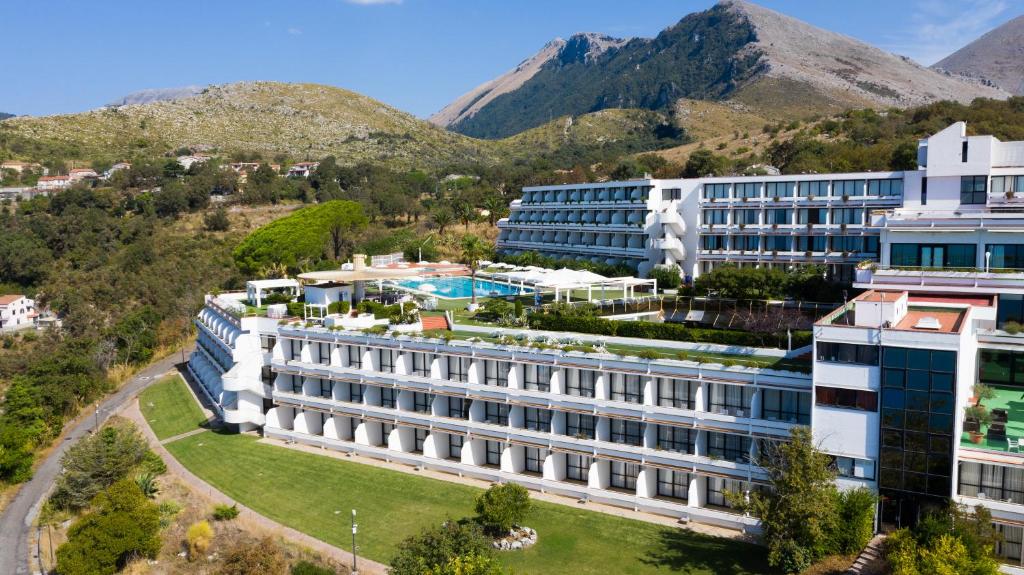
The Grand Hotel Pianeta Maratea Resort is a four-star property located in Contrada Santa Caterina, overlooking the Gulf of Policastro.
Publicly available commercial information describes a resort with approximately 155 rooms, arranged across several levels and offering:
-
swimming pools;
-
a wellness centre;
-
food & beverage facilities;
-
conference space;
-
sports facilities;
-
family-oriented services;
-
connections to the seaside.
This is therefore not simply a real estate asset.
It is a complex hospitality business with an established operational, organisational and commercial infrastructure.
And that fundamentally changes the way the situation should be assessed.
What has emerged publicly
On 5 October 2026, local news outlet SassiLive published an article on the situation at the Grand Hotel Pianeta Maratea, reporting statements from Fesica Confsal and the company's trade union representatives.
According to the report, the Court of Lagonegro had allegedly ordered the early termination of the business lease agreement between property owner Sagiba Turismo S.r.l. and current operator Much More, within the context of preventive restructuring proceedings involving the owning company.
According to the same trade union sources, more than 80 permanent and seasonal employees could be affected by developments surrounding the property.
A rigorous distinction is required, however.
At the time of writing, the full text of the court order referred to in press reports was not available through the public sources reviewed.
Consequently, information relating to:
-
the restructuring proposal;
-
the proposing party;
-
the SPV;
-
creditor treatment;
-
the implications for the management agreement;
must be attributed specifically to the trade union statements reported by the media and should not be presented as independent findings by Investimenti Alberghieri.
The first question: is this a corporate crisis or a hotel crisis?
This is the critical issue.
Within hospitality, at least four different forms of distress may exist.
Real estate distress
The physical asset requires levels of CAPEX that are disproportionate to its prospective value.
Operating distress
The hotel fails to generate sufficient GOP or EBITDA.
Financial distress
The underlying hotel may remain commercially sound, but the debt structure has become unsustainable.
Ownership distress
The asset retains value, but the owning company lacks the capital or financial structure required to maintain and develop it.
These are fundamentally different situations.
Treating them as though they were the same is a serious analytical mistake.
What Sagiba Turismo's financials indicate
Publicly accessible data relating to Sagiba Turismo S.r.l. indicate the following figures for 2024:
Revenue: approximately €1.69 million
EBITDA: approximately -€1.23 million
Net result: approximately -€2.36 million
Total assets: approximately €17.8 million
Shareholders' equity: approximately €6.05 million
Other corporate databases also report a progressive decline in revenue over the latest available financial years.
These figures represent a significant warning signal.
They should not, however, automatically be interpreted as the operating performance of the hotel itself.
Where a property is operated under a business lease structure, the economics of the owner and those of the hotel operator may be materially different.
The two should therefore not be conflated.
It is entirely possible for:
-
the property company to experience financial pressure;
-
the operator to report different trading results;
-
the real estate asset to retain meaningful value;
-
the hotel business itself to remain operationally viable.
Reconstructing this distinction is exactly what an Independent Business Review should achieve.
The value of the asset is not the same as the owner's balance sheet
With approximately 155 rooms, substantial public areas, swimming pools, wellness facilities, restaurants, meeting space and a prominent panoramic location, Grand Hotel Pianeta Maratea should be assessed through at least five different dimensions of value.
Real estate value
The value of the property and related real estate components.
Business value
The value of the hotel operation as a going concern.
Management value
The operator's ability to generate revenue and margins.
Repositioning value
The additional value that could potentially be created through CAPEX and repositioning.
Distressed value
The value of the asset within its current financial and corporate context.
This is the principle underlying the analytical approach of InvestimentiAlberghieri.it:
a hotel cannot be valued solely by reference to the balance sheet of the company that owns it.
The real test: how much can the hotel generate?
To determine whether recoverable value exists, the hotel's underlying operating P&L needs to be reconstructed.
The publicly available information does not currently allow a reliable assessment of:
-
occupancy;
-
ADR;
-
RevPAR;
-
F&B revenue;
-
GOP;
-
normalised EBITDA;
-
lease payments;
-
deferred CAPEX;
-
financial debt;
-
tax liabilities;
-
supplier balances.
Without these figures, any definitive valuation would be premature.
The correct analytical model should reconstruct:
**Room Revenue
-
F&B Revenue
-
Ancillary Revenue
− Departmental Expenses
− Undistributed Operating Expenses
= GOP**
and then assess whether that GOP is sufficient to support:
rent / management costs + CAPEX + debt service.
This is the type of analysis applied by HotelControl.it when assessing hotel profitability and operating margins.
Only then can one determine whether the underlying distress is primarily:
operational
or
financial.
Scale: competitive advantage or structural vulnerability?
A resort with approximately 155 rooms benefits from meaningful operating scale.
But scale also amplifies risk.
A property of this size carries significant fixed and semi-fixed costs, including:
-
payroll;
-
utilities;
-
maintenance;
-
swimming pools;
-
wellness facilities;
-
food & beverage;
-
public areas;
-
transportation;
-
distribution;
-
marketing.
When volumes are strong, scale generates operating leverage.
When occupancy declines, the same cost base can rapidly become burdensome.
The analysis should therefore go beyond average annual occupancy and focus on:
-
booking curve;
-
pickup;
-
ADR by segment;
-
Net RevPAR;
-
customer acquisition cost;
-
marginal contribution;
-
seasonality;
-
shoulder-season demand.
This is precisely the type of analysis that HotelIntelligence.it can apply to a seasonal resort.
The CAPEX issue
One of the most important questions is:
how much capital will Grand Hotel Pianeta Maratea require over the next five years?
A hotel may appear asset-rich while simultaneously requiring substantial investment to remain competitive.
CAPEX should be divided into two categories.
Maintenance CAPEX
Investment required to maintain standards, safety and competitiveness.
Growth CAPEX
Investment designed to increase ADR, occupancy, margins and terminal value.
The areas requiring assessment should include at least:
-
guestrooms;
-
bathrooms;
-
MEP systems;
-
energy efficiency;
-
public areas;
-
wellness facilities;
-
swimming pools;
-
F&B outlets;
-
meeting space;
-
digital infrastructure;
-
safety and compliance.
Without a five-year CAPEX plan, any valuation remains incomplete.
Maratea: strong location, but seasonality must be addressed
The destination is one of the property's strengths.
Grand Hotel Pianeta Maratea benefits from a prominent panoramic setting overlooking the Gulf of Policastro and a clear leisure positioning.
But a strong location does not eliminate seasonality.
The strategic mistake would be to invest in the physical product without changing the structure of demand.
This is where HotelMarketingLab.it becomes relevant.
An effective turnaround strategy should address multiple segments:
-
family leisure;
-
premium leisure;
-
weddings;
-
MICE;
-
wellness;
-
sport;
-
groups;
-
events;
-
international demand.
The objective should not simply be to achieve a higher ADR in August.
It should be:
to extend the economically productive season.
That can materially change annual GOP.
The management issue
The relationship between ownership and operator is another central element.
According to the press reconstruction, the relationship with Much More would be affected by the early termination order referred to by the trade union.
From an industrial perspective, any potential change of operator should be assessed using objective performance data.
The key questions include:
-
what revenue has been generated?
-
what GOP?
-
what occupancy?
-
what ADR?
-
what cost structure?
-
what CAPEX has already been invested?
-
what working capital is required?
-
what forward bookings are in place?
-
which commercial contracts need to be preserved?
-
what organisational structure needs to remain?
This is the type of distinction applied by HotelManagementGroup.it when separating asset quality from management quality.
A strong asset can be weakened by poor management.
But the opposite is equally true:
good management cannot indefinitely compensate for an unsustainable ownership capital structure.
More than 80 employees are part of the business value
According to Fesica Confsal, the employment perimeter potentially affected includes more than 80 permanent and seasonal workers.
The issue is clearly social.
But it is also economic.
In a resort of this size, human capital is an integral component of enterprise value.
Front office, housekeeping, kitchen, maintenance, sales, F&B and management together form a complex operating organisation.
If corporate distress causes that know-how to disperse, the damage directly affects business value.
In financial terms, this can be described as:
human capital destruction.
It is one of the most frequently underestimated elements in hotel restructuring processes.
The SPV is not the issue
According to the trade union account, the proposed structure would also involve a new corporate vehicle.
A Special Purpose Vehicle – SPV is not inherently positive or negative.
It is simply a transaction structure.
The real questions are:
-
how much equity capital does it have?
-
who are its shareholders?
-
what governance framework applies?
-
who will operate the hotel?
-
what is the business plan?
-
how will CAPEX be funded?
-
how much working capital is available?
-
what is the financing structure?
-
what guarantees are provided?
A properly capitalised SPV can be an effective vehicle for a turnaround.
An undercapitalised SPV could simply transfer the problem rather than solve it.
The key risk: restructuring the debt while destroying the hotel
This is the central strategic issue in the entire case.
A major mistake in hospitality restructuring is to:
optimise short-term financial recovery while destroying medium-term operating value.
The opposite mistake is also possible:
protecting operational continuity without properly resolving the capital structure.
Neither approach is sufficient.
The real objective should be:
to maximise enterprise value over the medium term.
That requires an integrated approach combining:
real estate + finance + operations + restructuring.
It is the same analytical framework used by Investhotel.it in situations where real estate value, earnings capacity and financial structure must be considered together.
A professional turnaround framework
A professional investor should approach a case such as Maratea through at least seven workstreams.
1. Independent Business Review
Independent reconstruction of revenue, GOP, EBITDA and cash flow.
2. Real Estate Valuation
Valuation of the property using comparable transactions and income-based methodologies.
3. Debt Review
Mapping of:
-
financial debt;
-
tax liabilities;
-
supplier balances;
-
security interests;
-
guarantees.
4. CAPEX Plan
Definition of the investment required over the following five years.
5. Operator Assessment
Comparison between:
-
direct management;
-
lease;
-
management contract;
-
appointment of a new operator.
6. Business Plan
Five-year projections under:
base / downside / upside scenarios.
7. Capital Structure
Definition of the appropriate balance between:
equity + senior debt + potential subordinated capital + working capital.
Only after these seven workstreams have been completed does it become possible to discuss value meaningfully.
Investment case: preliminary assessment
Strengths
-
approximately 155 rooms;
-
recognisable leisure destination;
-
panoramic location;
-
full-service resort infrastructure;
-
wellness, swimming pools, F&B and meeting facilities;
-
potential repositioning upside;
-
sufficient scale for professional management.
Key challenges
-
negative financial performance at ownership-company level;
-
potential need for financial restructuring;
-
seasonality;
-
significant operating cost base;
-
potential CAPEX requirements;
-
complexity in the owner/operator relationship;
-
risk of human capital erosion.
Information still required
Before reaching any definitive conclusion, the following information would be essential:
-
net financial debt;
-
tax position;
-
supplier balances;
-
lease terms and rent;
-
occupancy;
-
ADR;
-
RevPAR;
-
GOP;
-
operator-level EBITDA;
-
deferred CAPEX;
-
forward bookings;
-
independent real estate valuation.
What should be verified first
The first four analyses should be:
1. Normalised hotel GOP
2. Ownership Net Financial Position
3. CAPEX requirement
4. Independent real estate value
The real investment case emerges from the interaction of these four figures.
The twelve questions an investor should ask
-
What is the total outstanding debt?
-
Which creditors are secured?
-
What is the property's independent market value?
-
What rent was generated under the business lease?
-
What is the hotel's actual revenue?
-
What is normalised GOP?
-
How much CAPEX is required?
-
How much working capital is needed?
-
What is the going-concern value of the hotel business?
-
Which operating model would maximise value?
-
To what extent can seasonality be reduced?
-
What realistic exit value could be achieved following a turnaround?
Without documented answers to these questions, any valuation must remain preliminary.
From corporate distress to a hospitality special situation
The Grand Hotel Pianeta Maratea case demonstrates why the Italian distressed hospitality market should not only be monitored once an asset has already become severely impaired.
There is a far more interesting segment.
One in which:
-
the hotel continues to operate;
-
market demand still exists;
-
employees remain in place;
-
the underlying asset retains value;
-
but the ownership structure requires reorganisation.
These are genuine:
hospitality special situations.
And this is the stage at which value can still be preserved.
At RobertoNecci.it, we have repeatedly highlighted that financial distress at ownership level does not necessarily imply a loss of the hotel's underlying industrial value.
The Maratea case appears to require precisely this distinction.
Our assessment
Based solely on the public information currently available, it is not possible to draw definitive conclusions regarding:
-
the property's future sustainability;
-
the exact amount of outstanding liabilities;
-
the attractiveness of the restructuring plan;
-
the value of any potential investment;
-
whether any transaction opportunity exists.
However, one methodological conclusion can be stated very clearly.
The case should be assessed by separating:
the financial position of the owner
from
the operating performance of the hotel
from
the real estate and prospective value of the asset.
The coexistence of negative financial results at the property-company level and a sizeable resort that continues to maintain a structured commercial presence creates precisely the type of divergence that requires an Independent Business Review.
Conclusions
The Grand Hotel Pianeta Maratea case reflects one of the most important themes facing the Italian hospitality industry:
how to preserve the value of a strong asset when the ownership structure itself needs to be reorganised.
The answer cannot be purely financial.
It cannot be purely real estate-driven.
And it cannot be purely operational.
It must integrate:
**asset value
-
business value
-
financial restructuring
-
management
-
CAPEX
-
human capital.**
Value is not created simply by entering a distressed hotel situation.
It is created by the ability to:
identify the underlying cause of the distress, separate it from the intrinsic value of the asset, and build a financial and operating structure capable of restoring long-term business sustainability.
That is the difference between acquiring a problem and engineering a turnaround.
Investimenti Alberghieri | Distressed Hospitality & Special Situations
InvestimentiAlberghieri.it analyses complex hospitality situations through an integrated approach covering:
-
real estate valuation;
-
financial analysis;
-
operating performance;
-
CAPEX;
-
turnaround scenarios;
-
value creation strategies.
The objective is not to act as an intermediary, but to understand the underlying case before investment, financing, management or value-enhancement decisions are taken.
For hotel asset analysis, pre-distress situations, UTP cases, turnarounds, financial restructuring and hospitality special situations:
info@investimentialberghieri.it
Further insights:
Investhotel.it — hotel investment & finance
HotelIntelligence.it — data & performance intelligence
HotelControl.it — profitability & management control
HotelMarketingLab.it — demand, distribution & positioning
HotelManagementGroup.it — hotel management & operational turnaround
RobertoNecci.it — hospitality analysis & advisory
Methodological Note and Disclaimer
Article updated as of 6 October 2026.
This analysis is based exclusively on publicly accessible information and sources.
Information concerning the preventive restructuring proceedings, the reported early termination of the business lease, the proposal submitted by the relevant party, the SPV, creditor treatment and potential employment implications is included solely to the extent that it has been reported by the press on the basis of statements made by Fesica Confsal and company trade union representatives.
At the time of writing, the full text of the judicial order referred to in those reports had not been identified among the public sources reviewed.
This article does not express any view on the legality of the conduct of any party, the merits of the restructuring plan, or the existence of liability on the part of companies, directors, operators, creditors or any other party involved.
Financial information relating to Sagiba Turismo is sourced from commercial databases that state that they process information derived from filed financial statements and the Italian Companies Register. Such figures should be verified against official corporate documentation as part of any formal due diligence process.
Any reference to investment, turnaround, value creation or restructuring scenarios constitutes general methodological analysis only and does not imply or assert the existence of a sale process, a specific investment opportunity, an UTP/NPL classification or an intention to dispose of the asset.