Grand Hotel Riccione Awarded at €29.365 Million: The Price Rose 18% — Now the Real Investment Begins
UPDATE — 24 September 2026
When InvestimentiAlberghieri.it analysed Grand Hotel Riccione ahead of the auction, the conclusion was clear:
strong interest, limited aggressiveness and absolute discipline on price.
On 23 September, the market delivered its first answer.
The property complex was awarded at €29.365 million, compared with a starting price of:
€24.864 million.
Two bidders competed for the asset, pushing the final price approximately €4.5 million above the starting level, equivalent to:
+18.1%.
The auction has therefore resolved one of the key uncertainties highlighted in our original analysis.
We now know how much a competitive market was willing to pay.
What we still do not know is how much it will ultimately cost to:
turn that acquisition price into a profitable investment.
That is now the central question.
First Point: An Auction Award Is Not Yet a Completed Transfer
The €29.365 million figure is the result of the bidding process.
However, the procedure provides a window during which improved offers may still be submitted.
The technically correct description at this stage is therefore:
auction award.
Not necessarily yet:
completed transfer of ownership.
The distinction matters.
The investment does not end when the highest bid is submitted.
The real Day One begins at closing.
The Market Paid €4.501 Million Above the Starting Price
The first reading is purely quantitative.
Starting Price
€24.864 million
Award Price
€29.365 million
Increase
€4.501 million
Premium
+18.1%.
That premium does not automatically mean the buyer overpaid.
It means something much simpler:
the capital committed at acquisition increased by €4.5 million relative to the auction starting point.
And those additional €4.5 million must generate a return just like every other euro subsequently invested in the asset.
The “Emotional Premium” Risk Has Now Become a Real Variable
In our original analysis, we identified a specific risk:
paying a premium for the iconic nature of the asset.
Grand Hotel.
Riccione.
History.
Location.
Scarcity.
Recognition.
All of these characteristics can increase willingness to pay.
But hospitality economics does not ultimately reward emotion.
It rewards:
Cash Flow.
An 18.1% premium may prove entirely justified.
But only if the future project generates sufficiently greater value.
€29.365 Million Buys More Than a Hotel
The auction perimeter extends well beyond the main hotel building.
The portfolio includes:
-
Grand Hotel;
-
Villa Bianca;
-
Magazzini;
-
Torre 900;
-
Villa Bruna;
-
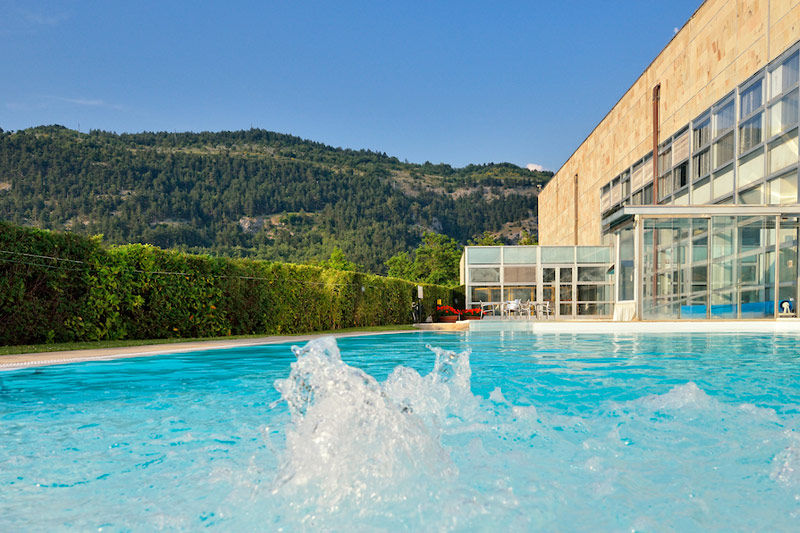
the swimming pool;
-
additional commercial, hospitality and residential components.
The buyer is therefore not merely acquiring a hotel.
It is acquiring control of a wider real estate complex that may potentially support a combination of:
Hospitality
Residential / RTA
Food & Beverage
Wellness
Events
Retail
Entertainment.
The correct strategic question is therefore not:
How should Grand Hotel be reopened?
It is:
Which configuration maximises the value of the entire complex?
Acquisition Price per Historical Key Rises to Approximately €189,000 — But the Metric Remains Incomplete
Using the 155 historical rooms referenced in the previous analysis:
€29.365 million / 155
=
approximately €189,000 per historical key.
At the auction starting price, the same calculation produced roughly:
€160,000 per key.
Competitive bidding has therefore increased the theoretical acquisition basis by approximately:
€29,000 per historical room.
But the metric remains highly imperfect.
Because:
-
the future key count may change;
-
the complex contains non-hotel assets;
-
some capital may be allocated to other uses;
-
the final CAPEX requirement remains unknown.
Therefore:
Purchase Price per Key ≠ Total Investment per Key.
The Real Investment Starts at €29.365 Million
The acquisition price is only the first line item.
The project may still require capital for:
-
transaction costs;
-
architecture and engineering;
-
structural works;
-
MEP systems;
-
fire safety;
-
energy efficiency;
-
guestrooms and bathrooms;
-
FF&E;
-
OS&E;
-
F&B;
-
swimming pool;
-
wellness;
-
event facilities;
-
technology;
-
landscaping;
-
financing costs;
-
contingency;
-
pre-opening;
-
recruitment;
-
marketing;
-
working capital.
The correct equation is:
Acquisition Price
CAPEX
Professional Fees
Financing Costs
Pre-opening
Working Capital
Contingency
=
Total Capital Employed.
That is the capital base the project will ultimately have to remunerate.
Three Total Capital Employed Scenarios
Consider three purely methodological scenarios.
These are not valuations of Grand Hotel Riccione.
They simply illustrate investment sensitivity.
Scenario 1 — Selective Repositioning
Acquisition Price: €29.365 million
Additional Capital: €20 million
Total Capital Employed:
approximately €49.4 million.
Scenario 2 — Significant Repositioning
Acquisition Price: €29.365 million
Additional Capital: €30 million
Total Capital Employed:
approximately €59.4 million.
Scenario 3 — Luxury Mixed-Use Transformation
Acquisition Price: €29.365 million
Additional Capital: €45 million
Total Capital Employed:
approximately €74.4 million.
The same auction award can therefore result in three completely different financial investments.
The message is straightforward:
returns will not depend on the €29.365 million acquisition price alone.
They will depend on the total amount of capital ultimately required.
The Critical Stress Test: Total Capital vs Stabilised Value
Now we can ask the right question.
What should the completed asset be worth once stabilised?
Again, the following scenarios are purely illustrative.
Case A
Total Capital Employed:
€50 million.
Stabilised Value:
€55 million.
Value Creation:
€5 million
equivalent to approximately:
+10%.
In nominal terms, that margin may be relatively thin once time, execution risk and illiquidity are considered.
Case B
Total Capital Employed:
€60 million.
Stabilised Value:
€75 million.
Value Creation:
€15 million
equivalent to approximately:
+25%.
The project begins to show greater capacity to compensate capital and risk.
Case C
Total Capital Employed:
€75 million.
Stabilised Value:
€100 million.
Value Creation:
€25 million
equivalent to approximately:
+33%.
The value-creation spread appears materially stronger, but the project would need to deliver a product capable of supporting a substantially higher stabilised valuation.
This is the metric that ultimately matters:
Stabilised Value – Total Capital Employed.
Not:
Auction Price – Auction Starting Price.
Even a €100 Million Exit Value Might Not Be Enough
There is a further layer.
If the project requires:
-
a long holding period;
-
substantial leverage;
-
significant execution risk;
-
a large equity commitment;
-
high financing costs;
-
planning risk;
-
operating volatility,
even a large nominal spread between invested capital and final value may fail to deliver an adequate return.
The analytical framework therefore needs to progress to:
Total Capital Employed
↓
Stabilised Cash Flow
↓
Exit Value
↓
Holding Period
↓
Equity IRR.
The difference between value and cost is only the first test.
Return on equity is the ultimate one.
The Auction Premium Has Increased the Project’s Implied Hurdle
Every additional euro paid at acquisition increases the economic threshold the project must clear.
The relationship can be expressed as:
Stabilised Value
−
Total Capital Employed
−
Required Investor Return
=
Economic Value Creation.
The auction has established:
the Acquisition Price.
The investor must now create:
the Value Creation Spread.
New Eden: For Now, It Remains a Press Attribution
According to press reports, the successful bidder would be New Eden Srl.
Until the transaction is fully completed, that wording should remain cautious.
If New Eden is ultimately confirmed, however, the investment case becomes even more interesting.
Because the company would not be a first-time investor in the destination.
It has already been linked to other Riccione assets, including the former Eden and Casadio hotels and the former Bertazzoni holiday colony.
This may turn the transaction into something broader.
From Trophy Asset to Destination Platform
If the same capital is ultimately confirmed as controlling several assets within Riccione, the thesis could evolve from:
Single-Asset Investment
to:
Destination Platform.
A territorial platform may generate synergies across:
-
development;
-
design;
-
procurement;
-
sales;
-
marketing;
-
revenue management;
-
maintenance;
-
institutional relationships;
-
capital allocation;
-
execution;
-
exit strategy.
The investment equation would then become:
Asset Value
Portfolio Synergies
=
Platform Value.
That is a considerably more sophisticated proposition than simply acquiring a hotel.
Local Market Knowledge Can Become a Competitive Advantage
In a complex special situation, local knowledge can reduce:
-
timelines;
-
mistakes;
-
execution risk;
-
costs;
-
uncertainty.
An investor already active in the destination may understand:
-
planning regulations;
-
local government;
-
contractors;
-
market demand;
-
seasonality;
-
real estate dynamics;
-
local operating conditions.
The true competitive advantage may therefore be:
Execution Capability.
And in a project of this scale, execution capability can be worth far more than a few percentage points on the initial acquisition price.
Highest and Best Use Before Brand Selection
The wider property complex supports several possible strategies.
The main hotel may potentially be repositioned as:
-
a luxury hotel;
-
an upper-upscale grand hotel;
-
an independent trophy property;
-
an internationally branded hotel.
The additional components may potentially support:
-
serviced apartments;
-
residences;
-
RTA;
-
wellness;
-
private club;
-
destination F&B;
-
events;
-
selective retail.
Before selecting a flag, the project therefore needs to define:
Highest and Best Use.
The correct sequence is:
Market
↓
Product
↓
Economics
↓
Operator
↓
Brand.
Not the other way around.
Heritage Must Translate Into Pricing Power
Grand Hotel Riccione possesses a historical asset that cannot be created through CAPEX:
heritage.
But heritage only creates economic value when it translates into:
Brand Recognition
↓
Guest Preference
↓
ADR Premium
↓
Higher GOP
↓
Higher Asset Value.
If heritage remains only a story:
it is memory.
If it creates pricing power:
it becomes economic capital.
This distinction is central to the analysis published on RobertoNecci.it.
CAPEX Risk May Be the Most Important Variable
The acquisition price is now known.
CAPEX is not.
And in a historic property, the potential range of outcomes can be significant.
Key risk areas may include:
-
structural works;
-
MEP;
-
heritage constraints;
-
restoration;
-
fire safety;
-
accessibility;
-
energy efficiency;
-
approvals;
-
materials;
-
construction timelines;
-
inflation.
If the initial CAPEX budget were:
€30 million,
a:
+20%
overrun would add:
€6 million.
That alone would exceed the entire premium paid above the auction starting price.
This illustrates which variable may ultimately matter more.
Purchase Price Risk vs CAPEX Risk
Competitive bidding increased the price by:
€4.5 million.
But an underestimated CAPEX programme could increase total project cost by:
€5 million, €10 million or €15 million.
Therefore:
the biggest risk is not necessarily having bid too aggressively.
It may be:
underestimating what comes next.
This is also a core principle in Investhotel.it analysis of distressed hospitality, turnarounds and special situations.
Future Value Will Depend on GOP, Not on the Asset’s Fame
The business plan must ultimately lead to a simple operating equation:
Rooms
F&B
Events
Wellness
Residential / Serviced Components
Ancillary Revenue
=
Total Revenue
less:
Payroll
Distribution
Utilities
Maintenance
F&B Cost
Sales & Marketing
Administration
=
GOP
↓
Fees / Fixed Charges
↓
EBITDA.
That EBITDA must justify the capital invested.
A Trophy Asset Must Produce Trophy Economics
Grand Hotel Riccione undeniably possesses:
-
location;
-
history;
-
recognition;
-
scarcity;
-
architecture;
-
strategic relevance within the destination.
But a trophy asset cannot be defined by reputation alone.
It must combine:
Scarcity
Location
Brand Equity
Cash Flow
Liquidity.
The first three already exist.
The final two still need to be rebuilt.
The Operating Model Is an Investment Decision, Not a Secondary Operational Choice
The future structure will need to determine whether the hotel is:
-
owner-operated;
-
leased;
-
operated under a management agreement;
-
managed by a white-label operator;
-
affiliated with an international brand.
Each model changes:
-
risk;
-
control;
-
fees;
-
EBITDA;
-
bankability;
-
exit value.
Therefore:
Operating Model = Investment Decision.
It is not something to decide when construction is almost complete.
HotelManagementGroup.it focuses precisely on the relationship between operating model, organisation, profitability and hotel sustainability.
A Brand Can Amplify Value. It Cannot Create It on Its Own.
An international flag may provide:
-
distribution;
-
loyalty;
-
pricing power;
-
visibility;
-
know-how;
-
greater bankability.
But a brand cannot compensate for:
-
an excessive acquisition price;
-
uncontrolled CAPEX;
-
the wrong product;
-
an unsustainable cost structure;
-
a weak operating model.
The principle remains:
Strategy First.
Brand Second.
Rebuilding Reputation Is Part of the Economic CAPEX
The new project will also need to create a decisive break with the narrative of recent years.
Bankruptcy.
Disputes.
Seizure.
Auction.
Closure.
The repositioning should establish:
New Ownership
↓
New Governance
↓
New Product
↓
New Management
↓
New Narrative.
This is not merely a communications exercise.
It is:
Commercial CAPEX.
Because it directly affects perception, pricing power and future demand.
The Auction Established the Price. The Business Plan Must Create the Value.
The first question has now been answered:
How much does it cost to enter?
The answer is:
€29.365 million.
The harder questions come next.
How much CAPEX?
What use mix?
Which brand?
Which operator?
What EBITDA?
What stabilised value?
What equity IRR?
The new investment framework becomes:
Distressed Trophy Asset
↓
€24.864M Auction Starting Price
↓
Competitive Bidding
↓
€29.365M Award Price
↓
+18.1% Premium
↓
Due Diligence
↓
Highest & Best Use
↓
Total Capital Employed
↓
Stabilised GOP / EBITDA
↓
Stabilised Value
↓
Equity IRR
↓
Sustainable Value Creation.
The auction has completed only the first part of the journey.
Conclusion: The Market Has Paid for the Icon. Now the Icon Has to Produce Returns.
The auction result demonstrates that Grand Hotel Riccione retains an extraordinary ability to attract capital.
But €29.365 million represents only:
the price of admission.
If New Eden is ultimately confirmed as the buyer, its other investments in the destination could support a second, broader thesis:
turning a trophy asset into the cornerstone of a Riccione hospitality platform.
But success will not be measured by the premium paid at auction.
It will be measured by:
CAPEX Discipline
Highest & Best Use
Execution
Product Strategy
Operating Performance
Governance
Exit Discipline
=
Sustainable Value Creation.
Because:
The auction established the price.
Total Capital Employed will determine the risk.
EBITDA will determine sustainability.
Stabilised Value will determine value creation.
And Equity IRR will determine whether the investment actually worked.
InvestimentiAlberghieri.it | Distressed Hospitality & Special Situations
Grand Hotel Riccione demonstrates why acquisition price, real estate value and hospitality investment value are three fundamentally different concepts.
A special situation should be assessed by integrating:
Acquisition Price + Legal Risk + Technical Due Diligence + CAPEX + Highest & Best Use + Financing + Operator + EBITDA + Stabilised Value + Equity IRR + Exit.
The original analysis of Grand Hotel Riccione is available on InvestimentiAlberghieri.it.
For analysis of hotel value, governance, positioning and financial sustainability: RobertoNecci.it.
For distressed hotels, UTP/NPL situations, acquisitions, turnarounds and extraordinary transactions: Investhotel.it.
For business planning, organisation, management control and hotel operating performance: HotelManagementGroup.it.
For hotel investment analysis, distressed hospitality, acquisitions, value creation and special situations:
info@investimentialberghieri.it
==================================================================
Grand Hotel Riccione is more than one of the most recognisable hotels on Italy’s Adriatic Riviera.
It has become a nationally significant case in which heritage, real estate value, corporate distress, criminal proceedings, physical deterioration and one of the most complex hospitality investment opportunities currently available in Italy all converge.
On 28 July 2026, acting on instructions from the Rimini Public Prosecutor’s Office, the Italian Financial Police executed an urgent precautionary seizure order involving real estate assets, financial resources and equity interests with a reported aggregate value of approximately €29 million.
Six individuals are reportedly under investigation in connection with alleged fraudulent bankruptcy offences.
This distinction must be stated clearly: the allegations remain at the investigative stage and will have to be established before the competent courts. All individuals involved must be presumed innocent unless and until a final conviction is entered.
From an investment perspective, however, the precautionary measure adds another layer of risk to an asset already involved in the judicial liquidation of its owner, Marebello S.p.A.
As of 28 July 2026, based on publicly available information, the auction remains scheduled for 23 September 2026, with a reserve price of €24.864 million and minimum bid increments of €250,000.
The question is therefore not simply who will acquire Grand Hotel Riccione.
The real question is:
What is an iconic hotel truly worth when the acquisition price must be combined with capital expenditure, legal uncertainty, regulatory remediation, financing costs and the rebuilding of its reputation?
The transaction at a glance
| Item | Figure |
|---|---|
| Auction reserve price | €24,864,000 |
| Minimum bid increment | €250,000 |
| Scheduled auction date | 23 September 2026 |
| Reported aggregate value of seized assets | Approximately €29 million |
| Assets included in the lot | 6 |
| Cadastral land area | 11,731 sq m |
| Historical room count | 155 |
| Official current hotel inventory | Not disclosed |
The €29 million figure should not be interpreted as a valuation of the hotel alone.
According to the available reports, the seizure perimeter also includes financial resources and equity interests. By contrast, the €24.864 million figure is the reserve price for the entire real estate lot.
The amounts are similar, but they refer to different perimeters and serve different purposes.
This is not simply a hotel acquisition—it is a mixed-use real estate complex
One of the most significant valuation mistakes would be to treat Grand Hotel Riccione as an ordinary hotel and divide the purchase price by its historical room count.
The auction lot comprises six separate assets:
-
Grand Hotel, including hotel accommodation, public-facing commercial operations, parking and ancillary areas;
-
Villa Bianca, including a tourist residence, retail premises and public-facing commercial space;
-
Magazzini, comprising a restaurant, retail space and apartments;
-
Torre 900, containing apartments and office accommodation;
-
Villa Bruna, including a restaurant and nightclub;
-
an underground swimming pool serving the complex.
The site is located in Riccione’s prime seaside district, between Lungomare della Repubblica, Viale Gramsci and Viale Milano.
It is therefore a diversified real estate complex with the theoretical capacity to combine:
-
hotel accommodation;
-
serviced or tourist residences;
-
apartments;
-
food and beverage;
-
events;
-
entertainment;
-
retail;
-
wellness;
-
services open to the local community.
The successful bidder would not merely be purchasing hotel rooms.
They would be acquiring the foundations of a potential mixed-use hospitality district, whose value will depend on the physical condition of the buildings, the permitted uses and the investor’s ability to develop a coherent master plan.
From 1929 to financial distress: why heritage alone cannot protect value
Grand Hotel Riccione was designed by architect Rutilio Ceccolini and opened in 1929.
Commissioned by entrepreneur Gaetano Ceschina, it originally offered 155 rooms and was regarded as one of the most modern and prestigious hotels on the Adriatic Riviera.
Throughout its history, it hosted Benito Mussolini, political delegations, senior institutional figures and, after the Second World War, the National Press Congress attended by Italian President Luigi Einaudi.
That history represents genuine intangible value.
However, the hospitality investment market does not automatically reward heritage.
History creates economic value only when it is converted into:
-
distinctive positioning;
-
a compelling guest experience;
-
pricing power;
-
international distribution;
-
destination dining;
-
events;
-
editorial content;
-
sustainable cash flow.
An iconic building without sound governance, maintenance and a viable business plan is not necessarily a trophy asset.
It may become a monumental value trap.
The Grand Hotel Riccione case demonstrates a fundamental principle of hospitality investment: the quality of the real estate does not protect an asset from uneconomic management, unbalanced contractual arrangements, undercapitalisation or ineffective corporate controls.
The guides published on RobertoNecci.it explore precisely the relationship between real estate value, hotel profitability, governance and risk—four dimensions that must be assessed simultaneously in an operation of this nature.
The collapse of Marebello
Marebello S.p.A., the owner of the property, was declared bankrupt in September 2023 following the unsuccessful outcome of an attempted composition with creditors.
The financial distress does not appear to have resulted from a single event, but rather from a progressive deterioration in the company’s financial and operational equilibrium.
The proceedings were subsequently accompanied by appeals, temporary suspensions of the liquidation process, creditor claims and operational disputes.
In February 2025, the Municipality of Riccione asserted claims of approximately €871,000 relating to property taxes, local taxation and penalties.
The precautionary seizure order followed on 28 July 2026 as part of the criminal investigation.
The timeline is significant:
| Period | Event |
|---|---|
| 2022 | Attempted composition with creditors |
| September 2023 | Bankruptcy of Marebello S.p.A. |
| December 2023 | Temporary suspension of liquidation pending appeal |
| 2024 | Appeal against the bankruptcy rejected |
| February 2025 | Tax claims asserted by the Municipality |
| June 2026 | Publication of the sale notice |
| 28 July 2026 | Urgent precautionary seizure |
| 23 September 2026 | Scheduled auction date |
This is therefore not simply a deteriorated property.
It is a distressed asset carrying additional judicial, corporate, regulatory and reputational risk.
What is Grand Hotel Riccione really worth?
The €24.864 million reserve price is currently the most relevant publicly available benchmark.
Dividing that amount by the hotel’s historical 155 rooms would produce a theoretical valuation of approximately €160,000 per room.
That metric would, however, be highly misleading.
The historical room count does not necessarily reflect the inventory that could be created following redevelopment. In addition, the lot includes villas, apartments, restaurants, offices, retail premises, a nightclub, a swimming pool and more than 11,700 square metres of cadastral land.
The valuation should therefore be separated into at least four distinct components.
1. Current real estate value
This is the value of the buildings in their existing physical, cadastral, planning and regulatory condition.
2. Redevelopment value
This depends on the permitted uses, the amount of recoverable floor area and the ability to integrate hotel accommodation, residences, restaurants and event facilities.
3. Stabilised hotel value
This can only be calculated once the following have been determined:
-
effective room count;
-
hotel classification;
-
market positioning;
-
average daily rate;
-
occupancy;
-
RevPAR;
-
food and beverage revenue;
-
event revenue;
-
gross operating profit;
-
management structure.
4. The value of risk
The acquisition price must reflect:
-
judicial risk;
-
planning risk;
-
capital expenditure;
-
authorisation timelines;
-
financing costs;
-
potential opening delays;
-
reputational remediation;
-
the return required by equity investors.
The auction price cannot therefore be treated as the total cost of the investment.
It will only be the first cheque.
Capital expenditure is the critical issue
The physical condition of the buildings is likely to represent one of the most significant risks.
The documents made available as part of the proceedings reportedly include valuation reports, photographs of the individual floors, cadastral documentation, planning records and mortgage searches.
An investor would need to budget for, at a minimum:
-
structural reinforcement;
-
façades and roofs;
-
windows and external doors;
-
electrical and plumbing systems;
-
heating, ventilation and air conditioning;
-
fire prevention systems;
-
lifts;
-
accessibility works;
-
kitchens and restaurants;
-
swimming pool remediation;
-
guestrooms and bathrooms;
-
acoustic insulation;
-
safety compliance;
-
energy efficiency;
-
technology systems;
-
external areas;
-
design and engineering;
-
authorisations;
-
pre-opening expenditure.
For a complex of this scale, even a 15-20% variation in capital expenditure could radically alter the economics of the transaction.
This is where experience in complex and extraordinary transactions becomes decisive.
Investhotel advises on complex hospitality transactions, including valuations, financial restructuring, turnaround projects and distressed assets whose value cannot be established through a straightforward real estate comparison.
What could the total investment requirement be?
Without access to the full technical reports, a confirmed room programme and an executive redevelopment design, any capital expenditure figure must be treated as entirely indicative.
Nevertheless, a preliminary editorial stress test can help demonstrate the sensitivity of the transaction.
Illustrative scenarios only—not a formal valuation
| Scenario | Acquisition and transaction costs | Capex, professional fees and pre-opening | Indicative total investment |
|---|---|---|---|
| Selective restoration | €27-29m | €18-23m | €45-52m |
| Upper-upscale repositioning | €28-31m | €27-35m | €55-66m |
| Luxury mixed-use transformation | €30-33m | €38-50m | €68-83m |
These figures do not constitute a valuation of Grand Hotel Riccione and cannot replace a full due diligence process.
They illustrate one essential point: an auction with a reserve price below €25 million may ultimately require an investment of €50 million, €60 million or more than €70 million once taxes, construction works, interest, design fees, contingencies, pre-opening expenditure and working capital are included.
The buyer should therefore not ask only how much to bid.
They should ask:
What stabilised value must the asset achieve in order to remunerate a total investment that could exceed twice the auction reserve price?
The maximum acquisition price must be calculated backwards
In a special-situations transaction, value should not be determined by starting with the auction reserve price.
It should be calculated by working backwards from the asset’s reasonably achievable stabilised value.
The correct approach is:
stabilised value of the completed asset
less
capex, transaction costs, financing costs, pre-opening expenditure, risk allowance and required return
equals
maximum sustainable acquisition price.
This approach prevents an investor from confusing the rarity of the property with the profitability of the transaction.
An asset can be unique and still be too expensive.
If the combined acquisition and redevelopment costs were to move too close to the property’s stabilised value, the investment would lose its economic rationale, regardless of how exceptional the building may be.
Does the seizure prevent the auction?
Not necessarily, but the position must be clarified before any bid is submitted.
An investor should obtain and review:
-
the full seizure order;
-
the precise identification of the affected assets;
-
the implications for transferability;
-
the relationship between the criminal measure and the insolvency proceedings;
-
the conditions under which the property could be released;
-
the position of the insolvency administrator;
-
the position of the delegated judge;
-
any rights held by occupiers or operators;
-
the buyer’s ability to access the buildings and commence works.
A court-supervised sale does not automatically remove every pre-existing risk.
The proceedings may transfer ownership of the property, but the buyer must establish the physical and legal conditions under which it can actually be used.
Asset deal and dedicated NewCo: separating the future from the past
Subject to the terms of the proceedings, the most rational structure would involve acquiring the lot through a dedicated NewCo.
The purpose would be to create a clear and substantive break with the past through:
-
new ownership;
-
new governance;
-
new accounting systems;
-
a new organisation;
-
new contracts;
-
a new control framework;
-
new management;
-
a new digital presence;
-
a new market narrative.
The buyer’s principal protection is unlikely to come from extensive vendor warranties, which are generally limited in a court-supervised sale.
Protection will instead have to come primarily from:
-
the acquisition price;
-
the transaction structure;
-
pre-acquisition verification;
-
adequate contingency reserves;
-
the ability to withdraw if critical red flags emerge;
-
separation from historical liabilities and management arrangements.
Three potential redevelopment strategies
Scenario 1: relaunch as an independent grand hotel
The historic main building could be restored to a predominantly hotel use, preserving the property’s name and original identity.
This would be the solution most closely aligned with its heritage, but also the one most exposed to:
-
seasonality;
-
high fixed costs;
-
organisational complexity;
-
substantial staffing requirements;
-
the need to achieve rates well above the local market average.
For this model to succeed, the project would need to integrate guestrooms, destination dining, events, wellness, outdoor facilities and strong links with the wider destination.
Scenario 2: mixed-use urban resort
This is potentially the most compelling industrial strategy.
The main building could retain its hotel function, while the surrounding buildings might be used—subject to planning approval—for:
-
serviced apartments;
-
tourist residences;
-
restaurants;
-
a private club;
-
curated retail;
-
wellness;
-
events;
-
representative office accommodation.
Diversifying the revenue base would reduce dependence on guestrooms and the peak summer season.
Scenario 3: international brand affiliation
A luxury or upper-upscale brand could improve distribution, international recognition and access to financing.
However, the brand should enter after the fundamentals of the project have been resolved, not as a substitute for them.
The correct sequence would be:
-
acquisition;
-
resolution of judicial issues;
-
planning and regulatory remediation;
-
design development;
-
financing;
-
operator selection;
-
brand agreement;
-
pre-opening.
No international flag can compensate for uncertain title, underestimated capital expenditure or weak governance.
The subsequent operation could be entrusted to a manager with proven expertise in repositioning, stabilising and financially controlling complex hotel businesses. Necci Hotels specialises in hotel management and value creation, with a particular focus on organisation, operating performance and long-term sustainability.
Due diligence must be forensic in scope
Grand Hotel Riccione requires a significantly broader due diligence process than an ordinary operating hotel.
| Area | Essential investigations |
|---|---|
| Insolvency proceedings and seizure | Court order, seizure perimeter, transferability, timing and conditions |
| Title | Historical company searches, chain of title, third-party rights and occupation |
| Planning | Permitted uses, compliance, irregularities and potential remediation |
| Cadastral and mortgage position | Individual units, easements, boundaries, registrations and common areas |
| Structures | Stability, roofs, façades, vulnerability and reinforcement requirements |
| Building services | Fire safety, electrical systems, plumbing, HVAC, lifts and swimming pool |
| Environmental and safety | Asbestos, legionella, water quality, contamination and workplace safety |
| Operations | Effective room count, F&B, events, parking, storage and guest flows |
| Employment | Contracts, social security positions, disputes and potential successor liability |
| Brand and digital assets | Trademarks, domains, OTA accounts, reviews, customer data and cyber risk |
| Business plan | ADR, occupancy, RevPAR, GOP, capex, financing and exit strategy |
Several critical pieces of information remain unavailable or unconfirmed:
-
current saleable room inventory;
-
EBITDA;
-
RevPAR and ADR;
-
technical capex;
-
the full content of the valuation reports;
-
planning irregularities;
-
the complete criminal court measures;
-
the contractual status of any occupiers;
-
the number of rooms achievable following redevelopment.
Until these data points are available, any valuation must be treated as preliminary.
Reputational risk is not a secondary consideration
Grand Hotel Riccione has progressively moved from being portrayed as an icon of the Adriatic Riviera to an asset associated with insolvency, disputes, an auction process and a precautionary seizure.
A new investor would not merely have to renovate the building.
They would also have to renovate the market’s perception of it.
This would require:
-
a new ownership identity;
-
institutional communication;
-
control of the relevant domains;
-
oversight of digital platforms;
-
recovery and curation of the historical archive;
-
a new SEO strategy;
-
engagement with the local community;
-
transparent governance;
-
a credible narrative around the property’s revival.
Reputational remediation is not an ancillary cost.
It is part of the commercial capital expenditure.
Which investors could realistically pursue the opportunity?
The transaction may be appropriate for:
-
value-add funds;
-
special-situations investors;
-
well-capitalised family offices;
-
hospitality groups with substantial financial resources;
-
developers with hotel expertise;
-
joint ventures between real estate capital and hotel operators;
-
investors capable of carrying the project for several years without immediate operating cash flow.
It is considerably less suitable for:
-
core or core-plus investors;
-
small independent hotel operators;
-
buyers excessively reliant on debt;
-
investors without strong technical and legal capabilities;
-
purchasers requiring an immediate reopening;
-
operators who believe heritage value can replace economic sustainability.
The investment recommendation can be summarised in one sentence:
High interest, limited aggression and absolute discipline on price.
The real investment thesis
Grand Hotel Riccione is investable only as a transformation opportunity.
It is not an acquisition of stability.
Its strengths are clear:
-
an irreplaceable location;
-
strong name recognition;
-
historical significance;
-
the scale of the real estate complex;
-
multiple potential uses;
-
a scarcity of comparable properties;
-
the possibility of creating a mixed-use product.
Its risks are equally clear:
-
criminal proceedings;
-
judicial liquidation;
-
physical condition;
-
potentially substantial capital expenditure;
-
incomplete operating information;
-
planning issues;
-
execution timelines;
-
reputational damage;
-
the risk of paying an emotional premium at auction.
The quality of the investment will ultimately depend on four variables:
-
entry price;
-
legal and planning certainty;
-
control of capital expenditure;
-
credibility of the business plan.
Conclusion: an icon can be revived—but not at any price
The precautionary seizure of 28 July 2026 adds further complexity to a case already shaped by insolvency and a court-supervised sale.
It does not automatically make Grand Hotel Riccione an asset to avoid.
It does, however, definitively place the opportunity within the domain of patient capital, multidisciplinary expertise and investors capable of distinguishing architectural fascination from economic value.
A buyer could restore one of Italy’s most recognisable hotel complexes and return it to the centre of the Adriatic Riviera’s hospitality market.
Equally, they could commit tens of millions of euros to a project that fails to achieve full operation within the anticipated timeframe.
The difference will not be determined by the façade, the hotel’s history or the famous guests it once welcomed.
It will be determined by:
-
the quality of the due diligence;
-
the acquisition structure;
-
the ability to isolate legacy liabilities;
-
control of construction costs;
-
financial resilience;
-
the gap between the price paid and the future value that can realistically be created.
Grand Hotel Riccione still has a future.
But that future must be acquired at a price consistent with the risk, financed with sufficient capital and built through a complete break with the past.
Are you considering a hotel auction, distressed asset or hospitality turnaround?
Participating in an auction does not automatically mean that you have identified an attractive investment.
Before submitting a bid, investors must assess the real estate value, hotel potential, capital expenditure, financial sustainability, planning position, operating model and potential exit strategy.
Hotel Management Group coordinates expertise across valuation, due diligence, financial control, restructuring, governance, asset management and hotel operations for complex hospitality transactions.
If you are considering acquiring, selling, repositioning or restructuring a hotel, do not wait until the auction or closing to discover the risks.
Contact info@investimentialberghieri.it today.
The best transactions are not necessarily those that appear cheapest.
They are those in which risks are identified, quantified and negotiated before capital is committed.
Roberto Necci - r.necci@robertonecci.it