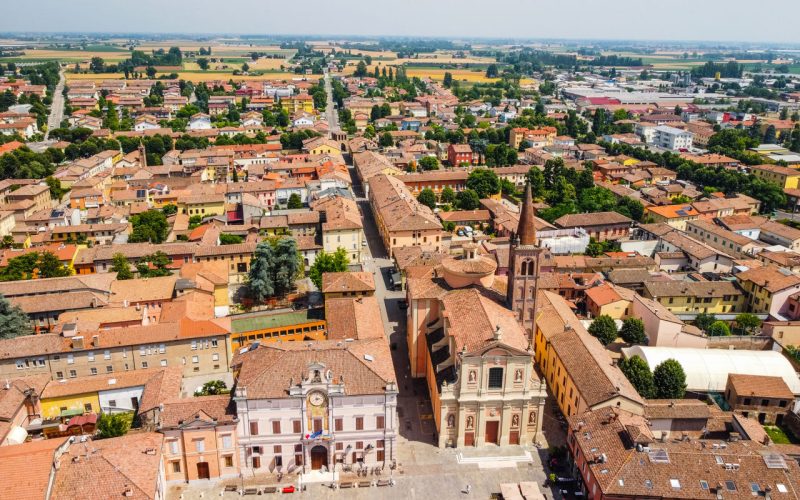
Pieve di Cento, near Bologna: a substantial mixed-use hospitality property enters the judicial sales market. The transaction raises critical questions for investors, hospitality funds and hotel operators concerning operational continuity, real estate valuation, capital expenditure requirements and the financial sustainability of a potential turnaround.
23 November 2026 | InvestimentiAlberghieri.it — Hospitality Investment & Asset Advisory
A €4.74 Million Hotel Asset: The Judicial Sale of a Major Hospitality Complex Near Bologna
A substantial hospitality property located at 42 Via Ponte Nuovo, Pieve di Cento, in the province of Bologna, has been offered for sale as part of judicial liquidation proceedings No. 113/2026 before the Court of Rome, involving Grand Hotel Sole S.r.l.
The sale notice, published on 19 November 2026, concerns an extensive mixed-use real estate complex associated in the sale documentation with the RHI Porta Bologna Hotel, comprising a reported 140 guestrooms alongside conference, restaurant, leisure, wellness and other complementary facilities.
The reserve price has been set at €4,740,000, with bids due by 28 December 2026 and the online auction scheduled for 29 December 2026.
The transaction deserves considerably more attention than a conventional hotel property sale announcement.
The scale of the complex, its multiple operating functions and the involvement of judicial liquidation proceedings require an assessment that distinguishes at least four separate dimensions:
-
The underlying value of the real estate.
-
The economic value of the hospitality and ancillary operations that could potentially be undertaken.
-
The contractual, ownership and operating arrangements affecting the property.
-
The investment required to secure operational continuity, regulatory compliance and commercial repositioning.
The purchase price is not necessarily the same as the economic value of the investment.
This distinction should form the starting point of any professional assessment of a hospitality asset being sold through insolvency proceedings.
Through Investhotel.it, the analysis of hotel real estate investment opportunities brings together the underlying property fundamentals and the economics of hotel operations, rather than treating the physical characteristics of an asset as sufficient evidence of its investment potential.
Grand Hotel Sole S.r.l.: What the Judicial Proceedings Reveal
According to the information published by the appointed sales platform, the proceedings concern Grand Hotel Sole S.r.l., which entered judicial liquidation on 5 February 2026.
The competent court is in Rome, while the property offered for sale is located in Emilia-Romagna.
Key Transaction Details
| Indicator | Details |
|---|---|
| Company in judicial liquidation | Grand Hotel Sole S.r.l. |
| Proceedings | Judicial Liquidation No. 113/2026 |
| Court | Rome |
| Property address | 42 Via Ponte Nuovo, Pieve di Cento (Bologna) |
| Region | Emilia-Romagna, Italy |
| Hotel identified in the documentation | RHI Porta Bologna Hotel |
| Reported guestrooms | 140 |
| Reserve price | €4,740,000 |
| Minimum acceptable bid | €4,740,000 |
| Minimum bid deposit | 15% of the amount offered |
| Minimum bid increment | €10,000 |
| Bid submission deadline | 28 December 2026, 12:00 noon |
| Online auction | 29 December 2026, 12:00–16:00 |
| Sale notice publication | 19 November 2026 |
The property is offered as a single lot under the specific terms established by the judicial proceedings.
Importantly, the minimum acceptable bid is equal to the reserve price. The 25% discount permitted in certain other Italian judicial sale procedures should therefore not be automatically applied to this transaction.
Primary source: Fallco Aste — Hospitality Property in Pieve di Cento.
A Mixed-Use Hospitality Asset: Much More Than a Hotel
One of the most significant aspects of the transaction is the composition of the property itself.
According to the description published by the sales administrator, the complex includes:
-
A five-storey hotel with 140 reported guestrooms.
-
Reception areas, conference facilities and technical rooms.
-
A multipurpose venue with retractable seating for approximately 1,000 people.
-
Restaurant and pizzeria facilities.
-
Medical, fitness and beauty treatment areas.
-
An indoor swimming facility.
-
A nightclub.
-
A former bingo hall, described as unused.
-
Gaming and commercial premises.
-
Covered structures, parking areas and other ancillary spaces.
This configuration creates a level of operating complexity considerably greater than that of a conventional standalone hotel.
An asset of this nature cannot be assessed solely by reference to its room count.
Its overall profitability depends on the ability to coordinate several revenue-generating activities, each with different operating requirements, cost structures, capital expenditure needs and target markets.
A credible repositioning strategy would therefore need to assess the hotel, conference, restaurant, wellness, leisure and commercial components separately.
The central question is whether these activities can generate sustainable incremental profitability or whether they create fixed costs and capital requirements that are disproportionate to achievable demand.
A large hospitality complex does not automatically constitute a profitable hospitality business.
Its economic value depends on how effectively its various components can be integrated into a coherent operating and investment strategy.
Judicial Liquidation and Hotel Operations: Two Fundamentally Different Issues
A particularly important consideration is the distinction between the company involved in the judicial liquidation and the entities that may currently occupy or operate parts of the property.
The proceedings concern Grand Hotel Sole S.r.l.
The property itself is associated in the sales documentation with the RHI Porta Bologna Hotel.
It would be incorrect to assume that the company operating the hotel is necessarily the same legal entity as the company undergoing judicial liquidation.
Similarly, the existence of an active hotel website does not, by itself, establish that the property is fully operational on the date of this analysis.
For a prospective investor, understanding the contractual and operational position of the property is one of the most important elements of due diligence.
The following questions must be addressed:
-
Who legally owns the real estate and the movable assets included in the sale?
-
Which entities currently occupy or use the various parts of the complex?
-
Are there existing property leases, business leases, management agreements or other occupancy arrangements?
-
Which contractual rights would remain enforceable against a purchaser?
-
Which operating licences and hospitality authorisations remain valid?
-
Under what conditions could existing activities continue, be reorganised or be restarted?
These matters must be clarified before any acquisition decision.
The judicial liquidation of a property-owning company does not necessarily result in the closure of the hotel business.
Equally, a building legally designated for hospitality use is not necessarily ready to operate without further investment.
The distinction can have a material impact on transaction value.
Is €4.74 Million an Attractive Price? Why Price per Room Can Be Misleading
A preliminary calculation can be made by dividing the reserve price by the reported number of guestrooms.
€4,740,000 ÷ 140 rooms = approximately €33,857 per room.
At first glance, this figure may appear relatively low compared with the capital typically associated with developing new hotel accommodation.
However, such a comparison has a fundamental limitation.
The reserve price relates to a mixed-use property complex, not simply to 140 hotel rooms.
Attributing the entire price to the guestrooms would disregard the other buildings and facilities included in the sale.
Furthermore, a price-per-room calculation does not account for:
-
The physical condition of the buildings.
-
Planning, building and regulatory compliance.
-
Required capital expenditure.
-
Actual possession and availability of the premises.
-
Current and prospective operating profitability.
-
Contractual obligations and restrictions.
-
Transaction costs and repositioning requirements.
The figure of €33,857 per room should therefore be regarded as a descriptive ratio derived from the reserve price, not an independent hotel valuation or a comparable market benchmark.
A professional investor should instead establish the property's value through an integrated assessment of sustainable income, capital requirements, operating risks and projected cash flows.
How Much Revenue Could a 140-Room Hotel Generate? Three Illustrative Scenarios
To understand the potential economic scale of the hotel component, three hypothetical operating scenarios can be considered.
These assumptions do not represent verified historical results, actual trading performance or reliable forecasts for the property.
They are intended solely to illustrate how changes in occupancy and average room rate can affect revenue generation.
Illustrative Room Revenue Model
| Indicator | Conservative | Base Case | Upside Case |
|---|---|---|---|
| Available rooms | 140 | 140 | 140 |
| Operating days | 365 | 365 | 365 |
| Occupancy | 45% | 60% | 70% |
| Average Daily Rate (ADR) | €75 | €90 | €105 |
| Annual room revenue | €1,552,163 | €2,759,400 | €3,756,375 |
Room revenue is calculated using the following formula:
Available Rooms × Operating Days × Occupancy × ADR
The difference between the conservative and upside scenarios exceeds €2.2 million in annual room revenue.
This illustrates how strongly a hotel's financial performance can depend on commercial positioning, revenue management and its ability to capture market demand.
It does not establish that the upside scenario is achievable in Pieve di Cento.
Validating these assumptions would require a detailed examination of local corporate and conference demand, competitive hotel supply, accessibility to Bologna and Ferrara, seasonal demand patterns and the property's realistic market positioning.
From Revenue Generation to Operating Profitability
Revenue is only the first stage of the financial assessment.
A credible business plan must also account for payroll, utilities, maintenance, distribution costs, outsourced services and the operating expenses associated with ancillary departments.
Particular attention should be paid to distinguishing three different financial measures.
Gross Operating Profit (GOP): The operating result of the hotel before certain non-operating, ownership-related and financing costs, depending on the reporting framework applied.
Normalised EBITDA: A measure of operating earnings adjusted, where appropriate, to reflect the actual business structure, contractual arrangements and relevant recurring expenses.
Available Cash Flow: The cash generated after the applicable operating outflows, recurring capital requirements and other relevant financial commitments.
These measures are not interchangeable.
A hotel can generate substantial revenue while failing to deliver an adequate return on invested capital.
This is why revenue potential must always be considered alongside operating margins, capital expenditure and investment risk.
Capital Expenditure: The Factor That Could Fundamentally Change the Investment Case
An apparently attractive acquisition price can become considerably less compelling once the capital required to restore, upgrade or reposition the asset is taken into account.
For this reason, any assessment of the Grand Hotel Sole property should include a comprehensive technical review of the buildings, equipment and operating infrastructure.
Potential expenditure may involve guestrooms, public areas, mechanical and electrical systems, fire safety, furniture, fixtures and equipment, technology infrastructure and ancillary facilities.
To demonstrate the potential impact of refurbishment expenditure, consider three hypothetical investment scenarios.
Illustrative Total Capital Commitment
| Item | Scenario A | Scenario B | Scenario C |
|---|---|---|---|
| Acquisition at reserve price | €4,740,000 | €4,740,000 | €4,740,000 |
| Hypothetical CAPEX | €1,500,000 | €3,000,000 | €5,000,000 |
| Total capital before additional costs | €6,240,000 | €7,740,000 | €9,740,000 |
Illustrative scenarios only. The property's actual capital expenditure requirements have not been independently established. The calculations exclude transfer taxes, transaction expenses, professional fees, potential liabilities, working capital and financing costs.
The table highlights a fundamental investment principle: the acquisition price may represent only one component of the total capital commitment.
A proper assessment must also examine the restrictions and conditions imposed by the judicial sale.
In particular, alternative-use strategies or real estate conversions should never be assumed feasible without first verifying the applicable planning regulations and any contractual or procedural restrictions.
A lower acquisition price does not necessarily translate into a higher investment return.
The relevant question is whether the total capital deployed can generate an acceptable risk-adjusted return.
Direct Operation, Business Lease or Management Agreement: Which Model Creates the Most Value?
Acquiring a hospitality complex of this size does not necessarily mean that the investor must directly operate every business activity.
Several operating structures may be considered.
Direct Hotel Operation
The investor retains control over hotel operations, revenue generation and cost management.
This structure provides direct exposure to improvements in operating performance but also involves assuming the associated commercial and operational risks.
Hotel Business Lease
A third-party operator manages the business under an agreement that may provide for fixed, variable or hybrid rental payments.
The sustainability of the lease must be assessed against the operating company's ability to generate sufficient earnings and cash flow.
Hotel Management Agreement
The owner retains economic exposure to the business while appointing a specialist operator to manage the property under contractually defined responsibilities, performance targets and remuneration arrangements.
Integrated or Separately Managed Operations
Different components of the property may be operated under distinct contractual or organisational arrangements, provided that the applicable legal, planning and technical conditions allow such a structure.
The most appropriate model should not be selected solely on the basis of investor preference.
It should emerge from a comparison of projected profitability, capital requirements, risk allocation and the capabilities of prospective operators.
In this context, HotelManagementGroup.it provides a relevant framework for exploring professional hotel operations, organisational efficiency and performance management.
Tailored Hotel Advisory: Bringing the Efficiency of International Hotel Chains to Independent Properties
The Pieve di Cento transaction raises a broader issue affecting a substantial part of Italy's independent hotel sector.
A hotel's underlying problem is not always its real estate. In many cases, it is the gap between the asset's economic potential and the performance delivered by its existing operating model.
This distinction becomes particularly important when a property experiences a change in ownership, financial restructuring or operational discontinuity.
Acquiring a hotel building does not automatically create a profitable hotel business.
Value creation requires a coordinated strategy covering market positioning, revenue management, distribution, staffing, financial controls, budgeting and performance measurement.
Major international hotel groups benefit from established systems and procedures designed to address these issues systematically.
However, professional operating efficiency does not necessarily require affiliation with an international brand.
Independent hotels can adopt structured management practices while preserving their individual identity, ownership structure and distinctive market positioning.
Roberto Necci's Advisory Approach: Improve the Operating Model Before Deciding the Property's Future
This principle is explored in greater depth in the following analysis:
TAILORED HOTEL ADVISORY: THE EFFICIENCY OF MAJOR HOTEL CHAINS WITHOUT SACRIFICING YOUR HOTEL'S IDENTITY
The approach is particularly relevant to hotel acquisitions, business turnarounds and the repositioning of underperforming hospitality assets.
Before deciding how much to invest in a hotel, investors must first understand what that hotel could realistically generate under an appropriate operating model.
Tailored hotel advisory addresses this challenge through an integrated assessment of business performance, organisational structure, profitability and investment requirements.
For an investor evaluating the Pieve di Cento complex, such an approach could involve the following stages:
-
Preliminary assessment of the property and available documentation.
-
Review of the financial, ownership and contractual position.
-
Market analysis and evaluation of achievable demand.
-
Assessment of refurbishment and capital expenditure requirements.
-
Comparison of alternative operating and management structures.
-
Preparation of a business plan and investment return analysis.
-
Development of a value-enhancement or repositioning strategy.
The purpose of professional advisory is not to produce an optimistic forecast.
It is to provide investors with the analytical framework and quantitative evidence required to determine whether to acquire an asset, how much capital to commit, which operating model to adopt and what financial results may reasonably be achievable.
For further information on this methodology and related professional services, visit RobertoNecci.it.
Five Essential Due Diligence Areas Before Acquiring a Hotel Through Judicial Liquidation
The Grand Hotel Sole case illustrates five areas that should be addressed before any binding investment commitment.
1. Real Estate and Planning Due Diligence
Review of ownership titles, permitted uses, building and cadastral compliance, technical systems and applicable restrictions.
2. Contractual Due Diligence
Assessment of property leases, business leases, management agreements, occupancy rights and their enforceability against a prospective purchaser.
3. Financial and Operating Due Diligence
Review of historical financial performance, where available, operating expenses, financing requirements and realistic earnings potential.
4. Technical Due Diligence and CAPEX Assessment
Identification of the investment required for safety, regulatory compliance, refurbishment, modernisation and commercial repositioning.
5. Business Planning and Exit Strategy
Assessment of expected returns, debt service capacity, cash flow generation and potential medium- to long-term investment value.
Without these investigations, an investor risks confusing a relatively low entry price with an economically attractive acquisition.
A properly structured assessment can instead identify the conditions under which an asset may generate sustainable returns.
Grand Hotel Sole: A Case Study in the Transformation of Italy's Hospitality Real Estate Market
The sale of the Pieve di Cento complex provides a relevant case study for Italy's hospitality investment market.
Its significance lies not only in the scale of the property or its €4.74 million reserve price, but also in the complexity of the underlying investment proposition.
A prospective purchaser should not simply ask whether €4.74 million represents an attractive acquisition price.
The essential questions are which parts of the property can generate sustainable income, which activities are commercially viable, what capital expenditure is required and which contractual arrangements can best protect the investment.
The judicial liquidation proceedings make it particularly important to distinguish real estate ownership, contractual rights and the continuity of business operations.
A hotel's value cannot be measured solely by its floor area, room count or asking price. Its true economic value is determined by the scale, quality and sustainability of the cash flows it can generate.
This is why hospitality assets offered through judicial liquidation or affected by financial and organisational discontinuity require an integrated combination of real estate valuation, financial analysis and hotel management expertise.
That integration lies at the heart of a professional approach to hospitality investment.
Acquiring, Investing in or Repositioning a Hotel? Start with an Independent Assessment
Are you a hotel owner, real estate investor, hospitality operator or investment professional evaluating the acquisition or repositioning of a hospitality asset?
A hotel investment should begin with a structured assessment of the property's economic, financial and operating potential.
Professional advisory services may include:
-
Preliminary assessment of hotel acquisition opportunities.
-
Hotel business and hospitality real estate valuation.
-
Feasibility studies and business planning.
-
Profitability analysis and cash flow modelling.
-
CAPEX assessment and refurbishment scenarios.
-
Comparison of direct operation, business leases and management agreements.
-
Asset repositioning and value-enhancement strategies.
-
Assessment of distressed hospitality assets, insolvency proceedings and ownership or management transitions.
The advisory process is not dependent on acting as a real estate intermediary. Its purpose is to support informed investment decisions through independent analysis, financial modelling and professional evaluation.
Discover How Independent Hotels Can Benefit from the Efficiency of International Hotel Chains
Request a Confidential Preliminary Assessment
Email: info@investimentialberghieri.it
To facilitate an initial review, please provide the property's location, asset type, approximate size and the principal investment or strategic issue requiring assessment.
Professional Resources
RobertoNecci.it — Strategic hospitality advisory, hotel management and business performance improvement.
Investhotel.it — Hotel investment opportunities, hospitality asset analysis and value-enhancement strategies.
HotelManagementGroup.it — Professional hotel management, operational efficiency and performance optimisation.
Sources and Methodological Notes
Documentary Sources
-
Fallco Aste — Hospitality Property in Pieve di Cento, Judicial Liquidation No. 113/2026.
-
Creditors' Portal — Grand Hotel Sole S.r.l., Judicial Liquidation No. 113/2026.
Methodological Disclaimer
The information concerning the judicial proceedings and the property's reported characteristics is based on the cited sources. The revenue and CAPEX scenarios are illustrative only and do not constitute certified valuations, verified historical financial results, market appraisals or forecasts for the property.
The hotel's current operating status, contractual relationships with occupants, applicable restrictions and conditions of transfer require a full review of the relevant documentation and independent verification.
Prospective purchasers should review the latest official sale notice and obtain appropriate legal, technical and financial due diligence before making any investment decision.