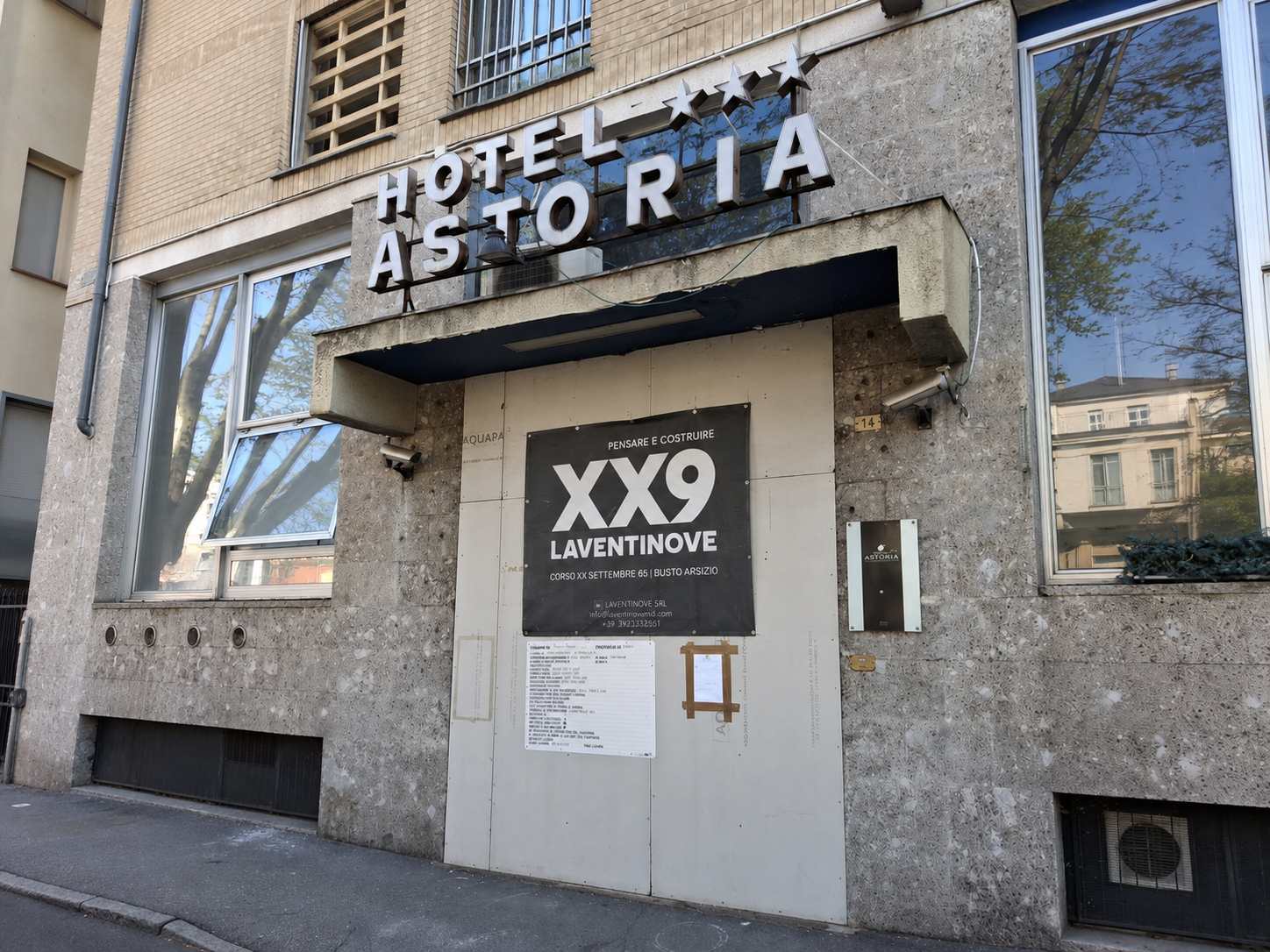
The redevelopment of the historic hotel on Viale Duca D’Aosta is progressing at a slower pace. The case offers a useful opportunity to examine one of the most underestimated risks in hotel redevelopment: committing to the real estate investment before the operating model has been fully defined.
The starting point
Hotel Astoria in Busto Arsizio belongs to a category of properties that hotel investment professionals immediately recognise: a central location, strong local recognition, a historically established hospitality use, and a long period of inactivity that still needs to be converted back into value.
Opened in 1959 on Viale Duca D’Aosta, just a short distance from the city centre and courthouse, the Astoria was for decades one of Busto Arsizio’s best-known hotels and conference venues. It later closed and remained inactive for years, becoming part of the broader phenomenon of the city’s “ghost hotels” previously documented by La Prealpina.
A turning point came in 2025, when the property was acquired by Laventinove Srl, a Busto Arsizio-based company led by architects Paolo Cerè and Katia Mantovani, which began the redevelopment process.
Public statements at the time indicated completion around mid-2026, with the first rooms expected to be finished by the end of 2025.
One aspect of the project was particularly relevant from a hotel investment perspective: Laventinove intended to retain ownership of the property, while hotel operations would be entrusted to a third-party operator that had yet to be identified.
The construction timetable has since slowed and work is now progressing at a reduced pace (source: La Prealpina).
There is no publicly available evidence sufficient to establish that the slowdown is linked to the absence of an appointed operator.
But that very circumstance provides the opportunity to address a much broader issue.
What happens when the real estate investment moves ahead before the hotel’s operating structure has been fully defined?
The real risk: a PropCo without a defined OpCo
There is a recurring methodological mistake in Italian hotel redevelopment.
It is not necessarily about architectural quality.
It is not necessarily about access to capital.
It is about the sequence in which decisions are made.
In a properly structured hotel investment, the property design should be aligned from the outset with the intended operating model.
Room count and mix, the size of common areas, breakfast facilities, restaurant space, meeting rooms, back-of-house areas, laundry facilities, storage, plant and equipment, FF&E, staff circulation and technology standards are not merely architectural decisions.
They are economic variables.
They affect the cost per key.
They affect staffing requirements.
They affect the RevPAR required to reach break-even.
They affect GOP and EBITDA.
Ultimately, they affect the value of the asset itself.
For this reason, the real estate design should flow from a credible operating business plan, not the other way around.
When the order is reversed — the property is acquired, the project is designed, construction begins and only then does the search for an operator start — the risk of having to adapt the product retrospectively increases significantly.
That is when costs can begin to escalate.
1. The design brief remains open for too long
Without an operator, brand or at least a clearly identified operating concept, many decisions can remain subject to change.
How many rooms?
What average room size?
Which market segment?
How much space should be allocated to food and beverage?
Is a meeting room genuinely needed?
How large should the kitchen be?
Which technology standards are required?
What is the right balance between guestrooms and common areas?
These questions may appear architectural.
In reality, they are first and foremost profit-and-loss questions.
Because every square metre dedicated to a low-revenue function must ultimately be supported by revenue generated elsewhere in the property.
2. Variations can destroy margin
Bringing an operator into the process after the project has already advanced can trigger a series of design changes.
A room that is too small.
A bathroom that needs to be redesigned.
A corridor that does not meet brand standards.
Insufficient back-of-house space.
A reception desk in the wrong location.
A building system that does not comply with the operator’s specifications.
Individually, these may look like minor details.
Across dozens of rooms, they become CAPEX.
And a variation introduced during construction almost always costs more than making the same decision at the design stage.
The mistake is not spending money. It is spending it twice.
3. Time changes negotiating power
There is also a less visible but strategically important factor.
The moment at which the operating agreement is negotiated.
An owner with a property still at the planning stage can negotiate with a reasonable degree of flexibility.
An owner facing an open construction site, capital already deployed, financing costs accumulating and an opening date that keeps moving enters the same negotiation from a very different position.
Time becomes a bargaining variable.
And whenever one party needs the agreement more urgently than the other, the price of that urgency almost always ends up embedded in the contract.
It may appear in the form of:
-
a lower rent;
-
stronger guarantees requested by the operator;
-
greater owner contribution to CAPEX;
-
higher management fees;
-
operator incentives;
-
more favourable termination rights;
-
rent-free periods;
-
additional FF&E investment.
The economic cost of delay can therefore appear in places where it is never recorded as a construction cost.
The cost of time is not measured in months
When a hotel construction project slows down, its economic cost is not simply the additional time required to complete the works.
It emerges through at least four different channels.
Carrying costs
Financing costs, property taxes, insurance, security, utilities, professional fees, maintenance and site costs continue to accumulate while the property generates no revenue.
It is tied-up capital.
And tied-up capital always has a cost.
Revenue that will never be recovered
Every month of delayed opening represents lost productive capacity.
In hospitality, time cannot be recovered.
A room that went unsold on 15 October 2026 cannot be sold twice on 15 October 2027.
Hotel inventory is perishable.
A three-month delay does not simply mean “revenue starts three months later”.
It means that those three months of revenue will never exist.
CAPEX escalation
A slowdown can generate:
-
price revisions;
-
contractor rescheduling;
-
expired quotations;
-
higher materials and supply costs;
-
loss of workforce availability;
-
additional professional fees;
-
design variations.
A stop-start construction programme is generally less economically efficient than a continuous one.
Deal fatigue
There is also a cost that is difficult to see in financial statements.
It is the reputational cost of the transaction itself.
When an asset remains in the market for too long while searching for an operator, investor or partner, prospective counterparties inevitably begin to ask:
“Why has nobody taken it yet?”
This is what can be described as deal fatigue.
The property may not have changed.
Its fundamentals may be exactly the same.
But market perception has.
And in relatively illiquid markets such as hotel real estate, perception can affect pricing almost as much as fundamentals.
Busto Arsizio: why the fundamentals remain interesting
The slowdown of the project does not necessarily imply that the location itself has become less attractive.
On paper, Busto Arsizio continues to benefit from several credible demand drivers.
The first is Milan Malpensa Airport, together with the broader economic and logistics ecosystem that surrounds it.
The second is Fiera Milano Rho, which can create significant compression and rate peaks during major trade fairs and events.
The third is the industrial base of the wider Alto Milanese area, which supports predominantly weekday corporate and business demand.
This is therefore a market that may support an efficient hotel product, provided that positioning, room count, service level and cost structure are designed around the actual demand base.
The key issue is not simply whether Busto Arsizio is an attractive hotel market.
The more relevant question is:
What kind of hotel can generate the strongest economic return in this specific location?
Those are two very different questions.
And every hotel investment should begin with the second.
Business plan first, bricks second
For a project of this kind, the ideal sequence should include the following stages.
1. Feasibility study before the investment
The highest and best use should not be determined solely by the available building volume.
The first task is to identify which hotel product the market can genuinely support.
2. Operating business plan
ADR, occupancy, RevPAR, ancillary revenue, payroll costs, GOP, EBITDA and funding requirements should all be modelled before the property design is frozen.
Because room count is an economic outcome, not simply a planning exercise.
3. Operator market sounding
Before construction begins, it is useful to test the market and understand which operators may be interested in the asset and on what terms.
A final agreement may not yet be necessary.
But the owner should know whether the product being designed is consistent with what operators are actually willing to manage.
4. Term sheet
A preliminary agreement can already establish:
-
economic structure;
-
term;
-
guarantees;
-
rent;
-
management fees;
-
performance tests;
-
CAPEX contributions;
-
FF&E reserve;
-
product standards;
-
termination provisions.
It is far easier to modify a drawing than a completed building.
5. Aligned detailed design
Only then should the final project be locked.
At that stage, architect, owner, hotel advisor and future operator are all designing the same product.
6. An industrial opening schedule
The development timetable should not end with the handover of the building.
It should also cover:
-
completion of construction;
-
FF&E installation;
-
IT systems;
-
recruitment;
-
sales;
-
distribution;
-
pre-opening;
-
soft opening;
-
commercial opening;
-
ramp-up.
Because a hotel does not deliver a building. It delivers a profit and loss account.
Where value is really created
Real estate investors naturally tend to focus on:
acquisition price + CAPEX + completed asset value.
Hospitality requires another equation:
revenue − operating costs = the asset’s ability to remunerate invested capital.
It is this second equation that determines whether the first one is sustainable.
A beautifully renovated hotel that cannot generate EBITDA consistent with the capital invested is not a successful hotel investment.
It is simply an expensive building with guestrooms inside it.
The investor’s perspective
The Astoria case also highlights a particularly interesting asset category: hotels undergoing redevelopment where the real estate project is already advanced but the operating model still needs to be fully structured.
These are not necessarily distressed assets.
However, they may reach a stage in which:
-
a significant share of CAPEX has already been deployed;
-
planning and permitting risk has been reduced;
-
some construction uncertainties have already been resolved;
-
financing costs continue to accrue;
-
the owner has a stronger incentive to complete the operating structure of the deal.
For an investor, operator or advisor capable of bringing the industrial component into the transaction, this may be precisely the stage at which negotiating leverage becomes more attractive.
Capital alone is no longer enough
In many Italian hotel transactions, capital is no longer the only scarce resource.
Increasingly valuable is the ability to convert that capital into:
the right product → the right operator → a sustainable contract → EBITDA → real estate value.
It is a chain.
If one link is designed after all the others, risk increases.
This is why proper hotel due diligence should not ask only:
“How much does it cost to acquire this property?”
It should first ask:
“What kind of hotel business can operate profitably inside this building?”
Only then does price become meaningful.
Further reading
For further analysis of hotel investment and operating structures:
-
Investhotel covers hotel acquisitions, repositioning, turnaround strategies and the enhancement of hospitality assets.
-
Hotel Management Group explores operating models, hotel leases, management agreements, PropCo/OpCo structures and hotel advisory.
-
robertonecci.it brings together publications, analysis and case studies on hotel economics, operations and investment.
Are you evaluating a closed hotel, a redevelopment project or a hospitality asset in need of repositioning?
Before completing the real estate investment, it is essential to determine which operating model can economically support the value of the property.
We advise owners, investors and operators on:
-
feasibility studies;
-
hotel business planning;
-
hotel valuations;
-
PropCo/OpCo structuring;
-
operator search and selection;
-
hotel lease and management agreement negotiations;
-
redevelopment and conversion projects;
-
turnaround and repositioning strategies.
Contact: info@investimentialberghieri.it
We work on a mandate basis, with fee structures aligned to the nature of each transaction and, where appropriate, performance-related components.
Roberto Necci - r.necci@robertonecci.it
Source: La Prealpina — “Busto, hotel Astoria in stand by: i lavori vanno a rilento”.
The observations contained in this article are intended as a general analysis of the economic and operating dynamics relevant to hotel redevelopment projects. They do not constitute an assessment of the specific Hotel Astoria transaction or a judgment on the actions of the parties involved. References to the project are based exclusively on publicly available information.