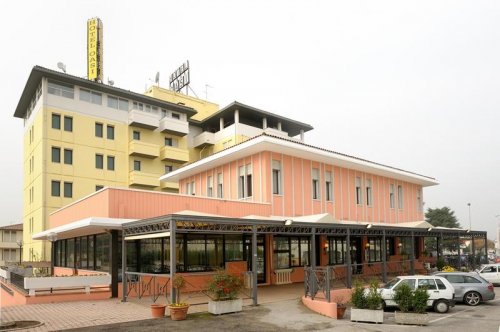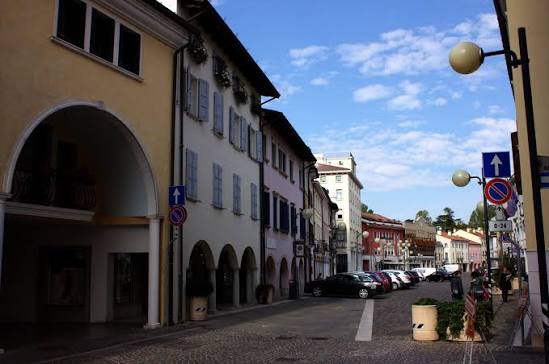
In Latisana, in the province of Udine, 100% of the share capital of the company owning Hotel Bella Venezia is being offered for sale. The reserve price is €1.2 million. But this is not a straightforward real estate transaction: the buyer would acquire a company that owns the hotel, bar and restaurant, while the operating businesses are currently leased to third-party operators under two separate business lease agreements.
This structure turns the transaction into a genuine hospitality corporate real estate case, where value sits at the intersection of:
real estate + corporate structure + contracts + operations + CAPEX + future optionality.
The asset is Hotel Bella Venezia, located in Latisana, in the province of Udine, north-eastern Italy.
The sale concerns 100% of the share capital of DE.MA. Servizi Srl, the company that owns the complex.
Key Transaction Figures
Reserve price: €1,200,000
Rooms: 23
Bed capacity: 49
Additional facilities: manager’s apartment, bar and restaurant
Offer deadline: 13 October 2026, 12:00 p.m.
Competitive sale: 14 October 2026, 10:00 a.m.
Restaurant business lease expiry: 31 December 2026
Hotel and bar business lease expiry: 31 December 2027
The available documentation also refers to furniture, equipment and operating licences connected with the businesses.
But the key issue lies elsewhere.
This is not simply the acquisition of a hotel.
It is the acquisition of a company that owns hospitality assets whose current economic use is governed by contracts with third-party operators.
That distinction fundamentally changes the due diligence process.
An Asset Deal and a Share Deal Are Not the Same Thing
In hospitality investment, there is a fundamental difference between:
acquiring a property
and
acquiring the company that owns the property.
In an asset deal, the transaction is primarily focused on the underlying asset.
In a share deal, the investor acquires the company's equity and, with it, its wider financial, tax, legal and contractual perimeter.
This is why:
Equity Value ≠ Property Value
The value of the shares should be assessed by considering:
**real estate value
-
other assets
-
cash
-
receivables
– financial debt
– tax liabilities
– trade payables
– other liabilities
± economic value of existing contracts**
The €1.2 million reserve price therefore cannot automatically be interpreted as the value of the underlying real estate.
It is the entry point into the transaction.
€52,000 per Room? A Deceptively Simple Number
Dividing €1.2 million by 23 rooms produces a theoretical figure of approximately:
€52,000 per key.
At first sight, that may appear compelling.
But it can also be misleading.
The price relates to 100% of the company’s share capital, not simply to the hotel real estate.
Before using price per key as a meaningful valuation metric, an investor would need to understand:
-
the standalone value of the property;
-
net financial position;
-
receivables and liabilities;
-
tax exposure;
-
required CAPEX;
-
terms of the business leases;
-
value of licences and other assets.
The arithmetic is straightforward.
The valuation is not.
The Two Business Leases Are at the Heart of the Investment Case
The available documentation refers to two separate arrangements.
Restaurant Business
Stated expiry:
31 December 2026
Hotel and Bar Business
Stated expiry:
31 December 2027
This means that the buyer may not obtain immediate direct operational control over the entire property.
Before investing, the following should therefore be reviewed carefully:
-
rent levels;
-
remaining contract duration;
-
guarantees;
-
maintenance obligations;
-
responsibilities of each party;
-
renewal provisions;
-
termination clauses;
-
investments funded by the operators;
-
licensing status;
-
responsibilities for common areas;
-
relationships with employees and suppliers.
In this transaction, the contracts are not ancillary documentation.
They are part of the asset value itself.
Contracted Rent vs Market Rent
A business lease can create value.
It can also restrict it.
The answer depends on one key relationship:
Contracted Rent vs Market Rent
If the contractual rent is aligned with or above market levels, and the operator is financially sound, the property owner may benefit from a relatively predictable income stream.
If, however, the contracted rent sits materially below the economic capacity of the business, the owner may be locked temporarily into a sub-optimal return.
The analysis should therefore consider:
Annual Rent / Invested Capital = Contractual Yield
and compare it with:
-
expected real estate yield;
-
normalised EBITDA;
-
operator EBITDAR;
-
market value of the operating business;
-
future CAPEX;
-
remaining lease duration.
Value does not sit only in the bricks and mortar.
It also sits in the contractual framework governing how those assets are used.
Sustainable Rent: The Operator Must Be Able to Afford the Lease
Once the current contracts expire, the owner may decide to re-let the businesses.
At that point, the right question is not:
“What is the highest rent the property can command?”
It is:
“What is the maximum sustainable rent the business can support without weakening the operator?”
The analysis should begin with EBITDAR.
Rent must leave sufficient headroom to:
-
support operations;
-
remunerate operating capital;
-
absorb volatility;
-
fund routine investments;
-
maintain service quality.
An excessive rent may improve the landlord’s theoretical return while simultaneously undermining the operator’s financial sustainability.
Three Scenarios After the Current Leases Expire
The investment case should be modelled under at least three different operating structures.
Scenario 1 — Property Ownership with Business Lease
The owner retains a predominantly property-investment role.
The operator assumes the operating risk.
Returns are generated mainly through rent.
The key metrics become:
-
rent coverage;
-
tenant creditworthiness;
-
indexation;
-
contract duration;
-
guarantees;
-
landlord-funded CAPEX.
This model is closer to real estate income investing.
Scenario 2 — New Business Lease with a Different Operator
At expiry, the buyer could appoint a new operator.
In this case, value depends on establishing the correct:
Sustainable Rent
A new contract can create value if:
-
the product is competitive;
-
underlying demand is adequate;
-
the operator has strong commercial capabilities;
-
rent remains compatible with EBITDAR.
Rent should not be determined by the owner’s desired return.
It should be determined by the economics of the hotel.
Scenario 3 — Management Contract or Direct Operation
A third alternative would be to change the model entirely.
The owner could consider:
-
direct operation;
-
management contract;
-
white-label operator;
-
franchise;
-
hybrid structure.
Under these models, returns are no longer primarily generated by fixed rent.
The owner becomes more directly exposed to operating performance.
The analysis must therefore begin with:
ADR × Occupancy = RevPAR
and then assess:
-
room revenue;
-
F&B revenue;
-
ancillary revenue;
-
payroll;
-
energy;
-
distribution;
-
marketing;
-
GOP;
-
management fees;
-
EBITDA.
This is where the operational analysis developed through HotelControl.it and HotelManagementGroup.it becomes particularly relevant.
Hotel and Restaurant: One Property, Two Different Economics
The presence of two separate business leases creates a typical hospitality challenge.
To the guest, the hotel, bar and restaurant form part of a single experience.
Economically, however, they may be operated by different parties.
This raises fundamental questions:
-
Who manages breakfast?
-
Who controls banqueting?
-
How are shared utility costs allocated?
-
Who maintains common areas?
-
Who owns the customer experience?
-
Who funds refurbishments?
-
Who controls reputation and brand positioning?
An asset can be physically integrated but commercially fragmented.
And that fragmentation can erode value.
CAPEX: Who Funds the Next Investment Cycle?
Every hotel requires recurring investment.
Guestrooms, bathrooms, plant and machinery, kitchens, technology and public areas all have different economic life cycles.
Where third-party operators are involved, responsibilities should be clearly separated between:
Structural CAPEX
Major structural and building-services investment.
FF&E CAPEX
Furniture, fixtures, equipment and operating assets.
Operating CAPEX
Expenditure required to maintain day-to-day operational quality.
Repositioning CAPEX
Investment designed to change the hotel’s product or market positioning.
The owner’s real return must be calculated after deducting the CAPEX it is ultimately required to fund.
A high rent may appear attractive until it is compared with the reinvestment required to preserve the underlying asset.
From Acquisition Price to Total Cost Basis
The investment does not end with the purchase price.
The relevant metric is the:
Total Cost Basis
which should include at least:
**Acquisition Price
-
Transaction Costs
-
Corporate Due Diligence
-
Legal Due Diligence
-
Tax Due Diligence
-
Technical Due Diligence
-
CAPEX
-
Working Capital
-
Financing Costs
-
Contingency**
Returns should be measured against this total capital commitment.
This is the principle applied by InvestimentiAlberghieri.it when analysing hospitality investment cases.
In This Transaction, Corporate Due Diligence Comes Before Hotel Valuation
A conventional property appraisal would not be enough.
At least seven areas need to be reviewed simultaneously.
Corporate
Articles of association, governance, share capital, corporate records and litigation.
Financial
Debt, receivables, cash, liabilities and net financial position.
Tax
Tax position, outstanding liabilities and potential exposures.
Legal
Business leases, guarantees, licences and contractual provisions.
Technical
Property condition and future CAPEX.
Operational
Historical and potential hotel performance.
Market
ADR, occupancy, RevPAR, competitors and local demand.
In a share deal:
an unidentified liability can be worth more than the discount achieved on the purchase price.
What Is Hotel Bella Venezia Actually Worth?
The analysis should compare at least three different valuation approaches.
1. Real Estate Value
What is the standalone value of the property?
2. Income Approach
What is the value of the cash flows generated by the existing leases?
3. Optimised Hotel Value
What could the property be worth under an optimised operating structure?
This allows the investor to distinguish:
As Is Value
from:
Optimised Value
The difference represents potential value creation.
But only if the required CAPEX and transformation costs are lower than the incremental value generated.
The Real Upside May Emerge After 2027
The stated expiry of the hotel and bar lease on 31 December 2027 could represent a strategic turning point.
Subject to the actual contractual and legal provisions, the owner could potentially:
-
retain the existing operator;
-
renegotiate rent;
-
appoint a new operator;
-
change the contractual model;
-
reposition the hotel;
-
introduce a new brand;
-
deploy new CAPEX;
-
integrate F&B and rooms more effectively.
This represents genuine operational optionality.
And optionality has value.
But only when it is financially modelled before the acquisition.
Debt Capacity: Financing Must Follow Cash Flow
The financing structure should reflect the operating model selected.
Under a rental structure:
Rent / Debt Service
Under an operating model:
EBITDA / Debt Service
The key metric therefore becomes:
DSCR — Debt Service Coverage Ratio
The work developed through Investhotel.it focuses precisely on the interaction between:
cash flow + leverage + cost of capital + debt sustainability.
Collateral protects the lender.
Cash flow repays the debt.
The Role of Data
The investment analysis should not rely solely on historical hotel performance.
A competitive benchmark should include:
-
ADR;
-
occupancy;
-
RevPAR;
-
competitors;
-
guest reviews;
-
pricing;
-
corporate demand;
-
leisure demand;
-
seasonality;
-
distribution channels;
-
average length of stay.
HotelIntelligence.it develops this data and decision-intelligence perspective for hospitality assets.
Commercial Performance Matters
Even a hotel acquired at the right price and financed appropriately can destroy value if its commercial performance is weak.
The analysis should therefore assess:
-
direct bookings;
-
OTA dependency;
-
revenue management;
-
corporate contracts;
-
groups;
-
events;
-
F&B;
-
online reputation;
-
website conversion;
-
customer acquisition cost.
HotelMarketingLab.it focuses on this dimension of hotel value creation.
Because over time:
Commercial Performance Becomes Asset Value.
An Integrated Ecosystem for the Investment Case
A transaction such as Hotel Bella Venezia requires complementary capabilities.
RobertoNecci.it develops the strategic perspective on the hotel industry.
InvestimentiAlberghieri.it analyses assets, scenarios and overall investment sustainability.
Investhotel.it focuses on capital structure, financing and debt capacity.
HotelControl.it analyses KPIs, costs and operational performance.
HotelIntelligence.it integrates data and decision intelligence.
HotelMarketingLab.it analyses distribution, pricing and commercial performance.
HotelManagementGroup.it focuses on operating models, execution and management governance.
It is the integration of these perspectives that transforms a hotel property into a genuine investment case.
The 12 Questions to Answer Before Bidding
Before making an investment decision, an investor should be able to answer at least twelve questions.
1.
What is the standalone value of the real estate?
2.
What is the company’s net financial position?
3.
What other liabilities exist?
4.
What is the economic value of the two business leases?
5.
Are the current rents aligned with market levels?
6.
What guarantees have been provided by the operators?
7.
Who is responsible for maintenance and CAPEX?
8.
How much CAPEX will the property require over the next five years?
9.
What is the hotel’s potential EBITDA?
10.
What is the Sustainable Rent?
11.
What Debt Capacity can the investment support?
12.
What is the Optimised Exit Value once the current contracts expire?
Without those answers, €1.2 million remains only a price.
Not yet an investment case.
The Economics of the Transaction
Hotel Bella Venezia can be summarised through the following equation:
**Real Estate Value
-
Corporate Structure
-
Contracted Cash Flow
-
Operational Optionality
– Liabilities
– Future CAPEX
= Equity Investment Case**
That is the real equation investors need to solve.
Conclusion
Hotel Bella Venezia is particularly interesting because it demonstrates how limited a purely real estate-based approach can be when assessing a hotel investment.
Here, value is distributed across:
real estate, corporate structure, contracts, cash flow, CAPEX and future options.
The €1.2 million reserve price may attract investors.
But it does not determine the quality of the investment.
The correct question is:
What is the economic value of the equity being acquired today, and how much additional value can be created when the current contractual structure reaches expiry?
In a hotel share acquisition, the buyer is not simply acquiring a building. The buyer is acquiring contracts, liabilities, rights and future options. That is where the real value lies.
In hotel real estate, the price opens the file. Due diligence determines whether there is genuinely an investment case.
CTA — The Dossier Comes Before the Bid
Are you evaluating the acquisition of:
-
hotels;
-
hotel companies;
-
hospitality real estate;
-
operating businesses;
-
assets in liquidation;
-
properties requiring repositioning?
InvestimentiAlberghieri.it provides independent preliminary analysis before capital-allocation decisions are made.
We assess:
-
assets;
-
corporate structures;
-
contracts;
-
CAPEX;
-
business plans;
-
EBITDA;
-
EBITDAR;
-
Sustainable Rent;
-
Total Cost Basis;
-
Debt Capacity;
-
DSCR;
-
operating scenarios;
-
Exit Value.
We do not intermediate the purchase price. We analyse the value and economic sustainability of the investment case.
For enquiries:
info@investimentialberghieri.it
Methodological Note
This article is based on the information contained in the public notice concerning the sale of 100% of the share capital of DE.MA. Servizi Srl, owner of Hotel Bella Venezia in Latisana.
The stated reserve price is €1,200,000.
The documentation indicates an offer deadline of 13 October 2026 at 12:00 p.m. and a competitive sale scheduled for 14 October 2026 at 10:00 a.m.
Information relating to the business leases, their expiry dates, the assets, liabilities, licences and overall corporate perimeter should be independently verified against the complete official documentation before any investment decision is made.
The financial, economic and operating considerations contained in this article are methodological scenarios and do not constitute a valuation of the property, the company, its shares or the underlying contracts.