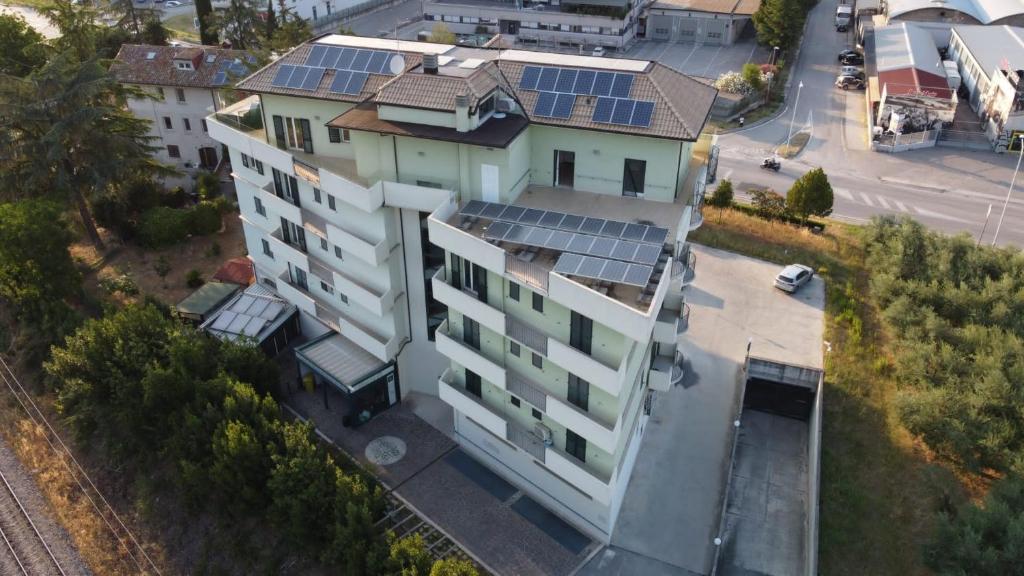
Hotel Clodi in Ascoli Piceno is at the centre of a proposed conversion into a 50-bed student residence. But the most interesting aspect lies elsewhere: according to local press reports, the property is expected to retain a hotel function during the summer. This is therefore not simply a conversion, but a potential hybrid model designed to monetise the same real estate through student demand and hospitality at different times of the year.
Most real estate conversions require a choice.
Hotel or student housing.
Hospitality or residential.
Tourism or long stay.
In the case of Hotel Clodi in Ascoli Piceno, however, the proposed strategy introduces a more sophisticated model:
student housing for most of the year, hospitality during the summer.
The property, owned by entrepreneur Bernardino Campitelli, is involved in a project to convert it into a 50-bed student residence.
The final administrative steps required for the change of use have not yet been completed and, during this transitional phase, some students are reportedly already being accommodated while the property continues to operate as a hotel.
According to local press reports, once the process is completed, the asset would operate primarily as student accommodation while retaining a hospitality use between 15 July and 15 September.
This is what transforms the Hotel Clodi story from a straightforward real estate conversion into a relevant investment case for InvestimentiAlberghieri.it.
The question is not simply:
“Does it make sense to convert a hotel into student housing?”
The more interesting question is:
“Can the annual return of the same property be increased by allocating it to the most profitable source of demand at different times of the year?”
The Project: 50 Beds and Student-Oriented Common Areas
The conversion provides for 50 student beds.
Local press reports also refer to spaces and services consistent with a university residence, including:
-
dining hall;
-
internal restaurant area;
-
reading room;
-
gym;
-
study room;
-
laundry;
-
games room;
-
TV room.
This is therefore not simply a matter of renting hotel rooms for longer periods.
The product itself is being adapted to a different source of demand.
And that distinction is fundamental.
Student housing is not simply a hotel with longer stays.
It has:
-
a different revenue structure;
-
different staffing intensity;
-
longer contractual periods;
-
different customer acquisition costs;
-
different use of common areas;
-
lower revenue volatility.
The conversion should therefore be understood as a change in the economic model of the asset.
The Conversion Is Not Yet Complete
At present, the property continues to participate in the hotel market.
This confirms an important point:
the conversion should not be described as fully completed.
The change-of-use process still needs to complete its administrative pathway.
For professional investment analysis, this distinction is critical.
A proper dossier must always separate:
-
current status;
-
proposed project;
-
approvals already obtained;
-
approvals still required;
-
future operating scenario.
Why Student Housing Can Improve Cash Flow Stability
The hotel business has one structural characteristic:
the room must be sold every night.
Student housing works differently.
Once a student has been contracted, the bed can generate revenue for several consecutive months.
Conceptually:
Hotel
Keys × 365 × Occupancy × ADR
Student Housing
Beds × Monthly Rent × Occupied Months
A hotel can generate higher daily revenue.
Student housing can offer greater:
-
predictability;
-
continuity;
-
occupancy stability;
-
cash flow visibility;
-
reduction in customer acquisition frequency.
This is one of the reasons why hotel-to-student-housing conversions are becoming increasingly relevant in the type of asset analysis developed by Investhotel.it.
The Real Advantage May Be the Calendar
The most interesting element of the Hotel Clodi case is the potential annual rotation of the operating model.
For most of the year:
Student Housing
During the summer:
Hospitality
If authorised and efficiently managed, the model could theoretically capture two complementary sources of demand.
When university demand falls, tourism demand may increase.
When the leisure peak ends, students return.
This is a form of:
Calendar Optimisation
The same square metre is allocated to different markets at different times of the year.
That is the real innovation within the investment case.
But a Hybrid Model Only Works if Switching Costs Remain Low
It is not enough simply to add student housing revenue to summer hotel revenue.
Moving from one operating model to another creates costs.
These may include:
-
deep cleaning;
-
room turnover;
-
maintenance;
-
room preparation;
-
hotel distribution;
-
additional staffing;
-
marketing;
-
OTA commissions;
-
amenities;
-
breakfast;
-
potential F&B.
The correct test is:
Incremental Summer Hotel EBITDA > Switching Costs
If this equation does not hold, maintaining a summer hotel operation may simply add complexity without generating sufficient additional value.
Three Scenarios Should Be Compared
An advisor should assess at least three configurations.
Scenario 1 — Pure Hotel
The property remains fully dedicated to hospitality.
Value depends on:
-
ADR;
-
occupancy;
-
RevPAR;
-
GOP;
-
EBITDA;
-
CAPEX.
Scenario 2 — Pure Student Housing
The asset is permanently allocated to student accommodation.
The model depends on:
-
number of beds;
-
monthly rent;
-
occupied months;
-
vacancy;
-
utilities;
-
services;
-
maintenance;
-
staffing.
Scenario 3 — Hybrid Model
Student housing during the academic year and hotel operations during the summer.
This may potentially maximise the utilisation of the property across the calendar.
But it also requires the strongest operational execution.
The Economics of the Hybrid Model
The model can be expressed as follows:
Student Housing Revenue
Beds × Monthly Rate × Occupied Months
Summer Hotel Revenue
Available Keys × Summer Nights × Occupancy × ADR
Ancillary Revenue
F&B
-
laundry
-
additional services
=
Total Annual Revenue
From which the following must be deducted:
-
payroll;
-
utilities;
-
maintenance;
-
cleaning;
-
distribution;
-
administration;
-
marketing;
-
property costs;
-
replacement reserve;
-
switching costs.
The result is:
Stabilised EBITDA
That figure should then be compared against the EBITDA of the pure hotel scenario and the NOI of the pure student housing scenario.
Revenue Is Not the Right Benchmark
A hybrid model may generate more revenue while simultaneously producing less value.
The real comparison is between:
Revenue
and
Operating Complexity
and then:
EBITDA
and
Capital Invested
The relevant metric is therefore:
Return on Invested Capital
If the conversion requires significant CAPEX, the incremental EBITDA must be sufficient to justify that capital.
How Much CAPEX Is Required?
There is currently insufficient public information to estimate the specific CAPEX of the Hotel Clodi project reliably.
Methodologically, however, a conversion of this kind should consider:
-
rooms;
-
bathrooms;
-
study areas;
-
common spaces;
-
gym;
-
laundry;
-
F&B areas;
-
building systems;
-
safety;
-
accessibility;
-
digital infrastructure;
-
furniture;
-
access control;
-
fire safety upgrades;
-
design;
-
permitting costs.
The key formula is:
Value Creation > CAPEX + Costs + Required Return
If the increase in value does not exceed the capital invested plus the required return, the conversion does not create value.
It merely reallocates it.
Location Has Different Value Depending on the Use
Hotel Clodi is located in the industrial area of Ascoli Piceno.
For a leisure hotel, a non-central location may represent a competitive disadvantage.
For student housing, however, the hierarchy of location factors changes.
What may become more important is:
-
connectivity;
-
public transport;
-
accessibility to university facilities;
-
parking;
-
room affordability;
-
internal services;
-
safety;
-
quality of common areas.
A property can therefore have a different location value depending on its use.
This is one of the fundamental principles of highest and best use analysis.
An Asset Can Be Weak for One Market and Strong for Another
The real estate market should not ask:
“Is this a good hotel?”
It should ask:
“Which source of demand makes the most efficient use of this property?”
The same building may be:
-
weak as a leisure hotel;
-
interesting as a business hotel;
-
strong as student housing;
-
efficient as serviced apartments.
Value is created by the relationship between the building and the demand it serves.
Not by the original use of the property.
Student Housing: Stability Versus Unit Yield
The principal advantage of student housing is stability.
In a hotel:
a room unsold tonight is revenue lost forever.
In student housing:
a contracted bed can generate income for months.
This can improve:
-
forecasting;
-
cash flow visibility;
-
break-even;
-
working capital;
-
operating planning.
But the equivalent daily revenue per bed will generally be lower than hotel ADR.
The real question therefore becomes:
stability or unit yield?
The hybrid model attempts to capture both.
The Risk: Creating Two Average Businesses Instead of One Excellent One
Dual use is not automatically an advantage.
It can create:
-
duplicated processes;
-
higher costs;
-
staffing overlap;
-
maintenance issues;
-
commercial complexity;
-
branding challenges.
For the concept to work, the asset should be designed to switch operating modes quickly.
Ideally, the same room should work effectively as:
a student room
and as:
a hotel room
without requiring costly interventions at every seasonal transition.
Flexible Hospitality Real Estate
This is where the Hotel Clodi case introduces a particularly interesting concept:
Flexible Hospitality Real Estate
A property designed not around a single source of demand, but around the ability to adapt to different markets during the year.
The same principle could potentially apply to:
-
student housing + hotel;
-
serviced apartments + corporate housing;
-
coliving + short stay;
-
senior living + hospitality;
-
resort + long stay.
Value no longer depends solely on the permitted use.
It also depends on the ability of the asset to change function without destroying operating efficiency.
The Value of the Hybrid Asset
A hybrid asset may theoretically increase in value if it is able to achieve:
-
higher annual occupancy;
-
more stable cash flow;
-
higher EBITDA;
-
lower revenue volatility;
-
better utilisation of floor area.
Conceptually:
Higher Stabilised Cash Flow + Lower Volatility = Higher Investment Value
But only if:
Switching Costs + Operating Complexity < Incremental Profit
That is the core equation behind the Hotel Clodi case.
The Operating Model Becomes Critical
Managing students during the academic year and hotel guests during the summer means operating two different products.
They require different capabilities.
Student Housing
-
contracting;
-
community management;
-
maintenance;
-
security;
-
shared services;
-
long-stay operations.
Hospitality
-
revenue management;
-
distribution;
-
OTAs;
-
housekeeping;
-
front office;
-
F&B;
-
guest experience.
For HotelManagementGroup.it, the central question would therefore be:
“Which operating model maximises annual asset returns while minimising complexity?”
One Operator or Two?
There are at least three possible structures.
Single Operator
One operator manages both functions.
Advantages:
-
stronger coordination.
Risks:
-
need for expertise across two different businesses.
Dual Operator
A specialist student housing operator and a specialist hotel operator.
Advantages:
-
vertical expertise.
Risks:
-
more complex coordination and potential duplication of costs.
Owner-Managed Hybrid
The owner retains control and outsources individual services.
Greater flexibility, but greater exposure to operating risk.
The optimal model depends on scale and available margin.
University Demand Also Requires Due Diligence
The conversion cannot be justified merely by saying that “students need accommodation”.
A proper market analysis is required.
At a minimum, investors should assess:
-
out-of-town students;
-
current enrolment;
-
enrolment trends;
-
student origin;
-
average length of stay;
-
universities and courses;
-
competing student residences;
-
private rental supply;
-
willingness to pay;
-
accessibility.
Student housing is also a competitive market.
The presence of a university alone is not enough.
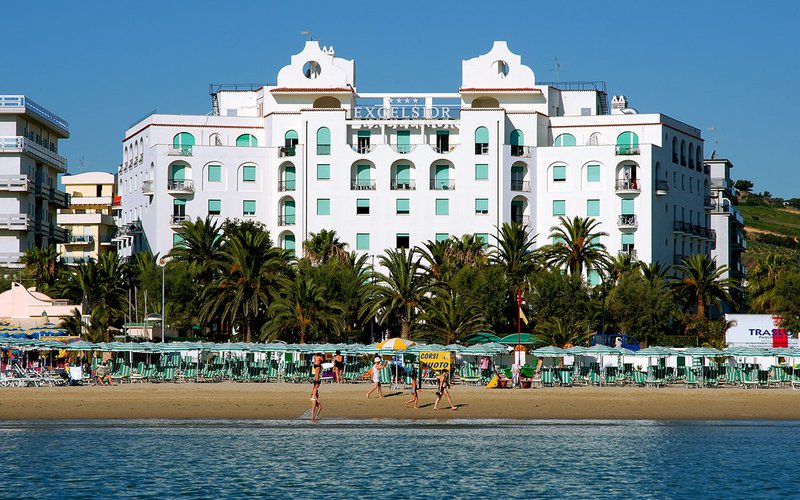
The Comparison with Grand Hotel Excelsior Is Revealing
The two Marche cases illustrate opposite forms of transformation.
Grand Hotel Excelsior
Hotel → potential residential conversion
because the alternative use may generate greater real estate value.
Hotel Clodi
Hotel → student housing + seasonal hospitality
because a different temporal allocation of demand may potentially increase asset returns.
In both cases the fundamental question is the same:
Which use provides the best return on the real estate capital?
But the Clodi case adds another dimension:
not only which use, but which use at which time of year.
A New Metric: EBITDA per Available Square Metre
The hotel industry traditionally focuses on:
-
ADR;
-
occupancy;
-
RevPAR;
-
GOPPAR.
For a hybrid property, a broader metric may be more useful:
EBITDA per Available Square Metre
Because the real question is not simply how many rooms are sold.
It is:
How much operating profit does each square metre of the property generate over twelve months?
This allows hotel, student housing and hybrid models to be compared using the same real estate denominator.
The Real Hotel Clodi Investment Case
Without the property's financial data, it is not possible to establish which model produces the highest return.
But the analytical framework is clear.
Hotel Scenario
Hotel EBITDA
Student Housing Scenario
Student Housing NOI
Hybrid Scenario
Student Housing NOI + Summer Hotel EBITDA − Switching Costs
Then:
Stabilised Cash Flow / Required Yield = Investment Value
The model that generates the highest value, on a risk-adjusted basis and after accounting for capital requirements, represents the most economically efficient alternative.
Conclusion: The Future of a Hotel May Not Be Exclusively Hotel
The Hotel Clodi case challenges a rigid view of hospitality real estate.
A hotel does not necessarily need to operate as a hotel twelve months a year.
And a conversion does not necessarily have to eliminate hospitality.
The asset can instead become a flexible operating platform.
During the academic year:
Student Housing
During the summer:
Hospitality
The final equation becomes:
Student Housing NOI
-
Summer Hotel EBITDA
− Switching Costs
− Incremental Operating Complexity
= Hybrid Stabilised Cash Flow
If this cash flow, relative to the capital invested, exceeds the value achievable under the pure-use alternatives, the hybrid model creates value.
If it does not, hybridisation is merely complexity.
The real Hotel Clodi investment case therefore becomes:
How much value can the same square metre generate when it is allocated to the most profitable source of demand at the moment that demand exists?
Not:
hotel or student housing.
But:
which use, at which time, at what return?
That is the difference between a simple conversion and a true asset management strategy.
InvestimentiAlberghieri.it | Advisory
InvestimentiAlberghieri.it analyses hotels, hospitality real estate and conversion projects for investors, owners, operators, banks and family offices.
Our work may include:
-
investment screening;
-
highest and best use analysis;
-
hotel vs student housing analysis;
-
hybrid-use modelling;
-
business planning;
-
CAPEX analysis;
-
feasibility studies;
-
financial modelling;
-
operating model analysis;
-
stabilised EBITDA;
-
NOI analysis;
-
residual value;
-
scenario analysis.
The question is not what the property's original use was.
The question is which use can generate the highest sustainable value on invested capital.
📩 info@investimentialberghieri.it
Ecosystem:
InvestimentiAlberghieri.it — Hospitality Real Estate & Investment Advisory
Investhotel.it — Hotel Finance, Debt & Investment Strategy
HotelManagementGroup.it — Hotel Operations, Management & Performance
Robertonecci.it — Hospitality Industry, Strategy & Market Analysis
Editorial and Legal Disclaimer
Information concerning the proposed conversion of Hotel Clodi is based on local press reports dated 8 October 2026. According to those sources, the project concerns a 50-bed student residence; some students are already being accommodated at the property, while the final administrative requirements for the change of use remain to be completed.
The proposed predominantly student-oriented use and the retention of a summer hotel function are likewise based on the same public reporting.
This article therefore does not state that the change of use has already been definitively approved or completed.
Any discussion of student housing, hybrid operating models, CAPEX, EBITDA, NOI, management structures and asset value represents professional analytical scenarios only and should not be interpreted as financial information relating to Hotel Clodi or as decisions already taken by the owner or competent authorities.