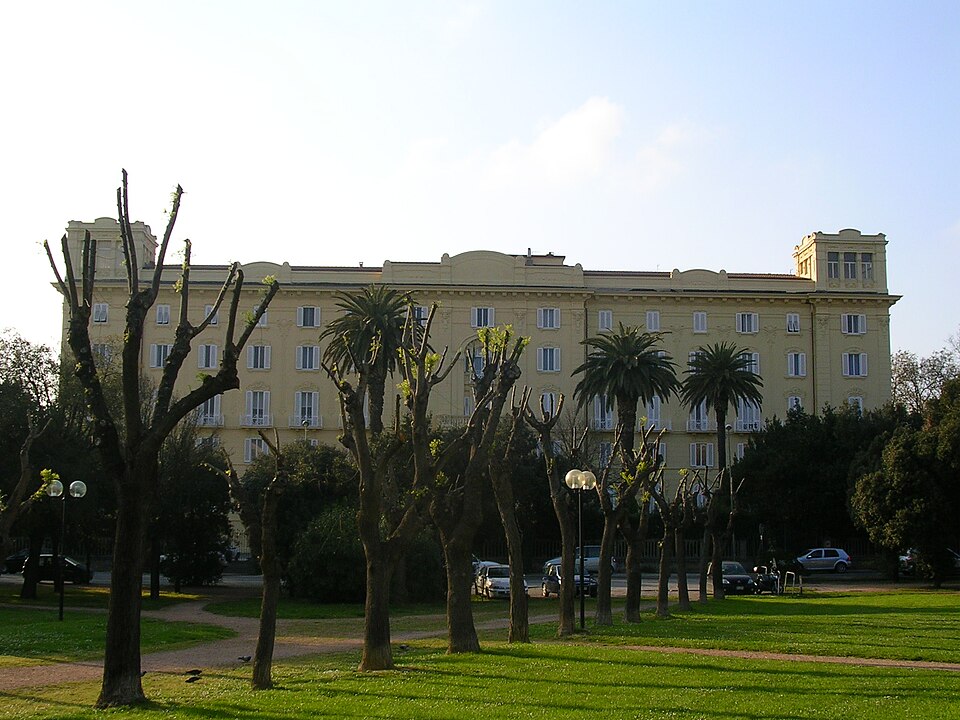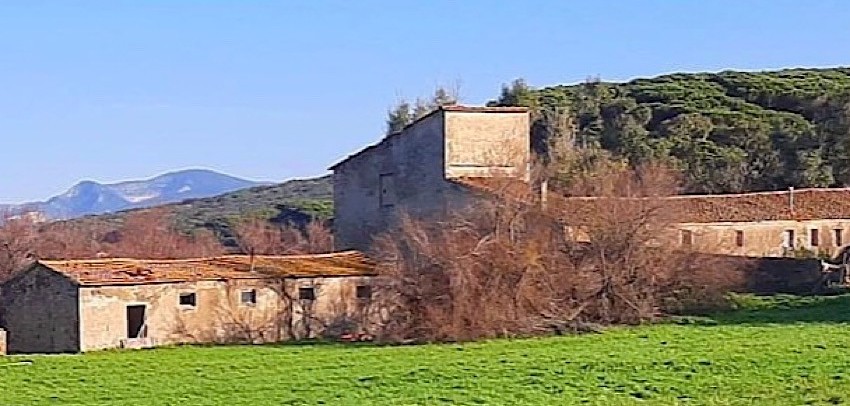
Eighteen years of proposals, plans and announcements, but no completed redevelopment. The Casone di Baratti is a compelling case study in what happens when real estate value, available floor area and hotel economics stop aligning.
by Roberto Necci
The facts
The Casone di Baratti has returned to the centre of public debate following the property's reappearance in the prime real estate market and renewed discussion around its possible conversion to hospitality use.
The story has, however, seen an important update.
The ownership has clarified that the property is not currently for sale and that the intention is to proceed with the redevelopment of the complex through private investment, maintaining a use consistent with the planning framework governing the area. According to MaremmaOggi, a new preliminary scheme is also expected to be submitted.
That clarification changes the news story, but it does not change the economics.
For anyone assessing hotel real estate transactions, the core question remains the same:
Can a hospitality conversion on that site, with that amount of existing floor area and that level of planning and heritage protection, generate a return commensurate with the capital required?
The question extends well beyond Baratti.
It applies to hundreds of historic properties, former holiday colonies, convents, villas, farmhouses, estates and former industrial buildings that are periodically presented as potential hotel conversion opportunities.
In many cases, the reasoning starts from an apparently simple equation:
exceptional property + hospitality-compatible use + luxury rendering = high hotel value.
But between the rendering and the value lies one decisive variable:
the operating economics.
And before the operating economics, there is an even simpler number that can often tell us, within minutes, whether further analysis is worthwhile:
gross square metres per key.
Methodological note. The analysis below is an illustrative hotel investment model based on publicly available information and sector benchmarks. It is not a valuation of the Casone di Baratti, does not constitute an architectural or planning proposal, and does not express any judgement regarding the intentions of the ownership, the local authorities or any other party. The figures are used exclusively to illustrate a methodology applicable to hotel conversion projects.
The asset: before asking what it is worth, ask what it can become
The information made public over the years allows the following indicative picture to be reconstructed.
| Item | Data |
|---|---|
| Existing built area | approx. 1,100 sq m |
| External land | approx. 15,000 sq m |
| Acquisition | 2008, from Populonia Italica |
| Reported historical acquisition value | approx. €5.0m |
| Marketing values reported over time | up to approx. €4.8–5.0m |
| Hospitality concept previously marketed | 30+ rooms, spa, restaurant and bar |
| Planning framework | Baratti-Populonia Detailed Plan |
| Permitted functions | including tourism and hospitality uses |
| Context | highly sensitive landscape and archaeological setting |
In 2013, the Detailed Plan provided for the Casone to accommodate cultural and tourism-related functions, including hospitality uses.
Planning documents have also referred to a capacity of 50 bed spaces, within a framework based on the reuse of the existing building stock.
In 2021, a private redevelopment and conversion proposal was reportedly prepared and submitted to the Municipality.
The question, therefore, is not simply:
“Can a hotel be developed here?”
The far more important economic question is:
“How much hotel can actually be delivered within the floor area that can realistically be recovered and authorised?”
That distinction is fundamental.
The number that can decide the entire deal: 36.6 gross sq m per key
Start with the most basic figures.
1,100 sq m / 30 rooms = 36.6 gross sq m per key.
That does not mean 36.6 sq m guestrooms.
Those 36.6 sq m must also accommodate, directly or indirectly:
-
guestrooms and bathrooms;
-
corridors and circulation;
-
lobby and reception;
-
restaurant;
-
kitchen;
-
bar;
-
spa;
-
changing rooms;
-
offices;
-
storage;
-
plant rooms;
-
back-of-house areas;
-
potential staff facilities.
This is where a hotel investment begins to look very different from a real estate brochure.
As a broad design benchmark, a highly efficient urban hotel can operate at a relatively low gross floor area per key.
A full-service four-star hotel usually requires substantially more.
A luxury or resort product with spa, restaurants and extensive common areas can require 90-110 gross sq m per key or more, depending on the concept.
These are not planning rules.
They are economic and design benchmarks.
Applying a range of 90-110 sq m to a 30-key scheme produces a theoretical gross floor area requirement of:
2,700-3,300 sq m.
Against approximately 1,100 sq m currently existing, this implies a very substantial increase in functional floor area.
And that is where the core issue emerges.
It is not enough for hotel use to be permitted in principle.
The real question is whether the hotel product required to generate an acceptable investment return can actually be delivered within the floor area that can be recovered and authorised.
That is the variable capable of determining the viability of the entire investment.
Scenario A — 30 rooms: the economics work, but substantially more floor area is required
Let us build a first theoretical scenario.
This is not an architectural proposal.
It simply illustrates the economics that a high-end 30-key resort might generate if a functional gross floor area of approximately 2,850 sq m were achievable.
Illustrative investment
| Item | Amount |
|---|---|
| Asset value assumed in the model | €5.00m |
| Refurbishment of existing 1,100 sq m × €2,800 | €3.08m |
| Additional 1,750 sq m × €2,600 | €4.55m |
| Spa, pool, external works and landscaping | €1.20m |
| Soft costs, design, fees and financing component | €1.24m |
| Total investment | €15.07m |
| Cost per key | €502,000 |
These are, of course, benchmark assumptions.
Their purpose is not to provide metre-by-metre accuracy, but to establish the likely order of magnitude of the investment.
Illustrative stabilised P&L
| Item | Amount |
|---|---|
| Average ADR | €780 |
| Operating days | 200 |
| Occupancy during opening period | 68% |
| Rooms sold | 4,080 |
| Rooms revenue | €3.18m |
| F&B, spa and other revenue | €1.59m |
| Total revenue | €4.77m |
| GOP at 32% | €1.53m |
| Yield on cost | 10.1% |
| Illustrative stabilised value at a 6.0% cap rate | €25.4m |
The theoretical spread between total cost and capitalised stabilised value would exceed €10 million, before further adjustments for timing, taxation, exit costs, contingencies and risk.
Purely from a hotel operating perspective, therefore, the project becomes compelling.
And that is precisely the point.
The value is not generated by the building as it currently stands. It is generated by the ability to deliver a given number of rooms, with a given service offering and a given amount of floor area.
Without that configuration, the economics change completely.
Scenario B — 12 rooms: the hotel fits the building, but returns compress
Now reverse the reasoning.
Assume approximately 1,100 sq m of existing floor area and create an ultra-luxury product with just 12 keys.
The ratio becomes:
1,100 / 12 = 91.7 gross sq m per key.
From a design perspective, the concept now looks significantly more consistent with a small luxury resort offering substantial common areas, dining and wellness facilities.
The problem shifts to the economics.
Illustrative investment
| Item | Amount |
|---|---|
| Asset value assumed in the model | €5.00m |
| Restoration of 1,100 sq m × €3,600 | €3.96m |
| Spa, pool and external works | €1.20m |
| Soft costs and fees | €0.72m |
| Total investment | €10.88m |
| Cost per key | €907,000 |
Stabilised operating model
| Item | Amount |
|---|---|
| Average ADR | €950 |
| Operating days | 190 |
| Occupancy during opening period | 68% |
| Rooms sold | approx. 1,550 |
| Rooms revenue | €1.47m |
| F&B, spa and other revenue | €0.71m |
| Total revenue | €2.18m |
| GOP at 25% | €0.55m |
| Yield on cost | 5.0% |
| Illustrative stabilised value at a 6.0% cap rate | €9.1m |
| Spread versus development cost | −€1.8m |
The result is almost the mirror image of the previous scenario.
The product fits the available floor area far better, but the investment economics weaken dramatically.
And this happens despite strong commercial assumptions:
-
€950 average ADR;
-
68% occupancy during the operating season;
-
significant ancillary revenues;
-
ultra-luxury positioning.
The issue is scale.
A 12-room property offering a restaurant, spa, maintenance, reception, management and high-touch service carries fixed costs that do not fall proportionally with the number of rooms.
A small boutique hotel can certainly be profitable.
But in a seasonal, full-service, labour-intensive model, falling materially below 25-30 keys tends to compress operating efficiency unless the property achieves exceptional ADRs or operates with an unusually lean cost base.
That distinction matters.
In a small luxury hotel, margin cannot be recovered through volume. It must largely be recovered through price.
How much can the asset support for a hotel investor?
We can now reverse the model.
This is one of the most important steps in any hotel conversion analysis.
I do not start with an asking price and build a business plan designed to justify it.
I do the opposite.
I start with the hotel’s ability to generate income and determine how much capital that income can support.
In the 12-key scenario:
Stabilised GOP: approximately €545,000.
Assume an investor requires a 7.5% yield on cost to compensate for development, execution, planning, seasonality and operating risk.
The maximum sustainable total cost becomes:
€545,000 / 7.5% = approximately €7.27 million.
The refurbishment, external works and soft costs in the model total approximately:
€5.88 million.
This leaves:
€7.27m − €5.88m = approximately €1.39 million.
Under these assumptions, that would be the maximum value the hotel investor could attribute to the property while still achieving the target return.
Now make the assumptions more aggressive:
-
GOP margin: 27%
-
GOP: approximately €589,000
-
required yield on cost: 7%
The result becomes:
€589,000 / 7% = approximately €8.41 million.
Less €5.88 million of capex and soft costs:
maximum supportable asset value: approximately €2.53 million.
The resulting range is therefore:
approximately €1.4-2.5 million.
This is not a valuation of the Casone di Baratti.
It is simply the amount this particular hotel operating model could support under the assumptions used.
That distinction is essential.
A property may have different values depending on whether it is being considered for:
-
residential use;
-
public use;
-
passive real estate investment;
-
land value creation;
-
hotel use;
-
acquisition by a strategic investor.
Here, we are measuring only its economic carrying capacity as a hospitality investment.
The real value gap is not between buyer and seller. It is between the property and the project
Let us now use €5 million not as a current asking price — because the ownership has stated that the Casone is not presently for sale — but as a historical reference value, broadly consistent with both the 2008 acquisition and the highest marketing values reported over the years.
Compared with the supportable value under the 12-key model, this produces an indicative gap of:
€2.5-3.6 million.
And this leads directly to the central thesis of the analysis.
That gap does not necessarily indicate that the property itself has been mispriced. It measures the economic value of being able to deliver a larger and more profitable hotel than the existing floor area alone would support.
In other words:
a meaningful portion of the value lies in planning optionality.
If usable floor area increases, the number of rooms changes.
If the number of rooms changes, the cost structure changes.
If the cost structure changes, GOP changes.
If GOP changes, the value of the asset changes.
Hotel value is the final output of this chain.
Not the starting point.
Planning consent as an economic option
The issue can also be viewed through a simple probability model.
In the theoretical Scenario A, the investment produces a positive spread of approximately €10.3 million.
In Scenario B, the model produces a negative spread of approximately €1.8 million.
Using an extremely simplified binary model:
p × 10.3 − (1 − p) × 1.8 = 0
which gives:
p ≈ 14.9%
This means that, under these assumptions alone — and ignoring the time value of money, intermediate scenarios, additional costs and timing differences — the minimum probability of achieving the larger development scenario required to bring the expected spread to zero is approximately 15%.
This is not a “market-implied probability”.
It does not measure the actual likelihood of securing a planning approval.
It is simply the probabilistic break-even point of the model.
But it illustrates an important principle.
When we acquire a property whose economic viability depends on a future transformation that has not yet been authorised, we are not buying bricks and mortar alone.
We are acquiring, at the same time:
-
the existing property;
-
the right to pursue a transformation;
-
the risk that the transformation will not happen;
-
the economic upside if it does.
Those are four different assets.
And they should not all carry the same price.
Eighteen years tell us something
The Casone was acquired in 2008.
By 2010, discussion was already under way about its potential conversion into hospitality use.
In 2013, the Detailed Plan established a framework for redevelopment.
In 2020, the property returned to the market.
In 2021, a redevelopment proposal was prepared and submitted.
In 2026, the potential hotel redevelopment once again became the focus of public attention, while the ownership reiterated its intention to proceed with the asset’s redevelopment.
The most interesting point is not to assign responsibility.
It is to observe the outcome.
Almost eighteen years later, the transformation has still not been delivered.
That suggests that, so far, the market has not found a definitive equilibrium between:
-
real estate value;
-
available floor area;
-
heritage and landscape protection;
-
capital intensity;
-
hotel positioning;
-
expected returns.
This is precisely what happens in many adaptive-reuse hotel projects.
The problem is rarely simply whether an asset “can become a hotel”.
The problem is which hotel can economically fit inside that property.
How an investment of this type can be unlocked
When a significant portion of value depends on the outcome of a planning process, the solution is not necessarily to force one party to move on price.
There is a more sophisticated alternative:
separate certain value from future value.
That is the role of transaction structuring.
1. Conditional sale agreement
The final transfer takes place only once specified planning conditions have been satisfied.
The investor can fund and manage the technical and planning process without paying upfront for an upside that does not yet exist.
The higher price is paid only when the condition that justifies that price has actually materialised.
2. Variable price linked to authorised floor area
The parties agree:
a base value + a variable component linked to the square metres or number of rooms actually authorised.
This can be particularly effective because it aligns incentives.
The seller does not give up the potential future value.
The buyer does not pay it in advance.
3. Contribution of the asset into a NewCo
The owner contributes the property.
The investor contributes capital, expertise and execution capability.
Value is then allocated through equity participation and a future exit.
This can be especially effective where both parties believe substantial upside exists but disagree over the current value of the property.
4. PropCo / OpCo separation
The property company — PropCo — owns the real estate.
The operating company — OpCo — runs the hotel.
The relationship between the two may be structured through:
-
a lease;
-
a fixed rent;
-
a turnover-based rent;
-
a hybrid rent;
-
a hotel management agreement.
This is a model that we regularly examine through Investimenti Alberghieri and one that is becoming increasingly relevant as the Italian hotel investment market becomes more institutionalised and professionally managed.
5. Planning-linked earn-out
There is also an even more direct structure.
Part of the price is paid at closing.
A second component becomes payable once specific milestones are achieved, such as:
-
approval of the project;
-
an increase in usable floor area;
-
a minimum number of rooms;
-
the granting of defined planning permissions.
Future value is therefore converted into future consideration.
In many cases, that is economically more rational than converting it into today’s purchase price.
A public-use scenario also requires a business model
The debate surrounding the Casone has also revived the possibility of a public-use scheme involving research, education and activities linked to the archaeological heritage of the area.
That possibility deserves the same degree of financial discipline applied to a private-sector investment.
A project does not become economically sustainable simply because its purpose is public.
A university residence or research centre may have very significant social and cultural value while producing a negative operating result.
Those two things are not mutually exclusive.
In a purely illustrative scenario, a 30-40-bed facility incorporating educational and research spaces could generate revenues materially below the cost of maintaining:
-
staff;
-
security;
-
maintenance;
-
building services;
-
utilities;
-
protected heritage assets;
-
external areas.
The problem would not necessarily be the deficit.
The problem would be failing to plan for it.
A public project of this type becomes sustainable when it has:
-
fully funded capex, through public resources, grants or dedicated programmes;
-
contracted utilisation, through universities, research bodies or institutions;
-
multi-year funding for any structural operating deficit.
A public investment does not necessarily have to generate a real estate return.
But it still needs an economic model.
That is the distinction.
The checklist for assessing a hotel conversion
The real value of the Baratti case lies in the methodology.
Before spending tens of thousands of euros on design, due diligence, advisers and financial modelling, a number of preliminary tests can quickly eliminate projects that are structurally inconsistent.
1. Calculate gross square metres per key immediately
This is often the first genuine hotel feasibility test.
Before asking which brand might operate the property, determine how much hotel physically fits inside the building.
2. Separate permitted use from development capacity
The fact that hospitality use is permitted does not mean that every conceivable hotel configuration will be permitted.
The right question is not:
“Can I develop a hotel?”
It is:
“Can I develop the hotel required to make this investment economically viable?”
3. Test the relationship between keys and support areas
A guestroom generates revenue.
A spa, kitchen, lobby and plant room primarily generate cost, or contribute indirectly to revenue.
The ratio between revenue-generating space and support space is therefore crucial.
4. Model seasonality correctly
In many Italian leisure destinations, the key variable is not annual occupancy but the number of days during which the hotel can realistically achieve ADR and occupancy consistent with its positioning.
Artificially extending the operating season in the business plan can turn an unviable project into an apparently excellent one.
But only in Excel.
5. Use a GOP margin appropriate to the scale of the hotel
GOP does not depend solely on hotel category.
It also depends on scale.
A 100-room resort and a 12-room boutique hotel may achieve the same ADR while carrying completely different cost structures.
6. Build the operating model before the financial model
One of the most common distortions in hotel development is to decide what return the investment is expected to generate and then reverse-engineer the revenues required to produce it.
The correct sequence is the opposite:
market → revenue → costs → GOP → cash flow → value.
7. Calculate the maximum supportable property value by residual method
The asking price should not automatically become an input in the business plan.
It is something to be tested.
The supportable value derives from the investment’s prospective ability to generate income.
8. Treat planning risk as an economic variable
A permission that has not yet been obtained cannot be treated as certain.
It may have value.
But that value is optional and probabilistic.
It therefore needs to be priced accordingly.
9. If there is a value gap, structure it before negotiating it
A significant difference between current value and future value is rarely solved simply by asking the owner to reduce the price.
More often, it is solved through:
-
conditions precedent;
-
earn-outs;
-
variable consideration;
-
equity participation;
-
NewCos;
-
PropCo/OpCo structures;
-
planning milestones.
The contract itself becomes a value-creation tool.
The question is not what the Casone is worth. It is what generates that value
The Casone di Baratti is interesting precisely because it resists simplistic conclusions.
It is not enough to say that the location is exceptional.
It is.
It is not enough to observe that hospitality use is contemplated by the planning framework.
It is.
It is not enough to design a luxury concept.
That can certainly be done.
The decisive question remains:
How much floor area, how many rooms and what operating structure are required for the invested capital to generate a return proportionate to the risk?
This is where real estate and hotel investment become two different disciplines.
A beautiful property can produce a mediocre hotel investment.
An apparently ordinary property can produce an exceptionally profitable hotel.
The difference lies in the ability to convert:
square metres → keys → revenue → GOP → cash flow → value.
Conclusion
The Casone di Baratti does not prove that a hotel conversion is impossible.
It demonstrates something far more useful.
Planning compatibility with hospitality use and the economic viability of a hotel are not the same thing.
In the model developed above:
-
30 rooms can generate attractive economics, but require significantly more functional floor area than currently exists;
-
12 rooms produce a floor-area-per-key ratio compatible with a luxury product, but materially compress investment returns;
-
the supportable value of the property therefore changes radically depending on the development capacity that can actually be secured.
That is the key lesson.
The value of a hotel conversion does not sit inside the rendering. It sits in the combination of authorised floor area, number of keys, ADR, occupancy, GOP and the amount of capital required to produce them.
When a price or expected value incorporates a future transformation, that transformation should be analysed as an option.
And where there is a significant gap between current value and future value, the solution is rarely an endless negotiation over price.
It is to build a transaction structure in which future value is paid for only when that future value becomes real.
That applies to Baratti.
It applies to villas, convents, former holiday colonies, historic palazzi and former industrial buildings.
And it applies to a substantial portion of Italy’s real estate stock that may have a future as hospitality assets but must first pass the most important test of all:
demonstrating that it can create value.
Hotel conversion analysis and advisory
Through Investimenti Alberghieri, we analyse hotel and real estate investment opportunities starting from economic sustainability rather than from the asking price.
Through Investhotel, RobertoNecci.it and Hotel Management Group, we support property owners, investors, family offices and operators in the analysis of specific opportunities, including:
-
hotel feasibility studies;
-
highest and best use analysis;
-
hotel concept definition;
-
operating model development;
-
ADR, occupancy and GOP analysis;
-
determination of maximum supportable asset value;
-
PropCo/OpCo structuring;
-
lease and hotel management agreements;
-
operator search;
-
asset repositioning, management and disposal.
Depending on the transaction, mandates may include a fixed analytical component and/or a performance-linked success fee.
To discuss a specific opportunity: info@investimentialberghieri.it
Roberto Necci - r.necci@robertonecci.it
Primary source for the latest developments concerning the Casone di Baratti: MaremmaOggi. Information concerning floor area, acquisition history, previous marketing values, planning instruments and redevelopment proposals is based on journalistic sources and publicly available documentation. All financial calculations included in this article are illustrative models based on assumptions and industry benchmarks and do not constitute a property valuation, architectural proposal, forecast of future performance or judgement regarding the conduct of any party involved.