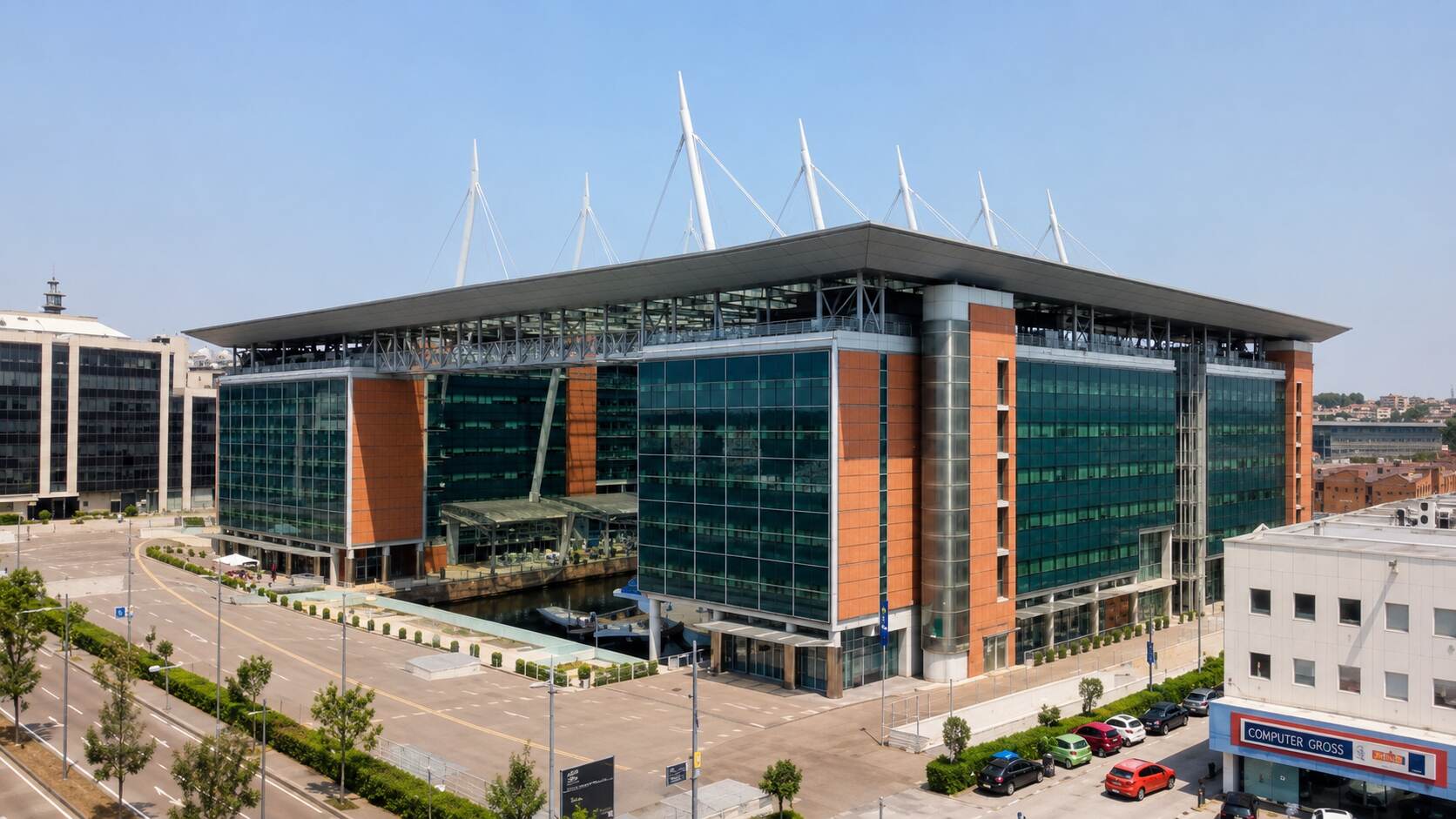
Laguna Palace in Mestre may soon change hands again. Acquired in 2023 for approximately €24 million by Cobalto SPV and closed following NH Hotels’ departure on 30 September 2025, the large hotel complex on the outskirts of Venice has yet to undergo the refurbishment originally envisaged. According to recent press reports, the current owner is now considering a sale, while a Veneto-based investor consortium is understood to have expressed interest. Yet the key question is not simply how much the property may cost to acquire. The real issue is how much total capital will be required to bring the hotel back to market — and whether the stabilised EBITDA can ultimately justify that investment.
Laguna Palace is particularly interesting because it combines almost every characteristic typically associated with a hotel special situation:
a previous ownership crisis, an acquisition through an insolvency process, a change of investor, the departure of the operator, the closure of the hotel, substantial capital expenditure requirements and the need to rebuild the business model from the ground up.
It is therefore a situation in which real estate pricing and underlying hotel investment value may diverge materially.
From a €24 Million Acquisition to a New Sale Process
Cobalto SPV acquired the property in 2023 for approximately €24 million from Venezia Futura, a company previously linked to the Danieli family.
At the time of the acquisition, NH continued to operate the property.
An agreement to renew the operating relationship was subsequently not reached, and NH definitively vacated the hotel on 30 September 2025.
From that point onward, Laguna Palace ceased to be merely a hotel asset in need of refurbishment.
It became a non-operating hotel requiring a full relaunch.
That distinction is crucial.
An operating hotel can continue to generate revenue, retain its workforce, preserve corporate accounts, maintain distribution, protect commercial history and remain visible in the market.
A closed hotel has to rebuild a significant part of that infrastructure.
How Many Rooms Does Laguna Palace Actually Have?
Different figures have appeared in media coverage regarding the number of rooms in the property.
For investment analysis purposes, however, the most relevant figure is contained in Minor Hotels’ official 2025 reporting, which records the departure of NH Venezia Laguna Palace from its portfolio and identifies the property as a 376-room four-star hotel.
That is the figure used in the following analysis.
The historical €24 million acquisition therefore equated to approximately:
€63,800 per room.
Taken in isolation, that number might appear exceptionally attractive.
But it would be an incomplete reading of the transaction.
€63,800 Per Room Does Not Necessarily Mean “Cheap”
One of the most common mistakes in distressed hotel underwriting is to divide the purchase price by the number of rooms and treat the resulting figure as the principal measure of value.
For assets requiring major repositioning, the more relevant metric is the Total Investment Cost per key.
The proper equation is:
**Acquisition Price
-
Hard Capex
-
FF&E
-
plant and energy-efficiency upgrades
-
design and professional fees
-
contingency
-
financing costs
-
pre-opening costs
-
working capital
= Total Investment Cost**
Only after calculating this figure is it possible to understand how much capital has genuinely been committed per available room.
And that is the metric against which Laguna Palace should ultimately be assessed.
Capex Is the Real Issue
The property was developed in the early 2000s.
According to comments reported by the Italian hospitality press, the building reflects the technical and energy standards of the period in which it was developed and is particularly energy-intensive. A significant redevelopment programme would therefore be required, with the refurbishment previously expected to take approximately two years.
The risk is obvious.
An investor may acquire the real estate at what appears to be an attractive price, only to discover that the capital required to make the asset competitive materially changes the economics of the deal.
A few illustrative scenarios help show how quickly this can happen.
How Much Capital Could Be Required? Three Scenarios
The following figures do not represent a technical estimate of the actual refurbishment cost of Laguna Palace.
A reliable Capex estimate would require a full technical due diligence process.
These are purely illustrative investment scenarios designed to show how the economics change as the required level of investment increases.
Scenario 1 — Efficient Four-Star Repositioning
Illustrative average Capex:
€70,000 per room
Across 376 rooms:
approximately €26.3 million
Using the historical €24 million acquisition price purely as a benchmark, and adding indirect costs, contingency, pre-opening expenses, working capital and carrying costs during the construction period, total capital invested could approach:
€58–60 million
or approximately:
€155,000–160,000 per key.
Scenario 2 — Upper-Upscale Repositioning with a Strong MICE Strategy
Illustrative average Capex:
€100,000 per room
Indicative room-equivalent Capex:
approximately €37.6 million
Including acquisition, works, professional fees, contingency, pre-opening expenses, working capital and financing costs during the development period:
Indicative Total Investment Cost: €72–75 million
equivalent to approximately:
€190,000–200,000 per key.
Scenario 3 — Deep Repositioning
If the project were to involve a more extensive transformation of the rooms, public areas, congress facilities, mechanical systems and energy infrastructure, an equivalent investment of:
€125,000 per room
would imply theoretical Capex of approximately:
€47 million.
The resulting Total Investment Cost could therefore reach approximately:
€83–86 million
or:
€220,000–230,000 per key.
This is precisely why the €24 million historically paid for Laguna Palace tells only a small part of the investment story.
The Decisive Question: How Much EBITDA Can the Hotel Produce?
A professional investor should work backwards.
The first question should not be:
“How much does Laguna Palace cost to acquire?”
It should be:
“What could Laguna Palace be worth once refurbished, reopened and stabilised?”
From that future value, the investor can work backwards to determine the maximum acquisition price that can be economically supported.
Again, three illustrative scenarios help demonstrate the logic.
Conservative Scenario
376 rooms
Stabilised occupancy: 68%
ADR: €145
RevPAR: €98.60
Indicative rooms revenue:
approximately €13.5 million
Including F&B, meetings, events and ancillary revenue:
illustrative total revenue: approximately €18.3 million
At a 24% EBITDA margin:
EBITDA: approximately €4.4 million
Applying, purely for illustration, a 10x multiple:
Stabilised Enterprise Value: approximately €44 million.
Under such a scenario, a highly capital-intensive redevelopment would be difficult to justify if the Total Investment Cost moved significantly above the €60–70 million range.
Repositioning Scenario
Occupancy: 72%
ADR: €165
RevPAR: €118.80
Indicative rooms revenue:
approximately €16.3 million
With a stronger MICE, F&B and events contribution:
illustrative total revenue: approximately €23.6 million
EBITDA margin: 28%
EBITDA:
approximately €6.6 million
At an illustrative 10.5x multiple:
Stabilised value: approximately €69.5 million.
At this level, the investment case becomes more interesting, but both acquisition price and Capex would still need to be underwritten with considerable discipline.
Upside Scenario
Occupancy: 75%
ADR: €185
RevPAR: €138.75
Indicative rooms revenue:
approximately €19 million
With stronger monetisation of the conference business, F&B and events:
illustrative total revenue: approximately €28.6 million
EBITDA margin: 30%
EBITDA:
approximately €8.6 million
At a theoretical 11x multiple:
Stabilised value: approximately €94 million.
These figures are not intended to constitute a valuation of Laguna Palace.
They demonstrate a much broader investment principle:
high Capex can only be justified when repositioning delivers sufficiently strong ADR, occupancy, ancillary revenues and EBITDA.
The Real Investment Case Extends Beyond the Bedrooms
For an asset of 376 rooms, the economics are unlikely to depend on accommodation revenue alone.
Laguna Palace has historically included a significant conference component and possesses an architectural configuration that is difficult to replicate.
Any future business plan should therefore assess at least five major revenue engines:
rooms, corporate, MICE, F&B and events.
The ability to generate revenue outside the guestrooms could become critical to the investment thesis.
A large conference centre with weak utilisation can quickly become a cost burden.
A well-positioned MICE platform, however, can simultaneously generate room nights, food and beverage revenue and event income while improving the absorption of fixed costs across the property.
The appropriate performance framework should therefore extend beyond RevPAR to include TRevPAR, GOP and, above all, GOPPAR.
Laguna Palace Does Not Necessarily Need to Become What It Was Before
This is arguably the most important strategic point.
The project should not begin with the question:
“How do we refurbish the old Laguna Palace?”
It should begin with:
“What hotel product should exist in this location today?”
Those are fundamentally different questions.
The first is an architectural exercise.
The second is an investment strategy.
Before defining guestrooms, materials, lobby design or the restaurant concept, the investor should analyse:
-
the competitive set;
-
corporate demand;
-
leisure demand;
-
group demand;
-
the conference and events market;
-
achievable ADR;
-
the optimal size of the meeting facilities;
-
food and beverage strategy;
-
parking;
-
accessibility;
-
distribution;
-
branding;
-
operating structure.
Only then should the architectural project be designed.
Because in hospitality investment, the project should not determine the business plan. The business plan should determine the project.
Which Operating Model?
The choice of future operating structure could have a material impact on the value of the asset.
The three main alternatives are lease, management agreement and franchise.
Lease
A hotel operator takes responsibility for the business and pays the property owner a fixed, variable or hybrid rent.
For the investor, this can provide greater predictability of property-level cash flow, but the value of the lease depends heavily on the financial strength of the tenant and the sustainability of rent coverage.
For an asset of this size, the operator covenant would therefore be critical.
Management Agreement
The owner retains the entrepreneurial risk and appoints an international operator to manage the hotel in exchange for management fees.
The upside may be higher, but Capex, working capital and operating risk remain substantially with the investor.
For an opportunistic investor willing to manage the ramp-up period, this model could offer greater participation in value creation.
Franchise
The owner retains greater control over operations while using the brand, distribution channels and commercial systems of an international hotel company.
This can be economically efficient, but it requires a strong management platform, either directly or through a white-label operator.
For Laguna Palace, the decision between lease, management agreement and franchise should not be made after closing.
It should form part of the pre-acquisition business plan, because the operating structure directly affects EBITDA, debt capacity and asset value.
Capital Structure Matters as Well
The project could also be funded through different layers of capital:
equity + senior debt + potential mezzanine/private debt + Capex facility.
However, leverage would need to be consistent with the fact that the asset may generate little or no operating cash flow during a lengthy development period.
A closed hotel undergoing a multi-year refurbishment does not produce sufficient EBITDA to support conventional debt service.
The financing structure should therefore consider:
-
capitalised interest during construction;
-
interest reserves;
-
contingencies;
-
cost overruns;
-
potential delays;
-
pre-opening expenditure;
-
post-opening ramp-up.
The greatest risk in a transaction of this kind is not necessarily overpaying for the real estate.
It is underestimating how much capital will be required before the property begins generating cash again.
Acquisition Price and Value Are Not the Same Thing
The previous €24 million transaction should therefore be regarded only as a historical reference point.
The price in any new sale process may be materially different.
Its economic sustainability should be assessed through a residual approach:
Stabilised Hotel Value
less
Capex
less
professional fees
less
pre-opening expenditure
less
working capital
less
financing costs
less
contingency
less
the investor’s required return for development risk
equals
Maximum Supportable Acquisition Price.
That is the number that ultimately matters.
The Greatest Risk: Buying Cheap and Investing Too Much
Hotel special situations often attract attention because the headline price appears low.
But value is ultimately created — or destroyed — by the relationship between three numbers:
Entry Price – Total Investment Cost – Stabilised Value.
An acquisition at €24 million can be exceptionally attractive if a further €30 million of investment produces a hotel worth €90 million.
The same €24 million acquisition can become economically destructive if another €60 million is required and the stabilised hotel is ultimately worth only €65 million.
The initial purchase price, in isolation, tells us very little.
Potentially an Institutional-Grade Investment Case
Given the size of the investment, the number of rooms, the MICE component and the complexity of the turnaround, Laguna Palace is unlikely to resemble a conventional private hotel acquisition.
The project requires integrated expertise across:
real estate, hospitality operations, corporate finance, technical due diligence, asset management and capital structuring.
It is precisely the type of transaction in which the financial and hotel operating dimensions must be assessed simultaneously.
This is also the analytical approach developed by InvestimentiAlberghieri.it, Investhotel.it, HotelManagementGroup.it and RobertoNecci.it in the assessment of hotel acquisitions, valuations, distressed assets and turnaround opportunities.
Conclusion: The Right Question Is Not How Much It Costs to Buy
Laguna Palace may represent a significant investment opportunity.
It offers scale, architectural identity, a strategic position within the wider Venice market and a demand mix that potentially extends well beyond leisure tourism.
But it also carries virtually all the risks associated with a large non-operating hotel.
The correct question is therefore not:
“At what price will it be sold?”
The correct question is:
“What Total Investment Cost will be required to generate what level of stabilised EBITDA?”
If a future investor can develop a product capable of generating EBITDA in the region of €6–8 million, while keeping the acquisition price, Capex and cost of capital under strict control, Laguna Palace could become a meaningful value-creation opportunity.
If, on the other hand, the transaction is underwritten primarily on the basis of the real estate purchase price, the investor may discover too late that the asset appeared inexpensive because most of the capital still had to be invested after acquisition.
That is the fundamental distinction between buying a distressed hotel and building a profitable hospitality investment.
For hotel acquisition analysis, distressed assets, special situations, valuations, due diligence and turnaround advisory: info@investimentialberghieri.it