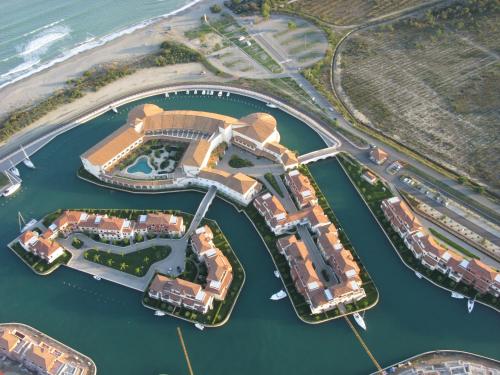
The Marinagri insolvency proceeding no. 4/2020 before the Court of Matera is bringing back to market one of the most complex hospitality special situations currently available through an Italian insolvency process. The single-lot transaction — comprising Hotel Marinagri, the marina, food & beverage, retail and nautical operations — is being offered at a base price of €15.50 million, 25% below the previous €20.67 million auction attempt. Yet the real question for investors is not the discount. It is whether Marinagri is worth more as an integrated tourism platform or through the separate disposal of its individual business units.
The procedure effectively offers two potential entry points.
Marinagri single lot: base price €15,502,746; minimum bid €11,627,060; minimum bidding increment €350,000; bid submission deadline 5 October 2026 at 12:00 noon; online auction scheduled for 6 October 2026 at 3:00 p.m.
Break-up scenario: if the single lot is not awarded, the five separate business units are scheduled to be offered individually from 13 October 2026. The Hotel Marinagri business unit alone carries a base price of €11,179,687 and a minimum bid of €8,384,765.
The spread between the minimum bid for the entire platform and the minimum bid for the hotel alone is therefore approximately €3.24 million.
This is one of the most important numbers in the entire transaction.
Not because it automatically represents the value of the marina, restaurants, retail and nautical activities, but because it raises a classic investment-committee question:
does the incremental capital required to acquire the entire platform generate a superior return to acquiring the hotel on a stand-alone basis?
That question — rather than the auction price itself — should form the foundation of the investment thesis.
This Is Not Simply a Hotel Auction. It Is a Distressed Tourism Platform
The Marinagri perimeter includes Hotel Marinagri, the marina, restaurant, wine bar, retail units, supermarket, caretaker accommodation and shipyard operations.
Describing the transaction merely as a “hotel auction” would therefore materially understate its nature.
Marinagri is an integrated tourism ecosystem in which hospitality, marina operations, food & beverage, retail and nautical services may generate mutually reinforcing synergies.
Hotel guests drive demand for restaurants and ancillary services. The marina may generate accommodation demand. A marina can enhance the destination’s attractiveness to higher-spending leisure customers. Commercial activities can further increase guest capture and wallet share across the destination.
The central question therefore becomes:
how much value lies in the individual assets, and how much value is created by keeping them integrated?
For InvestimentiAlberghieri.it, Marinagri represents precisely the type of transaction where a traditional real-estate valuation is insufficient.
The investment must simultaneously be analysed through the lenses of real estate, operations, contractual rights, concessions, cash flow, capex, management structure and potential exit scenarios.
The Market Has Already Imposed a 25% Repricing
The previous disposal attempt carried a base price of €20,670,329.
The new auction begins at €15,502,746.
That represents a 25% reduction.
The minimum acceptable bid has also moved materially lower, from €15,502,746 to €11,627,060.
This repricing inevitably alters the transaction’s risk-return profile.
However, one of the most common mistakes in hospitality special situations is to confuse a discount to a previous valuation or failed auction price with automatic value creation.
There is no direct equivalence between an auction discount and an investment return.
An asset acquired at a substantial discount can still prove to be a poor investment if it requires significant capex, working capital, organisational restructuring, commercial investment, technical remediation or a complex separation from surrounding operations.
The acquisition price is therefore only the first layer of the analysis.
From Auction Price to Total Investment Cost
A professional investor should not merely ask:
“How much can I pay for Marinagri?”
The correct question is:
“How much total capital will I need to deploy for Marinagri to reach a sustainable operating configuration?”
That is the difference between Purchase Price and Total Investment Cost.
Total Investment Cost includes the acquisition price, but also initial capex, deferred maintenance, working capital, transition costs, technology investment, product upgrades, marketing, distribution, organisational restructuring, professional fees and contingency reserves.
In distressed transactions, the gap between acquisition price and Total Investment Cost can be substantial.
This is why Investhotel.it approaches extraordinary hotel transactions through the industrial and financial sustainability of the investment rather than simply the nominal value of the underlying asset.
The Formula That Should Determine the Maximum Bid Price
The investor’s real task is to determine a Maximum Bid Price.
Conceptually:
Stabilised value of the investment
– required capex
– transition costs
– working capital
– separation or integration costs
– execution-risk reserve
– required investor return
= Maximum Bid Price
This distinction is fundamental.
The auction base price does not tell an investor what it should pay.
It merely defines where the procedure starts.
The economically sustainable maximum price must instead be derived from a forward-looking financial model.
An opportunistic fund, a family office, a hotel operator and a pure real-estate investor could therefore arrive at four materially different Maximum Bid Prices while analysing exactly the same opportunity.
Their cost of capital, industrial synergies, operating models, turnaround capabilities and exit strategies will differ.
The Real Choice: Integrated Marinagri or Break-Up
The Marinagri transaction supports two fundamentally different investment theses.
Scenario 1 — Integrated Marinagri
The investor acquires the entire platform and preserves the links between the hotel, marina and ancillary activities.
The thesis is that the integrated platform is worth more than the sum of its individual components.
In this scenario, the central value drivers are the synergies between hospitality and marina operations, the potential to establish a premium leisure positioning, and the ability to monetise guests across multiple business units.
Scenario 2 — Stand-Alone Hotel / Break-Up
The investor acquires only Hotel Marinagri or selects individual business units.
The thesis is the opposite: simplify the platform and concentrate capital on those operations capable of producing the highest risk-adjusted returns.
The advantage is lower initial capital deployment.
The risk is losing elements of the surrounding ecosystem that currently support hotel demand and the overall guest experience.
The correct analysis must therefore assess not only the value of each business unit, but also the value of the interdependencies between them.
The €3.24 Million Spread Is the Number Investors Should Interrogate
The minimum bid for the entire platform is approximately €11.627 million.
The minimum bid for the Hotel Marinagri business unit alone is approximately €8.385 million.
The difference is approximately €3.24 million.
The relevant question is not whether the marina and ancillary activities are “worth” €3.24 million.
The question is more sophisticated:
does the net present value of the incremental cash flows potentially generated by the marina, F&B, retail and nautical operations exceed the additional capital required to acquire the integrated platform?
If the answer is yes, the single-lot acquisition may provide an arbitrage opportunity.
If the answer is no, a break-up strategy may deliver superior economics.
The comparison should therefore be based on at least four variables: normalised EBITDA from the ancillary businesses, specific capex requirements, working-capital needs and the terminal value of the respective business units.
Only then does the price differential acquire genuine economic meaning.
Hotel Marinagri Is Operational: A Valuable Advantage That Must Be Properly Underwritten
Hotel Marinagri currently operates as a five-star property under the Greenblu brand/management platform.
Operational continuity is significant.
An open hotel retains staff, customers, distribution channels, online reputation, commercial relationships, pricing history and the ability to generate ongoing cash flow.
A closed hotel, by contrast, progressively loses these intangible operating assets, increasing the cost and execution risk associated with reopening.
However, the presence of an incumbent operator also introduces a critical contractual dimension.
The available procedure documentation indicates that the Hotel Marinagri business unit is subject to a business lease running until 31 December 2027, with the owner potentially entitled to terminate the agreement effective 31 December 2026 if the sale is completed by 30 November 2026.
This provision deserves careful analysis.
The business lease is not a secondary document.
It is one of the central components of the due diligence process.
Three Potential Management Strategies
A prospective purchaser could theoretically consider three operating configurations.
The first would be to retain the existing operator and use management continuity to protect cash flow.
The second would be to renegotiate the existing relationship, adjusting its term, economic structure, responsibilities, capex allocation or incentive mechanisms.
The third would be to regain operational control and implement a different model: direct management, a new business lease, a management agreement or another OpCo structure.
Each alternative could produce materially different EBITDA, operating risk and asset value.
The due diligence process should therefore include a rigorous assessment of the post-acquisition management model.
In transactions of this nature, HotelManagementGroup.it represents the type of operating expertise required to assess positioning, organisational structure, cost base, operating performance, potential GOP and the sustainability of the post-acquisition operating model.
Before Applying an EBITDA Multiple, Define the Perimeter
One of the most dangerous shortcuts would be to immediately apply a market multiple to historical EBITDA.
Before doing so, an investor must understand exactly what generates that EBITDA.
The analysis should distinguish between real estate, business operations, movable assets, concessions, licences, contracts, employees, systems, shared infrastructure and central services.
If Hotel Marinagri is separated from the wider Marinagri platform, stand-alone costs must also be reconstructed.
This is classic carve-out transaction analysis.
A hotel embedded within a broader platform may benefit from shared costs or infrastructure that will no longer be available following separation.
Marketing, maintenance, security, administration, procurement, utilities, IT, technical infrastructure and support functions may need to be recreated.
An EBITDA figure that has not been normalised for these effects may materially overstate the hotel’s true stand-alone value.
Due Diligence Should Be Structured Like an Investment Committee Process
For a transaction such as Marinagri, the analysis should be organised into a coordinated process covering commercial, operational, financial, legal, technical and strategic due diligence.
Commercial due diligence should assess demand, customer segmentation, seasonality, ADR, occupancy, RevPAR, competitive positioning and growth potential.
Operational due diligence should reconstruct GOP, labour productivity, staffing, F&B performance, maintenance requirements, procurement and organisational efficiency.
Financial due diligence should normalise EBITDA and cash flow, identify one-off items and assess working-capital requirements.
Legal due diligence should verify the precise perimeter of the businesses being transferred, contractual continuity, licences, employment relationships and concessions.
Technical due diligence should quantify the required capex.
Strategic due diligence should ultimately answer the decisive question:
which configuration produces the highest risk-adjusted return?
Only when these six workstreams converge should an investor authorise a bid.
Five-Star Positioning Increases Upside — and Capital Intensity
Hotel Marinagri’s five-star positioning can support higher ADRs and provide access to higher-spending leisure, MICE and nautical customer segments.
However, a five-star hotel also requires consistently high operating and capital standards.
Value is not created by the rooms alone.
It depends on the quality of the physical product, public areas, food & beverage, swimming pools, landscaping, technology, service standards, staffing, brand positioning and reputation.
Assessing the capex backlog therefore becomes essential.
An acquisition that initially appears inexpensive can quickly lose its attractiveness if substantial expenditure is required immediately after closing.
Total Investment Cost should consequently be stress-tested under downside scenarios.
The Marina May Be the Transaction’s Most Important Strategic Lever
The element that most clearly differentiates Marinagri from a traditional hotel transaction is the marina.
A marina can generate earnings in its own right while simultaneously increasing the value of the hotel.
Revenue may come from berths, nautical services, maintenance, storage, food & beverage, events and access to an affluent customer base.
The marina may also become a powerful positioning tool for the overall destination.
However, it must be underwritten as a stand-alone business unit.
Investors should analyse concession rights, remaining duration, concession fees, berth capacity, occupancy, pricing, capex, dredging requirements, maintenance, environmental liabilities and normalised cash flow.
The marina could represent the transaction’s greatest source of upside.
Or its largest source of capital absorption.
The underwriting process must determine which is closer to reality.
Valuation Is Not Enough: Return on Capital Is What Matters
Even if the prospective economic value exceeds the acquisition price, that alone does not make the transaction attractive.
Returns must be tested.
A professional investor should model, at a minimum:
Levered IRR, Unlevered IRR, Equity Multiple, cash-on-cash return, Debt Service Coverage Ratio, exit yield, and the asset’s resilience to downside scenarios affecting revenue, ADR, occupancy and capex.
In a special situation, the target return must compensate the investor not only for the capital deployed but also for execution risk.
The greater the complexity, the greater the margin of safety required.
Where Value Could Actually Be Created
In Marinagri’s case, value creation could potentially come from five sources.
The first is the repricing already generated by the insolvency procedure.
The second is operational improvement at the hotel.
The third is the monetisation of synergies between hospitality and marina operations.
The fourth is the optimisation of the ownership and operating structure between PropCo and OpCo.
The fifth is a future exit at a higher valuation once cash flows, governance and operations have been stabilised.
This means the investment thesis should not rely solely on future real-estate appreciation.
The stronger thesis would be an operational value-creation strategy.
The Exit Strategy Should Be Defined Before the Acquisition
Every distressed transaction should be underwritten with a clear understanding of the potential exit routes.
For Marinagri, theoretical options could include selling the entire integrated platform after stabilisation, disposing of the hotel and marina separately, selling the PropCo while retaining an interest in the OpCo, introducing an international operator, or refinancing after improving operating cash flows.
Each exit scenario generates a different value.
More importantly, each may require a different transaction structure from day one.
The exit strategy is therefore not merely the final chapter of the business plan.
It is one of the variables that should determine the maximum entry price.
The Real Risk Is Not Simply Paying Too Much. It Is Underestimating Complexity
In hospitality special situations, the most obvious risk appears to be overpaying.
Often, it is not.
The greater risk is underestimating what happens after the acquisition.
A low purchase price does not protect investors against poor governance, underestimated capex, an unsuitable operating agreement, an incomplete carve-out or an inadequate commercial positioning strategy.
The analysis developed on Robertonecci.it frequently starts from precisely this principle: the value of a hotel is not identical to the value of its real estate. It depends on the capacity of the property and the operating business to generate sustainable earnings over time.
In Marinagri’s case, that principle is even more relevant.
There is not one single asset.
There is a network of interconnected assets and businesses.
Conclusion: The Discount Creates the Opportunity. Underwriting Determines Whether Value Actually Exists
The move from €20.67 million to €15.50 million unquestionably makes Marinagri more interesting than under the previous auction attempt.
The possibility, should the single lot remain unsold, of submitting a minimum bid of €8.38 million for the Hotel Marinagri business unit alone further broadens the range of potential investment strategies.
But the objective is not simply to buy a hotel more cheaply.
The objective is to identify the configuration that delivers the strongest risk-adjusted return.
The single-lot transaction and the stand-alone hotel acquisition represent two different investment theses.
The first is based on ecosystem value.
The second is based on capital simplification and specialisation.
Choosing between them requires more than a valuation report.
It requires a normalised business plan, carve-out analysis, operating-contract review, capex plan, cash-flow model, financing structure and clearly defined Maximum Bid Price.
Only then can the discount be properly measured.
Marinagri is therefore an excellent example of what separates a straightforward real-estate opportunity from a genuine hospitality special situation.
The competitive advantage will not necessarily belong to the investor prepared to submit the highest bid.
It will belong to the investor that understands the complexity of the transaction better than the market — and can convert that complexity into return.
For further analysis of investment opportunities, auctions, distressed procedures and hospitality transactions: InvestimentiAlberghieri.it.
For hotel acquisitions, disposals, turnaround situations and extraordinary transactions: Investhotel.it.
For strategic analysis, valuations and hospitality-sector insights: Robertonecci.it.
For hotel operations, management, positioning and performance improvement: HotelManagementGroup.it.
For further information and transaction enquiries: info@investimentialberghieri.it
This article is provided solely for information and analytical purposes and does not constitute an offer, investment recommendation or solicitation. Interested parties should rely exclusively on the official documentation relating to the procedure and conduct their own independent legal, tax, technical, financial and operational due diligence.