Since September 2025, the auction reserve for the former Marinella di Nervi has fallen from €1.623 million to €684,704. The first three auctions attracted no bids, while the outcome of the fourth, scheduled for 21 July 2026, had not been made public at the time of writing. The City of Genoa has introduced an investment facilitator, planned coastal protection works and a 20-year concession running from completion of the redevelopment. Yet the market has still failed to validate the deal. The problem no longer appears to be price. It is what that price actually buys.
The asset
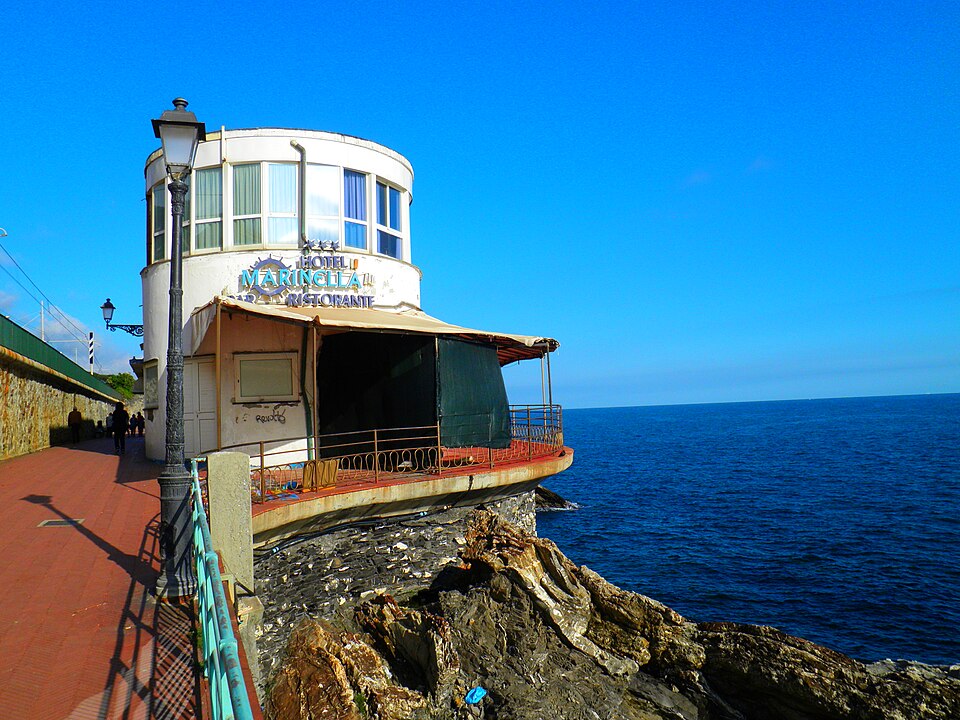
Marinella is one of the most recognisable buildings on Genoa’s eastern seafront.
The ship-shaped Rationalist complex sits directly on the Anita Garibaldi promenade in Nervi. It was built in 1933–34 to a design by Milanese architect Giacomo Carlo Nicoli, replacing an earlier Art Deco chalet dating from 1913.
Since 1964, the property has belonged to the State and its use has depended on a concession.
That fact, more than almost anything else, now determines the economics of the investment.
The most recent chapter began in July 2016, when a tender was launched for the operation of the property subject to redevelopment.
A company linked to Igor Mendelevich won the tender as the sole bidder.
The keys were handed over in April 2017.
Planning approval followed in 2018.
The project envisaged a four-star superior hotel with restaurant, bar and spa.
The original construction deadline, set for 2021, was repeatedly postponed.
The severe storms of 2018 and 2019, subsequent construction difficulties and the pandemic all contributed to the delay.
In January 2024, the property partially reopened with only the bar and restaurant operating while the rest of the building remained unfinished.
The operation lasted only a few months.
In February 2025, the Seventh Civil Division of the Genoa Court opened judicial liquidation proceedings, appointing accountant Dante Benzi as liquidator.
That marked the beginning of the attempt to bring the asset back to market.
The City of Genoa brought in the Genoa Business Unit as a facilitator to support the process and engage potential investors.
At the same time, attention turned to one of the site’s most structural risks: exposure to storm surges.
Genoa’s 2025–2027 public works programme allocates approximately €1.5 million to an offshore submerged breakwater.
Public institutions have expressed support.
Investor contact channels have been promoted.
The location is exceptional.
The price has continued to fall.
And yet, at least through the first three auctions, investors have stayed away.
That is where Marinella becomes particularly interesting from a hospitality investment perspective.
Four auctions and a 58% reduction
The numbers tell the story better than any commentary.
| Auction | Date | Reserve price | Outcome |
|---|---|---|---|
| I | 29 September 2025 | €1,623,000 | no bids |
| II | 19 December 2025 | €1,217,250 | no bids |
| III | 18 February 2026 | €912,938 | no bids |
| IV | 21 July 2026 | €684,704 | outcome not publicly available |
The minimum admissible bid for the fourth auction was €581,998.
From the first to the fourth sale, the reserve fell by approximately 58% in less than ten months.
And this is not an isolated ruin.
Marinella has already undergone substantial redevelopment work and occupies one of the most recognisable waterfront positions on the Ligurian coast.
When an asset of this kind fails to attract a single offer even with a reserve below €1 million, continuing to explain the problem purely through price becomes inadequate.
The market is probably saying something else.
Not:
“It is too expensive.”
But:
“I cannot clearly determine the economic value of what I am buying, or how much of the value I create will ultimately remain mine.”
What is actually being acquired?
This is the core of the entire case.
The auction does not involve freehold ownership of the building.
The property belongs to the State.
What is being sold is the Ex Marinella business undertaking, including the hotel, bar and restaurant activities and the relevant operating rights, including those relating to saline-iodine treatments.
The incoming investor would also be required to complete the remaining works and enter into a specific agreement with the City of Genoa for a 20-year maritime concession, beginning once the redevelopment has been completed.
That timing matters.
Starting the concession only after completion of the works prevents the construction phase itself from consuming valuable operating years.
But the investment horizon remains finite.
In practical terms, the successful bidder would acquire:
-
a business undertaking and its associated operating rights;
-
the obligation to complete the remaining works at its own cost and risk;
-
the ability to operate through a time-limited concession;
-
no ownership of the underlying real estate.
That distinction is what separates Marinella from a conventional hotel acquisition.
Article 49 of the Italian Navigation Code: the issue investors cannot ignore
For assets located on maritime public land, the treatment of works carried out by the concessionaire when the concession ends is one of the central valuation issues.
Article 49 of the Italian Navigation Code establishes, as a general principle, that non-removable works built on maritime public land revert to the State when the concession ends, subject to the specific terms of the concession and the legal framework applicable to the individual case.
For an investor, the implication is straightforward:
before deciding how much capital to deploy, it is necessary to establish how much of the value created can actually be recovered economically at the end of the concession.
This is where the auction price becomes almost secondary.
If completing Marinella requires several million euros across:
-
outstanding construction works;
-
technical systems;
-
FF&E;
-
spa development;
-
regulatory upgrades;
-
pre-opening;
-
working capital;
the key question is no longer whether the business is acquired for €600,000 or €900,000.
The real question is:
how will that CAPEX be recovered within twenty years, and what residual value, if any, will be recognised when the concession expires?
That is a question to answer before bidding, not afterwards.
And it is precisely the kind of issue that should sit at the heart of hotel and investment due diligence.
The operating economics
Let us build a purely analytical scenario.
This is not the liquidation procedure’s business plan, nor an official valuation of the company.
It is an independent exercise by InvestimentiAlberghieri.it designed solely to understand the approximate economic scale of the investment.
Initial capital requirement
Indicative acquisition price:
€600,000–700,000
Hypothetical residual CAPEX required to complete a four-star superior hotel, build the spa and bring a directly exposed seafront property into full operation:
€3–5 million
Once pre-opening, working capital, professional costs and contingencies are included, total capital exposure could reasonably move into a range of:
€4–6 million.
Investment horizon
The concession would run for:
20 years from completion of the redevelopment.
That is materially better than a concession beginning immediately upon award.
But it remains a closed economic horizon.
Terminal value
This is where the investment differs fundamentally from a traditional hotel real estate acquisition.
There is effectively no terminal real estate value for the concessionaire.
There may still be some value attached to the business, goodwill, transferable licences or other intangible assets, subject to the applicable legal framework.
But there is no conventional freehold real estate exit.
In a traditional hotel property investment, terminal value can represent a significant proportion of overall returns, particularly in strategies built around a defined holding period.
At Marinella, by contrast, the investment must be remunerated primarily through operating cash flows generated during the concession term.
That difference is critical.
Fourteen rooms cannot carry the entire investment
Historically, the property had twelve double rooms and one single room, all overlooking the sea.
Even assuming some reconfiguration, the accommodation component would remain relatively small.
Consider a scenario with:
-
14 rooms
-
average ADR of €320
-
occupancy of 55%
That would produce approximately 2,800 occupied room nights a year.
Room revenue would therefore be around €900,000.
Food and beverage changes the picture.
At Marinella, F&B could reasonably contribute more economically than the rooms themselves.
The restaurant, terrace, events and the extraordinary location along the promenade could theoretically lift total revenues into a range of:
€2.2–2.8 million.
Under an efficient operating model, EBITDA could reach several hundred thousand euros after taking account of the concession fee and operating cost structure.
But whether EBITDA is €400,000 or €600,000 is not the most important issue.
The real equation is:
initial CAPEX + concession duration + operating risk + absence of a freehold exit.
With €4–6 million of total capital committed and annual operating earnings of around half a million euros, payback could fall somewhere in the region of ten to fifteen years, before fully considering financing costs, taxation, extraordinary maintenance and potential periods of operational disruption.
Inside a 20-year concession, that leaves very little room for error.
And for a building sitting directly on the sea, a business plan with no margin for error is inherently fragile.
A risk that can be mitigated, but never entirely removed
Marinella was heavily affected by the 2018 and 2019 storm surges.
That is not simply historical context.
It is an underwriting variable.
A conventional lender assessing the transaction would need to consider simultaneously:
-
absence of real estate ownership for the investor;
-
a finite concession term;
-
limited recovery value in the event of default;
-
significant CAPEX requirements;
-
direct exposure to marine weather risk;
-
dependence, at least in part, on public coastal protection works.
This does not make the transaction unfinanceable.
It makes it considerably more difficult to finance through a conventional hospitality lending structure.
The transaction may require:
-
higher equity contribution;
-
external guarantees;
-
tighter covenants;
-
debt maturity aligned with the concession term;
-
dedicated maintenance reserves;
-
specific insurance coverage;
-
conditions precedent linked to coastal protection works.
The City of Genoa has allocated approximately €1.5 million for the submerged breakwater.
That is positive and potentially important.
But from the investor’s perspective it also creates dependency on a public infrastructure project whose timing and delivery remain outside the investor’s direct control.
The physical risk may therefore decline.
It does not automatically disappear from the financial model.
The market has already given its answer
This may be the most important point in the entire dossier.
In investments of this type, the market communicates through investor behaviour.
Three consecutive failed auctions are data.
Not opinion.
When the reserve falls:
from €1.623 million
to €1.217 million
then to €913,000
and finally to €684,704
without the first three sales generating a bid, the possibility must be considered that further price reductions will have progressively less impact.
An investor may care whether the acquisition price is €500,000 rather than €700,000.
But a €200,000 saving matters little if the decisive variables involve millions of euros of CAPEX and a 20-year concession term.
That is why the solution appears to be primarily structural, rather than simply financial.
Three levers that could change the equation
1. Extend the concession or recognise residual value
Twenty years can be a short period when the investor is required to deploy substantial upfront CAPEX.
There are several theoretical ways to improve the investment profile.
One would be a concession duration more closely aligned with the level of capital invested.
Another would involve mechanisms, within the applicable legal framework, that recognise some economic value for qualifying residual works at the end of the concession.
The economic principle is simple:
the more capital a concessionaire is required to commit, the longer the period available to earn it back should be.
Simply reducing the acquisition price does not correct that imbalance.
2. Expand the revenue perimeter
Fourteen rooms cannot support the entire investment on their own.
Nor should they be expected to.
Marinella should be viewed through a multi-revenue model:
rooms + F&B + events + terrace + services + sea-related activities.
The original project had also contemplated concepts connected with a marina and potential sea access.
Any such development would of course depend on the relevant authorisations and maritime concession rules.
But the industrial logic is sound.
Marinella is not simply a hotel. It is a destination with rooms above it.
Anyone valuing it purely through RevPAR and room revenue risks using the wrong model.
Its strongest economic engine may actually sit at ground-floor level.
The restaurant.
The terrace.
Events.
Footfall from the promenade.
The accommodation component can increase average customer value and extend dwell time.
It does not necessarily need to be the core business.
This is precisely where operating-model design, revenue mix and management control — areas developed by HotelManagementGroup.it — become as important as the physical redevelopment of the property.
3. Reverse the order of the equation
There is one further conceptual possibility.
Rather than progressively reducing the auction price, the structure itself could be redesigned around:
low entry price + certified CAPEX + concession incentives or duration
as three components of the same economic equation.
The investor would then be incentivised not merely to acquire the business, but to create long-term value at the property.
Because the message currently being sent by the market does not appear to be:
“How little can I pay?”
It is:
“How much of the value I am required to create will still belong to me?”
Those are fundamentally different questions.
Portofino Kulm, Sammezzano and Marinella: three different investment risks
Recent analyses published by InvestimentiAlberghieri.it have examined three very different iconic assets which, taken together, provide a useful framework for assessing complex hospitality investments in Italy.
Portofino Kulm: timing risk
A trophy asset where the critical issue is time-to-cash: how long does it take between deploying capital and generating the first euro of hotel cash flow?
Sammezzano: business-model risk
A monumental heritage property where hotel rooms represent only one of several revenue engines.
Museum admissions, events, hospitality and long-term patrimonial value need to be assessed as a single ecosystem.
Marinella di Nervi: tenure risk
Here the question is not simply:
how much can the hotel earn?
It is:
what right am I acquiring, for how long, and how much of the value I create will remain economically mine when that right expires?
Those three questions — time, revenue model and tenure — come before any calculation based on price per square metre.
The same analytical principle underpins the professional work and commentary published on RobertoNecci.it.
Italy’s concession-based hospitality stock has a structural issue
Marinella is not an isolated case.
Along Italy’s coastline there are:
-
hotels;
-
beach establishments;
-
chalets;
-
former holiday colonies;
-
restaurants;
-
marinas;
-
tourism facilities;
operating on public land or through time-limited rights.
In all of these cases, one of the most dangerous analytical mistakes is to apply freehold investment metrics automatically.
The investor is not simply acquiring:
a building + a business plan.
The investor is acquiring:
a right + a duration + obligations + cash flows + residual value.
Economic value emerges from the interaction between all five.
If the tenure structure is weak, a low purchase price does not automatically make the transaction attractive.
If the concession is sufficiently long and properly aligned with the capital deployed, a higher entry price may still be economically sustainable.
This is why, in concession-based hospitality investments, legal, financial and operational due diligence must come before the bid.
Price comes afterwards.
Four failed auctions are not a failure
They are information.
The market has been given several opportunities to express a view.
The reserve price has fallen by 58%.
The first three auctions generated no bids.
If further reductions were still unable to materially change investor behaviour, the conclusion would become increasingly difficult to ignore:
the problem is not the nominal value of the business undertaking.
It is the relationship between:
CAPEX, risk, duration and residual value.
And that may be the most important lesson Marinella di Nervi offers the hospitality investment market.
An asset can have:
an extraordinary location;
an apparently low price;
a credible redevelopment concept;
strong public-sector support.
And still fail to qualify as an attractive investment under the proposed terms.
Because a good property is not necessarily a good investment.
Value is not only what exists today.
It is also what the investor is entitled to retain tomorrow.
We will continue to follow the outcome of the procedure and any subsequent move towards a private negotiation.
The analysis does not end here
At InvestimentiAlberghieri.it we continuously analyse judicial auctions, liquidations, insolvency proceedings, closed hotels, redevelopment opportunities and hospitality investments involving public assets or concession-based structures.
If you are considering bidding for a hotel business, acquiring an asset operating under concession or investing significant CAPEX into a property that you will not own outright, Investhotel.it outlines our advisory services, including:
-
business valuation;
-
economic and operational due diligence;
-
analysis of concession structure and its impact on the business plan;
-
CAPEX assessment;
-
bid-price construction;
-
payback analysis;
-
cash-flow modelling over the concession term;
-
operating scenarios;
-
PropCo/OpCo structuring;
-
negotiation of hotel management and lease agreements.
For the industrial implementation of the project — operating model, rooms/F&B/events revenue mix, USALI-based management control, revenue management, pre-opening and management selection — visit HotelManagementGroup.it.
Further professional analysis and publications are available at RobertoNecci.it.
Considering a hotel auction, a public-domain hospitality asset or a concession-based investment and want to understand whether the economics genuinely work?
Contact info@investimentialberghieri.it for an initial assessment of the opportunity and to discuss a potential advisory mandate.
Methodology and sources
This article has been prepared using publicly available information available as of the publication date, including communications from the City of Genoa, ANSA Liguria, Il Secolo XIX, Genova24, GenovaToday, La Voce di Genova, Telenord, Mentelocale, Genova Quotidiana and the sale notices relating to the judicial liquidation proceedings before the Genoa Court.
The result of the fourth auction held on 21 July 2026 had not been made publicly available at the time of writing and should be verified directly with the liquidation procedure.
References to Article 49 of the Italian Navigation Code describe the general principle governing the reversion of non-removable works when a maritime public-domain concession ends. The exact treatment applicable to any specific investment depends on the concession agreement, any contractual provisions and the law in force, and must therefore be verified as part of the transaction’s legal due diligence.
All figures relating to CAPEX, room count, ADR, occupancy, revenues, EBITDA and payback identified as analytical assumptions are independent estimates prepared by InvestimentiAlberghieri.it solely for analytical purposes. They do not represent company data, valuations by the liquidation procedure or forecasts by the City of Genoa.
Any party mentioned in this article may request corrections, clarifications or documentary updates at any time by contacting the editorial team.