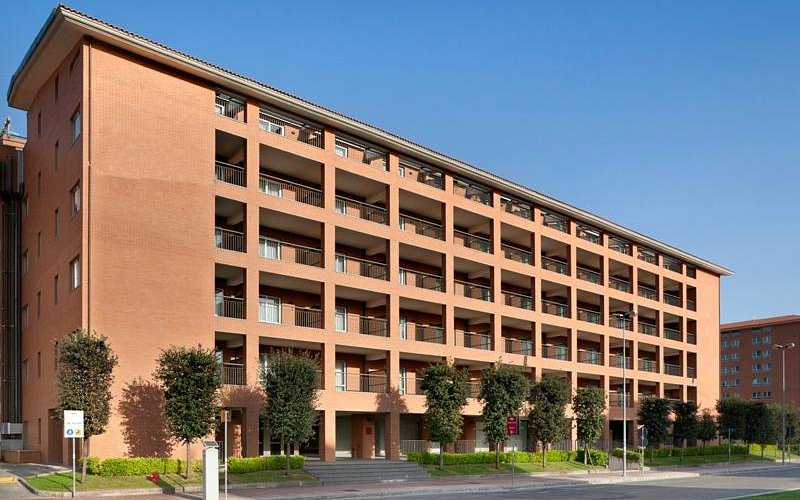
A four-star hotel still marketed through Marriott Bonvoy, a real estate asset subject to enforcement proceedings with a €28 million base price and a €21 million minimum bid, and at the same time a PNRR-backed project worth approximately €12.46 million to convert 312 rooms into 624 student beds. Plaza Caserta is not simply a hotel sale: it is a hospitality special situation in which real estate, going concern, international distribution and a potential student housing conversion overlap. Before assigning value to the asset, investors need to determine which of these scenarios is legally, technically and economically executable.
In the Italian hospitality special situations market, certain transactions require analysis well beyond the auction price.
Plaza Caserta is one of them.
The Court of Santa Maria Capua Vetere has scheduled the sale of the hotel complex located on Viale Lamberti for 10 December 2026, as part of Real Estate Enforcement Proceeding no. 22/2024.
The base price is €28 million, with a minimum bid of €21 million and bids due by 9 December 2026. The proceedings concern full ownership of the hotel complex. (astegiudiziarie.it)
But focusing only on those numbers would miss the most important part of the investment case.
Deal Snapshot
| Item | Details |
|---|---|
| Asset | Plaza Caserta |
| Location | Caserta, Viale Lamberti |
| Proceeding | Real Estate Enforcement 22/2024 |
| Court | Santa Maria Capua Vetere |
| Sale date | 10 December 2026 |
| Bid deadline | 9 December 2026 |
| Base price | €28,000,000 |
| Minimum bid | €21,000,000 |
| Rooms identified in proceedings | 320 |
| Rooms marketed by Marriott | 312 |
| Implied minimum price per key – 320 rooms | approx. €65,625 |
| Implied minimum price per key – 312 rooms | approx. €67,300 |
| Configuration | Hotel + congress + F&B + fitness + parking |
| Identified alternative-use project | Student housing |
| Student beds envisaged | 624 |
| PNRR funding identified | approx. €12.46 million |
| Core issue | Hospitality value vs alternative-use value |
A Large-Scale Hospitality Asset
The sale documentation describes a complex developed over two basement levels and six above-ground floors.
The perimeter includes, among other elements:
-
parking at the second basement level;
-
reception;
-
restaurants;
-
bar;
-
conference centre;
-
offices and management areas;
-
staff facilities;
-
guestrooms;
-
fitness facilities;
-
laundry;
-
external areas;
-
swimming pool and solarium.
The public documentation identifies 320 rooms, predominantly distributed between the first and fourth floors, together with staff rooms and ancillary areas. (legalmente.net)
This is therefore not a mid-sized independent hotel requiring a conventional repositioning strategy.
Plaza Caserta is a large-scale hospitality asset, and its underwriting needs to reflect that scale.
The Hotel Is Still Commercially Active
At the same time as the real estate enforcement process, Plaza Caserta continues to be marketed through Marriott Bonvoy.
Marriott presents it as a four-star hotel with 312 rooms, including 16 Superior rooms and 16 suites, together with restaurant facilities, meeting space, a fitness centre and parking. The website continues to offer availability searches and rates and indicates a staffed reception. (marriott.com)
This is highly relevant.
It evidences an active commercial presence.
It does not, however, establish:
-
who owns the hotel operating business;
-
which entity currently operates the property;
-
the legal nature of the relationship with Marriott;
-
whether the current distribution arrangement is enforceable against, or transferable to, a new owner;
-
whether employees, bookings, systems, brand rights and contracts fall within the real estate proceedings.
These are separate questions.
And it is precisely this separation between real estate and operating platform that makes the case complex.
320 Rooms in the Proceedings, 312 in the Market
There is also a numerical discrepancy that needs to be reconciled.
The sale documentation refers to 320 rooms.
Marriott markets 312 rooms. (legalmente.net)
A difference of eight rooms is not necessarily problematic.
It may reflect, for example:
-
non-marketable rooms;
-
units used for different purposes;
-
different real estate classifications;
-
staff accommodation;
-
a different operating inventory configuration.
But the figure should be reconciled before using price per key as a valuation metric.
€21 Million: Is That Really About €65,000 per Room?
The arithmetic is straightforward.
Using the 320 rooms indicated in the proceedings:
€21,000,000 / 320 = approximately €65,625 per key
Using the 312 rooms marketed by Marriott:
€21,000,000 / 312 = approximately €67,300 per key
Those figures are immediately attention-grabbing.
They can also be misleading.
A professional investor should not ask:
“Is it attractive to acquire 320 rooms at roughly €65,000 per key?”
The correct question is:
“How much total capital is required to acquire the real estate, preserve or rebuild the going concern, fund CAPEX and generate a stabilised EBITDA consistent with a €21 million entry price?”
That is the real underwriting question.
PropCo, OpCo and Marriott Distribution: Three Separate Layers
The case should be reconstructed across at least three levels.
PropCo
The entity owning the real estate subject to the enforcement proceedings.
OpCo
The entity operating the hotel business.
Brand / Distribution
The contractual relationship through which Plaza Caserta is currently marketed within Marriott Bonvoy.
These three levels should not be assumed to be the same.
Public sources also show that Pinewood Hotels S.p.A. provided hotel services at Plaza Caserta in the past: public Ministry of Defence documents identify Pinewood Hotels as an economic operator for hotel services at the property in 2023 and 2024. This evidences a historical operating relationship with Plaza Caserta, but does not, by itself, establish the current ownership or contractual structure. (esercito.difesa.it)
The following chain therefore needs to be reconstructed through documentary evidence:
PropCo → OpCo → Pinewood → Marriott → any additional contractual parties
before the going-concern value can be properly assessed.
The Second Investment Case: 624 Student Beds
This is where the transaction changes character.
OpenPNRR lists a project called “The Campus Caserta”, located in the same Viale Lamberti area and expressly referring to the conversion of Hotel Plaza from hotel accommodation into student housing.
The project provides for:
-
312 rooms;
-
624 student beds;
-
total funding of approximately €12.46 million;
-
the Ministry of Universities and Research as the responsible administration;
-
Pinewood Hotels S.p.A. as implementing entity.
At the latest publicly available update, OpenPNRR reported zero payments and classified the next milestone as “delayed”. (openpnrr.it)
This is a critical data point.
But it needs to be interpreted very carefully.
PNRR: Identified Funding Does Not Mean Automatically Transferable Value
The existence of a PNRR project does not automatically mean that a successful bidder can:
-
step into the grant;
-
use the allocated funding;
-
freely amend the project;
-
retain the same conditions and milestones;
-
convert the hotel into student housing without further approvals.
This is one of the key due diligence areas.
The analysis should establish:
-
the actual status of the project;
-
whether the funding remains valid;
-
obligations of the implementing entity;
-
whether any transfer is permitted;
-
conditions for any substitution of the implementing party;
-
unmet milestones;
-
planning and zoning authorisations;
-
potential grounds for withdrawal or revocation;
-
interaction between the project and the enforcement proceedings;
-
compatibility between the real estate acquisition and the funded project.
The €12.46 million should therefore not be automatically added to the asset value.
Hotel or Student Housing?
This is probably the central strategic question.
Plaza Caserta should be analysed under at least two principal investment cases.
Scenario A — Hospitality Going Concern
Maintain the hotel use.
The investor should assess:
-
historical occupancy;
-
ADR;
-
RevPAR;
-
rooms revenue;
-
MICE;
-
F&B;
-
payroll;
-
GOP;
-
EBITDA;
-
brand costs;
-
distribution costs;
-
CAPEX;
-
stabilised value.
The scale of the hotel makes corporate and MICE demand particularly important.
Marriott itself positions the property for meetings, conferences, events and business travel. (marriott.com)
Scenario B — Student Housing
Convert the asset into student accommodation.
The underwriting metrics would change completely:
-
beds;
-
academic occupancy;
-
average rent per bed;
-
operating expenses;
-
academic season;
-
ancillary services;
-
conversion CAPEX;
-
cost per bed;
-
stabilised NOI;
-
exit yield.
With 624 beds envisaged in the PNRR project, the minimum bid implies a theoretical acquisition cost of:
€21,000,000 / 624 = approximately €33,650 per bed
before conversion CAPEX and transaction costs.
Again, this is not a valuation.
But it allows investors to compare two entirely different frameworks:
Hotel value per key
versus
Student housing value per bed
A Third Scenario: Mixed Use?
There is also a theoretical third option.
Given the scale of the property, an investor may wish to test whether a mixed-use concept could be technically and legally feasible.
For example:
-
hospitality;
-
student housing;
-
extended stay;
-
serviced apartments;
-
MICE;
-
food and beverage;
-
coworking.
This is not a use currently documented in the enforcement proceedings.
It is simply a strategic scenario requiring prior planning, technical and regulatory verification.
But for an asset of this scale, highest and best use should be assessed before assuming that the existing hotel use is necessarily the economically optimal one.
The Real Issue Is Highest and Best Use
This is perhaps the most compelling feature of Plaza Caserta.
The investment case is not simply asking:
“What is the hotel worth?”
It is asking:
“Which use of the asset generates the highest risk-adjusted value?”
Those are fundamentally different questions.
At a minimum, the analysis should compare:
| Scenario | Primary Value Driver |
|---|---|
| Hotel | Stabilised EBITDA |
| Student Housing | NOI per bed |
| Repositioned Hotel | ADR + MICE + GOP |
| Mixed Use | Combined cash flows of different components |
The real estate value should therefore be determined after identifying the most efficient business model.
Not before.
Hospitality Case: EBITDA Determines the Maximum Bid Price
Under a hotel-continuity scenario, the underwriting should follow a disciplined sequence:
Historical Revenue
↓
Normalised Revenue
↓
Normalised GOP
↓
Normalised EBITDA
↓
Required CAPEX
↓
Debt Capacity
↓
Target Equity Return
↓
Maximum Bid Price
The fact that the minimum bid is €21 million does not mean €21 million is automatically a sustainable acquisition price.
The maximum bid should be driven by future cash flow.
Not by the auction.
Student Housing Case: A Completely Different Return Model
Under a conversion scenario, the model becomes:
Beds
×
Average Rent
×
Occupancy
=
Gross Residential Revenue
less
Operating Costs
=
NOI
and therefore:
NOI / Target Yield = Stabilised Value
from which the investor must deduct:
-
conversion CAPEX;
-
financing costs;
-
transaction costs;
-
contingency;
-
development risk.
The two models may produce materially different values.
CAPEX Is the Major Missing Number
A complex of this scale cannot be properly analysed without a full technical due diligence.
At a minimum, investors should assess:
-
guestrooms;
-
bathrooms;
-
building systems;
-
HVAC;
-
fire safety;
-
lifts;
-
kitchens;
-
restaurants;
-
conference centre;
-
roofs;
-
façades;
-
windows;
-
swimming pool;
-
parking;
-
energy efficiency;
-
FF&E;
-
IT;
-
any works required to maintain the brand;
-
any conversion CAPEX required for student housing.
The correct equation remains:
Acquisition Price + CAPEX + Transaction Costs + Working Capital + Financing + Repositioning/Conversion Costs + Contingency = Total Investment Cost
Returns must be measured against Total Investment Cost.
Investment Thesis
The investment thesis should not simply be:
“320 rooms available from €21 million.”
That is too simplistic.
The real thesis is:
“Acquire a large-scale hospitality real estate asset with an active going concern, Marriott distribution and an identified student housing alternative-use project, and determine which use generates the highest risk-adjusted return.”
That is a significantly more sophisticated investment case.
Potential Upside
Potentially attractive factors include:
-
large scale;
-
312–320 rooms;
-
active Marriott commercial presence;
-
MICE capability;
-
food and beverage;
-
parking;
-
proximity to Naples;
-
corporate demand;
-
repositioning potential;
-
existing student housing project;
-
624 planned beds;
-
optionality between hospitality and alternative use.
Key Risks
The principal risks include:
-
ownership structure still to be reconstructed;
-
PropCo/OpCo relationship;
-
nature and duration of the Marriott relationship;
-
transferability of the going concern;
-
unknown CAPEX;
-
discrepancy between 312 and 320 rooms;
-
relationship with Pinewood Hotels;
-
status of the PNRR project;
-
transferability or possible loss of the funding;
-
conversion risk;
-
planning approvals;
-
execution risk;
-
potential operating disruption;
-
debt sustainability;
-
asset scale relative to market demand.
Investment Committee Summary
Key Numbers
-
Base price: €28 million
-
Minimum bid: €21 million
-
Rooms in proceedings: 320
-
Rooms marketed by Marriott: 312
-
Minimum price per key: approx. €65,600–67,300
-
Planned student beds: 624
-
Implied minimum price per bed: approx. €33,650
-
Identified PNRR funding: approx. €12.46 million
-
Reported PNRR payments: €0
-
Sale date: 10 December 2026
Investment Thesis
Large-scale hospitality asset + active commercial platform + alternative-use optionality.
Key Risks
PropCo/OpCo + Marriott relationship + CAPEX + PNRR transferability + conversion execution.
Next Catalyst
10 December 2026: judicial sale.
Before that date, however, the real catalyst is access to documentation clarifying:
ownership → operating company → brand agreement → Pinewood relationship → PNRR → CAPEX → historical trading.
Twelve Questions to Answer Before Bidding
-
Who is the debtor and owner of the real estate?
-
Which entity currently operates the hotel?
-
What is Pinewood Hotels’ current role?
-
What is the legal nature of the Marriott relationship?
-
Does the Marriott agreement survive a change of ownership?
-
What is the hotel’s normalised EBITDA?
-
What is the five-year CAPEX requirement?
-
Why do the proceedings identify 320 rooms while Marriott markets 312?
-
What is the actual legal status of The Campus Caserta project?
-
Is the PNRR funding transferable, amendable or subject to revocation?
-
What is the true cost of converting the asset into student housing?
-
Which scenario produces the highest Stabilised Enterprise Value?
Without these answers, €21 million remains a procedural number.
It is not yet an investment thesis.
Hotel or Student Housing? The Value Depends on the Answer
Plaza Caserta is almost a textbook example of how hotel real estate is evolving.
A hotel should no longer be valued only for what it is today.
It should also be valued for what it can economically become.
For InvestimentiAlberghieri.it, the central issue is to compare real estate value, operating business value and alternative-use value before establishing a Maximum Bid Price.
At Investhotel.it, this analysis integrates debt capacity, DSCR, capital structure and financing sustainability.
HotelManagementGroup.it addresses the operating dimension: GOP, organisation, MICE, cost structure, revenue management and repositioning.
RobertoNecci.it places the transaction within the broader context of hotel economics and the transformation of the hospitality market.
The principle is simple:
the key question is not only how much Plaza Caserta costs.
The key question is:
which use supports the highest value after accounting for CAPEX, risk, timing and total capital required?
That is the difference between buying real estate and underwriting an investment.
Hospitality Investment & Special Situations Advisory
For preliminary hotel investment analysis, PropCo/OpCo reconstruction, business planning, feasibility studies, CAPEX assessment, alternative-use analysis, debt capacity and value-creation strategies:
info@investimentialberghieri.it
Methodological Note and Legal Disclaimer
Information relating to the sale is based on the official advertising for Real Estate Enforcement Proceeding no. 22/2024 before the Court of Santa Maria Capua Vetere. The sale is advertised with a €28 million base price, a €21 million minimum bid and a sale date of 10 December 2026. (astegiudiziarie.it)
The sale documentation identifies a hotel complex with 320 rooms and ancillary components. Marriott’s commercial presence identifies 312 rooms. This discrepancy should be subject to specific documentary and technical verification and is not interpreted in this article as evidence of any irregularity. (legalmente.net)
The presence of Plaza Caserta on Marriott Bonvoy evidences a current commercial/distribution relationship, but does not, by itself, establish the nature, duration, enforceability or transferability of the underlying agreements. (marriott.com)
Public sources evidence historical relationships between Pinewood Hotels S.p.A. and hotel operations at Plaza Caserta; those relationships are not used here to infer current ownership of the real estate or the current contractual structure. (esercito.difesa.it)
The “The Campus Caserta” project is listed by OpenPNRR with Pinewood Hotels S.p.A. as implementing entity, approximately €12.46 million of identified funding and a proposed conversion of the hotel into student accommodation for 624 beds. At the latest update reported by the platform, payments stood at zero and a milestone was classified as delayed. This information does not constitute evidence that the funding remains available, is transferable or may be used by a future purchaser. (openpnrr.it)
Any references to:
-
hotel continuity;
-
student housing;
-
mixed use;
-
repositioning;
-
value per key;
-
value per bed;
-
EBITDA;
-
CAPEX;
-
debt capacity;
-
Stabilised Enterprise Value;
-
Maximum Bid Price;
are analytical scenarios only and do not constitute a valuation of the property, a forecast of the outcome of the proceedings or a statement regarding the planning or regulatory feasibility of the scenarios described.
This article does not constitute:
-
a real estate valuation;
-
a fairness opinion;
-
due diligence;
-
legal advice;
-
an investment recommendation;
-
a solicitation to purchase;
-
confirmation that any financing or contract is transferable;
-
a forecast of the outcome of the sale.
Any potential transaction should be preceded by independent legal, corporate, real estate, cadastral, planning, technical, administrative, tax, financial, contractual and operational due diligence.